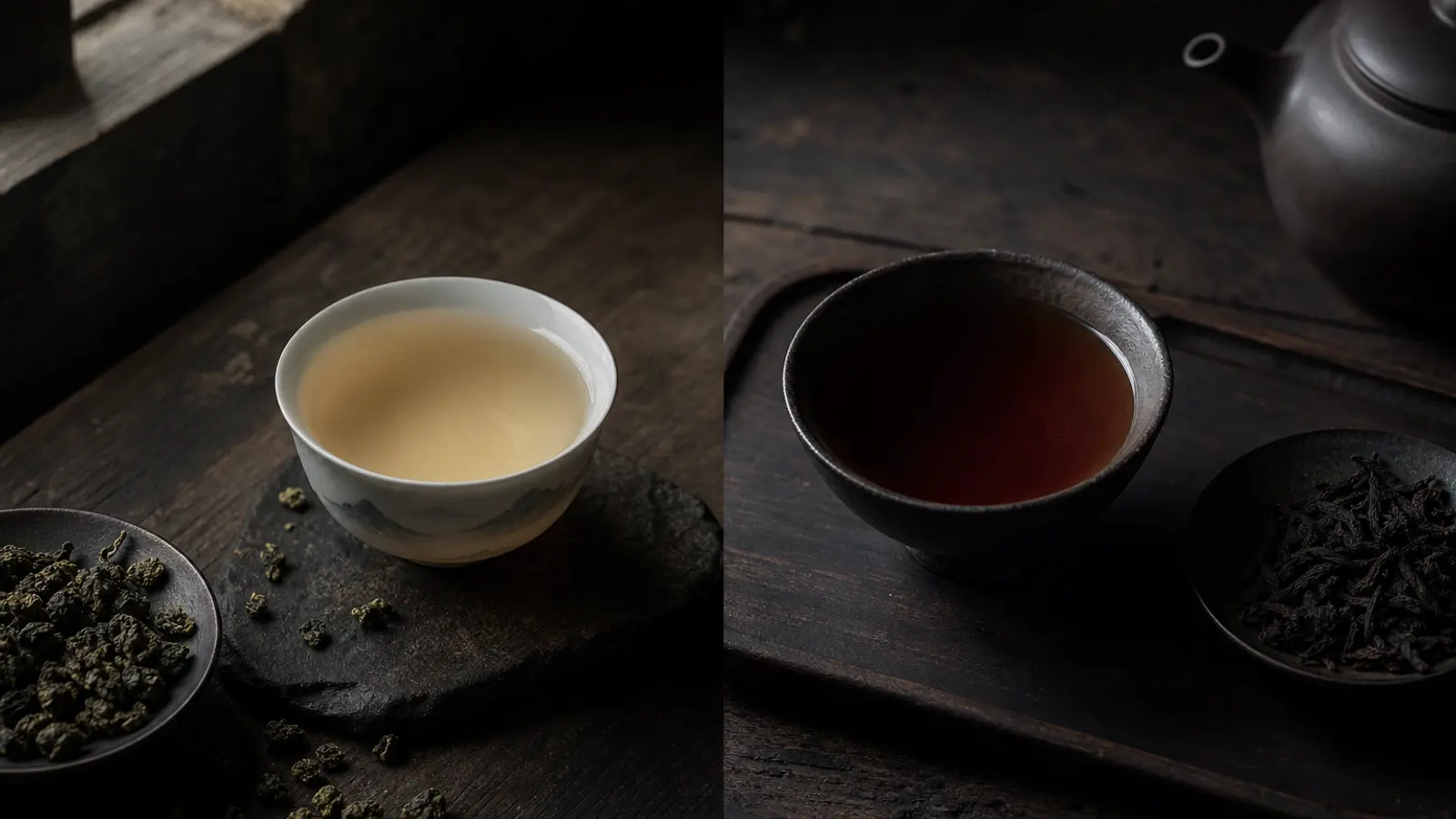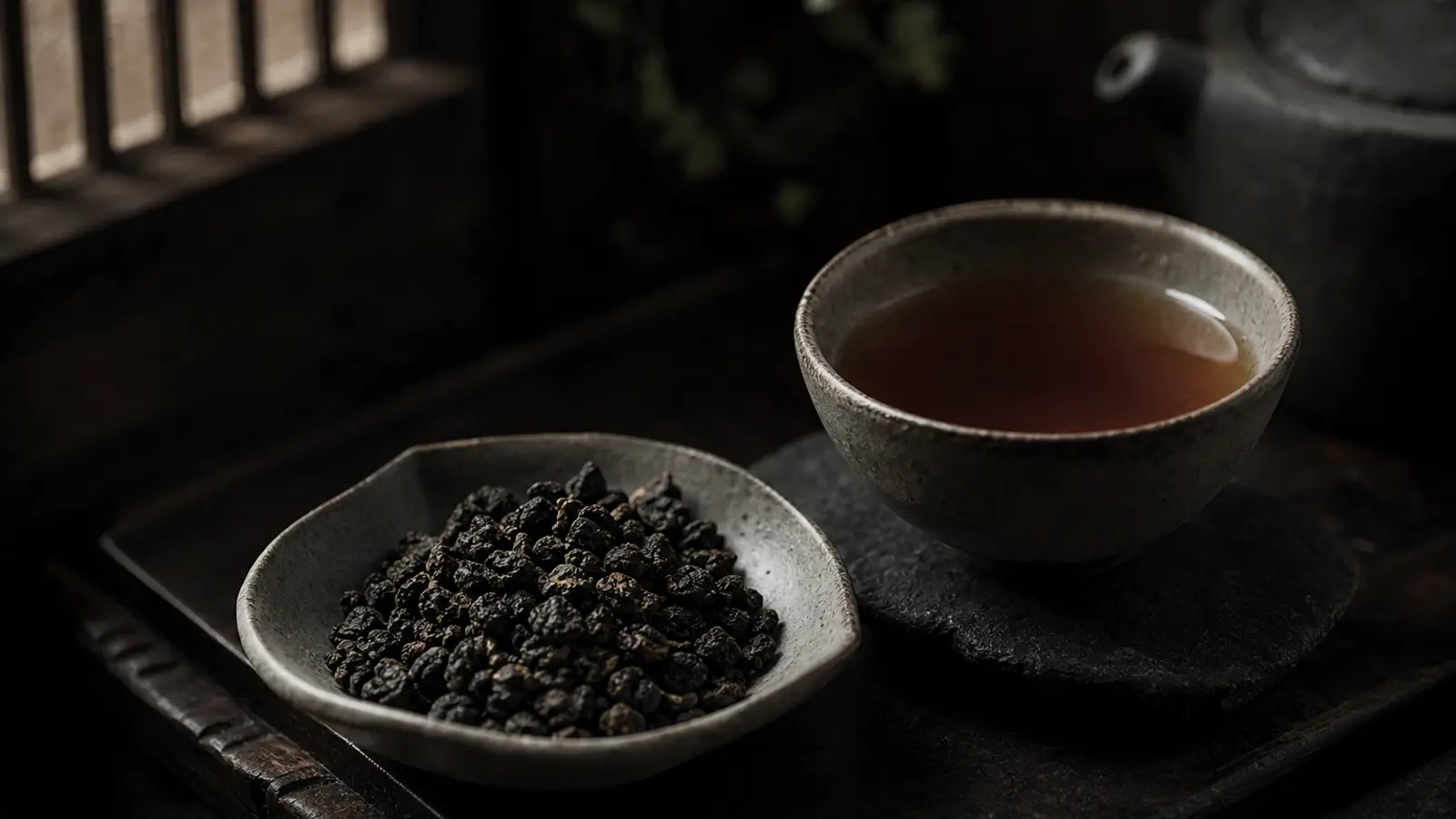
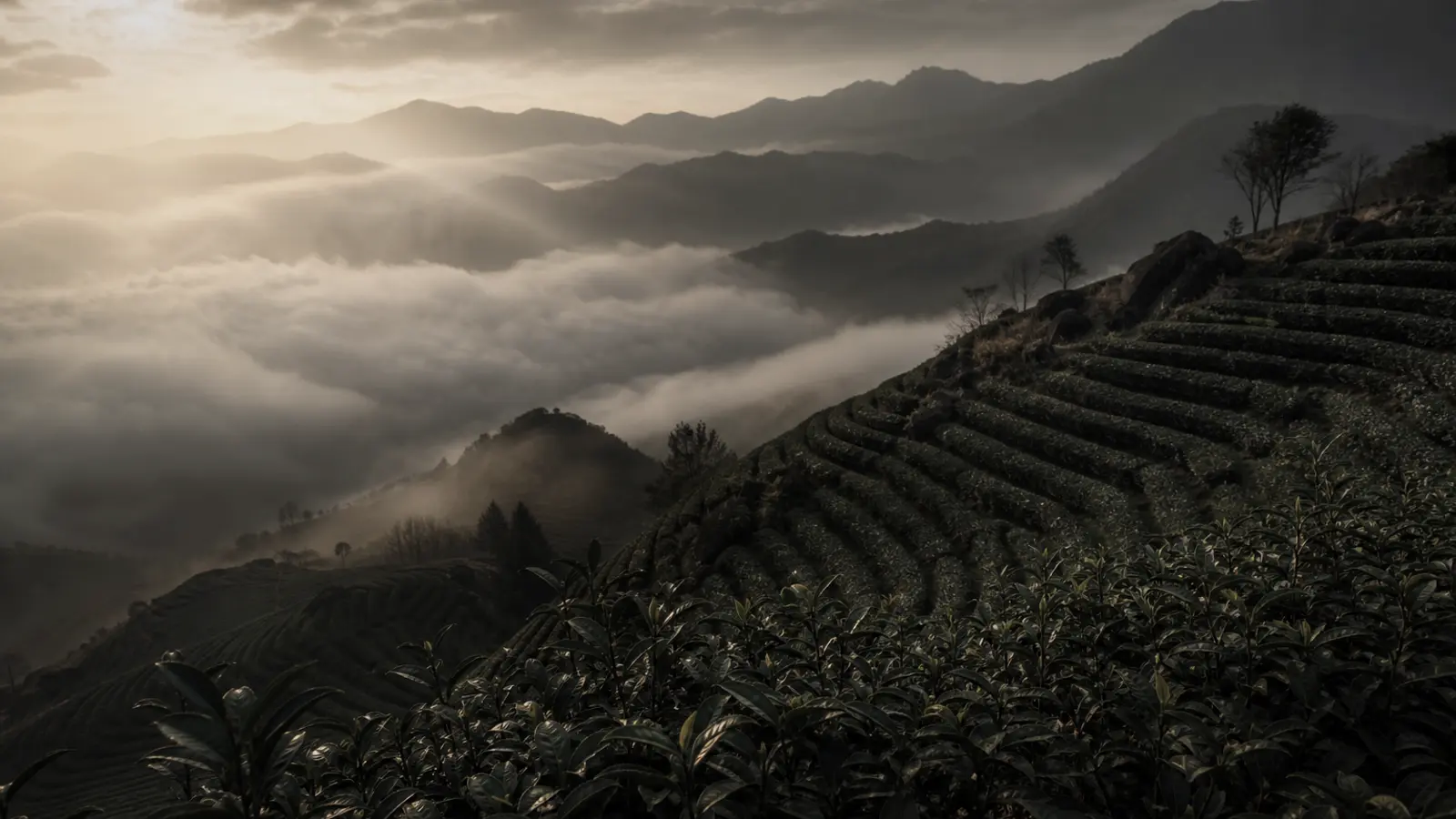
Taiwanese high mountain oolong (高山茶 gāoshān chá) refers to oolong tea grown above 1,000 meters in Taiwan’s Central Mountain Range — where cold nights and persistent fog slow leaf growth and concentrate amino acids and aromatic compounds to produce tea of extraordinary delicacy and complexity. Taiwan’s oolong tradition combines Chinese processing heritage with unique high-altitude terroir to create teas unavailable from any other origin.
If that sounds like a bold claim, consider the numbers. The Central Mountain Range pushes tea gardens to elevations that would be unthinkable in most producing regions — past 2,000 meters, even past 2,400. At those altitudes, average temperatures drop roughly 6°C for every 1,000 meters of elevation gained. Day-night temperature differentials widen. Fog blankets the gardens for hours each morning. The leaves grow slowly, and that slowness is the entire point.
A transparency note: I have not yet had the opportunity to taste Taiwanese high mountain oolong firsthand. I have teas from the Li Shan and Da Yu Ling areas on order, and when they arrive, this article will be updated with detailed session notes and brewing parameters from direct experience. What follows is built from extensive research — published analyses, credible tasting accounts, and the accumulated knowledge of Taiwan’s tea community. I’ll be clear about what I know from study versus what I’ve confirmed in the cup.
Why Altitude Defines Taiwanese High Mountain Oolong
Altitude is the single most important variable in understanding gaoshan cha. Not the cultivar. Not the processing. The mountain.
Here’s the mechanism. At higher elevations, three conditions converge:
- Lower average temperatures — roughly 0.6°C cooler per 100 meters of elevation gain
- Greater diurnal temperature range — warm days and cold nights force the plant into a cycle of daytime photosynthesis and nighttime conservation
- Increased fog and cloud cover — diffused light reduces harsh UV exposure and creates natural shade
These conditions slow leaf growth dramatically. A tea bush at 2,400 meters might take twice as long to produce harvestable shoots as the same cultivar at 800 meters. That extended growing period has measurable chemical consequences.
Slower growth increases the concentration of L-theanine (L-茶氨酸), the amino acid responsible for sweetness and umami in tea. It also increases the density of volatile aromatic compounds — the molecules that produce floral and fruity notes. Meanwhile, catechins — the polyphenols that contribute bitterness and astringency — develop at lower concentrations because they’re produced through photosynthesis, which is reduced under foggy, cool conditions.
The practical result: high mountain oolong from 1,800 meters is measurably sweeter and more aromatic than the same cultivar grown at 800 meters on the same island. This isn’t marketing. It’s plant chemistry responding to altitude.
The wine parallel writes itself. Taiwanese high mountain oolong is Mosel Riesling — crystalline purity from extreme conditions where altitude and cold concentrate everything into the glass. The steep slate vineyards of the Mosel force vines into stress that produces wines of piercing clarity and sweetness. Taiwan’s mountain gardens do the same thing to Camellia sinensis.
How Taiwanese High Mountain Oolong Is Processed
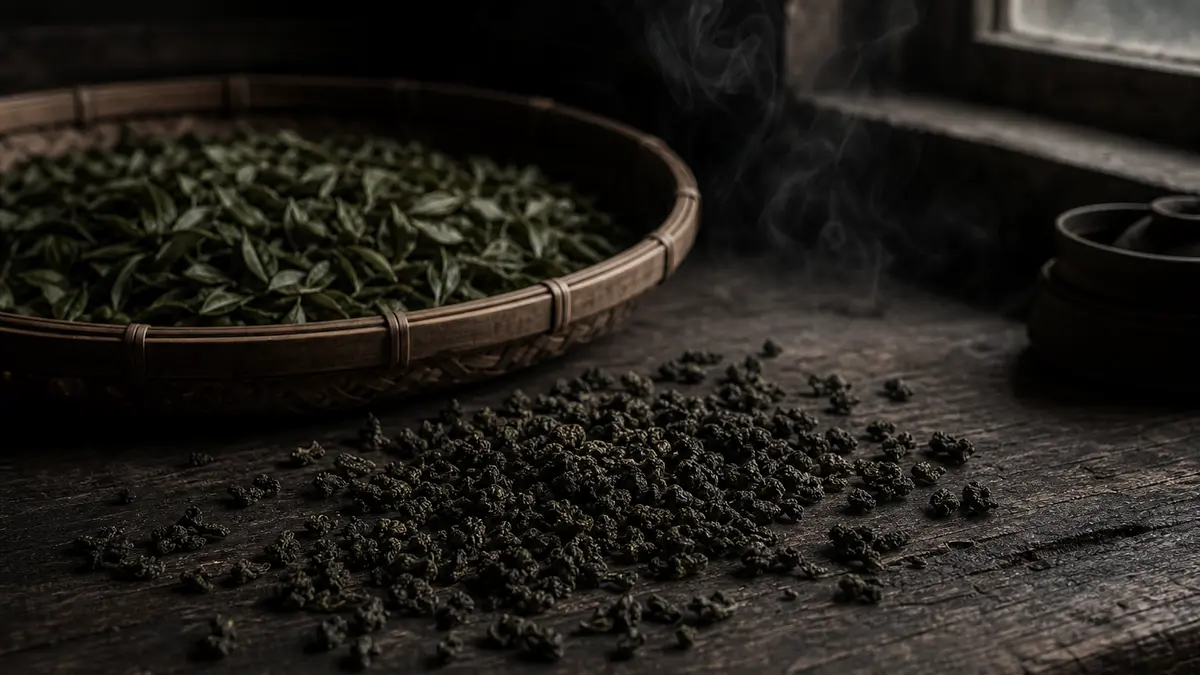
The processing philosophy behind gaoshan cha is one of restraint. The maker’s goal is transparency — let the mountain speak through the cup.
Oxidation: Light and Deliberate
Taiwanese high mountain oolong is lightly oxidized, typically 15–25%. Compare that to a traditional Dong Ding at 30–40%, or a Wuyi yancha (岩茶) at 60–80%. This light oxidation preserves the fresh, floral character that altitude creates in the leaf.
After plucking (hand-plucked, standard two leaves and a bud), the leaves are withered outdoors and then indoors, with periodic gentle tossing (浪青 làngqīng) to bruise the leaf edges and initiate oxidation. The skill is knowing when to stop — enough oxidation to develop aroma and body, not so much that the high-mountain freshness is lost.
Ball-Rolling: The Signature Shape
The defining visual characteristic of Taiwanese high mountain oolong is its tight, spherical pellet shape. This is achieved through ball-rolling (揉捻 róuniǎn) — the leaves are wrapped in cloth bags and repeatedly compressed and rolled by machine or hand. The process can take hours, with alternating cycles of rolling and brief heating to prevent over-oxidation.
These tight pellets serve a practical purpose beyond aesthetics. They unfurl slowly during brewing, allowing for many sequential infusions — each steep revealing a slightly different facet of the tea as the leaves progressively open. A well-rolled high mountain oolong can yield eight to twelve meaningful steeps.
Roasting: Minimal to None
Most high mountain oolong receives minimal roasting — just enough to stabilize the tea and remove residual moisture. Some producers apply no roast at all. This is a deliberate choice: heavy roasting would obscure the very qualities that altitude creates. The floral-creamy-sweet profile of a high elevation tea is best served by staying out of its way.
This sets high mountain oolong apart from Taiwan’s older roasting tradition. Dong Ding oolong (凍頂烏龍) is defined by its roast. High mountain oolong is defined by its absence.
The Key Regions of Taiwanese High Mountain Oolong
Taiwan’s tea-growing elevations span from roughly 200 meters to over 2,600 meters. The high mountain designation begins at 1,000 meters, but the most celebrated gardens sit far higher. Each region has a distinct character shaped by its specific elevation, microclimate, and surrounding landscape.
Ali Shan (阿里山) — 1,200–1,600m
Ali Shan is the gateway to high mountain oolong. Located in Chiayi County in southwestern Taiwan, it’s the most accessible of the major gaoshan regions — both geographically and in terms of flavor profile.
Tea from Ali Shan tends toward the floral and creamy end of the spectrum. Gardenia, butter, and sugarcane are common descriptors. The texture is smooth and round. There’s sweetness, but it’s gentle — approachable rather than demanding.
In the Mosel analogy, Ali Shan is Kabinett Riesling: elegant, balanced, and the ideal starting point for understanding what altitude does to tea.
Ali Shan also produces the largest volume of any high mountain region, which makes it the most commonly available and the most frequently faked. Provenance matters here.
Li Shan (梨山) — 1,800–2,400m
Li Shan — Pear Mountain — sits in Taichung County in central Taiwan. The elevation jump from Ali Shan is significant, and it shows in the cup. Published analyses suggest that teas from these altitudes show notably higher amino acid content and aromatic compound density compared to lower-grown counterparts.
The character shifts from creamy-floral toward orchid, stone fruit, and mineral. Multiple credible sources describe a more profound huigan (回甘) — returning sweetness — that lingers longer than Ali Shan’s. The texture is reported as silkier, denser.
Li Shan is Spätlese — more concentrated, more complex, more demanding of attention.
Da Yu Ling (大禹嶺) — 2,400m+
Da Yu Ling represents the pinnacle of Taiwanese high mountain oolong. At 2,400 meters and above, these are among the highest commercially cultivated tea gardens in the world. The gardens sit along the ridgeline of Taiwan’s Central Cross-Island Highway, wrapped in cloud cover for much of the day.
The character at this elevation is described as ethereal and crystalline — a word that keeps appearing across independent accounts. The sweetness reportedly becomes almost abstract. The florals lighten. What emerges, according to multiple sources, is a mineral purity and a lingering aftertaste that stretches for minutes.
Da Yu Ling is Trockenbeerenauslese — the extreme pinnacle, produced in tiny quantities from the most demanding conditions, priced accordingly.
A practical note: genuine Da Yu Ling is scarce. The Taiwanese government has been reclaiming some high-altitude tea land for environmental conservation, and production quantities are small. Prices for authenticated Da Yu Ling commonly exceed $70–100 USD per 100g at retail, and can go much higher for premium lots. Fakes and mislabeled teas are widespread.
Shan Lin Xi (杉林溪) — 1,600–1,800m
Shan Lin Xi sits in Nantou County, surrounded by forests of sugi (杉 shān) — Japanese cedar — that give the region its name: Cedar Forest Creek. Those forests aren’t just scenic. They create a distinct microclimate and, according to multiple tasters, contribute detectable character to the tea itself.
The signature of Shan Lin Xi oolong is a cool, mentholated note — sometimes described as cedar, mint, or eucalyptus — layered over the standard high mountain floral base. It’s a fascinating counterpoint to the buttery warmth of Ali Shan or the orchid elegance of Li Shan.
This forest-influenced character makes Shan Lin Xi one of the most distinctive gaoshan regions. It’s the equivalent of a single vineyard with an unmistakable site signature.
Dong Ding (凍頂) — ~800m
Dong Ding — Frozen Summit — in Nantou County sits below the 1,000-meter threshold for gaoshan classification. I include it here because you cannot understand Taiwanese high mountain oolong without understanding what came before it.
Dong Ding is the original Taiwanese oolong. Cultivars brought from Fujian’s Wuyi Mountains in the 19th century were planted here, and the processing tradition that developed — moderate oxidation (30–40%) and medium-to-heavy charcoal roasting — defined Taiwanese oolong for generations.
Where high mountain oolong is about transparency, Dong Ding is about transformation. The roast adds caramel, toasted grain, ripe fruit, and a warming depth that the lighter high mountain teas deliberately avoid. A well-made traditional Dong Ding has a dimension that gaoshan cha lacks, just as gaoshan cha has a crystalline purity that Dong Ding doesn’t attempt.
They’re not in competition. They’re different answers to what oolong can be.
Region Comparison at a Glance
| Region | Elevation | Oxidation | Roast Level | Character Profile |
|---|---|---|---|---|
| Ali Shan (阿里山) | 1,200–1,600m | 15–20% | Minimal | Floral, creamy, butter, sugarcane |
| Shan Lin Xi (杉林溪) | 1,600–1,800m | 15–20% | Minimal | Cool mint, cedar, floral |
| Li Shan (梨山) | 1,800–2,400m | 15–20% | Minimal | Orchid, stone fruit, mineral |
| Da Yu Ling (大禹嶺) | 2,400m+ | 15–20% | Minimal/None | Ethereal, crystalline, profound huigan |
| Dong Ding (凍頂) | ~800m | 30–40% | Medium–Heavy | Caramel, toasted grain, ripe fruit |
The Dominant Cultivar: Qingxin
Most Taiwanese high mountain oolong is made from the Qingxin (青心烏龍 qīngxīn wūlóng) cultivar — also called Ruanzhi (軟枝 “soft stem”). This cultivar dominates the high mountain gardens for good reason: it responds to altitude stress with exceptional aromatic complexity and a natural sweetness that amplifies as elevation increases.
Qingxin is not a high-yield cultivar. It’s finicky, cold-sensitive in extreme conditions, and susceptible to pests. But it produces leaves with a chemical profile ideally suited to light oxidation processing — high in amino acids and volatile aromatics, moderate in catechins.
Other cultivars appear in Taiwanese oolong production — Jin Xuan (金萱 #12), Cuiyu (翠玉 #13), Si Ji Chun (四季春) — but these tend to dominate at lower elevations. At the heights where gaoshan cha earns its reputation, Qingxin is king.
How to Brew Taiwanese High Mountain Oolong
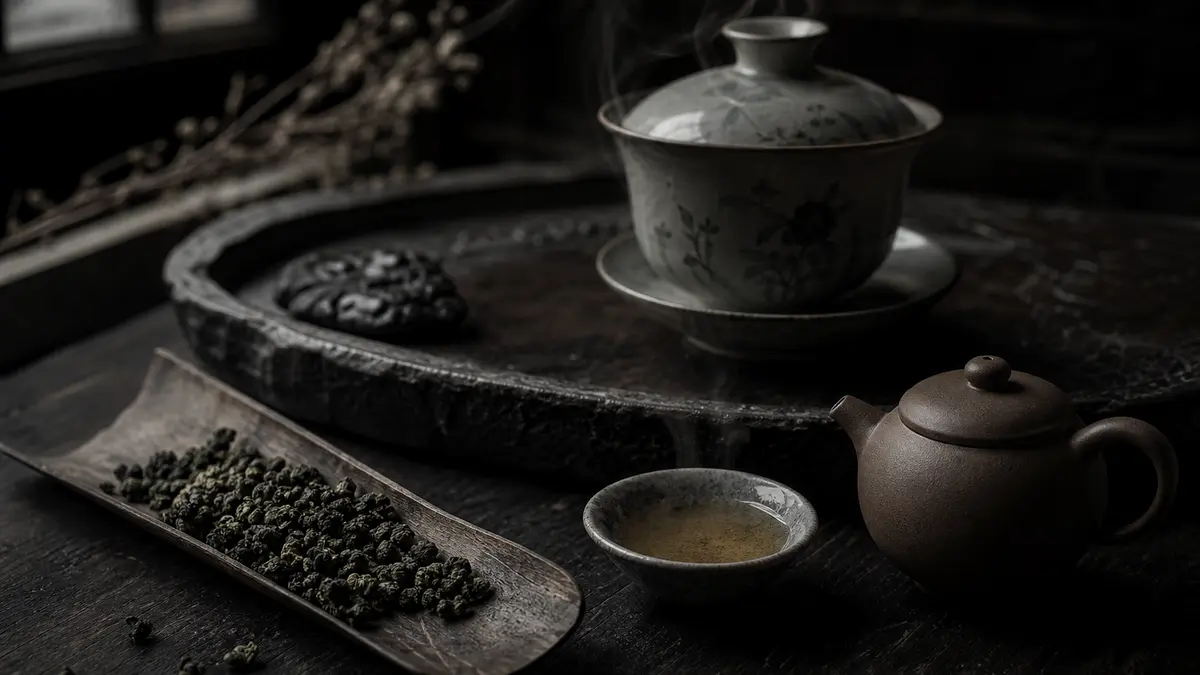
I’ll update this section with specific parameters once I’ve had the chance to work through sessions with actual gaoshan teas. For now, here are the widely recommended starting points based on established practice.
Gongfu Style (蓋碗 Gaiwan)
- Leaf quantity: 5–7g per 100ml gaiwan (蓋碗)
- Water temperature: 90–95°C (194–203°F) — lower for the highest elevations, higher for Dong Ding
- Rinse: One brief rinse, 3–5 seconds, to open the pellets
- First infusion: 30–45 seconds
- Subsequent infusions: Add 5–10 seconds per round
- Expected steeps: 8–12 from quality leaf
Western Style
- Leaf quantity: 3–4g per 200ml
- Water temperature: 90–95°C
- Steep time: 3 minutes for the first infusion, increasing to 4–5 minutes for subsequent steeps
- Expected steeps: 3–5
Gongfu brewing is the preferred method. The tight ball-rolling of Taiwanese high mountain oolong is designed for sequential infusions — the leaves unfurl gradually, and the flavor profile evolves across steeps in ways that a single long extraction cannot capture. The early steeps tend toward bright florals; the middle steeps deepen into sweetness and body; the later steeps trail off into mineral and soft wood notes.
Use a porcelain gaiwan rather than Yixing clay. The light oxidation and delicate aromatics of gaoshan cha are best served by a neutral vessel that doesn’t absorb or alter flavor. This is the opposite advice from what I’d give for aged pu’erh or heavy roast oolong — but the tea dictates the teaware.
What to Pay for Taiwanese High Mountain Oolong
Genuine high mountain oolong is not cheap. The combination of high-altitude labor costs, limited growing seasons (typically spring and winter harvests only), hand-plucking standards, and small garden sizes pushes prices well above most other oolong categories.
Rough price ranges at international retail:
- Ali Shan: $15–40 USD per 100g
- Shan Lin Xi: $20–50 USD per 100g
- Li Shan: $30–80 USD per 100g
- Da Yu Ling: $70–150+ USD per 100g
- Dong Ding (traditional roast): $15–50 USD per 100g
These ranges are wide because quality varies enormously within each region, and seasonal variation (春茶 spring vs. 冬茶 winter harvest) affects pricing. Spring teas generally command higher prices for their aromatic intensity, though winter teas from some regions are prized for their sweetness and body.
If you see “Ali Shan high mountain oolong” for $8 per 100g, be skeptical. The economics of genuine high-altitude Taiwanese production don’t support those numbers. Mislabeling is a real problem across the gaoshan category, particularly at the entry level.
Taiwanese vs. Chinese Oolong: A Necessary Distinction
Taiwanese oolong descends directly from Chinese oolong traditions — the cultivars, the processing frameworks, even the terminology trace back to Fujian province. But the teas themselves have diverged significantly.
Chinese oolong encompasses an enormous range: Wuyi yancha (武夷岩茶) with its heavy roast and mineral depth, Anxi Tieguanyin (安溪鐵觀音) in both traditional and modern styles, Phoenix Mountain dancong (鳳凰單叢) with its mimicry of fruit and flower aromatics. These teas span oxidation levels from 15% to 80% and roast levels from none to charcoal-heavy.
Taiwanese high mountain oolong occupies a specific, narrow band within the oolong spectrum: light oxidation, minimal roast, altitude-driven character. It shares a processing approach with modern Anxi Tieguanyin, but the terroir is fundamentally different — Taiwan’s volcanic soils, subtropical mountain climate, and extreme elevations produce a character that Anxi’s lower-altitude gardens cannot replicate.
The distinction matters because these teas are not interchangeable. If you love the charcoal depth of a traditional Wuyi oolong, gaoshan cha will feel like a different category of beverage entirely. It is. And that’s fine.
Storing Taiwanese High Mountain Oolong
Lightly oxidized, minimally roasted gaoshan cha is among the more perishable styles of oolong. The qualities you’re paying for — fresh florals, delicate sweetness, creamy texture — degrade with exposure to air, light, moisture, and heat.
Store sealed, in opaque packaging, in a cool and dry place. Refrigeration is common practice in Taiwan and extends freshness significantly, but only if the tea is sealed airtight to prevent moisture absorption. Vacuum-sealed bags stored in the refrigerator can keep gaoshan cha in excellent condition for six months or longer.
This is not a tea to age. The freshness is the point. Drink it within a season of purchase if possible, certainly within a year.
A Living Document
This guide will evolve. When my Da Yu Ling and Li Shan area teas arrive, I’ll add detailed tasting notes, session-by-session brewing data, and firsthand observations about how altitude differences manifest in the cup. The framework above is built from careful research; the experiential layer is coming.
Taiwanese high mountain oolong represents one of tea’s clearest expressions of terroir — a category where you can literally taste elevation. Understanding the regions, the processing philosophy, and the science behind altitude’s effect on leaf chemistry gives you the framework. The cup gives you the proof.