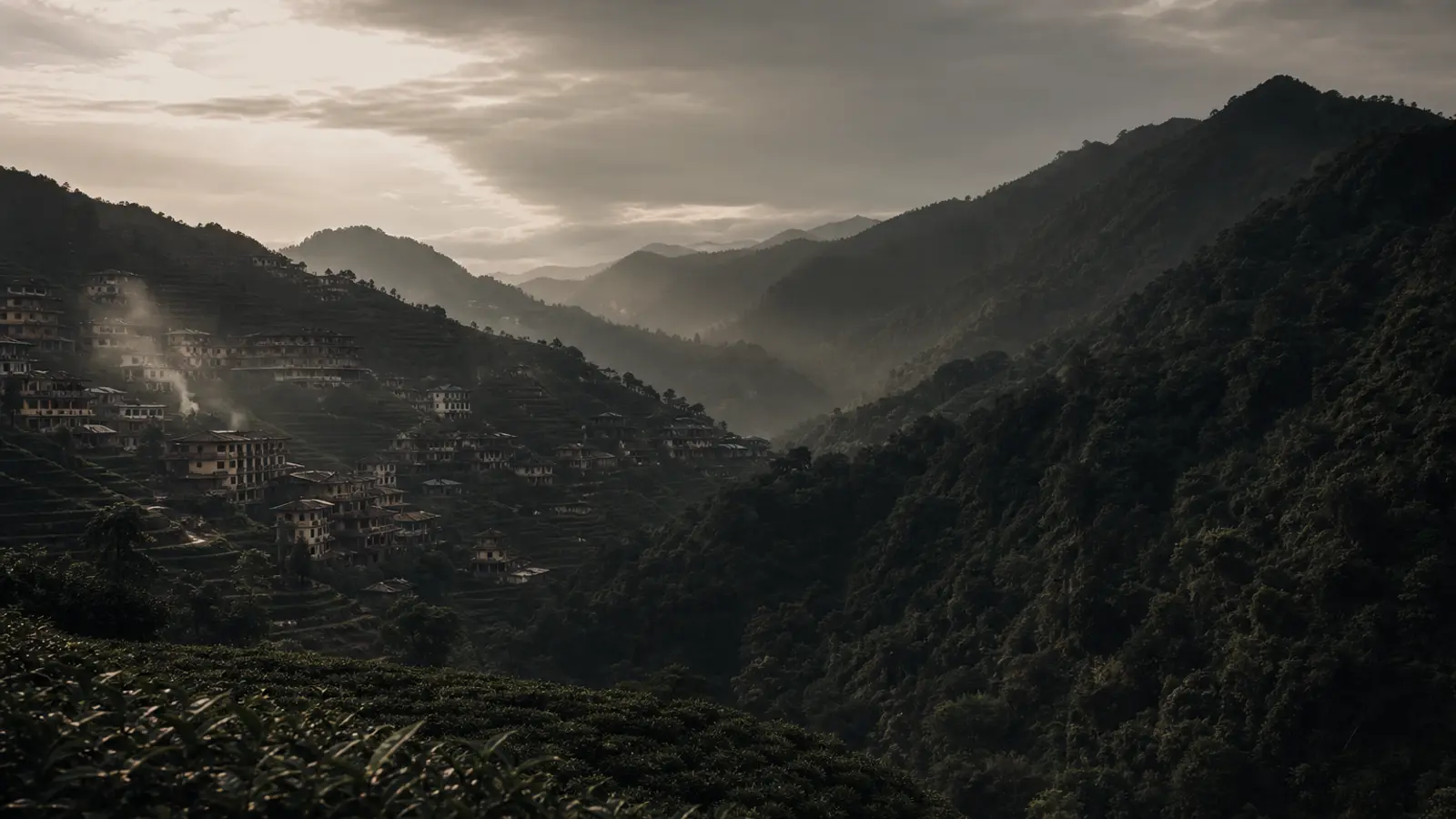
Bulang Mountain (布朗山, Bùlǎng Shān) is the power region of pu-erh. Every serious map of Xishuangbanna’s tea mountains marks Bulang — not because it is the oldest name or the most poetic, but because nothing else quite prepares you for what grows here. Young bulang mountain pu-erh arrives in the cup with a structural intensity that has no equivalent in the tea world: pronounced bitterness that grips the palate, a muscular astringency, and then — if the material is genuine and well-made — a sweetness that rises from the throat like something unlocked. That transformation, the kugan (苦甘) arc from bitter to sweet, is Bulang’s defining signature and its central promise.
I have not personally sat with Bulang’s most storied villages, but the research base on this mountain is unusually detailed. Laobanzhang alone has attracted more documentation — sensory, scientific, commercial — than almost any other tea origin on earth. What follows draws on that body of evidence and treats it honestly.
Geography & Location
Bulang Mountain sits in the southern reaches of Menghai County (勐海县), within the prefecture of Xishuangbanna (西双版纳傣族自治州) in Yunnan Province. The coordinates center around 21.6°N, 100.4°E — placing it close to the Burmese border, in the narrow subtropical belt where the Tropic of Cancer brushes the Yunnan highlands.
The mountain is not a single peak but a massif: a broad, ridge-heavy highland that creates a mosaic of microclimates across its villages. Elevation runs 1,500–2,000 meters, with most significant tea production concentrated in the 1,600–1,900m band where cloud cover, temperature, and rainfall intersect most favorably for complex leaf chemistry.
Within Menghai County, Bulang Mountain is one of six named “ancient tea mountains of Banna’s west bank” (版纳西岸六大茶山), grouped alongside Nannuo (南糯山), Jingmai (景迈山), Menghai (勐海), Xiding (西定), and Bada (巴达). These western mountains are generally considered more powerful and tannic in character than the historically famous eastern mountains (Yiwu, Yibang, Manzhuan, Gedeng, Mangzhi), which tend toward softer, more aromatic profiles.
Climate & Elevation
Bulang Mountain receives 1,300–1,500mm of annual rainfall, distributed across a pronounced monsoon pattern. The wet season runs May through October; the dry season from November through April. This seasonal rhythm directly shapes the tea calendar: spring (明前, míng qián, pre-Qingming, and 雨前, yǔ qián, pre-rain) harvests in March and April, autumn harvest in September and October.
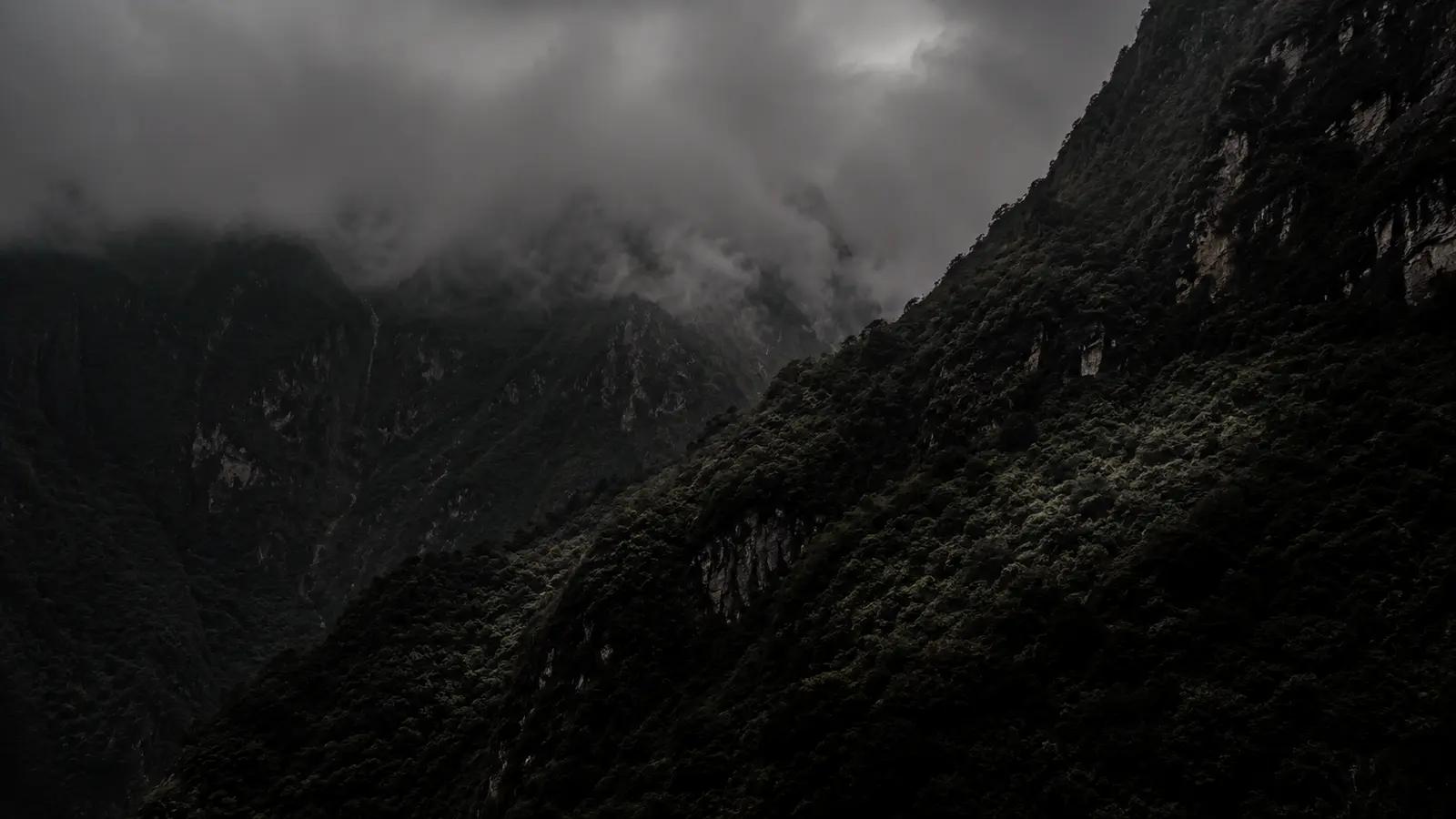
Cloud cover is near-constant during the wet season. Mist collects in the valleys each morning and disperses slowly through the canopy, maintaining high ambient humidity and diffusing direct solar radiation. The consequence for tea chemistry is significant: slower photosynthesis under diffuse light means higher chlorophyll, amino acid, and polyphenol concentrations accumulate in the leaf over a longer maturation cycle.
Mean annual temperature ranges 16–22°C. The diurnal temperature swing — warm days, cool nights — is wider at elevation and likely contributes to the aromatic complexity that distinguishes gushu (古樹, ancient tree) Bulang material from plantation-grown leaf at lower altitudes. Higher ground also means better drainage, less waterlogging, and root systems that drive deep into the mineral-dense bedrock.
Soil & Terroir
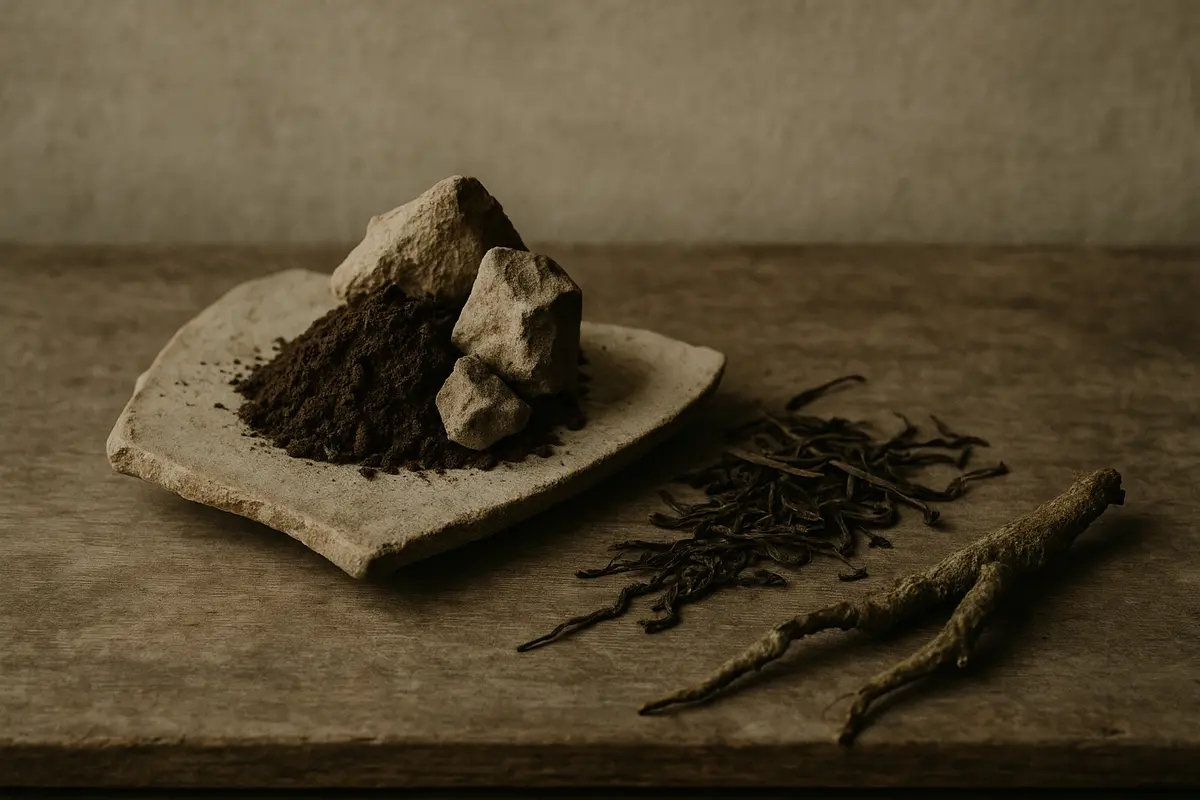
The soil profile of Bulang Mountain is one of the most discussed factors in understanding the tea’s character. Deep laterite clay over granite bedrock dominates the mountain’s terroir. Laterite forms through intense tropical weathering, stripping away silica and concentrating iron and aluminum oxides — the rust-red color of Bulang’s soil is direct evidence of this iron enrichment.
Soil pH tests from the region consistently fall in the 4.0–5.0 range, making these among the most acidic growing conditions for any major tea origin. Camellia sinensis tolerates acidity well, but thrives at the lower end of the pH scale in ways that measurably affect the leaf’s biochemistry. Multiple agronomic studies report that more acidic soils correlate with higher catechin concentrations in the leaf, and catechins — especially the bitter epigallocatechin gallate (EGCG) group — are the primary compounds behind Bulang’s famous intensity.
The granite bedrock beneath the laterite introduces a mineral dimension. Granite weathers slowly, releasing calcium, potassium, and trace minerals over geological timescales. The tea trees’ deep root systems — gushu specimens often have roots extending several meters — can access these mineral stores in ways that younger, shallower-rooted plantation bushes cannot. This likely contributes to the mineral backbone that experienced drinkers describe as a kind of stoniness or wet-rock quality in aged Bulang, distinct from the more floral or woody minerality found in other major origins.
The forest ecosystem matters too. Bulang Mountain’s higher elevations retain significant old-growth forest cover, and the remaining ancient tea trees grow within this forest canopy rather than in cleared monoculture rows. Biodiversity supports soil health — organic matter, mycorrhizal networks, natural pest management — in ways that decades of agronomic research have confirmed contribute to leaf quality, though the precise causal pathways remain an active area of study.
Key Cultivars & Tea Types
Bulang Mountain’s ancient trees belong primarily to the large-leaf Yunnan assamica type (云南大叶种, Yúnnán dà yè zhǒng), specifically the wild-adjacent and semi-wild populations that have grown on the mountain for centuries or millennia. These are not named cultivars in the way Taiwanese high mountain oolongs distinguish between Jin Xuan (金萱) and Qingxin (青心) — Bulang’s gushu trees are understood as place-adapted populations rather than intentionally selected varieties.
Leaf morphology in Bulang material tends toward the robust end of the assamica spectrum: broad, thick leaves with pronounced venation and visible leaf hairs on the underside. Stems are prominent. This physical robustness is one reason experienced processors favor confident shaqing (殺青, kill-green) technique — the thick leaf mass requires sufficient heat penetration to arrest oxidation uniformly.
Plantation-grade material (台地茶, tái dì chá) also exists extensively on Bulang Mountain’s lower slopes. Vegetatively propagated from known parent trees and grown in terraced, higher-density plots, plantation tea from Bulang can still show strong regional character — the soil and climate exert their influence regardless of tree age — but the intensity, complexity, and qi (氣) are generally considered lower than gushu material from the same village. Price reflects this: plantation Bulang is accessible; gushu Bulang commands a premium that has only increased as global demand has grown.
The primary tea type produced on Bulang Mountain is sheng pu-erh (生普洱, raw pu-erh), pressed into 357g bings (餅, cakes), tuos (沱, bird’s nest shapes), and bricks. Some producers also make shou pu-erh (熟普洱, ripe pu-erh) using Bulang area leaf, though the distinction of specific village provenance matters less for shou, which undergoes wet-piling fermentation that significantly reduces regional character differentiation.
Processing Traditions
Standard sheng pu-erh processing applies across Bulang Mountain: wilt (萎凋, wěi diāo) — often brief or minimal — followed by shaqing (殺青) in a large wok or drum, rolling (揉捻, róuniǎn) to break cell walls and shape the leaf, and solar drying (曬青, shài qīng) on bamboo mats or tarps in direct sunlight. The resulting maocha (毛茶, rough tea) is then steamed, compressed, and dried.
The point of meaningful variation is shaqing. Bulang leaf, with its high polyphenol load, is genuinely difficult to process without either under- or over-applying heat. Under-doing shaqing leaves enzymatic activity partially arrested — some oxidation continues post-processing, which can accelerate early aging in ways that look appealing at two years but may undermine 20-year potential. Over-doing it — excessive heat, too long in the wok — denatures the leaf’s enzymatic machinery too aggressively, producing a tea that smells slightly cooked even when young and that will never develop the depth great aged Bulang achieves.
The best producers on Bulang Mountain — particularly those with long family histories in Laobanzhang and Laoman’e — maintain deliberate restraint in shaqing. They work quickly, keep temperatures high enough to achieve proper kill-green, and stop before the leaf scorches. The result is a young tea that is almost aggressively bitter, which many buyers initially mistake for a flaw. It is not. It is the structural precondition for the most dramatic flavor transformation in pu-erh.
Some market-oriented producers apply heavier kill-green to produce Bulang material that is more immediately palatable — less bitter, more approachable in the first few years. This strategy works commercially. It fails the tea. Heavy shaqing sacrifices the bitter polyphenols before they have a chance to undertake the long chemical conversion that defines aged Bulang’s character. Such teas are pleasant at five years and boring at twenty.
Solar drying on Bulang Mountain is practiced when conditions allow, but the mountain’s frequent cloud cover and high humidity mean that drying conditions vary significantly by season and elevation. Autumn harvest material, processed during clearer weather, sometimes dries faster than spring harvest, which can be caught in lingering wet-season humidity. Incomplete solar drying is one of the documented risk factors for early mold development in storage — a genuine quality concern for material from any high-humidity origin.
Characteristic Flavor Signatures
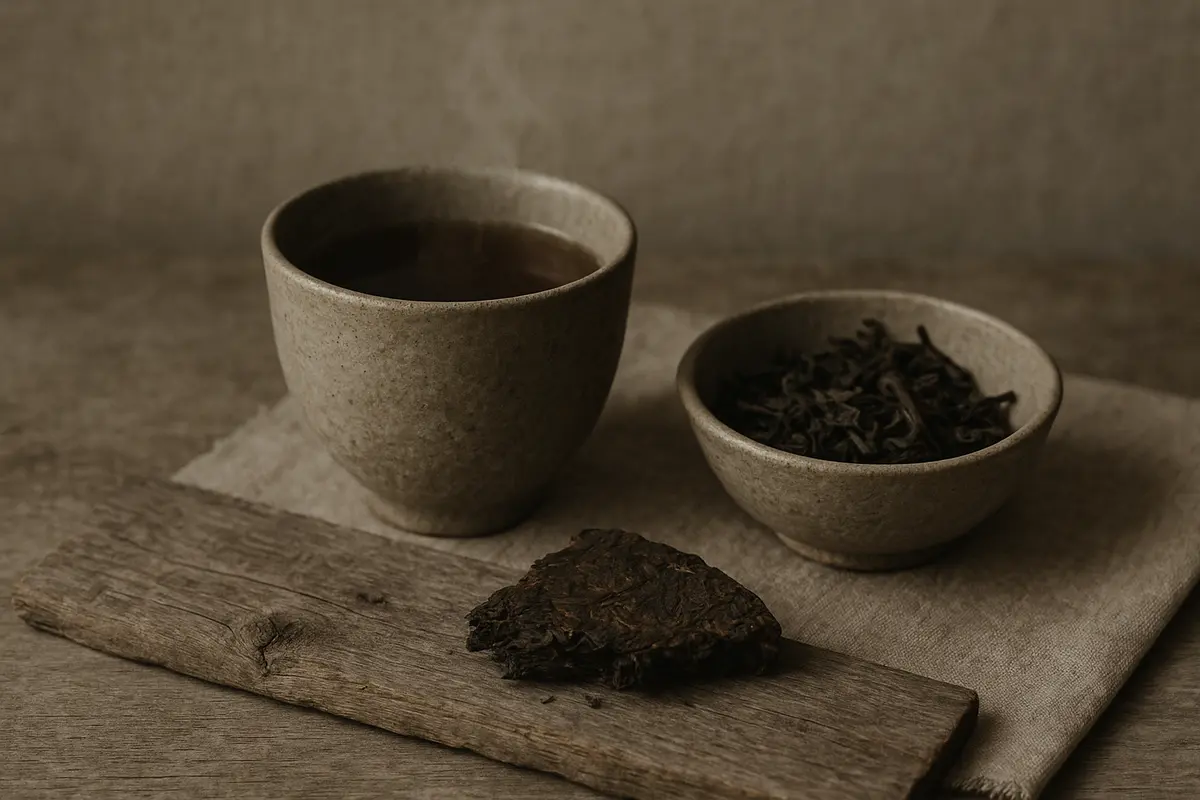
Bulang Mountain pu-erh occupies a specific position in the flavor space of Xishuangbanna tea. Where Yiwu (易武) is defined by softness and floral elegance — the region’s wines parallel runs to Margaux — Bulang is Pauillac: structured, concentrated, built on a foundation of tannin that demands time to reveal its full dimension.
Young sheng (0–5 years): The dominant impression is bitterness (苦, kǔ) — direct, persistent, coating the back of the tongue and the sides of the mouth. Astringency (澀, sè) accompanies it: a drying sensation that tightens the palate. These are not subtle background notes. In a fresh young Laobanzhang or Laoman’e, they are the entire foreground. Above these base notes, experienced drinkers report floral and herbaceous aromas in the early steeps — fresh grass, mountain flowers, something reminiscent of camphor even in youth — but the bitterness is what you remember.
The critical counterpoint is huigan (回甘, literally “returning sweetness”): the sweetness that rises in the throat 30–90 seconds after swallowing. In weak or plantation-grade Bulang, huigan is modest. In genuine gushu Bulang, it is powerful, sustained, and arrives in waves. The speed and intensity of huigan is one of the primary quality markers experienced buyers use when evaluating Bulang maocha.
Mid-aged sheng (5–15 years): The most dynamic phase. Bitterness softens but does not disappear — it begins converting. The astringency integrates. Secondary flavors emerge: dried fruits, tobacco, the early hints of camphor (樟香, zhāng xiāng) that characterize well-aged sheng from this region. The soup color deepens from bright yellow-green toward amber. Qi becomes more stable and pronounced.
Aged sheng (15+ years): Where the promise is fulfilled. Multiple documented sources describe well-stored 20–30 year old Bulang sheng as displaying extraordinary complexity: deep medicinal character, prominent camphor, dried plum, forest floor, sustained sweetness with remarkable length. The bitterness that defined the young tea has completed much of its transformation; what remains is structural depth rather than harsh edge. This is the aging trajectory that makes quality Bulang among the most sought-after raw material for collectors.
The kugan (苦甘, bitter-sweet) transformation is more dramatic in Bulang than in any other major Xishuangbanna region. It is the mountain’s central narrative arc — and the reason why evaluating Bulang on a five-year timeline misses the point entirely.
The Villages of Bulang Mountain
Laobanzhang (老班章)
The most expensive, most famous, and most discussed village on Bulang Mountain — covered in depth in a dedicated article, but impossible to omit here. Laobanzhang sits at approximately 1,700m and is home to some of the most coveted gushu trees in the pu-erh world. Gushu maocha from Laobanzhang commands $50–$200+ per gram at source — prices that reflect genuine scarcity, documented quality, and significant speculative demand. A single 357g cake of authentic, traceable Laobanzhang gushu from a reputable producer can exceed $5,000 USD on the secondary market.
The flavor is the apex expression of Bulang character: the most powerful bitterness, the most dramatic kugan conversion, the deepest huigan, the most potent qi. Whether it is proportionally better than Xinbanzhang at a quarter of the price is a question each drinker must answer for themselves.
Authenticity is the central challenge. Laobanzhang’s fame and price have made it a target for blending, mislabeling, and outright fraud. The volume of tea sold under the Laobanzhang name significantly exceeds what could possibly come from the village’s actual tree population. Buyers without established relationships with specific producers should approach Laobanzhang claims with proportional skepticism.
Xinbanzhang (新班章)
Adjacent to Laobanzhang, sharing similar elevation and soil profile, Xinbanzhang (新班章) produces tea with recognizable Bulang character at meaningfully lower prices. The bitterness is comparable; the complexity and huigan are often described as slightly less extreme than Laobanzhang’s peak expression. For drinkers who want genuine, high-quality central Bulang tea without paying the Laobanzhang premium, Xinbanzhang is the logical starting point.
Price range for gushu material: $15–$50 per gram at source, depending on tree age documentation and producer reputation.
Laoman’e (老曼峨)
Laoman’e is an exceptional case. Even among experienced pu-erh drinkers, it is described as the most bitter tea in existence — a statement that deserves to be taken literally rather than as hyperbole. The bitterness of a young Laoman’e gushu can be genuinely shocking: sustained, aggressive, requiring drinkers to mentally bracket everything they associate with “tea flavor” and recalibrate.
The village sits within the Bulang ethnic minority’s ancestral territory and has been producing tea for over a millennium. The old trees at Laoman’e have a biochemical profile that amplifies every Bulang characteristic to its extreme. For the right drinker — one who understands that this bitterness is temporal, that it is the raw material for one of pu-erh’s most extraordinary long-term transformations — Laoman’e is deeply compelling. For anyone approaching pu-erh as a beverage to enjoy now, it is a difficult introduction.
Aged Laoman’e (15–25 years) reportedly develops into something remarkable: the extreme bitterness creates proportionally extreme sweetness in transformation, a kugan arc that eclipses even Laobanzhang in sheer magnitude of change.
Bada (巴达)
Bada (巴达) occupies the western edge of the Bulang Mountain complex and is sometimes treated as a sub-region distinct from central Bulang. The terroir softens here: slightly lower average elevation in many production zones, somewhat different soil composition, and a flavor profile that retains Bulang’s fundamental structure but expresses it with more restraint. Bada is the approachable gateway to Bulang character.
Bada is also historically significant: it is home to some of the most cited “1,700-year-old wild tea tree” specimens, though the age claims on individual trees are difficult to verify definitively and should be understood as estimates. Wild tea trees (野生茶, yěshēng chá) from Bada have a genetic profile distinct from the cultivated gushu trees in central Bulang villages, and their flavor — intense, medicinal, sometimes almost savagely wild — is a category of its own.
Zhanglang (章朗)
Zhanglang is the cultural heart of the Bulang ethnic minority (布朗族, Bùlǎng zú) in the region, with continuous human habitation and tea cultivation documented for over 1,000 years. The village itself — a cluster of traditional stilt houses in dense forest — sits at roughly 1,600m and retains a character that feels more genuinely historical than the more commercially developed central Bulang villages.
The tea from Zhanglang expresses Bulang character within a somewhat softer register than Laobanzhang. Multiple sources describe a particular aromatic quality — a forest-floor depth, a quality of mountain herbs — that distinguishes Zhanglang material from the more concentrated power of central Bulang. Price is lower than Laobanzhang but rising as the village’s reputation grows.
The Bulang People
The Bulang ethnic minority (布朗族) are the original cultivators of these tea mountains. Their relationship with tea is not metaphorical or commercial in origin — it predates the commodity market by a millennium. Multiple ethnographic sources document the Bulang people’s understanding of tea as both a practical agricultural crop and a spiritual and medicinal substance central to their cultural identity.
The Bulang maintain that they planted the oldest trees on the mountain, and the weight of historical and genetic evidence supports that claim. Their oral traditions describe generations of tea cultivation extending well over 1,000 years. When you drink old-tree Bulang sheng, you are drinking the product of a civilization’s agricultural lineage — a fact worth sitting with.
As commercial demand for Laobanzhang and other Bulang villages has intensified over the past two decades, the Bulang communities have navigated the tension between economic opportunity and cultural preservation with varying results. The wealthiest families in Laobanzhang are now genuinely wealthy by any provincial standard; other villages have seen less dramatic economic transformation. The distribution of pu-erh’s commercial gains within these communities is an ongoing and contested story.
Quality Indicators & Authentication
Evaluating bulang mountain pu-erh quality requires separating several overlapping questions: Is this genuinely from Bulang Mountain? Is it from the claimed village? Is it from old trees or plantation? Is the processing sound?
Sensory markers of genuine Bulang gushu:
- Bitterness with structure. The bitterness should be assertive and coating, not thin or sharp. Thin bitterness suggests plantation material; sharp, metallic bitterness suggests processing flaws.
- Strong, rapid huigan. Sweetness should return in the throat within 30–60 seconds of swallowing and persist for several minutes. Weak or absent huigan is the most reliable indicator of low-grade material.
- Soup body. High-quality Bulang gushu produces a viscous, almost oily soup body. Thin, watery texture suggests plantation tea or blending with non-Bulang material.
- Leaf appearance. Genuine gushu leaves from central Bulang villages tend to be large, thick, with prominent white hair (白毫, bái háo) and a robust, almost leathery texture when wet. Uniformly small, delicate leaves may indicate plantation material from lower elevations.
- Qi. This is subjective and cannot be analytically verified, but experienced drinkers consistently report that genuine Bulang gushu produces a pronounced physical response: warmth spreading through the body, heightened alertness, sometimes a light cha zui (茶醉, tea drunk) sensation at higher concentrations.
Authentication challenges:
Geographic certification for Bulang pu-erh does not operate with the same rigor as, say, Champagne AOC. Village-level claims are largely unverifiable without direct producer relationships, and even then, the chain of custody from tree to finished cake requires trust in multiple actors. The market for “Laobanzhang” has been well-documented as significantly larger than what the village can actually produce. Buyers should price their trust accordingly: if a Laobanzhang cake is priced at $50–100 for 357g, the probability that it contains genuine Laobanzhang gushu in any meaningful quantity is low.
Price Ranges
Prices for Bulang Mountain pu-erh span a very wide range depending on village, tree age, vintage, and producer reputation. The following represents 2024–2025 market conditions for 100g of maocha (loose leaf) at source in Yunnan, converted to USD.
| Village | Plantation (per 100g) | Gushu (per 100g) | Notes |
|---|---|---|---|
| Laobanzhang (老班章) | $15–40 | $5,000–20,000+ | Extreme prices for verified gushu; widespread fraud |
| Xinbanzhang (新班章) | $8–20 | $1,500–5,000 | Better value entry to central Bulang |
| Laoman’e (老曼峨) | $5–15 | $500–2,000 | Undervalued given quality |
| Bada (巴达) | $3–10 | $200–800 | Most accessible entry point |
| Zhanglang (章朗) | $4–12 | $300–1,000 | Rising reputation |
Finished pressed cakes (357g) at international retail pricing typically run 3–5x the maocha prices, reflecting producer margin, pressing, aging, and import costs. Aged Bulang cakes (10+ years) from reputable vendors command additional premiums: a well-documented 2012 Laobanzhang cake in clean storage might trade at $800–$2,500+ depending on the producer.
For reference: the cost-to-quality curve on Bulang Mountain is perhaps steeper than anywhere else in pu-erh. Bada and Xinbanzhang gushu at $200–$300 per 100g of maocha delivers genuine, impressive Bulang character. The additional expenditure to reach verified Laobanzhang buys incremental quality improvements on an exponential cost curve that only makes sense for collectors with specific goals.
Aging Trajectory and Storage
Properly stored Bulang sheng is built for decades, not years. The conventional wisdom — supported by documented tasting records and the experience of collectors who have followed specific productions over 15–25 year windows — describes a trajectory that unfolds roughly as follows:
Years 0–5: Aggressive bitterness and astringency dominate. The tea is honest about what it is and makes no concessions to immediate palatability. Huigan is present and strong. Qi is pronounced. Most casual drinkers will find this stage demanding.
Years 5–10: A transitional phase. The harsh edges begin integrating. Secondary flavors emerge. The tea starts showing what it will become without yet being that thing. This is an interesting period for monitoring rather than primary drinking.
Years 10–20: The dramatic transformation period. Bitterness converts to complex sweetness. Camphor (樟香) and medicinal notes develop. Soup color has moved to deep amber-orange. The tea is now genuinely enjoyable on its own terms rather than as a structural exercise.
Years 20+: The fulfillment of the original promise. Deep, layered complexity. The bitter compounds that defined the young tea have largely completed their transformation; what remains is structural interest — a kind of mineral-sweet depth with tremendous length on the palate. This is what Bulang collectors are storing toward.
Storage conditions during this aging window matter as much as the original material quality. The target range is 60–75% relative humidity and 15–25°C, in an environment free from odor contamination. Overly dry storage (below 55% RH) slows aging significantly; overly wet storage (above 80% RH) risks accelerating microbial activity in ways that can produce unpleasant flavors or mold. Bulang’s high tannin load gives it some additional resilience against humidity fluctuation compared to softer-profile teas, but this resilience is not unlimited.
Approaching Bulang: A Framework
Bulang Mountain pu-erh rewards deliberate approach. A few practical orientations:
Start with aged or Bada material. If you have not spent time with Bulang before, a 10+ year old Bulang blend or a quality Bada gushu will show you the regional character without requiring you to bracket an extreme bitterness response while simultaneously trying to evaluate everything else. Once you understand what Bulang’s huigan and qi feel like in a more integrated state, young Laobanzhang or Laoman’e becomes legible rather than merely aggressive.
Brew parameters matter. Young Bulang sheng is sensitive to water temperature and concentration. At 95°C with standard gongfu (功夫茶) parameters — roughly 7–8g in a 100ml gaiwan (蓋碗), flash steeps — the bitterness is present but controlled. Higher leaf ratios or longer infusions at the same temperature produce bitterness that can overwhelm the other elements. Experienced drinkers of very young Bulang sometimes brew at slightly lower temperatures (88–92°C) in early sessions to slow the bitter extraction and allow more of the floral and aromatic character to read clearly.
Multiple short steeps. Standard gongfu methodology applies, but Bulang particularly rewards the 8th through 15th steeps. As the aggressive early bitterness exhausts itself, the later infusions often show exceptional sweetness and refined depth that the first three steeps obscure entirely. Patience within a session mirrors the patience required across decades of aging.
Approach Laobanzhang pricing with calibrated skepticism. The village is real, the trees are real, the tea is genuinely exceptional. The market claiming to sell it at accessible prices is not. Develop relationships with producers or vendors who can provide meaningful traceability before paying Laobanzhang premiums.
Bulang Mountain pu-erh is not a beginner’s tea and not a tea that flatters the impatient. It is built for drinkers who understand that the most interesting things in the cup are often the ones that take decades to arrive — and who have the storage space, the patience, and the willingness to be challenged in the short term for rewards that only time can deliver.