
Green tea is the most misunderstood tea category in the world. Most people who say they don’t like it have never actually tasted it — they’ve tasted overbrewed, scalded leaf. This green tea guide exists to fix that.
The category spans everything from a grassy Japanese sencha you drink cold from a vending machine in Kyoto to a buttery, chestnut-sweet Longjing (龙井) from Hangzhou that you’d happily compare to a fine white Burgundy. They are both green tea. They taste nothing alike. Understanding why — and understanding how to brew each correctly — changes how you think about tea entirely.
What Makes a Tea “Green”: Sha Qing (杀青)
Every tea starts as the same plant: Camellia sinensis. What separates categories isn’t the leaf — it’s what you do to the leaf in the hours after picking.
Fresh tea leaves contain active enzymes. Left alone, those enzymes begin oxidizing the leaf, breaking down chlorophyll, developing new aromatic compounds, and turning the leaf progressively darker. That process, if allowed to run its course, produces black tea. Interrupted partway, it produces oolong.
Green tea is defined by stopping that oxidation immediately. The method is sha qing (杀青) — literally “kill green” — a rapid application of heat that denatures the oxidative enzymes before they can do significant work. The leaf stays green. The fresh compounds stay intact.
How you apply that heat determines almost everything about the final flavor.
The Two Green Tea Traditions: Pan-Fire vs. Steam
This is the Chardonnay analogy that changed how I think about the category. Chardonnay from Chablis — unoaked, grown in cool limestone soils — tastes nothing like a buttery, barrel-fermented California Chardonnay. Same grape. Completely different winemaking. If you tried Chablis expecting California Chardonnay, you’d think you hated Chardonnay.
Green tea works the same way. The “winemaking” split is between China and Japan, and it’s primarily about sha qing method.
Chinese Green Tea: Pan-Firing
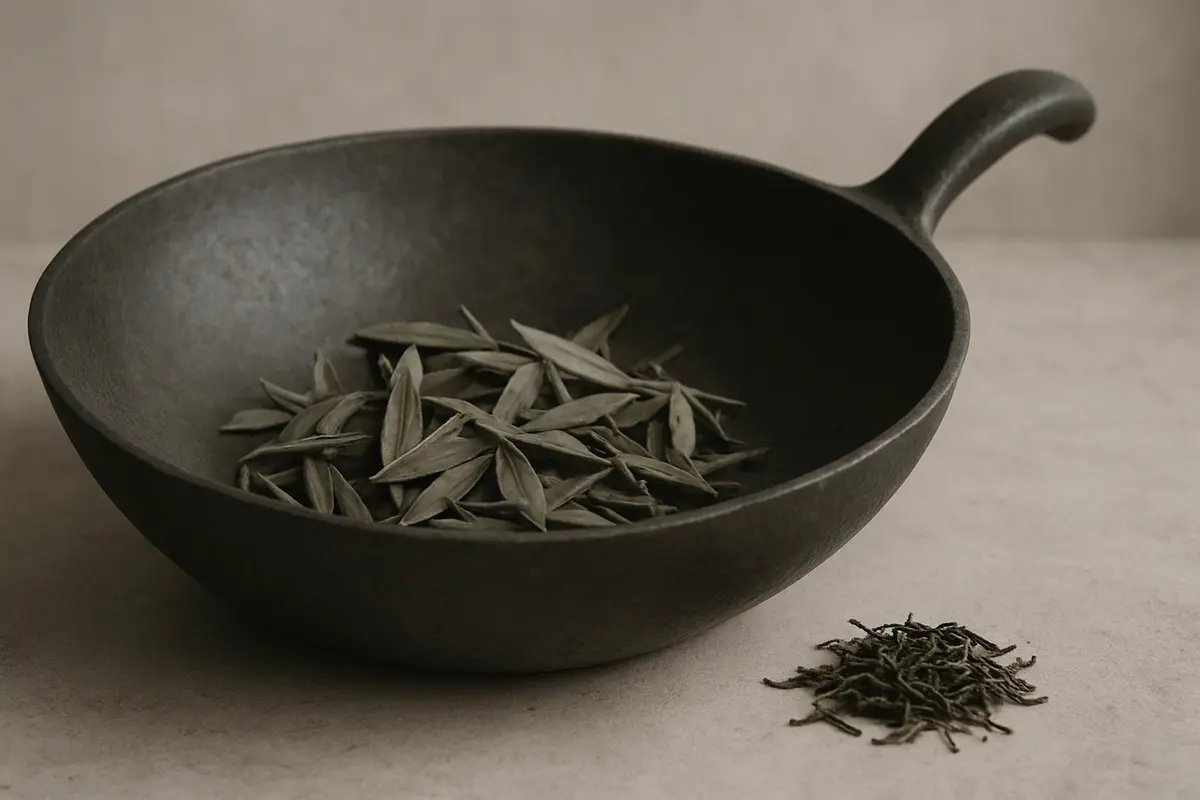
The dominant sha qing method in China is pan-firing — tossing fresh leaves in a hot wok or mechanical drum, typically around 200–300°C, for several minutes. The dry, conductive heat drives off moisture rapidly and produces Maillard reaction compounds: toasty, nutty, sometimes slightly sweet flavors. Think roasted grain, warm chestnut, fresh hay.
Pan-firing also tends to produce a lighter, more transparent liquor — pale yellow to pale green — with a clean, open aroma that unfolds across multiple steeps.
Japanese Green Tea: Steaming
Japan adopted a different sha qing approach: steaming. Fresh leaves pass over jets of steam for anywhere from 20 seconds (asamushi, light steam) to several minutes (fukamushi, deep steam). Wet heat is gentler and faster than pan-firing, and it preserves more of the leaf’s original chlorophyll, proteins, and amino acids intact.
The result is a flavor profile that’s unmistakably different: bright grass, seaweed, spinach, a savory umami quality, sometimes marine or oceanic notes. The liquor is typically deeper green, sometimes opaque, and heavier-bodied.
Neither approach is better. They’re different tools producing different results.
Key Types of Green Tea
Chinese Green Teas
Longjing (龙井) — Dragon Well
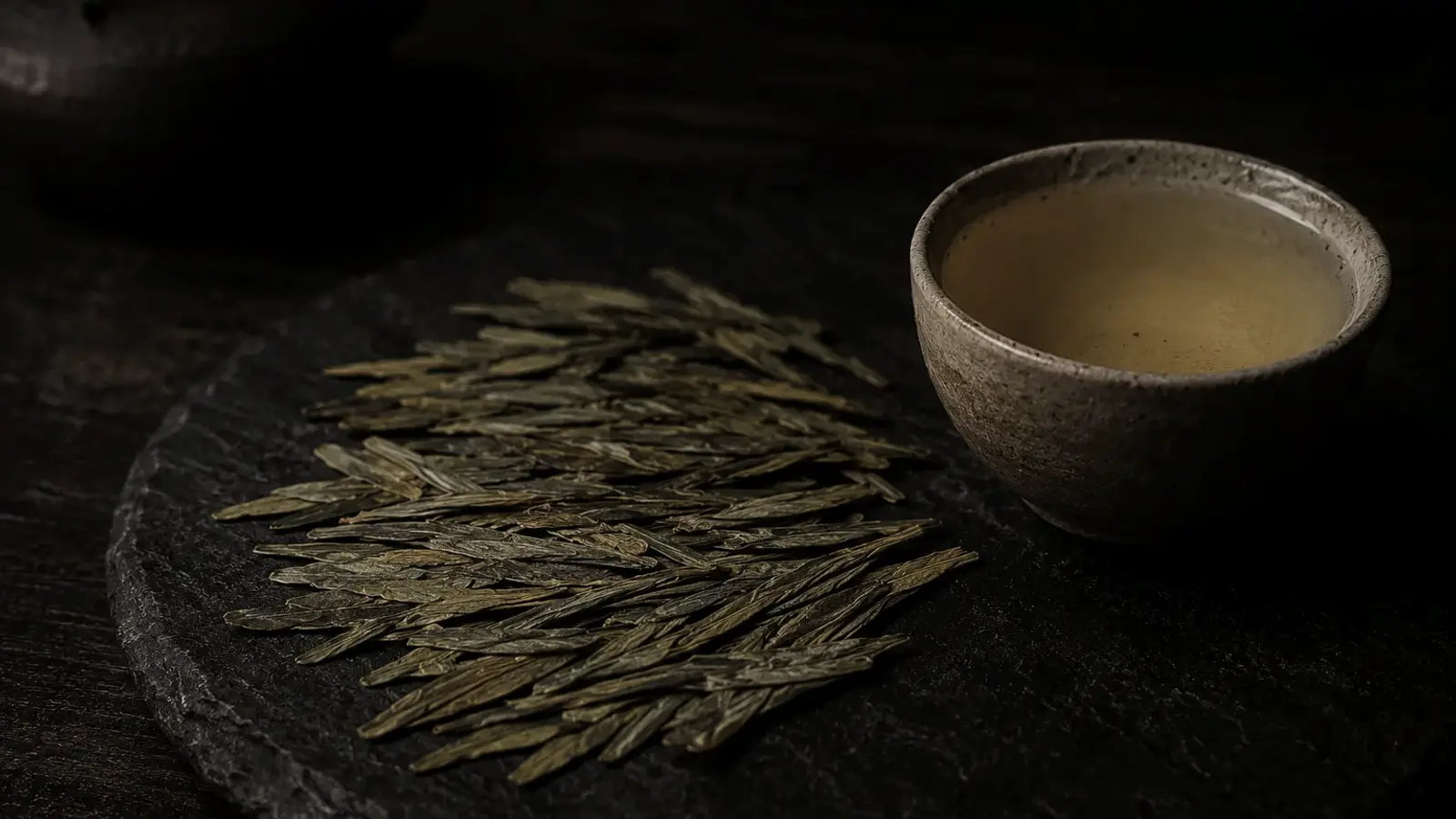
Longjing is China’s most famous green tea, grown in the hills around Hangzhou in Zhejiang province. The leaves are hand-pressed flat against a hot wok in a distinctive two-handed technique, producing the characteristic flat, sword-shaped leaf.
The flavor is what I reach for when I want to explain why pan-fired Chinese greens are special: warm chestnut, fresh snow peas, a hint of roasted grain, and a subtle sweetness that lingers well after you swallow — what Chinese tasters call huigan (回甘), the returning sweetness.
I’ve tasted Longjing from several sources, and the most memorable sessions have been with pre-Qingming (明前) material from a specialist tea shop in northern Thailand with strong Yunnan and Zhejiang sourcing relationships. The first-flush pre-Qingming Longjing has a delicacy that spring harvests from later in the season simply don’t match: more amino acids, less astringency, a almost creamy texture in the cup.
Brewing: 80°C, 3–4g per 100ml, 60–75 second steeps, gaiwan (蓋碗) or a glass vessel to watch the leaves open. Expects 3–4 good infusions.
Bi Luo Chun (碧螺春) — Green Snail Spring
One of China’s ten famous teas, grown in the Dongting mountain area of Jiangsu province. The leaves are tiny, picked as a single bud with one leaf, then hand-rolled into tight spirals while still warm — the characteristic shape that gives the tea its name (green snail spring).
Bi Luo Chun has a more floral, fruity quality than Longjing — traditionally attributed in part to the fact that the tea bushes grow interplanted with apricot, plum, and peach trees. Whether that contributes to the flavor or is just origin myth, I can’t verify from firsthand tasting. What I can say is that good Bi Luo Chun has a fresh, fruity sweetness that makes it arguably the most approachable introduction to Chinese greens for someone coming from Japanese teas.
Brewing: 75–80°C, shorter steeps (45–60 seconds), glass vessel recommended. The tiny rolled leaves unfurl beautifully and watching that happen is half the experience.
Huang Shan Mao Feng (黄山毛峰) — Yellow Mountain Fur Peak
From the Huang Shan (Yellow Mountain) range in Anhui province, Mao Feng is characterized by minimal processing — light pan-firing that preserves more of the leaf’s fresh character than Longjing or Bi Luo Chun. The name refers to the fine white down (毛) covering the young bud tips.
The flavor profile sits between fresh and toasty: light orchid floral notes, clean sweetness, and a softer body. It’s less assertive than Longjing, which makes it a good everyday green and a gentle entry point for people who find other Chinese greens too nutty.
Brewing: 75–80°C, 3g per 100ml, 60–90 second steeps.
Japanese Green Teas
Sencha (煎茶)
Sencha is the baseline of Japanese green tea — accounting for roughly 70% of Japan’s tea production and the default cup you’ll encounter everywhere from tea shops to convenience stores. It’s steamed, then rolled into thin needles, dried, and graded.
The flavor profile depends heavily on steam level and growing conditions, but most sencha reads as: fresh grass, light vegetal notes, a clean mineral quality, and moderate umami. It’s bright without being heavy. Good sencha should not be harsh; if it is, the brewing temperature is too high.
Brewing: 70–75°C, 2–3g per 100ml, 60–90 second steeps. Japanese kyusu (急須) teapots are traditional, but a gaiwan works fine.
Gyokuro (玉露) — Jade Dew
Gyokuro is where Japanese green tea gets serious. It’s shade-grown for 20–30 days before harvest — the tea plants are covered to reduce direct sunlight, which forces the plant to produce more chlorophyll and, critically, more L-theanine (the amino acid responsible for umami flavor and calm alertness). Less theanine converts to catechins (which are bitter), so gyokuro has a remarkably sweet, savory, umami-heavy profile with minimal astringency.
The flavor is intense: thick marine umami, seaweed, creamed spinach, a sweetness that borders on rich. It’s unlike anything else in the tea world. A wine parallel: gyokuro is the Montrachet of green tea — exceptional concentration and depth, requiring lower serving temperature and more focused attention.
Brewing: This is the tea where temperature matters most. 55–65°C. Yes, that’s uncomfortably cool water. Use 4–5g per 60–80ml (a high leaf-to-water ratio), and steep for 90 seconds to 2 minutes. The low temperature extracts theanine and sweetness while leaving harsh catechins largely behind.
Matcha (抹茶)
Matcha is shade-grown like gyokuro, but after harvesting, the stems and veins are removed (producing what’s called tencha/碾茶) and the remaining leaf material is stone-ground into a fine powder. Because you consume the whole leaf rather than an infusion of it, matcha delivers higher concentrations of everything: chlorophyll, L-theanine, caffeine, and antioxidants.
Ceremonial-grade matcha — used in traditional bowl preparation (the whisked thin tea, usucha/薄茶, or thick tea, koicha/濃茶) — should be vivid green, finely textured, and smell of fresh seaweed and grass. Culinary-grade matcha is intentionally more astringent and less vibrant, designed to hold up in baking or lattes.
Brewing: For usucha, sift 1.5–2g into a warmed chawan (茶碗), add 60–70ml of 70–75°C water, and whisk with a chasen (茶筅) bamboo whisk until frothy. Don’t use boiling water — it scorches the powder and eliminates the sweetness.
Green Tea Brewing: The Temperature Problem
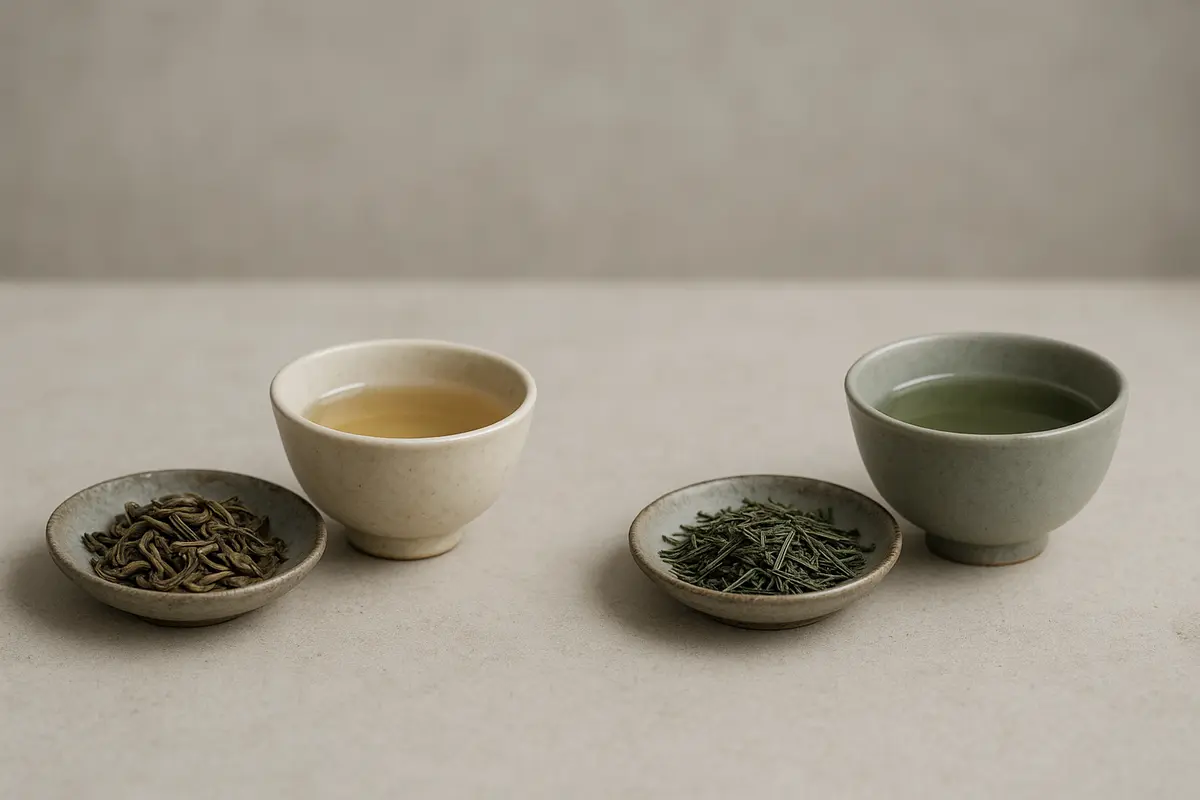
The number one reason people say they don’t like green tea is that they’ve brewed it with boiling water. This isn’t a minor issue — it fundamentally changes the chemistry of what’s in the cup.
Green tea leaves contain two main flavor compound groups in tension: L-theanine and amino acids (sweet, umami, smooth) and catechins/polyphenols (bitter, astringent). These compounds extract at different rates and temperatures. At high temperatures, catechins extract aggressively. At lower temperatures, the amino acids and sweeter compounds dominate.
Put simply: boiling water makes green tea taste like medicine. Correct temperature makes it taste like the reason people have been drinking this stuff for 1,500 years.
Temperature Reference by Style
| Tea | Water Temp (°C) | Leaf:Water Ratio | First Steep Time |
|---|---|---|---|
| Gyokuro | 55–65°C | 5g / 70ml | 90–120 sec |
| Matcha | 70–75°C | 2g / 60ml | N/A (whisked) |
| Sencha | 70–75°C | 3g / 100ml | 60 sec |
| Bi Luo Chun | 75–80°C | 3g / 100ml | 45–60 sec |
| Longjing | 78–80°C | 3–4g / 100ml | 60–75 sec |
| Mao Feng | 75–80°C | 3g / 100ml | 60–90 sec |
The easiest way to hit lower temperatures without a thermometer: boil your water, pour it into your empty brewing vessel, let it sit 2–3 minutes, then add leaf. Each transfer and minute of sitting drops temperature roughly 5–10°C depending on your vessel and ambient temperature.
A variable-temperature kettle is a better long-term investment if you brew green tea regularly. I use one daily.
Comparison Table: Major Green Tea Types
| Tea | Origin | Sha Qing Method | Flavor Profile | Brew Temp | Caffeine (approx.) |
|---|---|---|---|---|---|
| Longjing | Zhejiang, China | Pan-fired | Chestnut, sweet pea, toasty | 78–80°C | 25–35 mg/cup |
| Bi Luo Chun | Jiangsu, China | Pan-fired | Floral, fruity, delicate | 75–80°C | 25–35 mg/cup |
| Mao Feng | Anhui, China | Light pan-fired | Orchid, fresh, clean | 75–80°C | 25–35 mg/cup |
| Sencha | Japan (various) | Steamed | Grass, vegetal, mineral | 70–75°C | 25–40 mg/cup |
| Gyokuro | Japan (Uji, Yame) | Steamed | Marine, umami, creamy sweet | 55–65°C | 35–50 mg/cup |
| Matcha | Japan (Uji, Nishio) | Steamed (powder) | Rich umami, grass, bright | 70–75°C | 50–70 mg/serving |
Caffeine figures are approximate per standard serving and vary significantly by harvest, terroir, and brew parameters. Shade-grown teas (gyokuro, matcha) consistently sit at the high end because shading increases amino acid and caffeine production.
What Actually Matters When Buying Green Tea
Freshness Over Everything
Green tea is the most perishable tea category. The volatile aromatic compounds that make a good Longjing or sencha distinctive — the fresh grass, the delicate floral notes, the clean sweetness — begin degrading the moment the leaf is processed. Heat, light, oxygen, and moisture all accelerate this.
A Longjing from the current spring harvest, stored in a sealed, refrigerated foil bag, will taste more alive than last year’s material from the same farm, full stop. When buying Chinese greens, pre-Qingming (明前, before the Qingming Festival around April 5) and pre-Guyu (雨前, before the Grain Rain around April 20) designations indicate first and second flush, respectively. These early harvests command premium prices for good reason.
For Japanese greens, shincha (新茶) — first flush of the year — arrives in late April to May and is similarly prized.
Where the Tea Comes From
Terroir matters in green tea as much as it does in wine. The specific microclimate, elevation, soil type, and even neighboring plants in Longjing’s Xi Hu (西湖) growing area produce a tea that authorized growers elsewhere in Zhejiang cannot replicate, even using the same cultivar and processing technique. The designation “Xi Hu Longjing” (西湖龙井) is geographically protected in China for this reason.
For Japanese teas, Uji (宇治) in Kyoto prefecture is the prestige region for gyokuro and matcha; Shizuoka produces the majority of sencha volume. Yame in Fukuoka is the other major gyokuro production area.
This doesn’t mean non-origin tea is bad — it means you should know what you’re buying. A “Dragon Well style” tea from Sichuan might be excellent and excellent value. It won’t be the same thing as Xi Hu Longjing, and it shouldn’t be priced as if it were.
Processing Transparency
Good vendors tell you harvest date, harvest location, cultivar if relevant, and processing method. If a vendor can’t tell you when their sencha was harvested, that’s information — probably that it’s blended production tea with an uncertain supply chain.
A Note on Health Claims
I’m going to be direct here: the internet is full of exaggerated claims about green tea and health. The research on green tea catechins, particularly EGCG (epigallocatechin gallate), is real but often overinterpreted. Studies showing effects are frequently based on concentrated extracts, not cups of tea.
What I can say with confidence: green tea contains meaningful amounts of L-theanine, which in combination with caffeine produces a distinctively smooth, calm alertness that many people experience as different from coffee. This is well-documented and is a genuine reason to choose green tea if that quality of alertness matters to you.
The antioxidant activity is real. Whether it translates to specific health outcomes at the concentrations you get from drinking tea is a different question, and one where the evidence is weaker than popular coverage suggests. Drink it because it tastes good.
How to Start Exploring Green Tea
If you’re new to the category, I’d suggest this sequence:
-
Start with Chinese pan-fired — a Longjing or Mao Feng brewed at 78–80°C. This will likely be less confrontational than Japanese greens for someone accustomed to black tea or coffee.
-
Try a Japanese sencha — same temperature range, but notice how different the flavor profile is: grassier, more vegetal, a different kind of clean.
-
Taste gyokuro — drop to 60°C and experience what shade-growing and correct temperature do to astringency. If you’ve only drunk gyokuro from a tea bag in hot water, you’ve never tasted gyokuro.
-
Explore matcha — as a whisked bowl, not a latte. The point is the bowl.
-
Go back to the beginning — at this point, you’ll taste the Chinese pan-fired green completely differently, noticing what it doesn’t have (the marine quality, the heavy umami) and what makes it distinct (the warmth, the chestnut, the lightness).
The comparison is the education.