Longjing tea (龙井, Lóngjǐng) is the tea that other Chinese teas get compared to. It has been served to foreign dignitaries, praised by emperors, and drunk every morning by office workers across eastern China for centuries. It is simultaneously the most prestigious and most imitated green tea in the world — and that duality tells you almost everything you need to know about why it matters.
I have been working through a sample of Longjing from a specialist tea shop in Bangkok, which prompted me to write the comprehensive guide I wished existed when I first encountered this tea. What follows is a complete picture: the terroir, the processing, the harvest grades, how to identify authentic West Lake Longjing, and how to brew it in a way that does justice to the leaf.
What Is Longjing Tea?
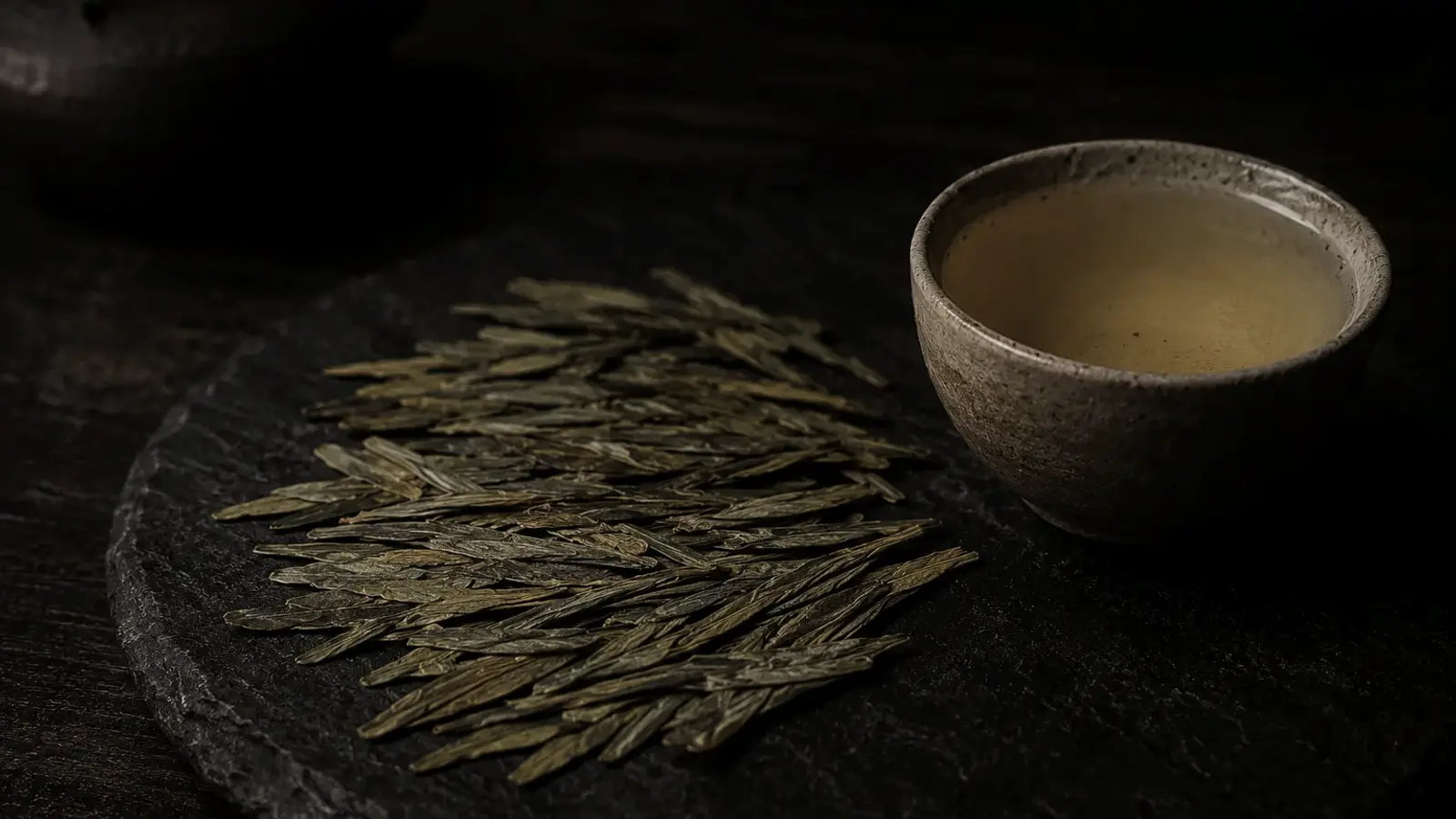
Longjing, literally translated as “Dragon Well,” is a pan-fired Chinese green tea (綠茶, lǜchá) produced primarily in the West Lake (西湖, Xī Hú) area of Hangzhou, Zhejiang province. Its most recognizable characteristic is the flat, smooth, needle-like leaf — a shape achieved entirely by hand during processing, not by any machine. The flavor is sweet and nutty, clean without bitterness when properly made, and the liquor runs pale gold to light green.
The name comes from a well in the hills near West Lake, which according to local legend connected to the sea, explaining why the water inside moved as though it were breathing. Whether the story is literal or not, the geography is entirely real: the hillside microclimate around West Lake produces a leaf that nowhere else can truly replicate.
The Terroir Question: Why “West Lake” Matters
This is where Longjing gets complicated — and where the wine parallel becomes genuinely useful.
Think of Longjing the way you think about Champagne. Champagne is a specific place in France, and the method of making sparkling wine developed there. Plenty of other regions produce excellent sparkling wines using the same method, but only wine from that specific appellation can legally be called Champagne. Everything else, however good, is just sparkling wine.
Longjing works almost identically.
Xi Hu Chan Qu — The Core Zone
The West Lake production area (西湖产区, Xī Hú Chǎnqū) is the smallest, most protected, and most historically significant Longjing zone. It is geographically tiny. The combination of the lake’s moderating influence on temperature, the specific mineral composition of the hillside soils, and centuries of cultivated tea trees produces a leaf character that even skilled producers a few kilometers away cannot exactly reproduce.
Genuine Xi Hu Longjing commands prices that can be startling. For Ming Qian grade (more on this below), you are looking at prices that make good Burgundy seem accessible. A significant portion of what is sold as “West Lake Longjing” internationally is not from the core production area.
Qiantang Longjing
Broader Zhejiang province production is officially designated as Qiantang Longjing (钱塘龙井, Qiántáng Lóngjǐng). This is legitimate, labeled Longjing, grown in the same province using the same processing techniques — and it is significantly less expensive. Much of what you will find outside China labeled as Longjing is Qiantang-origin material. It is not a fraud. It is simply not the same thing.
Provincial Longjing-Style Teas
Longjing-style flat-leaf green teas are also produced in provinces including Sichuan and Guizhou. These are sometimes sold under confusingly similar names. They are not Longjing — full stop. The flavor profile often diverges noticeably from Zhejiang production: more grassy, sometimes more astringent, lacking the characteristic chestnut sweetness.
If you care about provenance, ask your vendor specifically whether the tea is Zhejiang-origin and, if you are paying a premium, whether it is verifiably from the Xi Hu protected zone.
How Longjing Is Processed
The flat shape of Longjing is not an accident of the plant — it is the result of one of the most labor-intensive hand-processing techniques in Chinese tea production.
The Wok-Firing Method
After harvest, fresh leaves are withered briefly to reduce moisture content, then a skilled tea worker fires them in a hot wok (traditionally iron, now sometimes stainless) using their bare hands. The process involves ten distinct hand movements — pressing, rolling, shaking, flattening — applied repeatedly as the temperature of the wok is carefully managed.
The pressing motion against the wok surface is what produces the signature flat profile. The direct hand contact is also what makes this genuinely impressive to watch: the hands move fast, make contact with a surface that would blister unprepared skin, and must maintain exactly the right pressure to shape the leaf without scorching it.
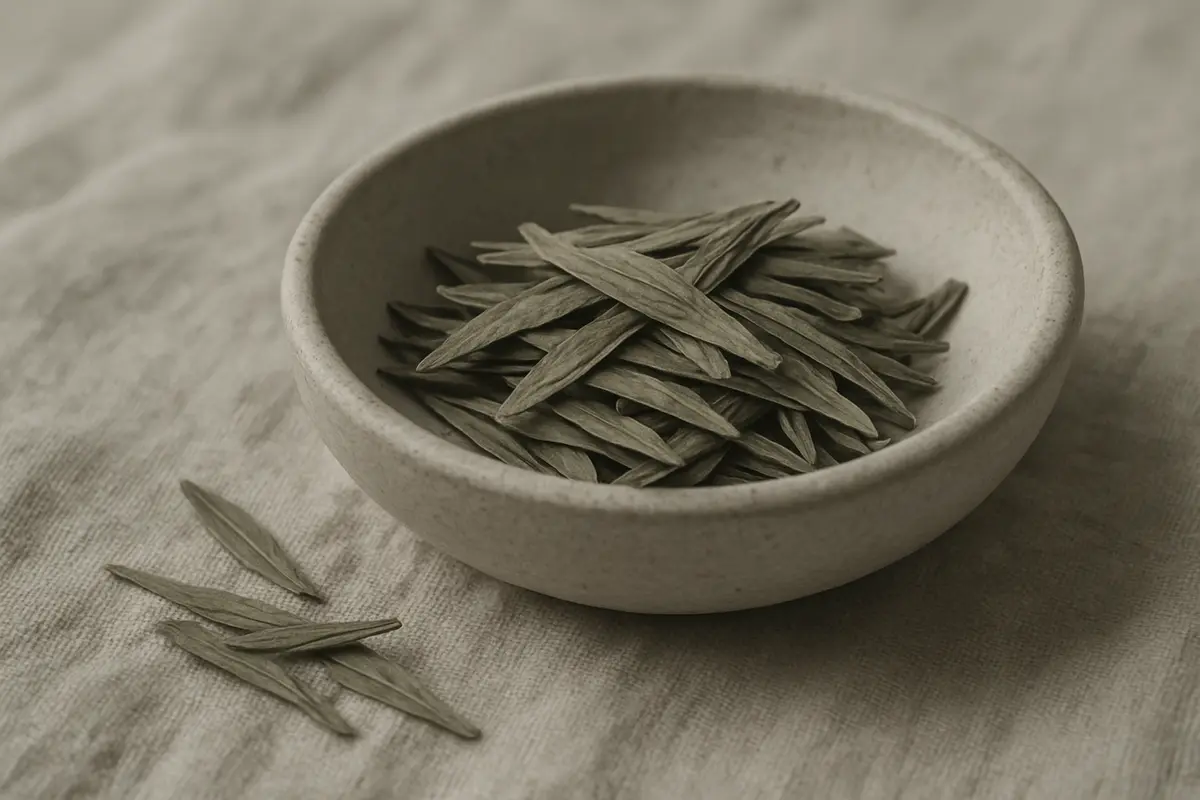
The result of successful firing is a leaf that is flat, smooth, slightly glossy, and deep jade to yellowish-green in color. Good Longjing leaves are uniform. Irregular, broken, or rough-textured leaves are a sign of either lower-grade material or mechanical processing.
Why Processing Grade Matters
Machine-processed Longjing exists and dominates the mid- and lower-market. The wok-firing technique creates a slightly more nuanced roast note in the final cup — a depth that mechanical processing tends to flatten out. If you have only ever had commodity-grade Longjing, you may not recognize what hand-processed material tastes like. The gap is real.
Harvest Grades: The Ming Qian Hierarchy
In Longjing, when the tea is picked matters at least as much as where it is grown. The Chinese harvest calendar structures this with precision.
Ming Qian (明前) — Before Qingming
Ming Qian (明前, Míng Qián) translates as “before Qingming,” the Chinese solar term that falls around April 5. These are the earliest leaves of the spring harvest, picked before the festival when the plants have grown slowly through cool late-winter temperatures.
The result is tiny, bud-dominant material with the highest sugar concentration and the lowest bitterness. The flavor is intensely sweet, delicate, and almost ethereal — this is the grade that earns the high prices and fills the gift boxes. Production volume is strictly limited by biology: the plants can only push so many early buds in the cold.
If you are buying Ming Qian Longjing, you should expect to pay significantly more per gram than for later harvests. Prices vary substantially by origin and vendor, but genuine Xi Hu Ming Qian at wholesale is expensive before it even reaches a retail customer outside China.
Yu Qian (雨前) — Before Grain Rain
Yu Qian (雨前, Yǔ Qián) means “before Grain Rain,” the solar term around April 20. These leaves are somewhat larger than Ming Qian material, include more opened leaf alongside buds, and develop a fuller body in the cup.
This is where serious value lives. Yu Qian Longjing has real complexity — the chestnut nuttiness is more pronounced, the body is satisfying, and the price is a fraction of Ming Qian. For everyday drinking, this is the grade I return to most often. It rewards careful brewing without demanding the reverence (and budget) of top-tier Ming Qian.
Post-Yu Qian
Material harvested after the Grain Rain period is broader leaf, sometimes with more astringency, and is the everyday commodity grade. It is not without merit — well-made post-Yu Qian Longjing is a decent daily cup — but the character that makes this tea famous is much harder to find in later harvests.
| Grade | Harvest Window | Leaf Character | Flavor Profile | Relative Price |
|---|---|---|---|---|
| Ming Qian (明前) | Before ~April 5 | Tiny buds, very uniform | Intensely sweet, delicate, minimal bitterness | Highest |
| Yu Qian (雨前) | April 5–20 | Buds + small open leaves | Nutty, fuller body, clean | Mid-range |
| Post-Yu Qian | After ~April 20 | Broader leaves | More vegetal, can be slightly astringent | Lowest |
What Longjing Tea Tastes Like
When I brewed this Longjing in a tall glass at 78°C, the first thing I noticed was the color of the liquor: pale gold with a greenish edge, transparent and clean. The aroma off the wet leaf was fresh-cut grass and something warmer underneath — roasted chestnut, faint and sweet.
The first sip confirmed what good Longjing does: no bitterness at all. The sweetness is upfront and rounded, not sharp. The chestnut quality is real, not a metaphor someone invented — there is a specific warm nuttiness that I have not found in any other green tea. The finish is clean, the aftertaste (回甘, huígān) mild but pleasant, a gentle sweetness that lingers.
The second infusion was where I found most satisfaction. The flavor deepens slightly, the grassiness becomes a little more present, and the overall character feels more settled. By the third pour the sweetness was fading but the warmth held.
The hallmark of well-brewed Longjing is exactly this: rounded sweetness without bitterness, a fresh vegetal quality that never becomes harsh, and a finish clean enough that you want the next cup immediately.
How to Brew Longjing Tea
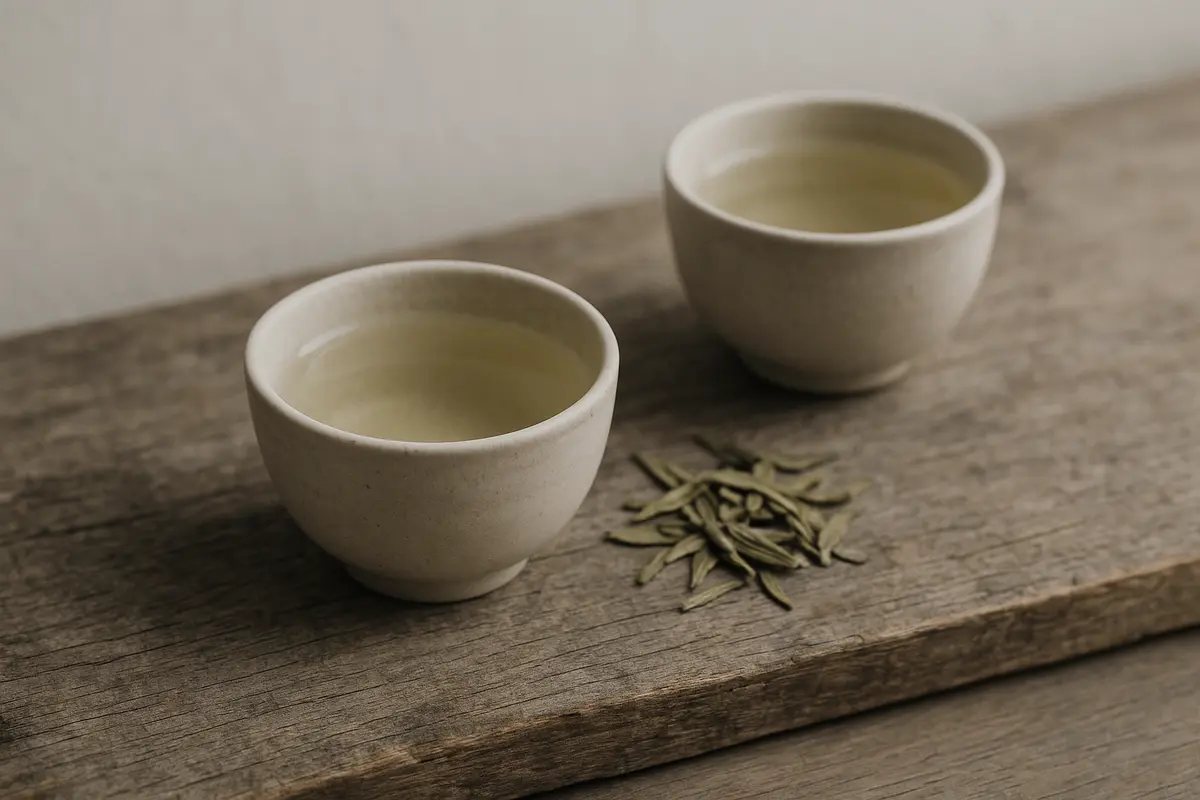
Brewing longjing correctly requires attention to water temperature above all else. This is not an optional refinement — using boiling water on Longjing damages the leaf and produces bitterness that cannot be corrected.
Parameters
- Water temperature: 75–80°C. I use 78°C as my default. If you do not have a temperature-controlled kettle, boil water and let it rest in the kettle for 8–10 minutes or transfer to a cool pitcher first.
- Leaf quantity: 2–3g per 150ml water. Longjing is a tea where less leaf often performs better than more — err light your first session.
- Vessel: A tall glass (高水杯, gāo shuǐ bēi) is traditional and functional. A gaiwan (蓋碗) works well too and gives you more control over steep time.
- First steep: 60–90 seconds.
- Subsequent steeps: Increase by 20–30 seconds each time. Good Longjing delivers 3–4 quality infusions; Ming Qian material can go further.
The Leaf-Standing Phenomenon
One of the pleasures of brewing Longjing in a glass is watching what happens to the leaves. When the water temperature is right and the leaf quality is high, the flat needle-like leaves will slowly orient themselves vertically in the cup, many standing upright from the bottom. This is partly a surface tension and density effect, partly dependent on the precision of the flat shape from processing. It is not just aesthetically pleasing — a cup full of upright-standing leaves is a good sign you have quality material and correct temperature.
Top-Casting vs. Bottom-Casting
There are two traditional methods for adding leaf and water to the glass:
Bottom-casting (下投法, xià tóu fǎ): Add leaves first, then pour water. This is the standard approach and works reliably for most Longjing.
Top-casting (上投法, shàng tóu fǎ): Fill the glass with water first, then float the leaves in from the top. This is occasionally recommended for very delicate Ming Qian buds where even moderate water agitation might bruise them. The leaves slowly sink and hydrate from above. It requires very even water temperature.
I use bottom-casting for daily brewing and top-casting when I am working through something particularly fine and want to slow the whole process down.
What Not to Do
- Do not use boiling water. This is the most common mistake and produces a bitter, flat cup.
- Do not overfill the glass. The leaves need space to move and fully hydrate.
- Do not cover a glass during brewing — the trapped steam raises effective temperature and can overheat the leaf.
How to Identify Genuine Longjing
Counterfeiting and mislabeling are endemic in the Longjing market. Here is what I look for:
Leaf appearance: Flat, smooth, slightly lustrous. Both sides of the leaf should be flat, not just one. The color should be a deep jade green or yellowish-green depending on roast level — not brown, not dull grey-green.
Uniformity: Higher grades are strikingly uniform in leaf size. Significant variation in a “Ming Qian” lot is a red flag.
Aroma dry: Clean chestnut nuttiness with green freshness. If it smells generic or grassy without the warm nut note, temper your expectations.
Liquor color: Pale gold to light green, clear and bright. Cloudiness suggests age or poor processing.
Price realism: Authentic Xi Hu Ming Qian Longjing at any credible vendor is expensive. If something is labeled premium Xi Hu Ming Qian and priced at commodity levels, it is almost certainly not what it claims to be.
Origin documentation: Reputable vendors will be able to tell you specifically where their Longjing originates — Xi Hu, Qiantang, or a specific village within those zones. Vague answers (“Hangzhou area,” “Zhejiang province”) are worth following up on.
Longjing in Context: Its Place in Chinese Tea Culture
Longjing’s prestige dates at least to the Tang dynasty, and the Song dynasty poet Su Dongpo wrote about the teas of the West Lake area. The Qing Emperor Qianlong famously visited the Hu Gong Temple tea gardens near West Lake in the 18th century and was so impressed that he designated eighteen tea trees there as imperial tribute trees — a designation that still exists today, and whose annual harvest is ceremonially auctioned at prices that function more as theater than commerce.
This history matters beyond tourism because it explains why the identity of the tea is so carefully guarded. The geographic indication protections for West Lake Longjing are legally significant in China, though enforcement in export markets remains uneven.
Longjing is also deeply embedded in Hangzhou’s civic identity. The city produces it, celebrates it, and builds considerable tourism infrastructure around it. The tea gardens adjacent to West Lake are genuine working farms, not recreations — walking through them in early April during harvest is one of the better tea experiences available to a visitor with an interest in terroir and where the leaf comes from.
Buying Longjing: Practical Notes
For buyers outside China, a few practical observations:
Domestic Chinese specialty shops often carry the most authentic material if you have access to one. Pricing will still be lower than imported retail.
Specialty tea vendors in Western markets who source directly from Zhejiang can be reliable. Look for vendors who specify harvest date and origin with precision.
Online platforms vary enormously. Generic marketplace listings claiming “premium West Lake Ming Qian Longjing” at $5 per 100g are not credible — do the math.
Seasonal purchasing matters. Longjing is a fresh-harvest tea. Buying during the spring following harvest (April–June) gives you the freshest material. Longjing does not age beneficially the way pu-erh (普洱, pǔ’ěr) does — consume within 12 months of harvest and store sealed in the refrigerator if you plan to hold it for more than a few months.
Storage
Store Longjing in an airtight, opaque container away from heat, light, and strong odors. The refrigerator works well if you seal the container thoroughly — condensation contamination from poor sealing is a real risk. Many producers in Hangzhou store Longjing in traditional lime-lined containers that absorb moisture; the home equivalent is simply good vacuum-sealed storage.
Do not store Longjing near pu-erh or heavily aromatic teas. Green tea absorbs odors readily.