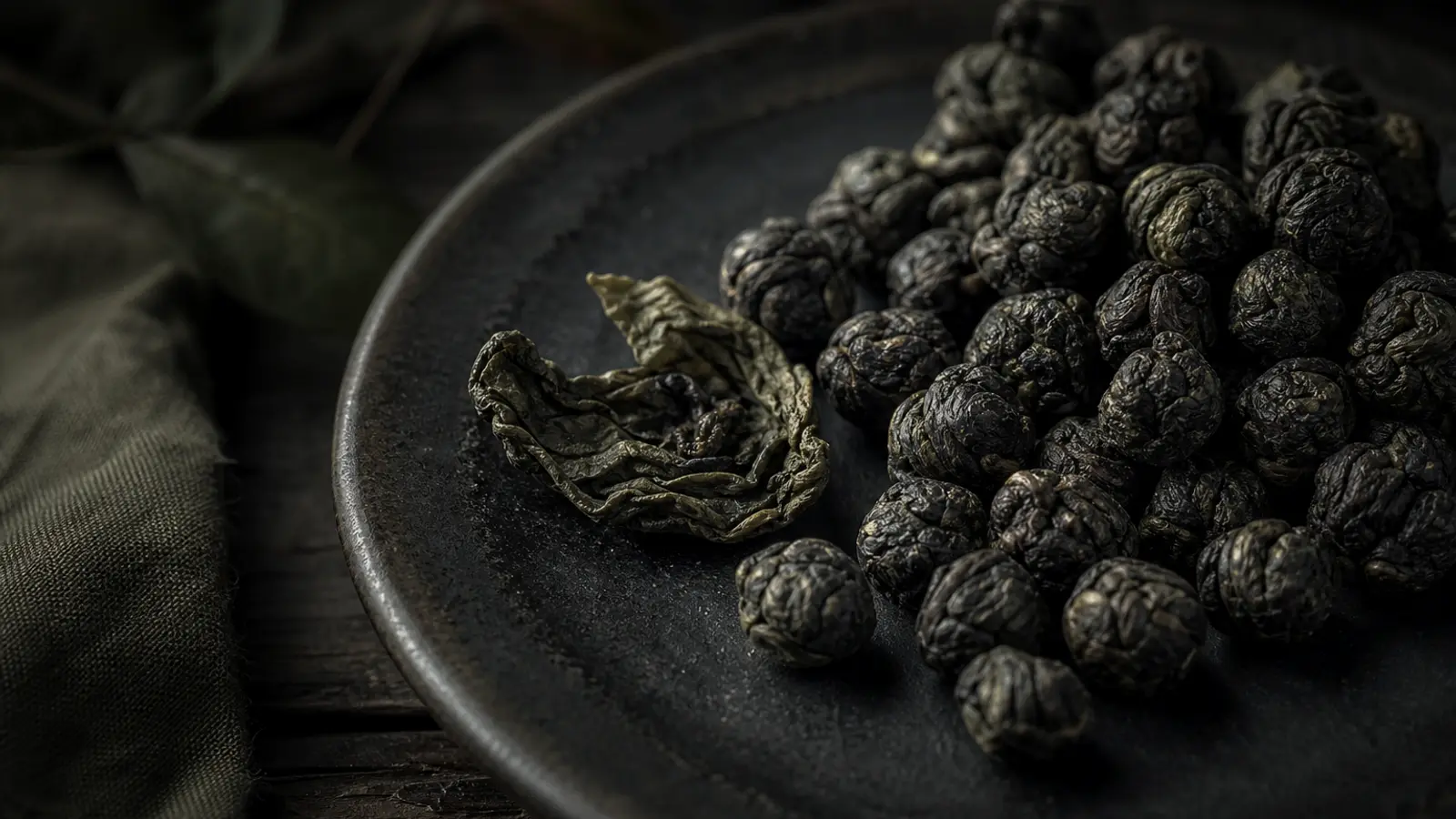
What Defines How Taiwanese Oolong Is Made
Taiwanese oolong production is defined by two techniques that distinguish it from its Chinese mainland counterparts: ball-rolling (揉捻 róuniǎn) — compressing withered leaves into tight spherical pellets — and a philosophy of minimal roasting that preserves rather than transforms the leaf’s natural character. Where Wuyi yancha makers coax stone-mineral depth through heavy charcoal roasting, and Anxi producers chase a middle path, Taiwanese tea makers tend toward restraint. The leaf speaks first. The maker stewards.
Understanding how Taiwanese oolong is made means following a single batch of leaves through 36–72 hours of continuous decision-making. Every step — from the angle of afternoon sun during withering to the twentieth round of ball-rolling — compounds. There are no shortcuts, and no step exists in isolation.
Sun Withering: The First Hours
Freshly picked leaves arrive at the processing facility with moisture content around 75–80%. The first task is reduction. Leaves are spread in thin layers under direct sunlight for sun withering (日光萎凋 rìguāng wēidiāo), typically lasting 1–3 hours depending on ambient temperature, humidity, and cloud cover.
Sun withering accomplishes two things simultaneously. It drives off surface moisture, making the leaves pliable enough for later handling. And it initiates early chemical changes — chlorophyll begins to degrade, and the leaf’s cellular structure starts to soften. The tea maker monitors the leaves by touch and scent, looking for a slight limpness and a clean vegetal aroma that has lost its raw, grassy sharpness.
After sun withering, the leaves move indoors for further moisture reduction in a controlled environment. This indoor withering phase can last several additional hours, and it sets the stage for the most consequential step in the entire process.
Oxidation Through Tossing: Reading the Leaf
During indoor withering, the leaves are gently tossed in a technique called langqing (浪菁 làngqīng). The tea maker — sometimes by hand on large bamboo trays, sometimes in a rotating bamboo drum — tumbles the leaves to bruise their edges. Each toss damages cell walls along the leaf margins, exposing enzymes to oxygen and initiating oxidation.
This is where taiwan oolong processing diverges most sharply from green tea (no oxidation) and black tea (full oxidation). For high mountain oolong (高山茶 gāoshān chá), oxidation is kept deliberately light — typically 15–25%. That narrow window is enough to develop complexity without overriding the floral-creamy character that high elevation leaves carry naturally.
The tea maker judges oxidation entirely by aroma. Between tossing rounds, leaves rest. The maker returns, lifts a handful, and inhales. The signal to proceed to kill-green arrives when the bruised leaf edges emit a fruity-floral scent — no longer grassy (under-oxidized) and not yet caramelized (over-oxidized). This judgment call, made in seconds, determines the character of the finished tea. There is no instrument for it. Experience is the only tool.
Kill-Green: Stopping the Clock
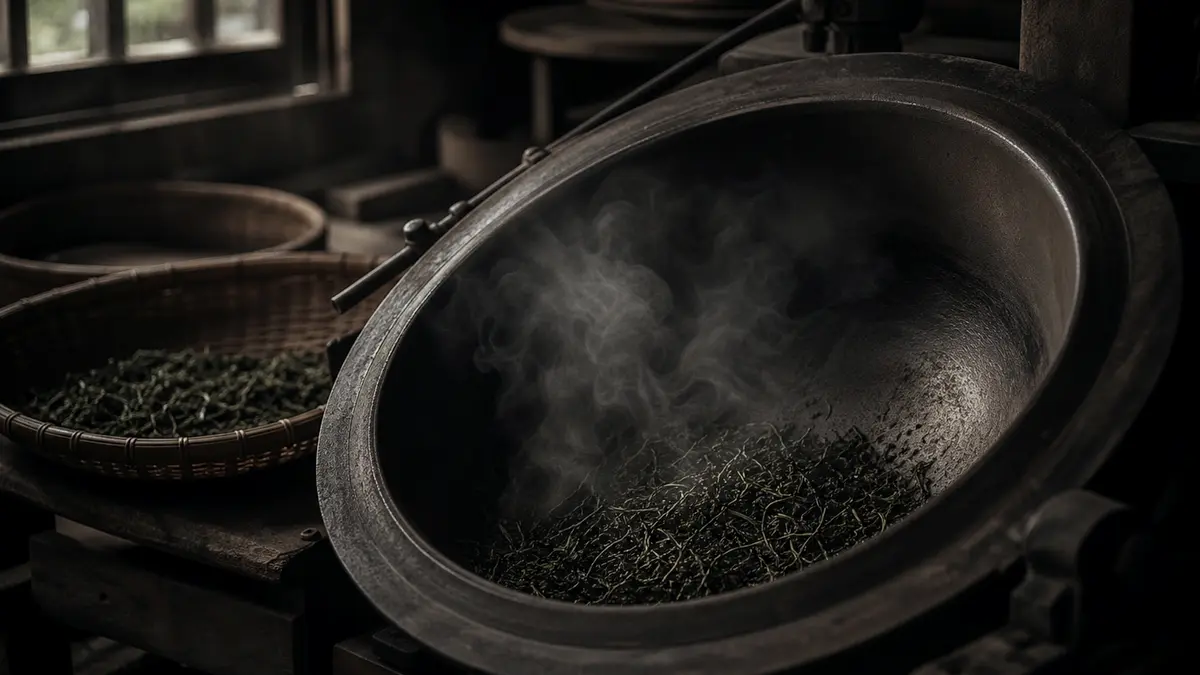
Once the maker reads the oxidation as correct, kill-green (殺菁 shāqīng) is applied immediately. In Taiwanese production, this means tumbling the leaves in a heated rotating drum at 250–300°C for 5–10 minutes. The high heat denatures the polyphenol oxidase enzymes, halting oxidation where it stands.
Taiwanese kill-green occupies a specific position on the processing spectrum. It is more thorough than pu-erh kill-green, which deliberately preserves some enzymatic activity to allow aging. But it is less aggressive than Japanese steaming, which blankets the leaf in steam to preserve chlorophyll and lock in green character. The Taiwanese goal sits between: stop oxidation cleanly while retaining the volatile aromatic compounds that developed during the tossing phase.
A poorly executed kill-green — too brief, too cool — leaves residual enzyme activity that causes the tea to degrade in storage. Too aggressive, and you burn off the delicate florals you spent hours developing. The maker is walking a narrow path.
Ball-Rolling: The Signature Taiwanese Technique
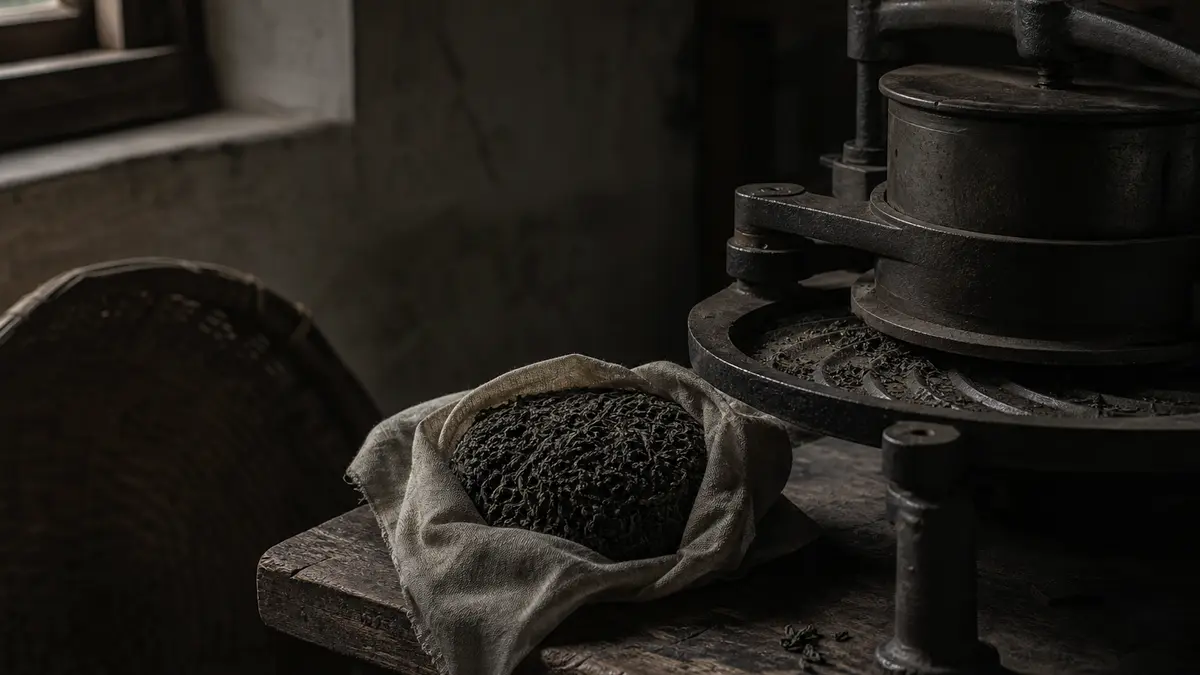
Here is where ball-rolled oolong earns its name and its form. After kill-green, the warm, pliable leaves are gathered into a large cloth bag — typically cotton or a durable synthetic weave — and the bag is cinched tight. A mechanical rolling machine then compresses and rotates the cloth bundle, squeezing the leaves against each other inside.
This is ball-rolling (布揉 bùróu), and it is the most physically demanding and time-consuming step in the entire process. Each round of compression breaks cell walls, releases internal juices that coat the leaf surface, and incrementally tightens the leaf mass into a denser sphere. After each round, the cloth is opened, the compressed mass is broken apart by hand, and the leaves are re-gathered for the next round.
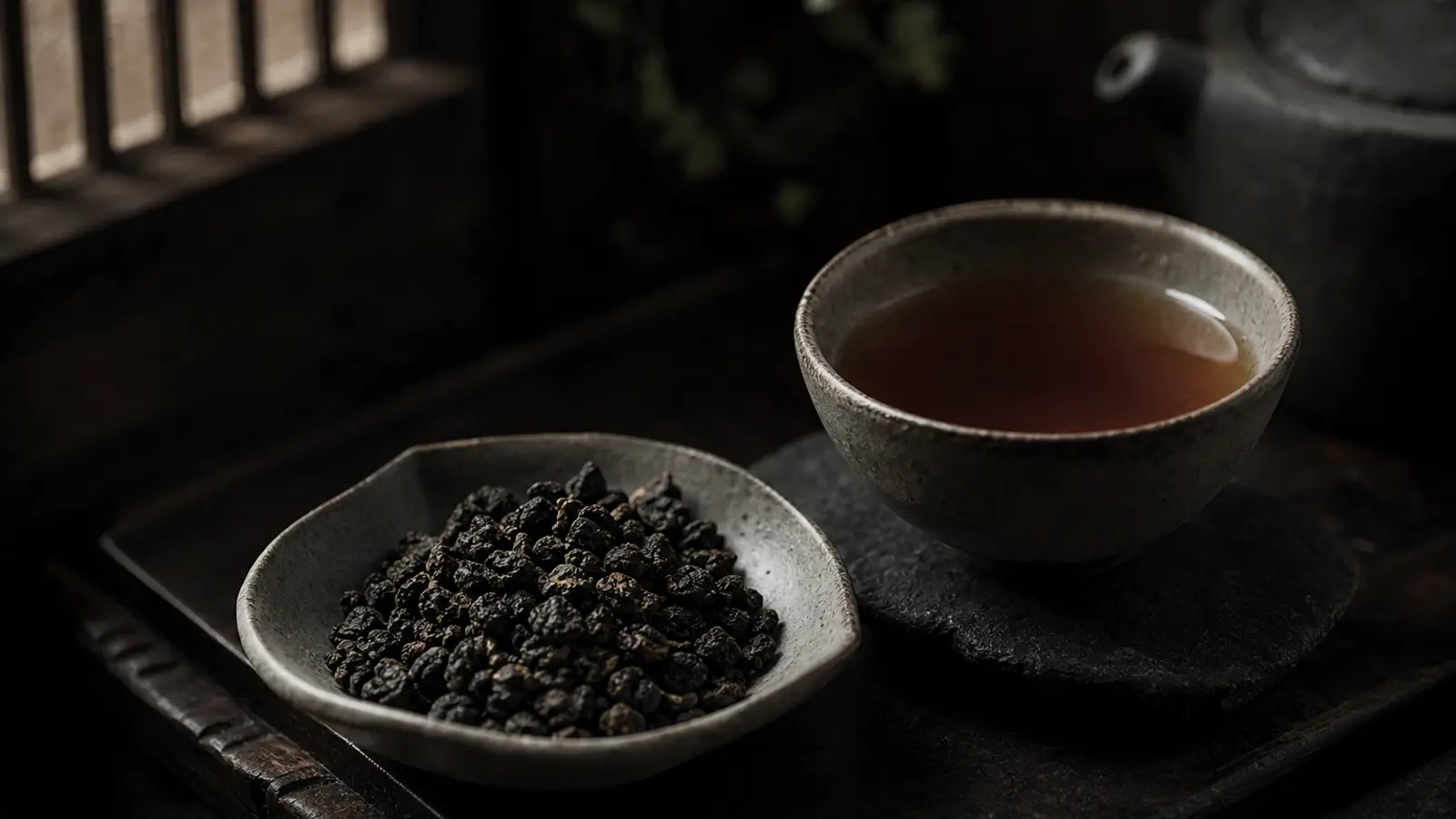
This cycle repeats 20–40 times over several hours. Early rounds are relatively loose — the leaves are still bulky and springy. By the final rounds, the leaves have compressed into the tight, spherical pellets that are the visual hallmark of Taiwanese oolong.
The tight compression serves two distinct purposes:
- Shape: It creates the characteristic pellet form. A well-rolled high mountain oolong pellet is tight enough to feel dense between your fingers, with no loose stems protruding.
- Extraction control: The pellet unfurls slowly during brewing, releasing aromatic and flavor compounds gradually across many steeps rather than dumping everything into the first infusion. This is why ball-rolled oolongs are natural candidates for gongfu brewing (功夫泡 gōngfū pào) — their architecture rewards patience.
The number of rolling rounds directly affects the finished tea. Fewer rounds produce a looser pellet that opens quickly and may deliver more immediate intensity but less stamina across steeps. More rounds create a tighter pellet with slower extraction and longer session life. The maker calibrates based on the leaf material and the intended style.
Drying: Locking In Stability
After ball-rolling, the shaped leaves still carry too much moisture for stable storage. They enter heated tumble dryers that reduce moisture content to below 5% — the threshold for shelf stability without refrigeration.
This drying step is functional, not transformative. The goal is preservation, not flavor development. Temperature and duration are calibrated to remove water without adding roast character. For high mountain oolongs destined for the floral-transparent style, this is often the final processing step. Some receive a very light finish roasting (焙火 bèihuǒ) purely for stability, but the intent is to keep the roast influence invisible in the cup.
Oolong Tea Roasting: The Production Fork
Here is where Taiwanese tea production splits into two philosophically distinct paths.
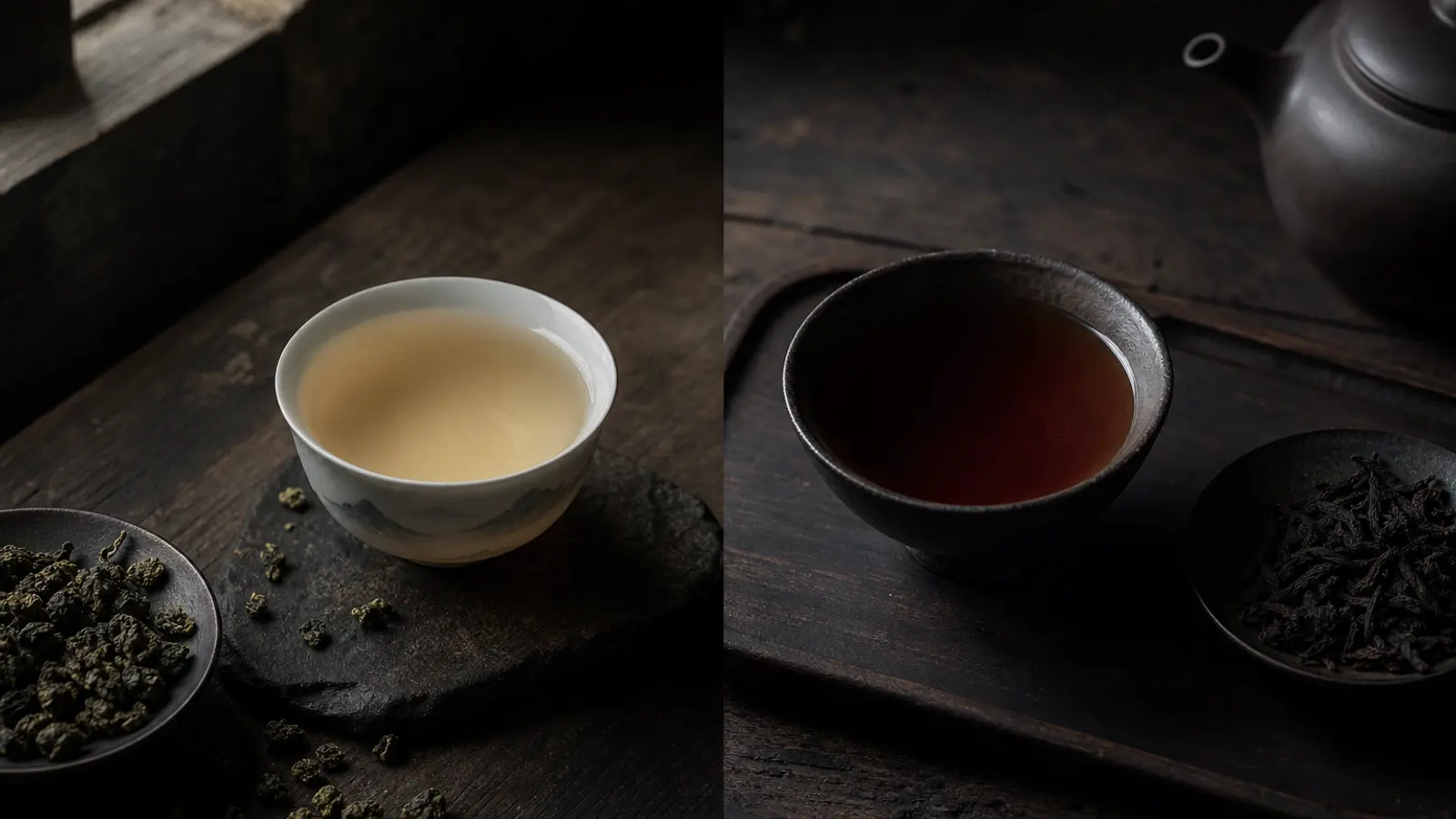
High mountain style skips or minimizes roasting. The finished tea tastes of the leaf itself — floral, creamy, sometimes buttery, with a clean sweetness. The processing is transparent. You taste terroir and cultivar, not technique.
Traditional roasted style — exemplified by Dong Ding oolong (凍頂烏龍 Dòngdǐng Wūlóng) — embraces roasting as a deliberate flavor tool. After initial drying, the tea undergoes multiple roasting sessions in bamboo basket dryers over charcoal or in temperature-controlled electric ovens. A traditional Dong Ding may receive 3–5 separate roasting sessions, each adding layers of caramel, toasted grain, dried longan, and a warming depth that sits underneath the oxidation-derived fruit and floral notes.
Roasting is not the opposite of quality. It is a different expression of craft. A skilled roast master works in the same way a skilled cooper works with wine barrels — the oak (or the roast) should integrate with the base material, not dominate it. When roasting is heavy-handed, you taste only char and grain. When it is precise, the roast becomes a structural element that supports the tea’s natural character and extends its shelf life significantly.
| Characteristic | High Mountain Style | Traditional Roasted Style (Dong Ding) |
|---|---|---|
| Oxidation level | 15–25% | 25–40% |
| Roasting | None to very light | 3–5 sessions, medium to heavy |
| Dominant flavors | Floral, creamy, buttery | Caramel, toasted grain, dried fruit |
| Color in cup | Pale gold to light green | Amber to deep gold |
| Shelf life (unrefrigerated) | 6–12 months optimal | 2+ years, improves with re-roasting |
| Best brewing approach | Gaiwan (蓋碗) at 90–95°C | Gaiwan or clay pot at 95–100°C |
The Craft Dimension: 36–72 Hours of Attention
From the moment leaves are plucked to the moment the finished tea cools after its final drying or roasting, taiwanese tea production demands 36–72 hours of nearly continuous attention. The tea maker sleeps in snatches during indoor withering. The ball-rolling phase alone can run 6–8 hours. Kill-green timing is measured in minutes and judged in seconds.
At every step, the maker faces a judgment call: When has the sun withering gone far enough? When does the langqing aroma signal readiness for kill-green? How many ball-rolling rounds does this particular batch need? Should the finished tea receive any roast at all?
The wine parallel I return to most often is Burgundy. A great Burgundy producer does not impose a style on Pinot Noir — they listen to what the vineyard and the vintage give them, then steward the fruit through fermentation and aging with as little interference as possible. Taiwanese high mountain oolong production operates on the same principle. The maker’s skill is measured not by what they add, but by how precisely they read what the leaf is telling them at each stage.
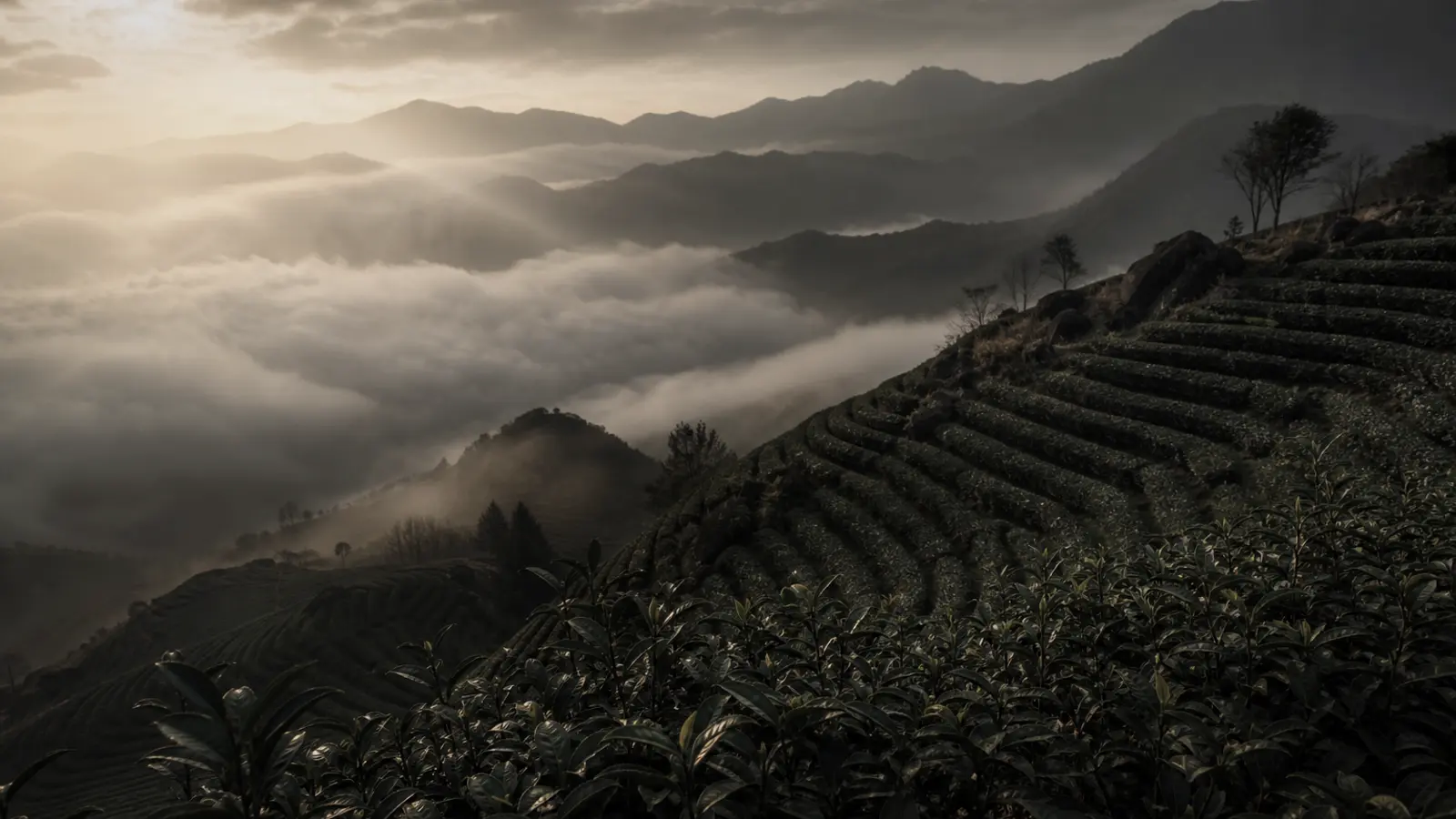
This is the art of restraint. Not passivity — every step requires active, skilled intervention. But the intervention serves the raw material rather than overriding it. The best Taiwanese oolongs taste like a place, a season, a specific afternoon’s sunlight on a specific mountain. The processing makes that possible without making itself the subject.
What to Notice When You Brew
Understanding how Taiwanese oolong is made changes how you taste it. When you drop a few grams of ball-rolled oolong into a gaiwan and watch the pellets slowly unfurl across the first three steeps, you are watching the ball-rolling process reverse itself. The tight compression is releasing. The compounds that coated the leaf surface during rolling are dissolving first. The interior of the leaf opens later.
Pay attention to how the tea changes across steeps. A well-made high mountain oolong should evolve — lighter florals first, then a creamy body in the mid-steeps, then a clean, sweet finish as the leaf fully opens. That arc is a direct consequence of the processing architecture: the oxidation level, the number of rolling rounds, and the absence of roast all contribute to how the flavor unfolds over time.
If you taste toasted grain or caramel in a tea labeled “high mountain oolong,” that is roast. It is not necessarily a flaw — some producers apply light roast for stability — but it tells you something about what happened after the ball-rolling. You are tasting a processing decision.
The leaf tells the whole story. You just need to know how to read it.