Tea iron absorption is one of the most replicated findings in nutrition science, and the practical rule it produces is one of the simplest: don’t drink tea with meals. One sentence. If you take nothing else from this article, take that.
Everything below is the evidence behind it, the nuance around it, and the guidance for people who need to be most careful.
What Tannins Do to Iron in Your Body
Tannins (單寧, dānnìng) are polyphenolic compounds present in all true tea — green, white, oolong, black, sheng and shou puerh. When you drink tea at or near meal time, tannins bind non-heme iron in your digestive tract and form insoluble complexes the body cannot absorb.
The magnitude is significant. Multiple studies show tea consumed simultaneously with a non-heme iron meal can reduce absorption by 62–87%. That’s not a marginal effect. That’s the difference between a meal contributing to your iron stores and contributing almost nothing.
Non-heme iron is the form found in:
- Spinach, lentils, beans, tofu, and other plant foods
- Eggs
- Fortified cereals and breads
- Iron supplements (ferrous sulfate and similar)
Heme iron — from red meat, poultry, and fish — has a different absorption pathway and is far less affected by tannins. A grilled steak with tea is metabolically different from a lentil bowl with tea. The plant meal with tea is the problem scenario.
The Dose-Dependent Reality
Tannin inhibition is not binary — it scales with tannin concentration in the cup.
Higher tannin extraction means stronger blocking. The variables that drive tannin concentration include:
- Steep time — longer steeps pull more tannins
- Water temperature — higher temperatures extract tannins faster
- Leaf-to-water ratio — more leaf per unit of water concentrates tannins
This is why gongfu brewing (功夫) deserves specific mention. A gongfu session uses a dramatically higher leaf-to-water ratio than a standard Western-style mug — often 1g per 10–15ml versus 1g per 50–75ml in a Western steep. Each individual sip from a gongfu session contains more dissolved tannins per volume than a lightly brewed Western cup.
That said, gongfu drinkers naturally insulate themselves from this problem. A dedicated gongfu session is its own ritual, typically observed away from meal times. The issue is more common with casual tea drinkers who keep a mug on their desk throughout the day, refilling it through breakfast, lunch, and dinner.
The Practical Rule: One Hour on Either Side
You don’t need a complicated protocol. The research supports a clean, memorable rule:
Wait at least one hour before eating after tea, or at least one hour after eating before tea.
A one-hour gap on either side of a meal allows gastric transit to move the meal’s iron content past the primary absorption window before tannins arrive, or vice versa. This simple window eliminates virtually all measurable interference.
For context, many traditional tea cultures have implicitly observed this rule for centuries — not because of nutritional science, but because tea sessions are a separate practice from eating. The timing rule aligns with good tea practice as much as with good nutrition.
Who Needs to Be Most Careful
The general population tolerates casual tea timing without clinical consequence because dietary iron from multiple sources accumulates across weeks, not single meals. But certain groups face meaningfully higher risk:
Vegetarians and vegans. Every gram of dietary iron comes from non-heme sources — the exact type tannins block. A vegan who drinks tea with every meal is systematically suppressing iron absorption at every opportunity.
People with diagnosed iron-deficiency anemia. When you’re already depleted, losing 60–87% of absorption from any given iron-containing meal is clinically significant. Strict timing is not optional for this group.
Pregnant women. Iron requirements roughly double during pregnancy. Non-heme iron from a balanced diet is often insufficient even without tannin interference. Tea timing matters here.
Children and adolescents. Growth demands sustained iron availability. Habitual tea-with-meals in this group warrants parental attention, particularly where plant-heavy diets are involved.
Endurance athletes. Distance runners and cyclists deplete iron through foot-strike hemolysis and sweat loss. Many endurance athletes drink large volumes of tea for its ergogenic and antioxidant properties. Timing awareness prevents compounding a common depletion risk.
The Vitamin C Counterweight
There is a practical counter-strategy: vitamin C consumed with a meal significantly restores iron absorption that tannins would otherwise block.
Vitamin C (ascorbic acid) converts ferric iron (Fe³⁺) to ferrous iron (Fe²⁺), the absorbable form, and competes with tannin-iron complexes. Studies show ascorbic acid at doses as low as 25–75mg can substantially offset tannin inhibition.
In practical terms:
- A glass of orange juice with a plant-based meal
- Squeezing lemon over spinach or lentils
- Eating bell peppers, tomatoes, or citrus alongside iron-rich plant foods
This matters for tea drinkers who eat plant-heavy diets and find the one-hour gap inconvenient to observe consistently. Adding vitamin C to iron-containing meals provides meaningful protection even when tea timing is imperfect.
Black Tea vs. Green Tea: Which Blocks More?
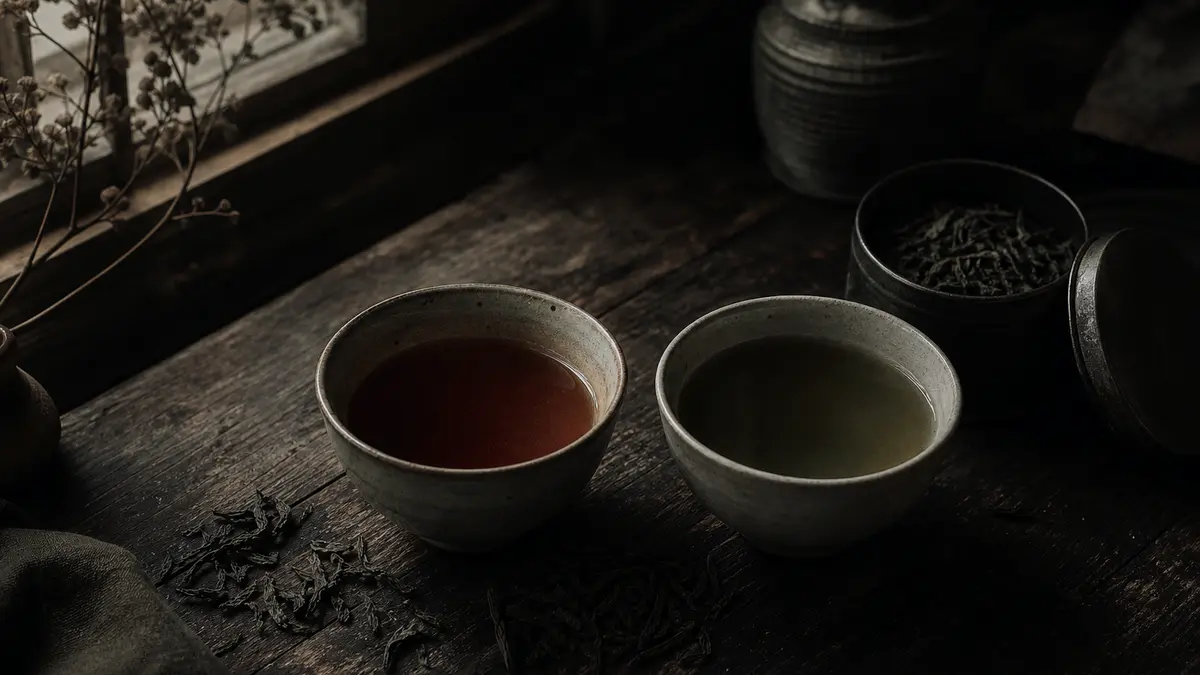
Black tea has a higher tannin content than green tea as a general category, making it a stronger inhibitor in controlled comparisons. Oolong sits in between, depending on oxidation level. Pu-erh, particularly aged sheng (生普洱), has complex tannin transformation through aging that modifies — but does not eliminate — this effect.
The more important variable, though, is how tea is brewed. A strongly brewed green tea (high leaf, long steep, near-boiling water) can inhibit more iron than a lightly brewed black tea. Brewing parameters outweigh tea type for most practical purposes.
The principle: stronger tea, longer steeping, more leaf, higher temperature all produce more tannins. All produce more inhibition. For a full reference on how temperature affects extraction across tea types, see the tea brewing water temperature guide.
The Single Action to Take
I’ll restate the practical rule plainly, because it’s the point of this entire article:
Drink tea at least one hour away from iron-containing meals.
Before breakfast, mid-morning, mid-afternoon, after dinner — all good windows. With a spinach salad, over a bowl of fortified oatmeal, alongside your iron supplement — these are the scenarios to change.
If you’re vegetarian, vegan, iron-deficient, pregnant, growing, or training hard: this single timing adjustment may be the most consequential dietary change you make this year. It costs nothing and requires no special equipment or new purchases.
It’s just a clock.