Pu-erh tea (普洱茶) contains caffeine—but how much, and what that caffeine actually does in your body, turns out to be a more interesting question than a single number can answer. The short answer: expect 30–70mg of caffeine per brewed cup. The complete answer involves leaf type, fermentation style, steep number, and a compound called L-theanine that fundamentally changes how that caffeine lands.
If you want to understand pu-erh tea caffeine well enough to control your intake—whether you’re avoiding afternoon jitters, trying to drink tea in the evening, or just curious why pu-erh feels so different from coffee—this guide covers everything you need to know.
How Much Caffeine Is in Pu-erh Tea?
The range is approximately 30–70mg of caffeine per 8-oz cup, depending on a set of variables I’ll break down below. That range is consistent with most black teas and sits well below drip coffee.
For a direct comparison across common drinks:
| Beverage | Serving Size | Caffeine (mg) |
|---|---|---|
| Espresso | 1 oz (single shot) | 60–75mg |
| Drip coffee | 8 oz | 80–150mg |
| Matcha | 8 oz (1 tsp powder) | 60–80mg |
| Black tea | 8 oz | 40–70mg |
| Young sheng pu-erh | 8 oz | 50–70mg |
| Shou pu-erh (ripe) | 8 oz | 30–50mg |
| Aged sheng pu-erh (10+ years) | 8 oz | 30–55mg |
| Green tea | 8 oz | 20–45mg |
| White tea | 8 oz | 15–30mg |
These are research-based estimates (Tier 2 knowledge)—actual caffeine content varies by specific leaf material, water temperature, and steep duration, and third-party lab testing of specific cakes would produce more precise numbers. What the table communicates accurately is the relative order and general magnitude.
The key takeaway: pu-erh caffeine is roughly half the caffeine of drip coffee, and roughly on par with other oxidized teas when comparing single steeps.
What Affects Caffeine Levels in Pu-erh
Leaf Grade and Bud Content
Caffeine concentrates in the youngest, most metabolically active parts of the plant. A tea made from buds and first leaves will have measurably more caffeine than one made from third, fourth, or fifth leaves. Large old-growth leaf material—common in high-end sheng pu-erh—tends to carry less caffeine per gram than tightly graded factory blends built around younger flush.
This is counterintuitive for people who assume “premium tea = more caffeine.” An aged single-tree sheng from a large-leaf Yunnan cultivar may have less caffeine per cup than a cheap tuo cha stuffed with young buds.
Sheng vs. Shou: How Fermentation Changes Caffeine
Young sheng (生普, raw pu-erh) generally carries more caffeine than shou (熟普, ripe pu-erh). The reason: the accelerated wet-piling fermentation (渥堆, wòduī) used in shou production degrades some caffeine through microbial activity and oxidative chemistry. Lab analyses comparing sheng and shou from similar leaf material typically find 10–25% lower caffeine in shou (Tier 2 knowledge—specific numbers vary by study and production batch).
The practical implication is real even if the exact percentage isn’t locked in: shou pu-erh is reliably the lower-caffeine choice when comparing like for like.
Age and Storage
Caffeine is relatively stable, but not completely so. Over decades of storage—particularly in traditional dry storage or the humid conditions of a Guangdong or Hong Kong warehouse—caffeine does degrade. The effect is modest on a year-to-year basis but becomes meaningful over 20–30 years. A genuine 1990s cake will typically test lower in caffeine than its young sheng equivalent.
This is one reason long-time pu-erh drinkers often report that aged sheng feels “cleaner” or less stimulating than young raw tea, even at the same volume. Some of that is perception shaped by the complex flavor profile, but some of it is real chemistry.
Water Temperature
Hotter water extracts caffeine more efficiently. Brewing at 90°C (194°F) pulls more caffeine than brewing at 80°C (176°F). Most shou pu-erh is brewed near boiling (95–100°C); some light sheng from younger trees is sometimes brewed cooler. If you’re managing caffeine intake, temperature is a real lever—though dropping below 85°C for pu-erh usually compromises the flavor extraction alongside the caffeine.
The Gongfu Caffeine Distribution: The Key Insight
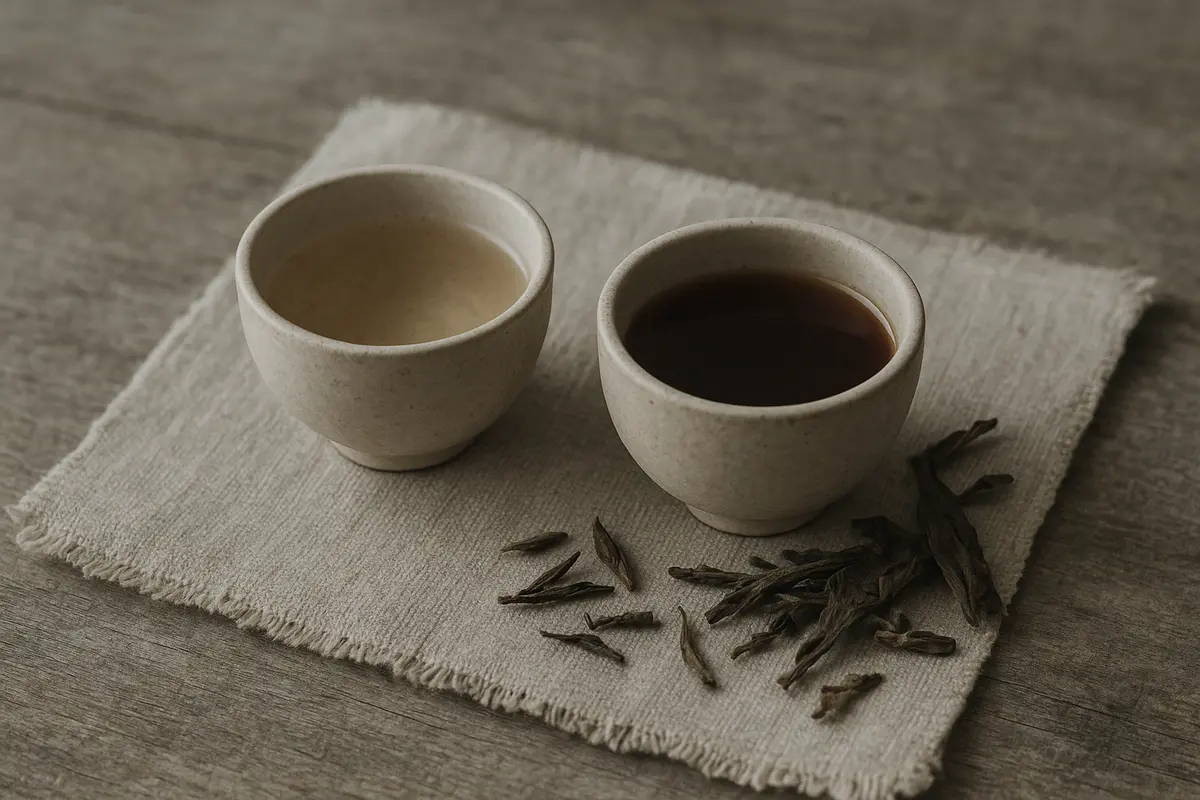
This is what most caffeine guides miss entirely, and it matters enormously for anyone who drinks pu-erh in the traditional gongfu (功夫茶) style.
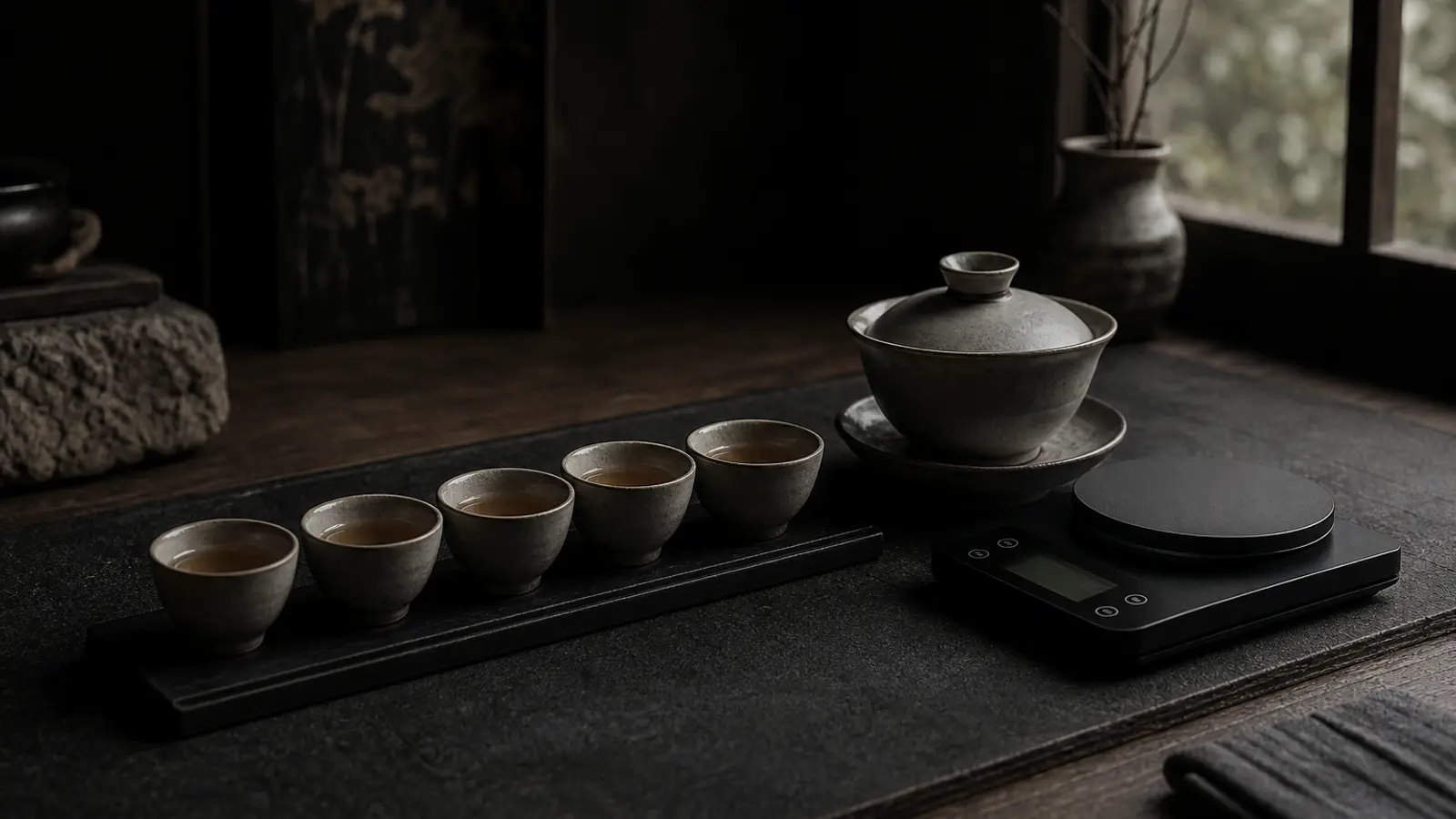
In gongfu brewing, you use a high leaf-to-water ratio (typically 6–8g per 100ml in a gaiwan (蓋碗) or small teapot) and brew many short successive steeps—anywhere from 5 to 20+ infusions from a single session.
Caffeine does not distribute evenly across those steeps.
Caffeine is highly water-soluble. In the first steep—even at just 10–15 seconds—a large fraction of the available caffeine extracts rapidly. By the second and third steeps, the extraction rate drops sharply. By steeps four through eight, you’re getting a fraction of the caffeine per cup that you got in the first two steeps—while flavor compounds, many of which are larger molecules or less water-soluble, continue extracting well.
Here’s an approximate caffeine distribution model for a gongfu session (Tier 2 estimate based on general solubility research; exact numbers vary by tea):
| Steep Number | Approximate % of Session’s Total Caffeine |
|---|---|
| Rinse (discarded) | 5–15% |
| Steep 1 | 25–35% |
| Steep 2 | 15–20% |
| Steep 3 | 10–15% |
| Steeps 4–6 | 5–8% each |
| Steeps 7+ | 1–3% each |
If a session produces a total of, say, 200mg of caffeine across all steeps from an 8g session of young sheng, the first two steeps alone might account for 80–100mg. Steeps six through ten might contribute 20–30mg combined.
What This Means in Practice
You have real control over your caffeine intake through steep selection:
-
Discard the rinse (a 5–10 second flash steep that also opens compressed cakes and removes any storage residue). You’re shedding 5–15% of total session caffeine before your first sip.
-
Discard or share the first steep. Pouring off steep one removes another 25–35% of total session caffeine. Combined with the rinse, you’ve eliminated roughly 30–50% of the session’s caffeine before you drink a drop.
-
Start drinking at steep 2 or 3. Your caffeine exposure per cup is already materially lower. Flavor is often better at this point anyway—the first steep is frequently harsh or thin on compressed pu-erh.
-
Reserve later steeps for evening. Steeps five through ten are beautiful for flavor—mature, complex, often sweet—and carry minimal caffeine. This is the most useful protocol for anyone who wants the ritual and flavor of pu-erh without the late-night stimulation.
The L-Theanine Factor: Why Pu-erh Caffeine Feels Different
Caffeine content alone doesn’t explain the subjective experience of pu-erh versus coffee. The difference is L-theanine (茶氨酸, cháānsuān).
L-theanine is an amino acid found almost exclusively in Camellia sinensis—the tea plant. It has two relevant effects. First, it promotes alpha-wave brain activity associated with calm alertness. Second, and more relevantly here, it modulates the rate and intensity of caffeine absorption, blunting the sharp cortisol spike and subsequent crash that many coffee drinkers experience.
The result is what tea drinkers often describe as “clear energy”—focused, calm, sustained—rather than the wired-then-tired cycle of espresso. The Chinese term huigan (回甘), meaning “returning sweetness,” describes a different phenomenon (the pleasant aftertaste of good tea), but the L-theanine effect is its pharmacological cousin: something pleasant that lingers rather than hammers and exits.
Pu-erh, particularly aged sheng, tends to have high L-theanine content—a result of the shade-grown conditions common in Yunnan’s forest tea gardens, where reduced photosynthesis converts more glutamic acid to theanine. This is part of why experienced pu-erh drinkers report a distinctive quality of alert calm that’s hard to replicate with other caffeinated drinks.
Sheng vs. Shou at Night: A Practical Decision Framework
If you’re caffeine-sensitive and want to drink pu-erh in the evening, here’s how I think about it:
Best options for evening:
- Aged shou (10+ years): lowest caffeine, softest profile, most sedative in character
- Fresh shou from mature large leaves: moderately low caffeine, smooth and earthy
- Any pu-erh, steeps 5+: negligible caffeine regardless of type
Use with caution in the evening:
- Young sheng: highest caffeine, most stimulating profile, vibrant and sharp
- Bud-heavy teas of any type: concentrated caffeine regardless of processing
Middle ground:
- Aged sheng (15–30 years): lower caffeine than young sheng due to degradation, complex flavor, often quite smooth. Many people find it workable into early evening.
The honest caveat: individual caffeine sensitivity varies enormously. Some people sleep through 200mg; others feel 20mg. If you’re caffeine-sensitive, treat any pu-erh before steep 4 as you would a cup of black tea—with respect for what it contains.
Does Rinsing Pu-erh Remove Caffeine?
The short answer: yes, somewhat, but not dramatically.
A rinse is a very short steep—typically 5–10 seconds—of water that’s discarded before the first drinking steep. Its primary purposes are to hydrate and open compressed leaf material, rinse away any storage residue, and warm the vessel. Caffeine extraction in 5–10 seconds is real but limited—I estimate 10–20% of what a full 30-second first steep would extract (Tier 2, based on caffeine solubility kinetics).
That’s meaningful when combined with discarding the first full steep, but it won’t make pu-erh caffeine-free. If you’ve seen claims that rinsing removes most of the caffeine within the first 30 seconds, those claims are not well-supported by chemistry. Caffeine continues extracting across multiple steeps; it doesn’t leap out of the leaf in the first few seconds.
The rinse is still worth doing—it’s standard practice for good reasons unrelated to caffeine—but don’t rely on it as a decaffeination strategy. The actual low-caffeine protocol is: rinse, discard steep 1, drink from steep 2 onward, and favor shou or aged sheng over young raw tea.
Caffeine-Sensitive Drinkers: A Summary Protocol
If you’re specifically managing caffeine intake—whether for anxiety, sleep, pregnancy, medication interactions, or simple preference—here’s a consolidated approach:
-
Choose shou pu-erh as your base. Ripe fermentation reduces caffeine 10–25% relative to equivalent sheng.
-
Choose aged material over young. A 15-year-old shou or sheng will carry less caffeine than a fresh cake.
-
Choose large-leaf material over bud-heavy blends. Avoid teas described as “golden buds” or high-grade tuo cha if minimizing caffeine.
-
Rinse, then discard the first steep. This removes roughly 30–50% of the session’s total caffeine before you drink.
-
Start drinking at steep 2 or 3. The caffeine curve has already dropped sharply.
-
Drink later steeps in the evening. Steeps 5+ are nearly caffeine-free and often among the most pleasant cups of the session.
-
Brew slightly cooler if needed. Dropping to 85–90°C for shou (still hot enough for good extraction) will modestly reduce caffeine extraction compared to boiling water.
Pu-erh vs. Coffee: The Core Difference
I came to tea through wine, and then through a period of troubling coffee dependence—the kind where you need two espressos to feel baseline functional rather than alert. Switching to gongfu pu-erh sessions changed my relationship with caffeine more than I expected, and L-theanine is the main reason why.
The math makes pu-erh look gentler than coffee: 30–70mg per cup versus 80–150mg. But the subjective difference is larger than that ratio suggests. A gongfu session might involve eight cups across an hour, each at 30–50ml. Total caffeine might be 80–120mg over that hour—comparable to a single drip coffee. But the delivery is slower, modulated by L-theanine, and spread across an hour of deliberate, mindful pouring. The experience is categorically different.
If you’re using coffee primarily as a performance tool and finding the side effects problematic—anxiety, heart rate, GI issues, poor sleep—pu-erh is worth serious consideration as a primary caffeine source. Not because it’s caffeine-free, but because of how it delivers what it has.