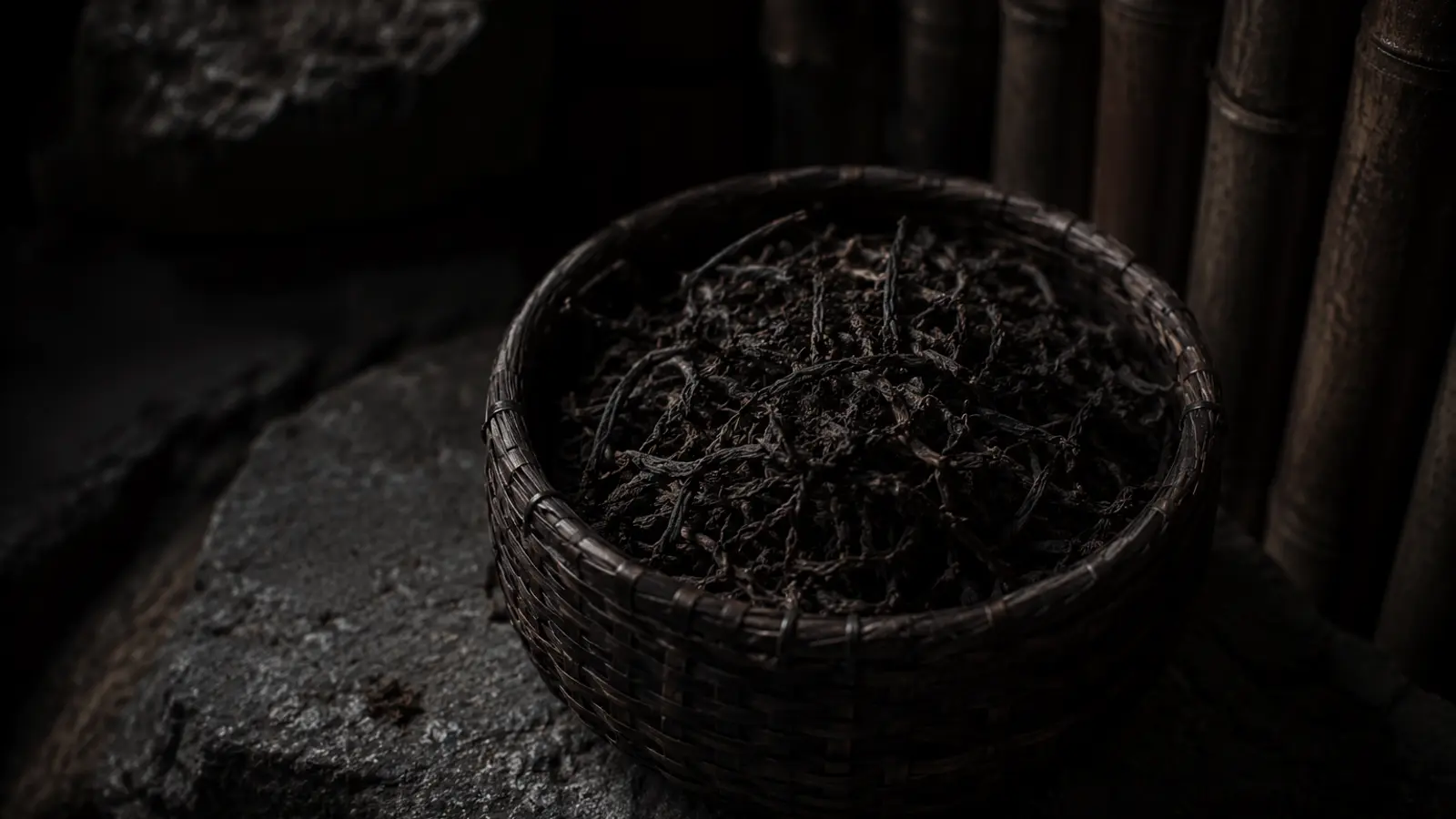
In 2025 I brewed a 1993 vintage Liu Bao (六堡茶) from a Guangxi heritage factory. By the sixth infusion, I set down the cup and drank a glass of plain water. The water tasted sweet — genuinely, unmistakably sweet — for the next several minutes. I have drunk a lot of tea. I have tasted shou pu-erh from the 1970s, aged oolong from high-mountain Taiwan, and roasted tieguanyin that had spent a decade in ceramic jars. Nothing has produced huigan (回甘, returning sweetness) of that magnitude.
The tea came from Guangxi (广西), not Yunnan. It was Liu Bao (六堡), not pu-erh. And it is, in my direct experience, one of the most underappreciated aged teas in the world.
This is a terroir profile of the guangxi liu bao tea origin: where it grows, why it tastes the way it does, how it differs from pu-erh, and why collectors who ignore it are making an expensive mistake.
Geography & Location
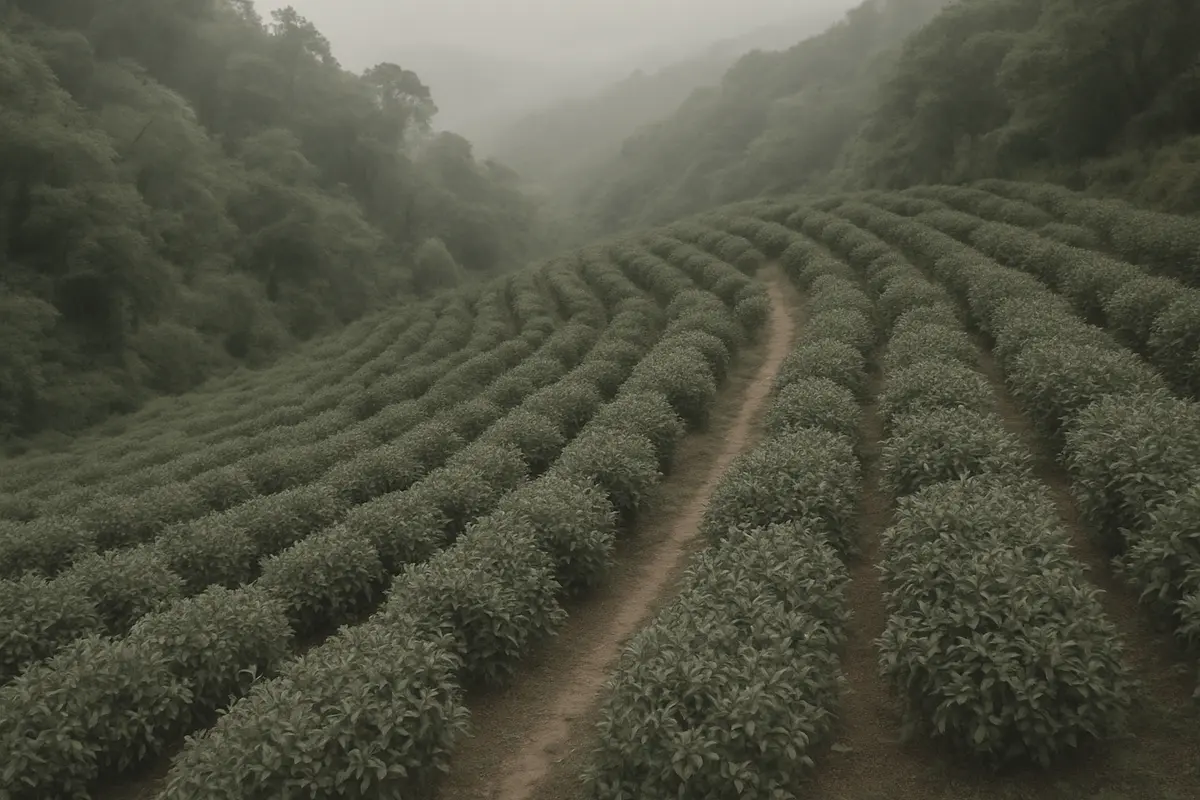
Guangxi Zhuang Autonomous Region (广西壮族自治区) occupies China’s subtropical south, sharing borders with Yunnan to the west, Guizhou and Hunan to the north, Guangdong to the east, and Vietnam to the south. The region’s geography transitions from karst limestone highlands in the northwest to lower, humid river valleys in the southeast — and it is in those southeastern lowlands that Liu Bao tea has been made for centuries.
The center of Liu Bao production is Wuzhou (梧州) prefecture, located at approximately 23.5°N, 111.3°E in the southeastern part of the region. Within Wuzhou, Liu Bao township (六堡镇) in Cangwu county (苍梧县) is the specific origin that gives the tea its name. The Hexi River (贺溪) and its tributaries run through the production area, historically serving as the transport route that connected Liu Bao tea to regional trade networks.
The township itself is small — a few thousand hectares of cultivated garden spread across steep hillsides and valley floors at elevations between 200 and 800 meters. This is dramatically lower than Yunnan’s famous tea mountains, which sit at 1200 to 2000 meters. That elevation difference is not incidental; it is foundational to everything that makes Liu Bao taste the way it does.
Think of it as the difference between a cool-climate Burgundy and a warm-climate Rhône. Same grape family, entirely different expression shaped by where the vines grow.
Climate & Elevation
Guangxi’s southeastern corner runs on a subtropical monsoon rhythm that most Chinese tea regions would consider extreme.
Summer temperatures in the Wuzhou area regularly exceed 35°C, and the monsoon season delivers rainfall in concentrated bursts. Annual precipitation in Liu Bao township ranges from 1500 to 2000mm. Relative humidity sits between 80 and 90% for most of the year — conditions that would destroy a warehouse of Yunnan pu-erh but that Liu Bao plants and processing have evolved around.
Winters are mild by Chinese standards: temperatures rarely drop below 5°C, which means the tea plants experience a shorter dormancy period than their highland counterparts. The result is a growing season that can extend across multiple flushes, with spring harvest being the most prized.
The low elevation matters in a specific biochemical way. At 200–800 meters, Liu Bao plants experience more heat, more UV radiation at ground level, and higher sustained humidity than high-altitude plants growing above cloud cover. This encourages a different ratio of polyphenols, amino acids, and aromatic precursors in the leaf — a chemical fingerprint that, after fermentation and years of aging, expresses itself as the warm, spice-forward character that distinguishes Liu Bao from all other dark teas.
The humidity of the growing environment also translates directly into the post-harvest world. Liu Bao has always been a tea that ferments naturally in its storage environment — the local climate essentially does part of the processing work, and the tea’s character is inseparable from that ongoing microbial activity.
Soil & Terroir
The soils of Liu Bao township are predominantly red laterite, with alluvial deposits in the valley floors closer to the river systems.
Laterite soils are heavily leached by the high rainfall and warm temperatures. They are iron-rich, acidic (typically pH 5.0–6.0), and relatively low in organic matter compared to highland forest soils. They drain quickly on slopes, which moderates waterlogging despite the high rainfall, but they offer a different mineral profile than the volcanic or granite-derived soils of Yunnan’s better-known tea mountains.
The comparison to tea terroir is instructive here. If Yunnan’s Lao Ban Zhang (老班章) village teas are like wines from schist-rich Mediterranean hillsides — mineral, grippy, structured — then Liu Bao’s laterite valley soils produce something closer to the alluvial plains of the southern Rhône: rounder, more immediate, built for warmth and spice rather than tension and acid backbone.
The practical effect on the cup is real, though separating soil influence from cultivar influence and processing influence requires careful analysis. What I can say from direct experience is this: the mineral quality of Liu Bao’s liquor — particularly in aged examples — is softer and more envelope-like than aged Yunnan teas of similar age, with less of the rocky, astringent edge that can persist in older shou pu-erh.
Key Cultivars & Tea Types
This is the detail that most Liu Bao discussions skip, and it matters more than almost anything else.
Liu Bao is not made from the same plant as pu-erh.
Yunnan pu-erh uses Camellia sinensis var. assamica — the large-leaf Yunnan cultivar, with leaf sizes often exceeding 15–20cm. Liu Bao uses the Cangwu group cultivar (苍梧群体种, cāngwú qúntǐ zhǒng), a medium-leaf variety distinct from both the large-leaf assamica and the small-leaf Camellia sinensis var. sinensis used for most green and white teas in eastern China.
The Cangwu group cultivar has smaller, more delicate leaves, a different polyphenol composition, and different aromatic precursors than Yunnan assamica. It has been cultivated in Guangxi for centuries and has adapted specifically to the hot, humid, low-elevation conditions of the region. When this cultivar undergoes Liu Bao-style fermentation and aging, it develops aromatic compounds — particularly the binlang xiang (槟榔香) complex — that Yunnan cultivars simply do not produce, regardless of processing method.
This is the single most important point for anyone trying to understand why Liu Bao is its own thing and not just a regional variation of pu-erh. The cultivar difference alone would make the teas distinct. Combined with the different elevation, climate, soil, and processing traditions, the divergence becomes absolute.
Liu Bao is classified as hei cha (黑茶, dark tea) — the same broad category as shou pu-erh, Hunan Fu brick tea (安化黑茶), and Sichuan Ya’an Tibetan tea (雅安藏茶). Within the hei cha category, Liu Bao occupies its own appellation-like identity.
Processing Traditions
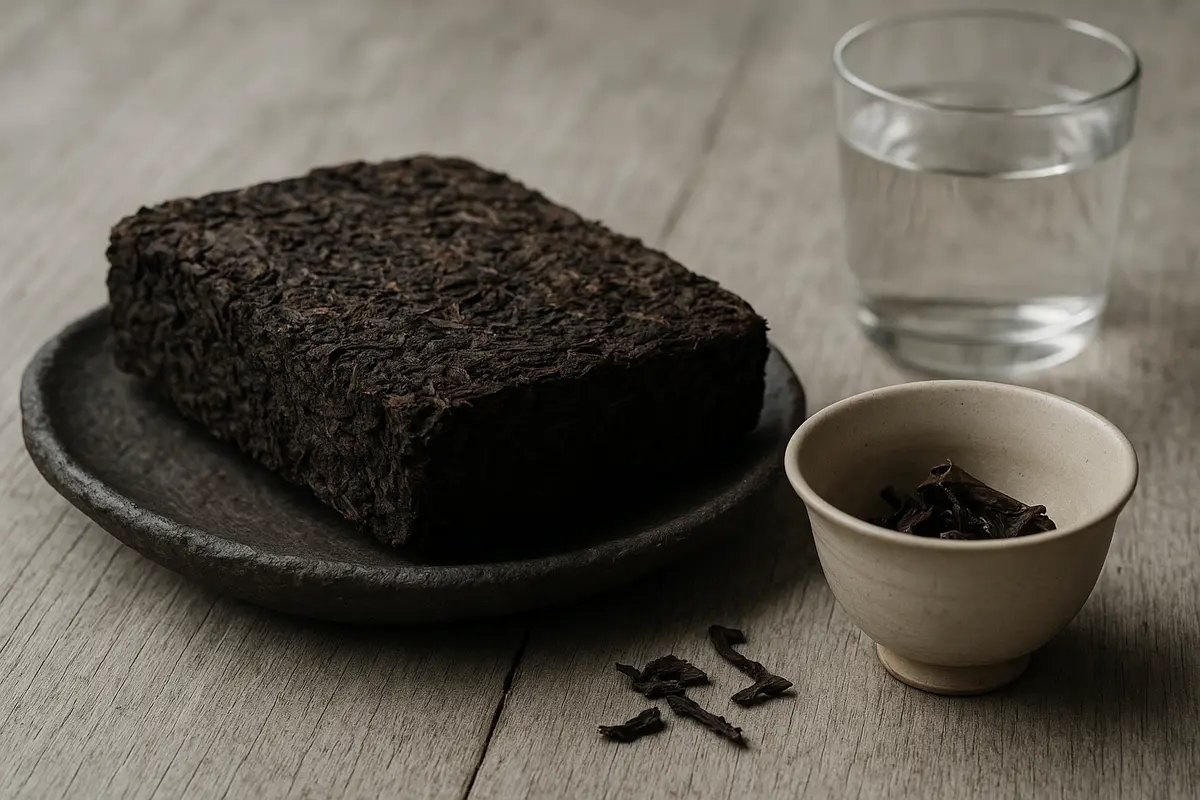
Understanding Liu Bao processing requires one historical note first: Liu Bao-style pile fermentation predates the shou pu-erh production method by decades. When Menghai Tea Factory (勐海茶厂) developed the accelerated fermentation technique that created shou pu-erh in 1973, they were drawing on existing knowledge of wet-pile fermentation from Liu Bao and other hei cha traditions. Liu Bao is not a regional copy of shou pu-erh — if anything, shou pu-erh is a Yunnan adaptation of principles Liu Bao had already established.
The Liu Bao processing sequence:
1. Picking Spring harvest is prioritized. The Cangwu group cultivar produces one-bud-two-leaf to one-bud-three-leaf picks for higher grades. For grades 4–6 (preferred by many aged Liu Bao drinkers for their sweetness contribution from stem material), more mature leaf and light stem is included.
2. Kill-Green (杀青, shāqīng) Heat is applied — traditionally in a wok over direct fire, now often in rotating drum machines — to halt enzymatic oxidation and fix the leaf’s character before fermentation. This is the same basic step used in green tea production, though Liu Bao’s kill-green is typically less thorough, allowing some oxidative potential to remain.
3. Rolling (揉捻, róuniǎn) The leaf is rolled to break cell walls and distribute juices, which accelerates later fermentation. Traditional hand-rolling produced tightly twisted leaves; modern machine rolling produces more uniform results.
4. Wet-Pile Fermentation (渥堆, wò duī) This is the defining step. Moistened leaf is piled and covered, creating a controlled composting environment where heat and microbial activity — primarily Aspergillus niger and other fungi — break down the leaf’s plant compounds over weeks. The pile is turned periodically to regulate temperature (ideally 50–65°C at the core) and ensure even fermentation.
Liu Bao’s wo dui differs from Yunnan’s shou pu-erh wo dui in several respects: pile sizes are often smaller, the moisture levels and duration differ, and the starting material (the Cangwu cultivar) responds differently to the process, producing a different fermentation byproduct profile.
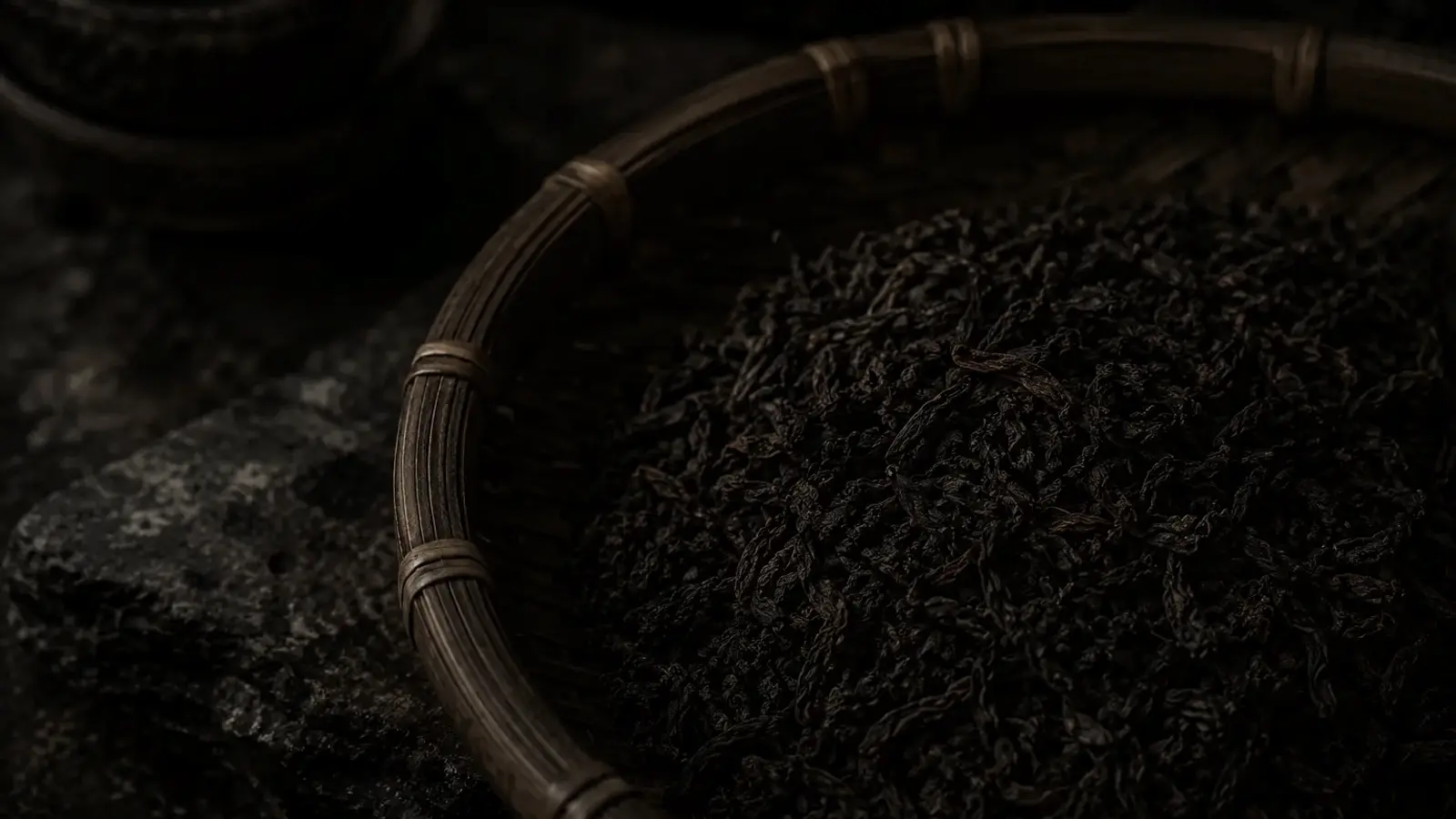
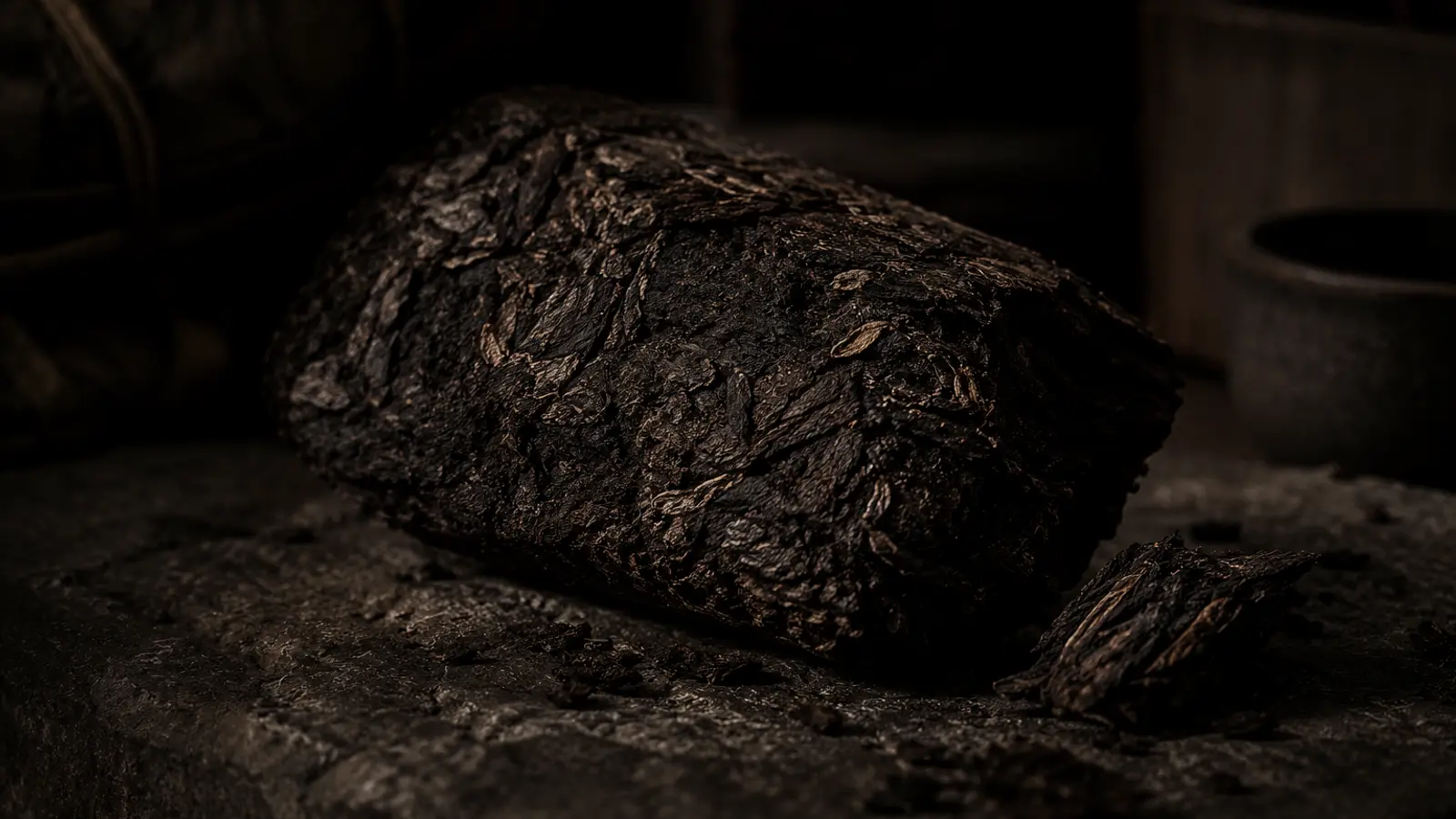
5. Steaming and Basket Storage (竹篓, zhúlǒu) After initial fermentation, Liu Bao is steamed to soften the leaf for compression and packing. The traditional vessel is a large bamboo basket — the 竹篓 is as iconic to Liu Bao as the 357g bing is to pu-erh. The bamboo is not inert: it contributes trace aromatics and allows slow, regulated gas exchange between the tea and its environment during the years and decades of aging.
The bamboo basket aging environment supports continued slow microbial transformation. As years pass, the harsh notes from fresh fermentation smooth out, the binlang xiang develops and deepens, and the liquor color shifts from murky brown toward a clear, jewel-toned reddish-black.
Characteristic Flavor Signatures
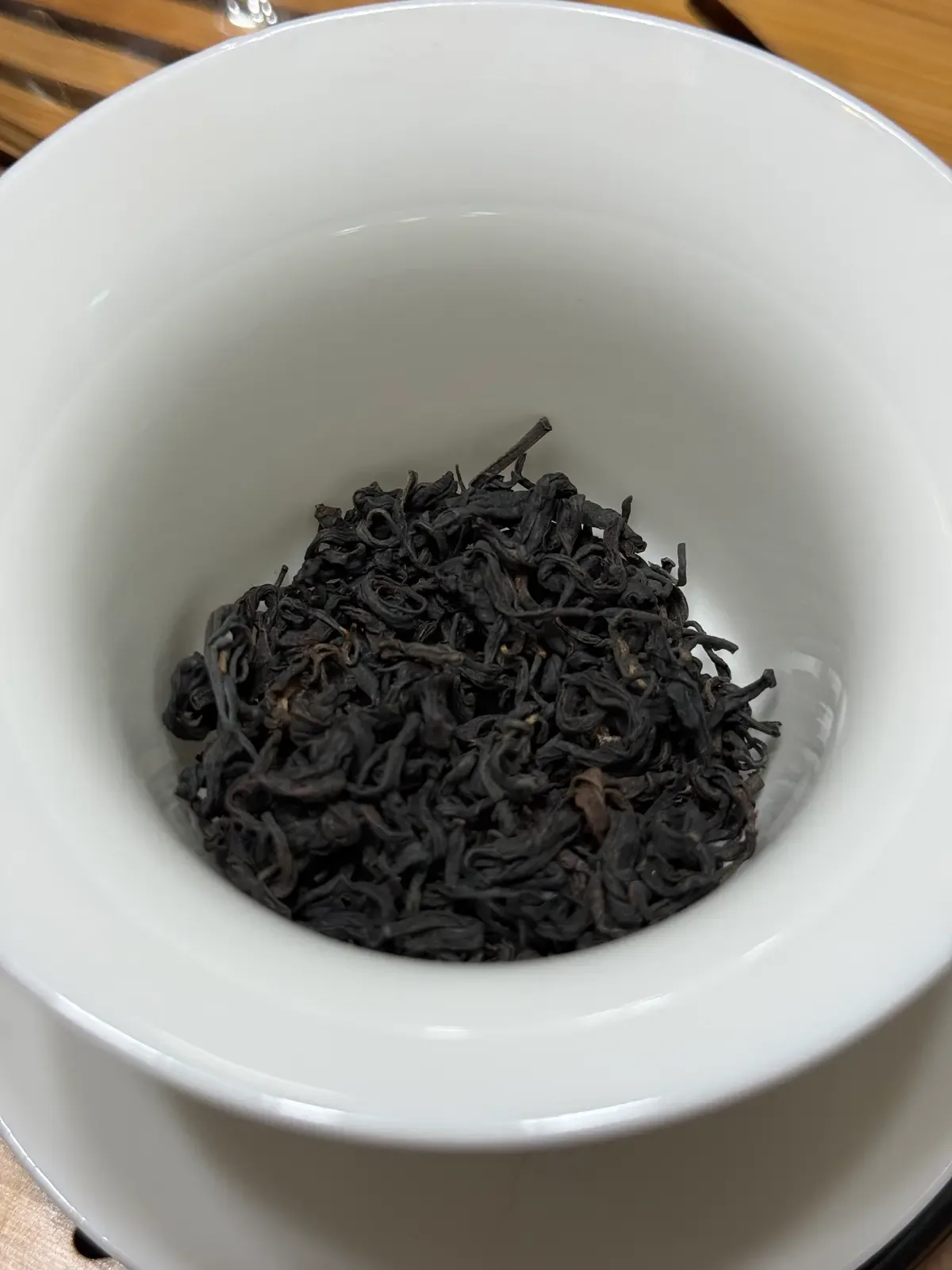
I brewed the 1993 vintage Liu Bao at 95°C in a gaiwan (蓋碗) using approximately 8g to 120ml, with flash-rinse first infusion, then 15-second infusions extending to 30–45 seconds by infusion six. This is firsthand data.
Liquor appearance: Chocolate-burgundy, more transparent and ruby-toned than most shou pu-erh I’ve brewed from similar vintages. At infusion three, held to light, it showed genuine translucency — a sign of clean aging.
Mouthfeel: Thick, rich, and oily in a way that felt lubricating rather than coating. The texture is one of Liu Bao’s most distinctive qualities — there’s a gliding quality to it that persists through the swallow.
Aroma: Chocolate, dark wood, hazelnut, and the signature note I’ll describe in detail below.
The cinnamon signature: The defining flavor I encountered in the 1993 Liu Bao was a warm, burning spice — cinnamon-adjacent but with additional complexity, simultaneously sharp and sweet, simultaneously a warmth in the throat and a brightness on the palate. I have not encountered this note in any pu-erh in my collection, including aged sheng and shou from similar vintages. It is uniquely Liu Bao.
This note is almost certainly a component of what connoisseurs call binlang xiang (槟榔香) — the areca nut or betel nut aroma that defines quality aged Liu Bao. Areca nut has a warm, spicy-sweet, slightly astringent quality that matches what I tasted. The binlang xiang complex develops through the interaction of the Cangwu cultivar’s specific aromatic precursors with decades of bamboo-basket aging, and it is unique to this tea type.
Huigan (回甘): On my 10D tasting scale, I scored this tea 9/10 for huigan — the highest of any tea I have evaluated. By infusion five, the returning sweetness was so strong that a sip of plain water tasted unmistakably sweet for several minutes. This is not a subtle quality I’m interpreting into existence; it was the most visceral and immediate huigan experience I’ve had.
Qi: Calming, centering, noticeably warming in the body. No stimulant edge, no racing thoughts, zero insomnia risk even brewed in the evening. The qi profile of Liu Bao is consistently described as soothing and warming in Chinese tea literature, and my experience aligned completely.
The General Flavor Spectrum by Age
Fresh Liu Bao (under 5 years): earthy, slightly harsh, with grass and wood notes, the fermentation character still prominent. Most benefit from additional aging.
Lightly aged Liu Bao (5–15 years): smoother, with emerging sweetness and early hints of spice. Chocolate and dried fruit notes begin to appear.
Well-aged Liu Bao (15–30 years): full expression. Chocolate, dark plum, hazelnut, sweet wood, and the developing binlang xiang. Mouthfeel becomes increasingly oily and luxurious. Huigan extends and deepens.
Exceptional aged Liu Bao (30+ years): rare and extraordinary. The binlang xiang should be fully developed and complex. Liquor should be clear and jewel-like.
Quality Indicators & Authentication
Liu Bao uses a numeric grade system that runs from 特级 (tèjí, special grade — finest bud-heavy material) through grades 1 through 6 (progressively larger, more mature leaf with increasing stem content).
Here is the counterintuitive reality: for aged Liu Bao, lower grades are often more desirable. Grades 4–6, which include more stem material, contribute additional sweetness and body to the aged liquor. The stems are rich in sugars that transform beautifully over decades. Special grade and grade 1 Liu Bao can be too delicate to benefit from extended aging.
Authentic Liu Bao indicators:
- Clear liquor: Well-aged Liu Bao should show clarity when held to light — murky liquor suggests poor storage conditions.
- The binlang xiang: The warm, spicy-sweet aroma should be present in the dry leaf, wet leaf, and cup. It should not smell musty, sour, or off-putting. A clean, sweet, warming fragrance is the mark of quality aging.
- Bamboo basket character: Genuine bamboo-basket-aged Liu Bao may carry a faint, clean woody-grassy note from the vessel. This is distinct from unpleasant off-aromas.
- Mouthfeel density: Quality aged Liu Bao has a notably thick, oily texture that cheap examples — whether young or poorly stored — do not develop.
- Huigan strength and duration: The returning sweetness should be substantial and lasting. A weak or absent huigan in an ostensibly aged Liu Bao is a red flag.
Authentication challenges: The Liu Bao market has significantly less established authentication infrastructure than pu-erh. Vintage factory labels exist — Zhongcha (中茶) and other documented producers made recognized runs — but the same caveats about provenance apply as with aged pu-erh.
The Southeast Asian secondary market (Malaysia, Singapore, Hong Kong) has historically been the richest source of genuinely aged Liu Bao, because the tea was shipped there in large volumes for laborer communities in the colonial era. Teas that have spent decades in Malaysian or Singapore storage often carry distinctive storage characteristics that are actually desirable — a kind of tropical wet storage that accelerates the binlang xiang development.
Historical Significance
Liu Bao has a colonial-era export history that pu-erh lacks, and it shaped the tea’s entire identity as a practical, community health drink rather than an object of connoisseurship.
From the 19th century through the mid-20th century, Chinese emigrant workers — predominantly Hakka and Cantonese speakers from Guangdong and Guangxi — traveled to British Malaya, Dutch Indonesia, and colonial Singapore to work in tin mines, rubber plantations, and trading ports. They brought Liu Bao with them.
The tea’s value in that context was explicitly functional: Liu Bao was believed to counteract the ailments of tropical labor — heat exhaustion, digestive illness, and the general toll of working in extreme humidity. Whether the health claims were medically precise matters less than the social reality: Liu Bao was the daily drink of working-class Chinese communities across Southeast Asia for generations. It was brewed in large clay pots and drunk continuously throughout the workday.
This export demand shaped production. Large factory-style operations in Wuzhou packed Liu Bao into bamboo baskets specifically sized for shipping and long-term storage in warehouse conditions. Teas shipped in the 1950s, 1960s, and 1970s, stored in the natural humidity of Malaysian or Singaporean warehouses, have undergone decades of slow transformation. Some of those teas now surface at auction and in antique shops across the region.
The practical consequence for collectors: old Liu Bao is not locked away in Chinese factory archives or private Taiwanese cellars, as much aged pu-erh is. It is distributed across Southeast Asia in quantities that make it genuinely findable, if you know where to look and what to look for.
Price Ranges
Liu Bao is one of the most significant value anomalies in the aged tea market. This is not a tentative opinion — it is an observable fact of current pricing.
| Category | Price per 100g (USD) | Notes |
|---|---|---|
| Everyday grade, contemporary | $1–3 | Grade 4–6, recent production, for daily use |
| Quality factory Liu Bao, contemporary | $5–20 | Named factories, good material, 0–5 years |
| Lightly aged Liu Bao (5–15 years) | $15–60 | Quality varies significantly |
| Well-aged Liu Bao (15–25 years) | $40–200 | Certified provenance commands premium |
| Exceptional aged Liu Bao (25–35 years) | $100–400 | Comparable age pu-erh: $400–2000+ |
| Legendary vintage Liu Bao (35+ years) | $200–1000+ | Rare; documented heritage factory and Zhongcha labels |
For reference: a comparable vintage shou pu-erh — same age, similar documentation, similar drinking quality — typically trades at 3 to 10 times these prices on the same markets.
The pricing gap is not explained by quality difference. It is explained by awareness. Pu-erh has benefited from two decades of aggressive marketing in mainland China, Hong Kong, and internationally. Liu Bao has not. The result is a market where a 1993 Liu Bao can drink as well as a 1993 shou pu-erh while costing a fraction of the price.
The Southeast Asian market prices are often lower than international export prices, because Liu Bao remains a familiar, working-class tea there rather than a collectible. If you have access to Malaysian or Singaporean tea shops — particularly in older commercial districts in Kuala Lumpur, Ipoh, or Singapore’s Chinatown — the value proposition becomes even more pronounced.
Liu Bao in Context: The Hei Cha Landscape
Liu Bao is one of several Chinese dark teas, and situating it within that family clarifies what makes the guangxi liu bao tea origin distinctive.
| Tea | Region | Cultivar type | Elevation | Key character |
|---|---|---|---|---|
| Liu Bao (六堡茶) | Guangxi | Cangwu medium-leaf | 200–800m | Binlang xiang, warm spice, rich oil |
| Shou Pu-erh (熟普洱) | Yunnan | Yunnan large-leaf assamica | 1200–2000m | Earth, mushroom, dark fruit |
| Fu Brick (茯砖茶) | Hunan / Shaanxi | Variable | Variable | Eurotium mold character (“golden flower”) |
| Ya’an Tibetan Tea (雅安藏茶) | Sichuan | Variable | 800–1500m | Earthy, mild, utilitarian |
Liu Bao stands apart from all of these. Its terroir — lower elevation, subtropical humidity, the Cangwu cultivar, bamboo-basket aging — produces a flavor complex that exists nowhere else in the hei cha world. The binlang xiang is not found in Hunan Fu brick. The warm cinnamon spice I tasted in the 1993 vintage Liu Bao is not found in any aged shou pu-erh I have brewed. These are not incremental differences; they are categorical ones.
Why This Region Matters Now
Guangxi’s Liu Bao production has expanded significantly in the 21st century, partly driven by renewed domestic interest in hei cha and partly by the growing aged tea market. New factory productions are being made with better quality control than some of the middle-period output from the 1980s and 1990s. The Guangxi government has pursued geographical indication (GI) protection for Liu Bao, which has clarified production standards.
For a collector building an aged tea portfolio, the calculus is straightforward: buy documented, quality Liu Bao now, at current undervalued prices, and let time do what it does. The tea has a proven 30-year track record of aging beautifully. The binlang xiang develops and deepens. The huigan strengthens. The mouthfeel becomes more oily and complex. The price gap with pu-erh will likely close as awareness spreads — which means today’s prices represent a window that will not stay open indefinitely.
The 1993 vintage Liu Bao I brewed is evidence of what patience produces. A 30-year-old tea with the strongest huigan I have ever experienced, a flavor signature unlike anything in the pu-erh world, and a price that makes comparable pu-erh look absurd. Guangxi’s liu bao tea origin has been making teas like this for centuries. The rest of the tea world is just catching up.