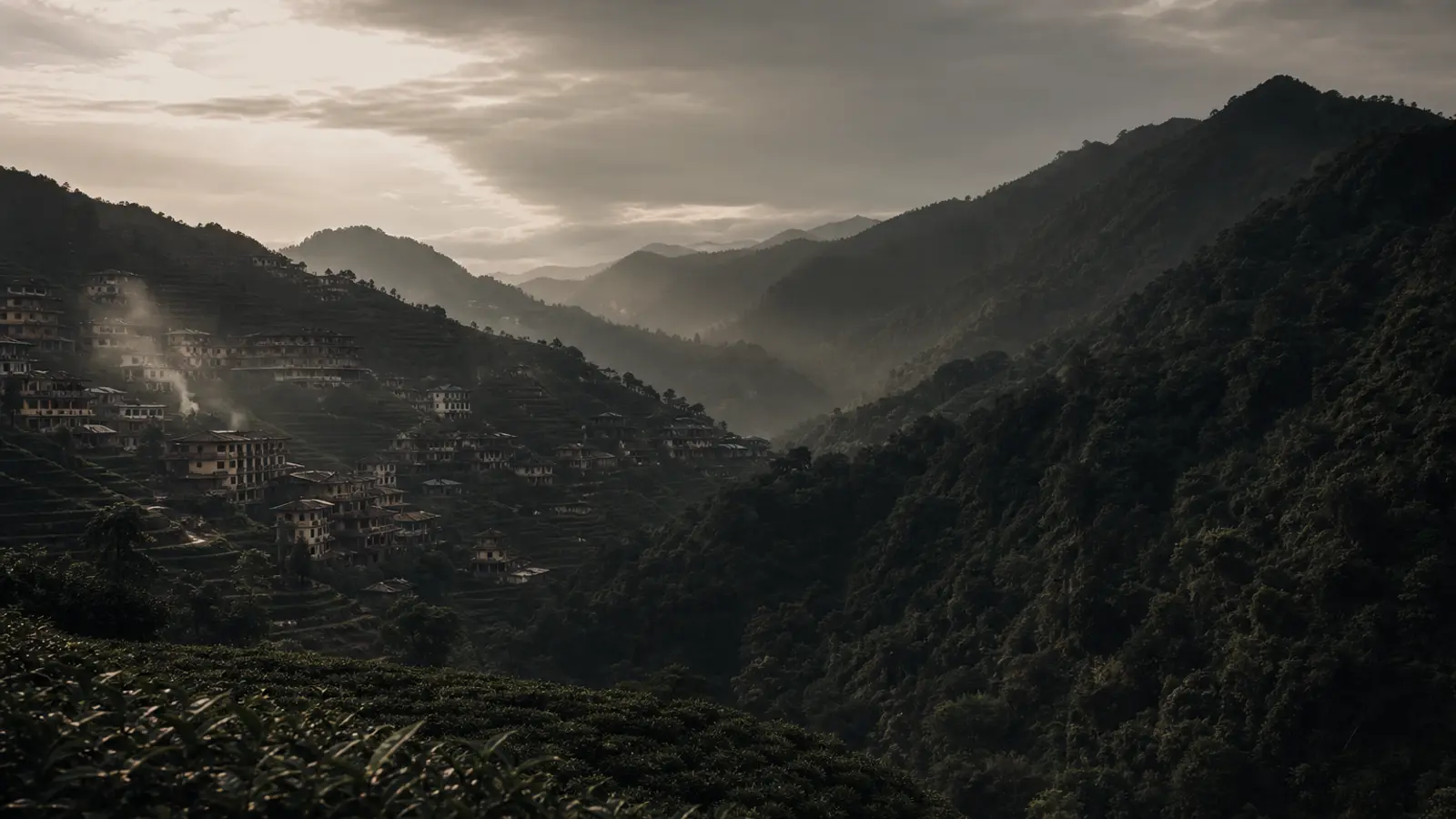
Nannuo Mountain sits in Menghai County (勐海县), Xishuangbanna Dai Autonomous Prefecture (西双版纳傣族自治州), Yunnan Province. Its approximate center coordinates place it at 21.9°N, 100.6°E — due east of Menghai town, separated from the Bulang Mountain (布朗山) range to the southwest by the Nanluohe River valley.
If you ask experienced sheng drinkers which Xishuangbanna region to recommend to someone new to single-origin pu-erh, Nannuo Mountain (南糯山) comes up repeatedly. Not because it is the most dramatic, the most expensive, or the hardest to find. Because it works. It delivers clean bitterness, honest sweetness, good complexity, and an accessible price point with unusual consistency. In a world of pu-erh regions that market themselves on extremes, nannuo mountain pu-erh earns its reputation by being reliably excellent.
That reliability deserves serious attention.
Geography & Location
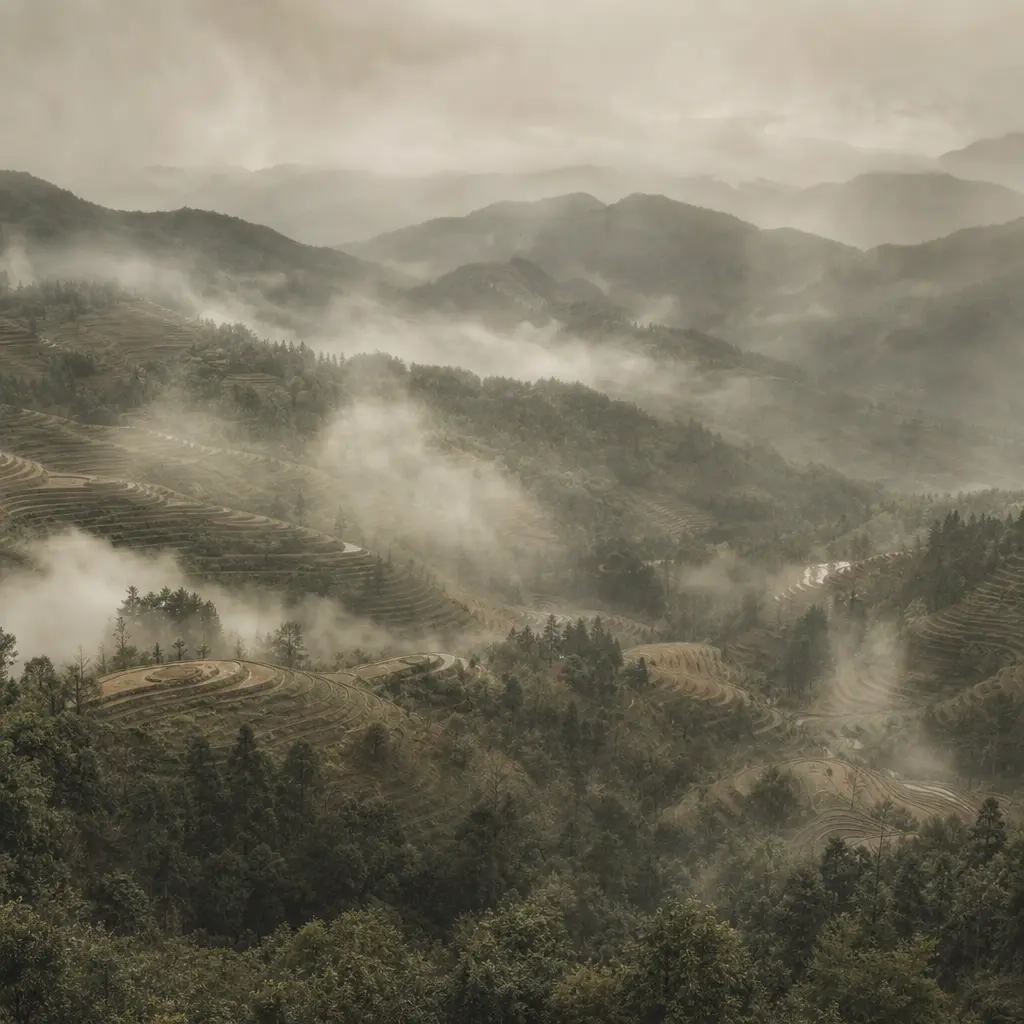
Nannuo Mountain sits in Menghai County (勐海县), Xishuangbanna Dai Autonomous Prefecture (西双版纳傣族自治州), Yunnan Province. Its approximate center coordinates place it at 21.9°N, 100.6°E — due east of Menghai town, separated from the Bulang Mountain (布朗山) range to the southwest by the Nanluohe River valley.
The mountain is large by Yunnan standards, covering roughly 90 square kilometers of continuous tea-producing terrain. That scale matters: Nannuo isn’t a single ridge with a handful of ancient trees. It is a layered landscape of old-growth forest, smallholder gardens at varying elevations, and plantation blocks on lower slopes — all compressed into one appellation-like zone.
Villages are scattered across the mountain at different elevations, and the differences between them are meaningful. Banpolaozhai (半坡老寨) occupies the upper reaches and produces the material most serious buyers seek. Duoyishu (多依树), Nannuolao (南糯老), and Banpo Xin Zhai (半坡新寨) are other recognized producing villages, each with slightly different microclimates and tree populations. Understanding Nannuo well means understanding that “Nannuo” on a wrapper tells you the mountain but not the story — the village, elevation, and tree age fill in what the place name leaves out.
Climate & Elevation
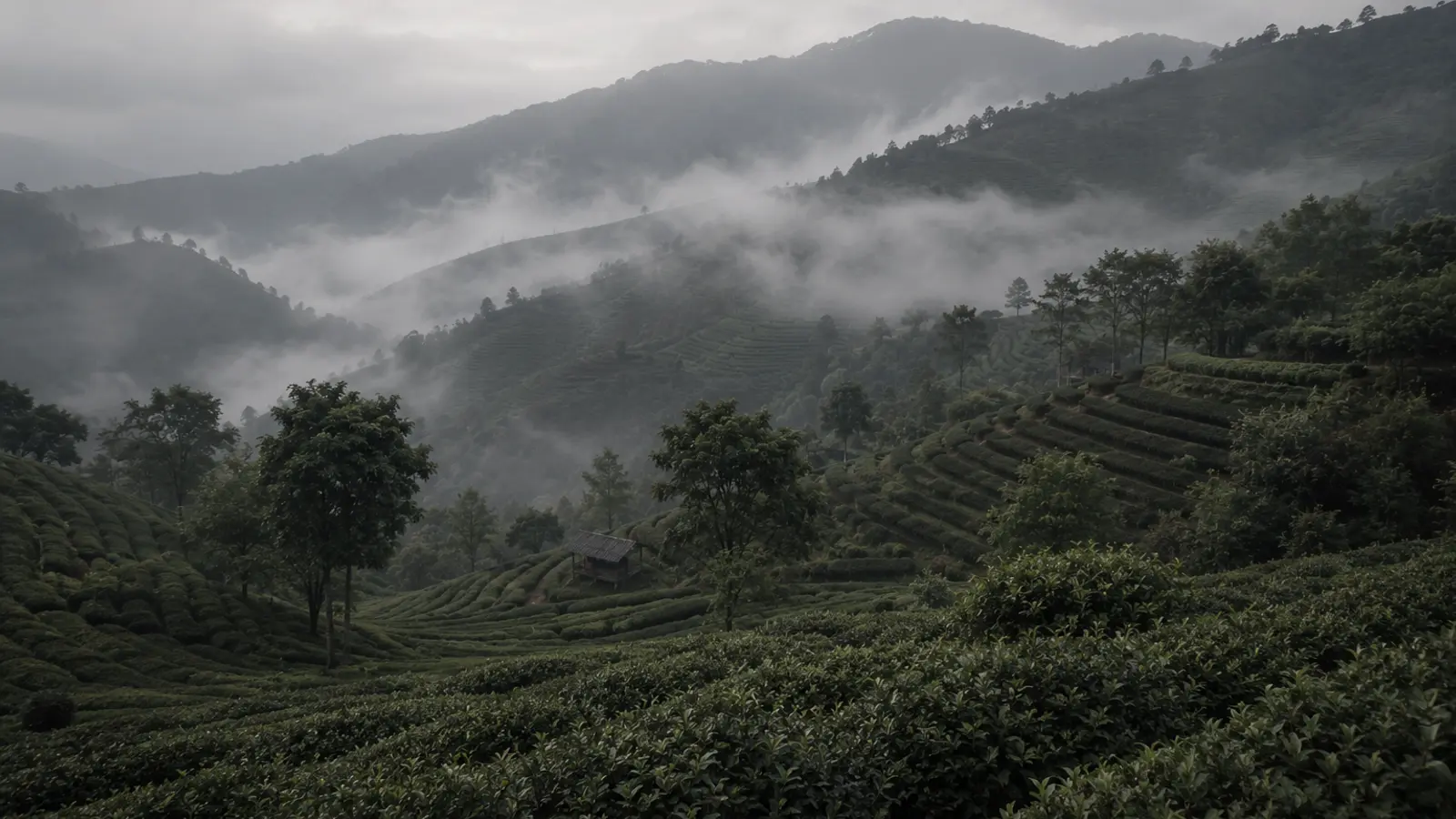
Elevation on Nannuo Mountain runs from approximately 1,400m at the lower productive slopes to around 1,800m at the upper village elevations. This range is significant. In practical terms, it means the highest-elevation gardens sit in a meaningfully cooler, more consistently misted environment than the lower plantation blocks — a difference that registers in the leaf and in the cup.
The climate is subtropical montane. Annual rainfall is reported at 1,400–1,600mm, distributed unevenly across wet and dry seasons, with the wet season running roughly May through October. What distinguishes Nannuo’s microclimate is persistent cloud cover and mist, particularly at higher elevations. Multiple sources describe the mountain as having some of the most consistent mist cover of any Xishuangbanna growing area. This moisture retention slows photosynthesis slightly, extends leaf development time, and contributes to the amino acid concentration that underpins Nannuo’s sweetness.
The temperature range at upper elevations is estimated at 15–22°C year-round, with cool nights even in summer. That diurnal temperature variation — warm days accelerating cell development, cool nights slowing it — is the same mechanism responsible for complexity in high-altitude wine and coffee. The pattern strongly suggests it plays a similar role in Nannuo’s flavor profile, though attribution to any single climate variable is necessarily speculative.
Frost is not common at the main producing elevations but has been recorded in unusually cold winters. The practical effect is that Nannuo’s growing season, while not dramatically short, produces leaves that develop more slowly than lower-elevation material — a factor often cited by producers working with the old-growth gardens.
Soil & Terroir
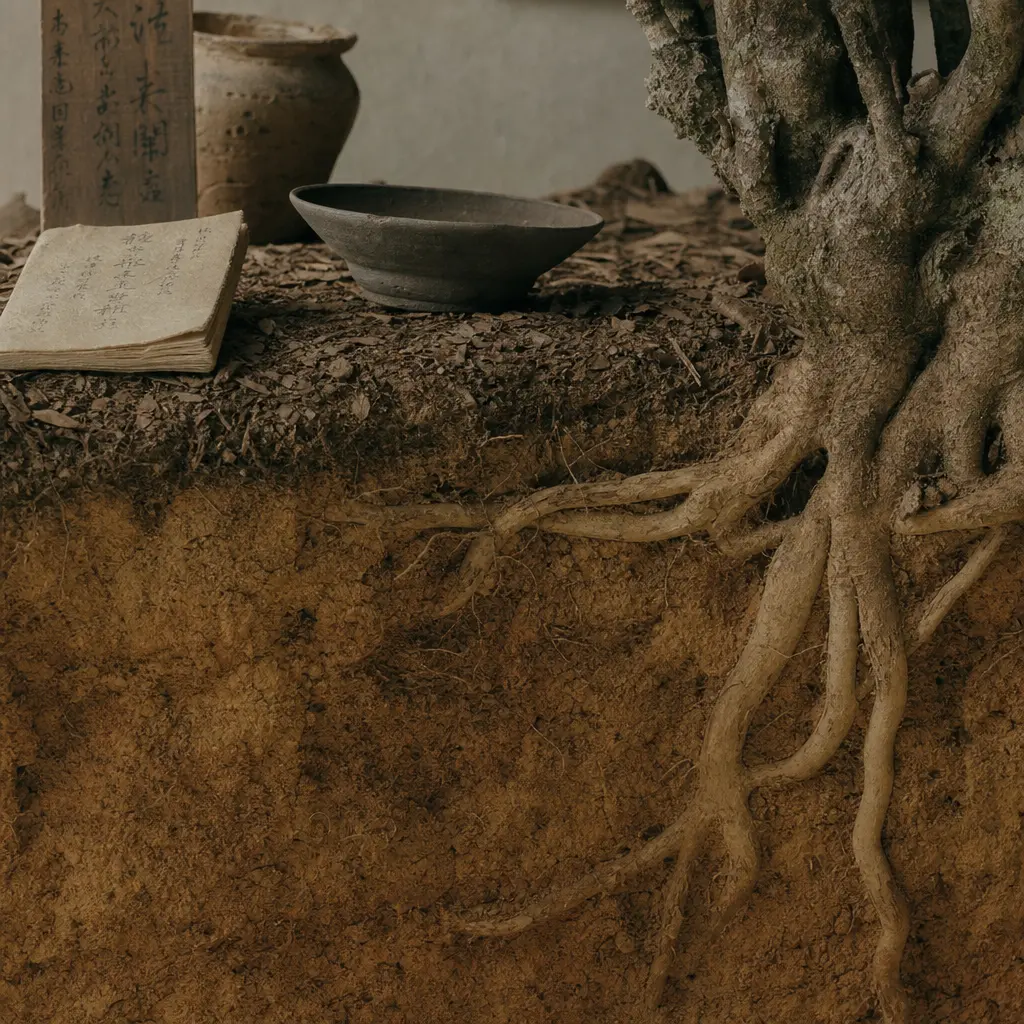
Nannuo Mountain’s soil is predominantly yellow laterite clay (黄壤). This is the standard substrate for much of Xishuangbanna, but Nannuo’s particular expression of it has some notable characteristics. Published soil analyses for Xishuangbanna tea regions consistently show pH values in the 4.0–5.5 range, and Nannuo’s soils are typically reported at the higher end of that band — approximately pH 4.5–5.5 — meaning they are slightly less acidic than Bulang Mountain’s more aggressively leached soils.
The practical implication is mineral availability. Tea plants are efficient acidophiles, but the degree of soil acidity affects which minerals are soluble and accessible to the roots. Bulang’s more acidic soils may contribute to that region’s sharper, more confrontational bitterness. Nannuo’s marginally higher pH — combined with its deep forest litter layer in old-growth zones — likely contributes to a more rounded bitterness profile and better sweetness retention. I want to be careful not to over-specify this: soil-to-cup causation in tea is genuinely complex, and drawing straight lines from a pH number to cup character overstates what we know. But the correlation between soil type and regional flavor consistency is real enough to take seriously.
The upper-elevation old-growth gardens benefit from decades of accumulated forest litter — leaves, bark, decomposed organic matter from the surrounding forest canopy. Ancient tea trees growing in this environment have root systems reaching 3–5 meters into the subsoil, accessing mineral layers unavailable to shallow-rooted plantation tea. This depth difference is one of the most credible mechanisms for the qualitative gap between gushu (古树, ancient tree) and taidi (台地, terrace plantation) material.
Key Cultivars & Tea Types
Nannuo Mountain’s predominant cultivar is large-leaf assamica (大叶种, dayezhu ng), specifically the Yunnan big-leaf variety (云南大叶种) that characterizes most of Xishuangbanna’s serious tea production. Among researchers and producers, Nannuo’s ancient tree population is considered genetically diverse — a reflection of the mountain’s long cultivation history and the tendency of older tea gardens to contain seedling-grown trees rather than clonally propagated material.
Seedling diversity matters to flavor. Clonal plantation blocks produce consistent, predictable leaf. Old-growth seedling populations produce variation — tree to tree, season to season — that experienced drinkers read as complexity. When you taste a well-sourced Nannuo gushu blend from Banpolaozhai, you’re tasting the averaged expression of dozens or hundreds of genetically distinct trees. That averaging produces something richer and more layered than any single clone could offer.
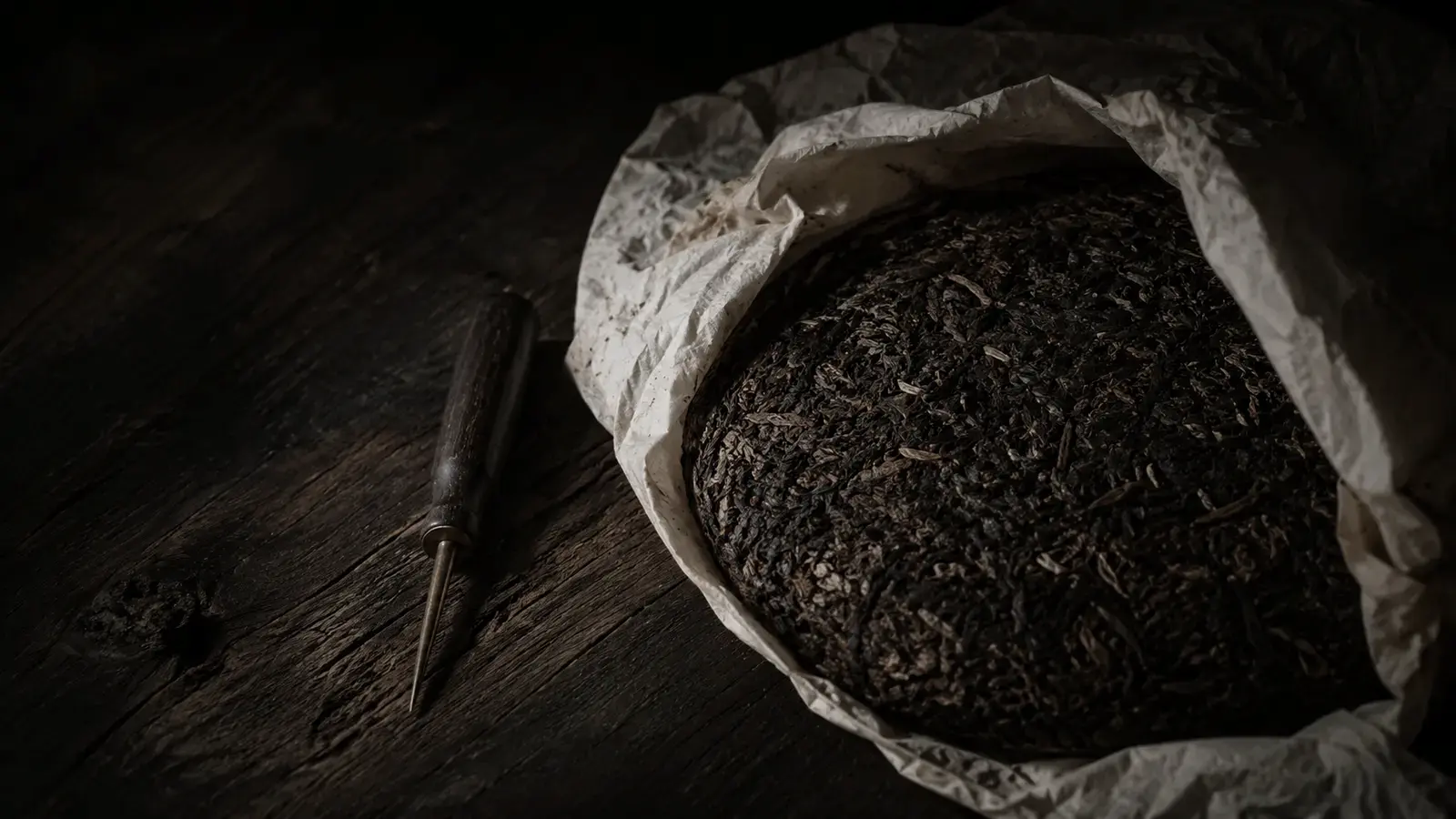
The primary commercial output of Nannuo is sheng pu-erh (生普洱), processed as maocha (毛茶, raw dried tea) and pressed into cakes. Some Nannuo material also appears in blended productions — Menghai Tea Factory (勐海茶厂) and other large-scale producers have historically sourced from the mountain, and its balanced character makes it useful as a blending component in productions that need sweetness and structure without excessive bitterness.
Shou pu-erh (熟普洱) production exists but is less the focus of Nannuo’s identity. The mountain’s reputation is built on sheng.
Processing Traditions
Standard sheng processing applies on Nannuo: hand-picking (采摘), brief withering, kill-green in a wok (杀青, shāqīng), rolling (揉捻), sun-drying on bamboo trays (晒青, shàiqīng), and pressing into cakes or selling as loose maocha.
One detail worth noting is kill-green temperature and duration. Nannuo’s leaf character — moderate bitterness, inherent sweetness — means producers working with this material generally don’t need to apply aggressive shaqing to tame astringency. Bulang material, with its higher catechin load and sharper bitterness, sometimes receives more intensive kill-green to make it approachable. Nannuo’s gentler chemistry allows a lighter touch, which in turn preserves more of the volatile aromatic compounds responsible for the floral-vegetal notes the region is known for.
Spring harvest (春茶, chūnchá), specifically the pre-Qingming or early-spring first flush, commands the highest prices and produces the most complex material. Autumn harvest (秋茶, qiūchá) has its advocates — the drier conditions often produce tea with a slightly different aromatic profile — but spring dominates the premium segment.
The rolling step on Nannuo material is typically light to moderate, preserving leaf integrity. Tightly rolled material releases more slowly across multiple steepings; looser rolling opens faster but fades earlier. For Nannuo, where the goal is consistent expression across 8–12 steepings, moderate rolling is the standard approach.
Characteristic Flavor Signatures
This is where Nannuo earns its middle-path reputation. Based on extensive research, reported tasting notes from multiple credible sources, and the flavor logic of its climate and soil, the characteristic profile looks like this:
Dry leaf and rinse: Light vegetal-floral aromatics, sometimes with a sweet grass or hay quality. The leaf itself tends toward medium-green with good intact trichome coverage on old-tree material.
Early steepings (1–3): Clean entry, medium body, brightness without sharpness. Bitterness appears in steepings two and three — present but not aggressive, closer to dark chocolate than to quinine. The key marker is how quickly it resolves: good Nannuo bitterness converts to huigan (回甘, the returning sweetness) within 30–60 seconds of swallowing. A slow or absent huigan is a quality indicator worth tracking.
Mid steepings (4–7): The floral-vegetal character deepens. Depending on the specific material, notes of orchid, fresh forest, light stone fruit, or sweet grain are reported across multiple sources. Body remains consistent rather than fading dramatically. This is where Nannuo’s balance is most evident — it doesn’t spike and crash the way lower-quality material does.
Late steepings (8–12+): Old-tree Nannuo holds flavor unusually well into extended sessions. The bitterness softens first, leaving sweetness and a mild creaminess. The finish lengthens. This staying power in late steepings is one of the clearest practical markers of genuine gushu material, and Nannuo’s upper-elevation gardens produce it consistently.
What Nannuo is not: It is not Bulang. There is no gut-punch bitterness, no dark mineral intensity, no sense that the tea is testing your tolerance. It is not Yiwu. There is no Nannuo equivalent of the perfumed transparency that makes great Yiwu so prized. Nannuo is substantial without being heavy, sweet without being soft, complex without being demanding. This is genuinely a difficult balance to achieve, and the region achieves it with notable regularity.
The Tea King Tree and Nannuo’s Historical Standing
No terroir profile of nannuo mountain pu-erh is complete without addressing the 南糯山茶王树 (Nannuo Shan Cháwáng Shù) — the Nannuo Tea King Tree. This tree, estimated at over 800 years old when it was formally documented in the 1950s, played a significant role in establishing Xishuangbanna’s credibility as an ancient tea-producing region during the modern era. Its existence provided concrete evidence that tea cultivation on these mountains was not a recent commercial enterprise but a multi-century tradition predating any written records most buyers had encountered.
The Tea King Tree itself is no longer harvested — it died in the 1990s after decades of visitors and the stresses of fame. But its legacy is real: Nannuo’s documentation as a site of ancient cultivation created the foundation on which the region’s gushu market was built. When buyers pay premium prices for Banpolaozhai old-tree material today, they are paying partly for a provenance that the Tea King Tree helped establish in the collective memory of the trade.
Other producing villages on the mountain have their own ancient tree populations. Banpolaozhai, at the highest elevations, is generally considered to contain the densest concentration of genuinely old trees — estimates of 300–500+ years are commonly cited for the oldest specimens in active production, though precise dating of individual trees remains methodologically contested.
Quality Indicators & Authentication
The gushu/taidi divide on Nannuo is particularly instructive precisely because both exist in close proximity. A buyer visiting the mountain can, in principle, taste directly from old-growth gardens and from adjacent plantation blocks on the same day and note the differences. Reported observations from multiple credible sources point to these contrasts:
Body and texture: Gushu material tends toward a fuller, more glycerin-like mouthfeel. Taidi is thinner, sometimes watery by comparison.
Bitterness character: Plantation material bitterness tends to linger and not fully convert to sweetness. Old-tree bitterness arrives cleanly and resolves through huigan.
Session length: Taidi material fades meaningfully after steep 5–6. Old-tree material from upper Nannuo holds through 10–12 steepings with diminishing but still pleasant returns.
Leaf appearance: This is genuinely difficult for most buyers to assess reliably. Larger leaf doesn’t automatically mean old tree; trichome density on the bud is relevant but can be faked by blending; wet leaf texture after steeping is occasionally cited as an indicator but requires hands-on experience to interpret.
Price as signal: Plantation-grade Nannuo maocha runs roughly $5–15 per 100g. Old-tree material from Banpolaozhai ranges from $50–200 per 100g depending on tree age, village, and season, with exceptional single-tree harvests occasionally higher. The spread is wide enough that the market is sorting on something real — but this also means authentic old-tree Nannuo at the lower end of the gushu price band warrants careful sourcing attention.
Authentication is a persistent challenge across all Xishuangbanna origins, and Nannuo is no exception. The region’s strong reputation creates commercial incentive to label plantation material as gushu. There is no foolproof consumer-level test. The most practical advice from sourcing literature is to develop direct relationships with producers whose land tenure and tree populations can be verified, and to build comparative tasting experience with known material before investing heavily.
Price Ranges
Nannuo occupies the middle tier of Xishuangbanna pricing — more expensive than Menghai estate blends and anonymous plantation material, less expensive than comparable-quality Yiwu and Laobanzhang.
| Material Type | Approximate Price (USD per 100g) |
|---|---|
| Taidi/plantation maocha | $5–15 |
| Mid-range mixed-age garden | $15–50 |
| Gushu (Banpolaozhai, 300+ yr) | $50–200 |
| Single-tree special harvest | $200+ |
These figures reflect the international export market and represent approximations derived from market research. Domestic Chinese market pricing is generally lower, particularly for plantation-grade material. The premium for genuine Banpolaozhai old-tree reflects both scarcity — the harvest from a limited number of trees, once — and the market premium Nannuo’s reputation commands.
Relative value: for the quality achieved, Nannuo gushu is consistently reported as better value than comparable Yiwu or Laobanzhang (老班章) material at similar price points. Whether that assessment holds for any specific cake requires case-by-case evaluation.
The Saint-Julien Parallel
The wine comparison that best captures Nannuo’s position is Saint-Julien in Bordeaux’s Médoc. Saint-Julien produces no classified first growths, and it lacks the raw power of Pauillac’s best or the perfumed delicacy of Margaux. What it produces, consistently, is wine that balances both without sacrificing either — structured enough to age, elegant enough to drink young, priced below its quality equivalent in neighboring appellations.
Nannuo holds exactly this position. It is not Bulang — there is no Nannuo equivalent of the grip and intensity that makes serious Bulang demanding to drink young and transformative with age. It is not Yiwu — there is no Nannuo equivalent of the transparency and floral delicacy that makes great Yiwu so prized. What Nannuo offers is the balance point between those poles, executed with unusual consistency across villages, seasons, and producers.
This is not a consolation prize. Balance in tea, as in wine, is genuinely difficult to achieve and valuable when you find it. The teas that age most dependably are rarely the most extreme. The teas that reward new drinkers most consistently are rarely the most austere. Nannuo’s willingness to meet the drinker in the middle — without compromising on complexity or longevity — is the foundation of its long-term reputation.
Aging Potential
Properly stored Nannuo sheng follows a dependable aging trajectory. The first three to five years often show some of the sharp green notes common to young sheng — a slight rawness in the bitterness, high volatile aromatics that read as fresh but sometimes strident. Around year five to eight, a softening begins. The bitterness integrates. The sweetness that was present in youth deepens into something honeyed and more persistent.
At 10–15 years of appropriate storage (55–75% relative humidity, no light exposure, away from strong odors, ideally with seasonal temperature variation that is not extreme), multiple sources describe Nannuo as having developed smooth honeyed sweetness with remaining structural backbone — enough grip to keep the tea interesting, enough evolution to reward patience. For practical guidance on achieving those conditions, see how to store pu-erh tea.
What Nannuo rarely produces is the dramatic transformation of the best aged Yiwu — that almost ghostly quality of great old sheng that is almost impossible to connect to the young cake from which it came. Nor does it develop the deep mineral earth complexity of well-aged Bulang. Its aging story is evolution, not revolution. For collectors managing multiple aging projects, this predictability has real value. You know roughly what you’re building toward, and the odds of a bad outcome from poor storage are somewhat lower than with more delicate material.
The lesson here for buyers: if you are acquiring Nannuo specifically for aging, prioritize storage quality over acquisition price. The tea will reward good storage faithfully. It will not overcome poor storage heroically.
Recommendations by Drinker Profile
Beginners to single-origin sheng: Nannuo is one of the most consistently recommended entry points in sourcing literature. The bitterness is present — it is genuine sheng — but it is not punishing. The sweetness is real. The complexity is accessible rather than demanding. Starting here builds the reference points you need to appreciate the extremes.
Drinkers who prefer balance over intensity: Nannuo is probably your home appellation. If you find Bulang confrontational and Yiwu evanescent, Nannuo’s middle path is not a compromise — it is a genuine destination.
Drinkers building an aging library: Nannuo’s dependable aging curve makes it an excellent choice for medium-term aging projects (10–20 years). It doesn’t require heroic storage conditions or perfect luck to deliver a satisfying result. Buy more than you need for current drinking and set some aside.
Experienced drinkers exploring sub-village differences: The contrast between Banpolaozhai gushu and lower-elevation material on the same mountain is one of the most instructive comparative tastings available in Yunnan tea. If you already know what Nannuo tastes like and want to go deeper, the elevation and village variables repay exploration.
A Region Worth Knowing
The regions that earn sustained respect in any serious producing area are rarely the flashiest. They are the ones that over-deliver relative to their reputation, remain accessible relative to their quality, and show up consistently year after year without dramatic failures. In Burgundy, this describes Chambolle-Musigny’s village-level wines. In Napa, certain Oakville producers. In Xishuangbanna, it describes Nannuo.
Nannuo mountain pu-erh doesn’t need to be the most extreme tea in your collection to be the most reliable. In a category where authenticity is contested, provenance is murky, and quality varies enormously, a region you can return to with reasonable confidence is worth more than its price tag suggests.
That is Nannuo’s middle path. It is not a lesser path. It is a well-worn one, for good reason.