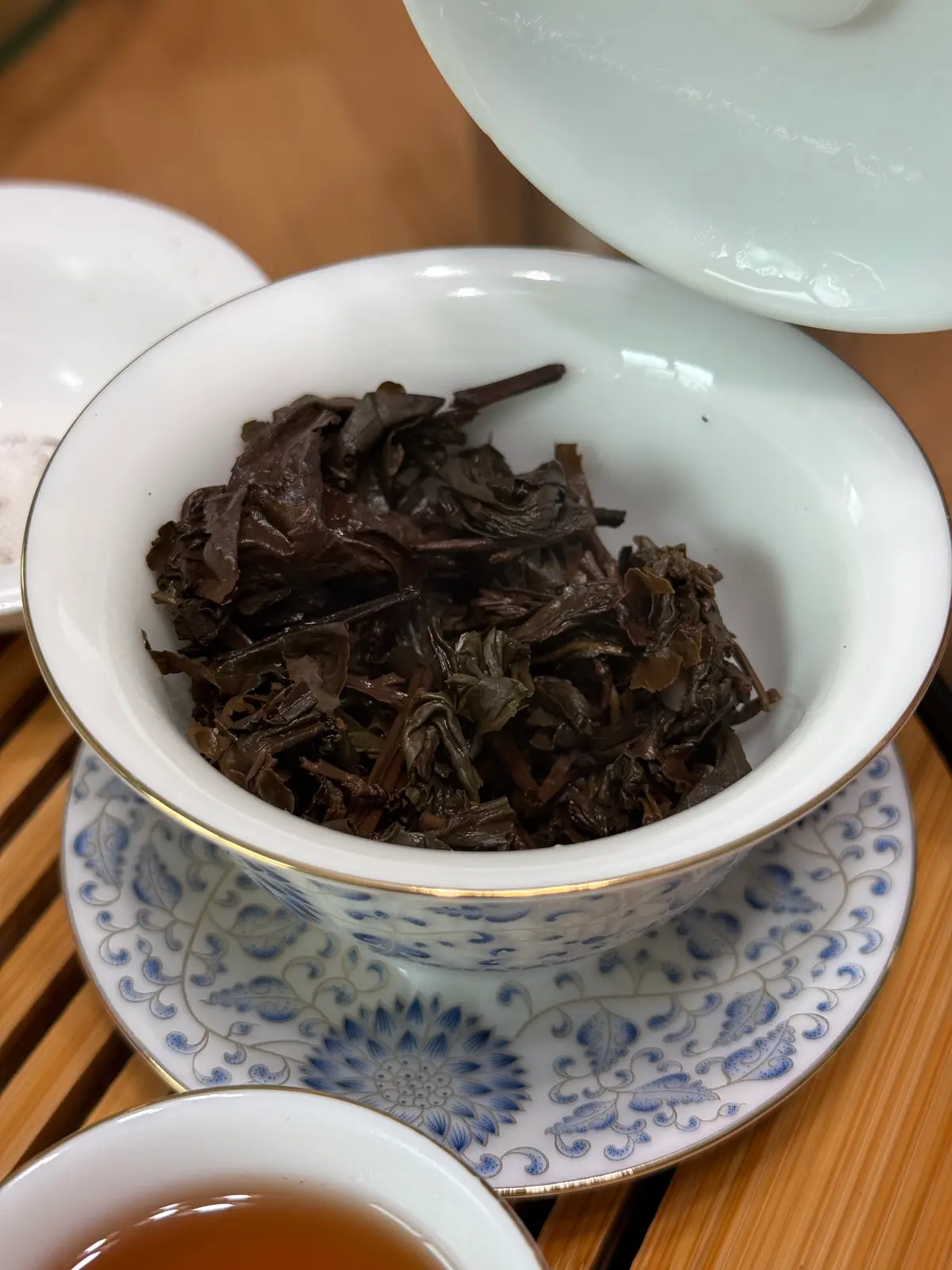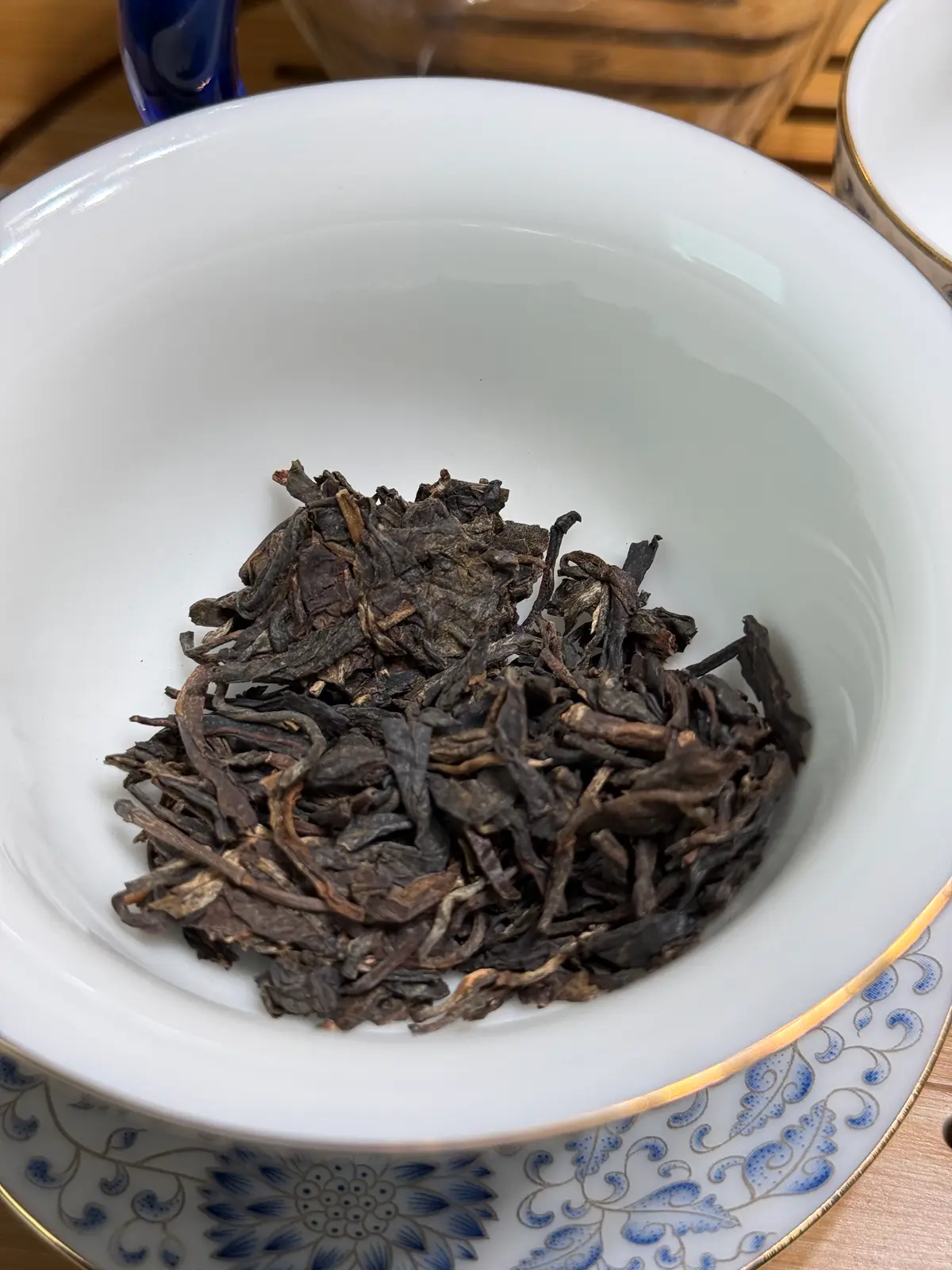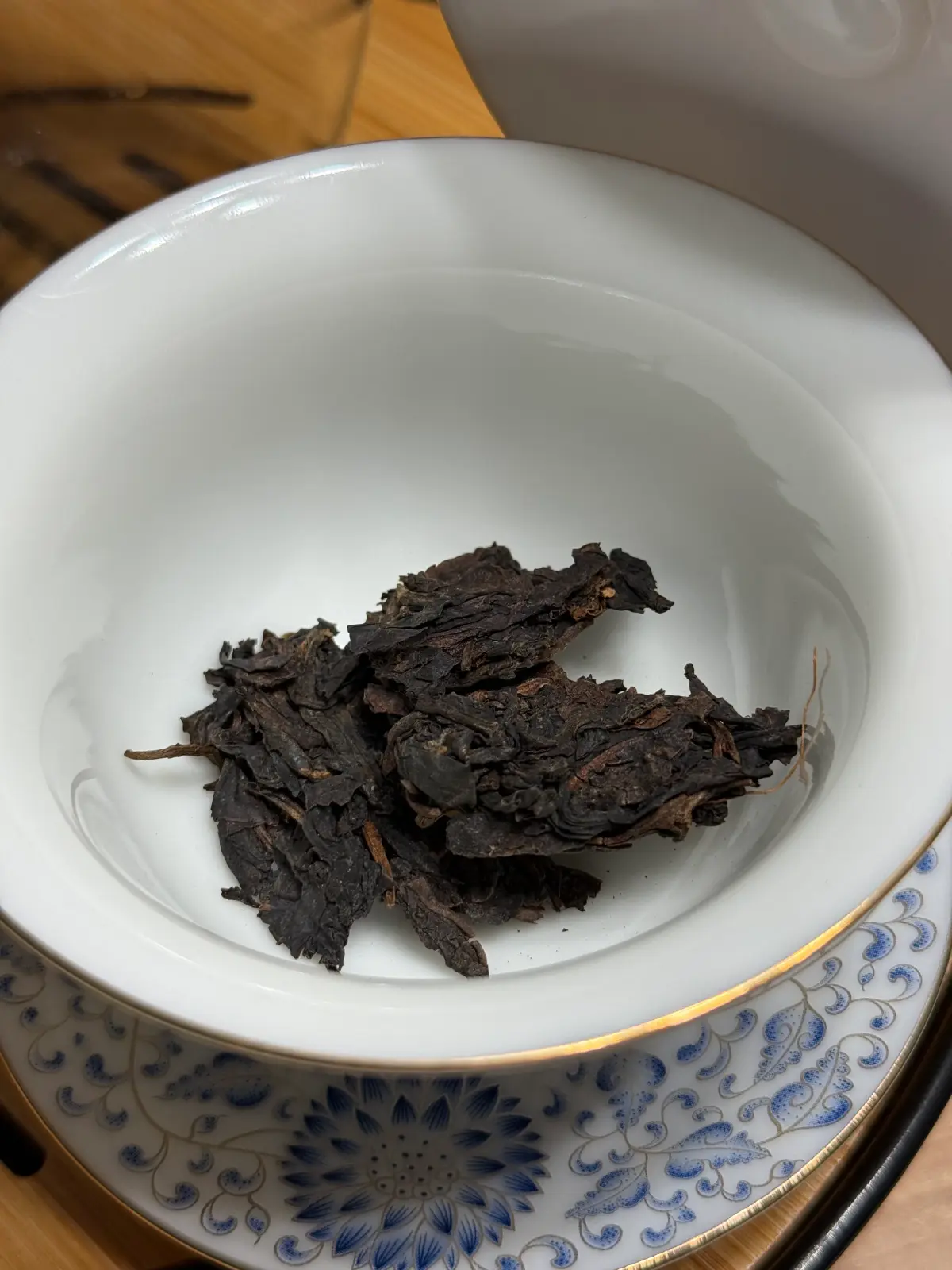
My first cake. Not a sample. Not 25 grams in a foil pouch. A full cake — 400 grams of 22-year-old Yi Wu sheng pressed by the Chang Tai factory in 2004, purchased from a tea shop for ฿5,000. The cake that made the hobby permanent.
Chang Tai (昌泰) established their first factory in Yiwu town in 1999 and built their reputation on early 2000s Yi Wu pressings that are now sought-after collector’s pieces. This 2004 cake is from that era — Yiwu area material, stone-mold pressed, aged over two decades in clean storage. The wrapper says what it says. The cup confirmed it.

Dry Leaf
The first thing was the smell through the bag. Rich. Not musty, not stale, not off. Rich. That distinction matters — mustiness means bad storage, dampness, mold. This had none of that. What it had was dates, roasted chestnuts, toasted caramel, cooked brown sugar. The bag smelled like a high-end pantry in autumn. Dark, compressed cake. Twenty-two years old and clean.

The Session
The first steep was gentle. Sweet, soft, inviting — dates and caramel in a quiet register. Nothing aggressive. A polite opening. Then the second steep hit and the tea woke up. Same 10-second steep, dramatically deeper and stronger. The liquor darkened. The dates intensified. Toasted caramel and cooked brown sugar arrived in the mid-palate. This was no longer polite. This was rich. Premium. The kind of quality that fills a room.
And I could smell something underneath — the faintest hint of peach sweetness trying to surface, the same note that defined both my previous Yiwu shengs. But barely there. A distant memory. The peach that dominated the 2006 and 2003 Yiwus has, at 22 years, transformed further down the aging path into dates (枣香, zǎo xiāng). This is where the peach goes. This is the next chapter.
Steep 3 shifted. The dates pulled back and wood moved to the foreground. Not the sharp hinoki/편백나무 of Thai aged sheng. Something different — oak. Aged timber. A woody richness that surrounded everything like the walls of an old library. The 편백나무 was there, slightly, in the background — confirmed when I put my nose directly into the wet leaves — but the dominant wood character was broader, darker, more oak than cypress.
And then a flavor I couldn’t name at first. Something from Chinese herbal medicine. Not bitter, not unpleasant — familiar in the way that walking past a traditional Chinese medicine shop is familiar. A deep, complex, herbal warmth that had no equivalent in any tea I’d tasted before. This is 药香 (yào xiāng) — medicinal fragrance. One of the most prized characteristics in aged pu-erh, emerging only after 15-20+ years of proper aging. The fact that it was here confirmed both the age and the storage quality.

Steeps 4-5 brought the dates back. The session completed a circle: dates opened, wood and medicine took over in the middle, and dates returned in the final act — richer now, layered with the wood and medicine, carrying more complexity than the opening sweetness. The tea told a story across five steeps.
No bitterness. None. Not a trace. But also not sweet-sweet — not the cloying sweetness that triggered the “too sweet” response in the Liu Bao or underdosed shou sessions. This was balanced. Smooth. Rich without shouting. I don’t know if it was knowing the price, knowing this was a cake and not a sample, knowing it was 22 years old — but it felt premium. It felt prestigious. It tasted rich in a way that went beyond flavor into experience.
Flavor Profile
The front is dates — 枣香, the dried jujube sweetness that is the signature of well-aged sheng past the 15-20 year mark. Caramel, toasted grain, cooked brown sugar. Where the younger Yiwu shengs gave peach, this one has moved past peach into the deeper, darker sweetness of dried fruit and Maillard-like transformation. The mid is wood and medicine — aged oak, timber, resinous depth, with 药香 (medicinal fragrance) emerging as a complex herbal warmth. The finish brings the dates back, now layered with everything the mid-palate introduced. Rich, sustained, warm.
Mouthfeel & Huigan
Smooth. Completely, utterly smooth. Twenty-two years of aging dissolved every trace of the astringency and bitterness that young sheng carries. The mouthfeel has the weight of rich aged tea without any of the tannic grip that exhausted the palate on the Kunming-stored Bulang Tuo. This is full conversion — polyphenols transformed entirely into softer, sweeter, more complex compounds.
The huigan is gentle and sustained rather than dramatic. There is no bitterness to convert from, so the mechanism is different from Bulang terroir’s explosive bitterness-to-sweetness arc. Here the sweetness simply persists, deepens, and returns. Dates as the vehicle, carrying the sweetness steadily across the session.
Qi Notes
Quietly present. A warmth and sense of richness that registers less as a specific body sensation and more as an overall feeling of quality. Not the potent dizziness-risk of Meng Song or the cha zui danger of the 1988 aged sheng. Something subtler — the tea settling into the body the way a comfortable weight settles into a chair.
Value Assessment
฿5,000 (~$140 USD) for a 400g cake of 22-year-old Chang Tai Yi Wu sheng with clean storage and confirmed dates/medicinal character. Comparable aged Yiwu factory cakes from the early 2000s trade internationally at $200-500+. This is fair to underpriced for what it delivers. The first cake in the collection — and a justified one.

Verdict
Three Yi Wu shengs tasted. Three different storage conditions. Three different chapters of the same mountain’s story. The 2006 Kunming-stored Yiwu gave peach and 편백나무 — cool, bright, stone fruit preserved by mountain air. The 2003 Banna-stored Yiwu gave peach and chestnuts-on-fire — warmer, more integrated, humid tropical storage developing darker aromatics. This 2004 Chang Tai gave dates, medicine, and oak — the deepest transformation of the three, the stone fruit fully converted into the dried-fruit-and-herbal vocabulary that only decades of aging produce.
The peach is still in the mountain. But at 22 years in warm storage, the peach has become something else. It’s become dates. And medicine. And the oak walls of a room where something valuable has been kept for a very long time.
My first cake. Not a sample to try once and analyze. A cake to return to across months, across seasons, to watch myself learn what it teaches as my palate develops. This is why people buy cakes. Not to finish them. To grow with them.
This tea's strongest axis is Aroma (8/10). Notably low: Astringency, Mineral, Acidity.