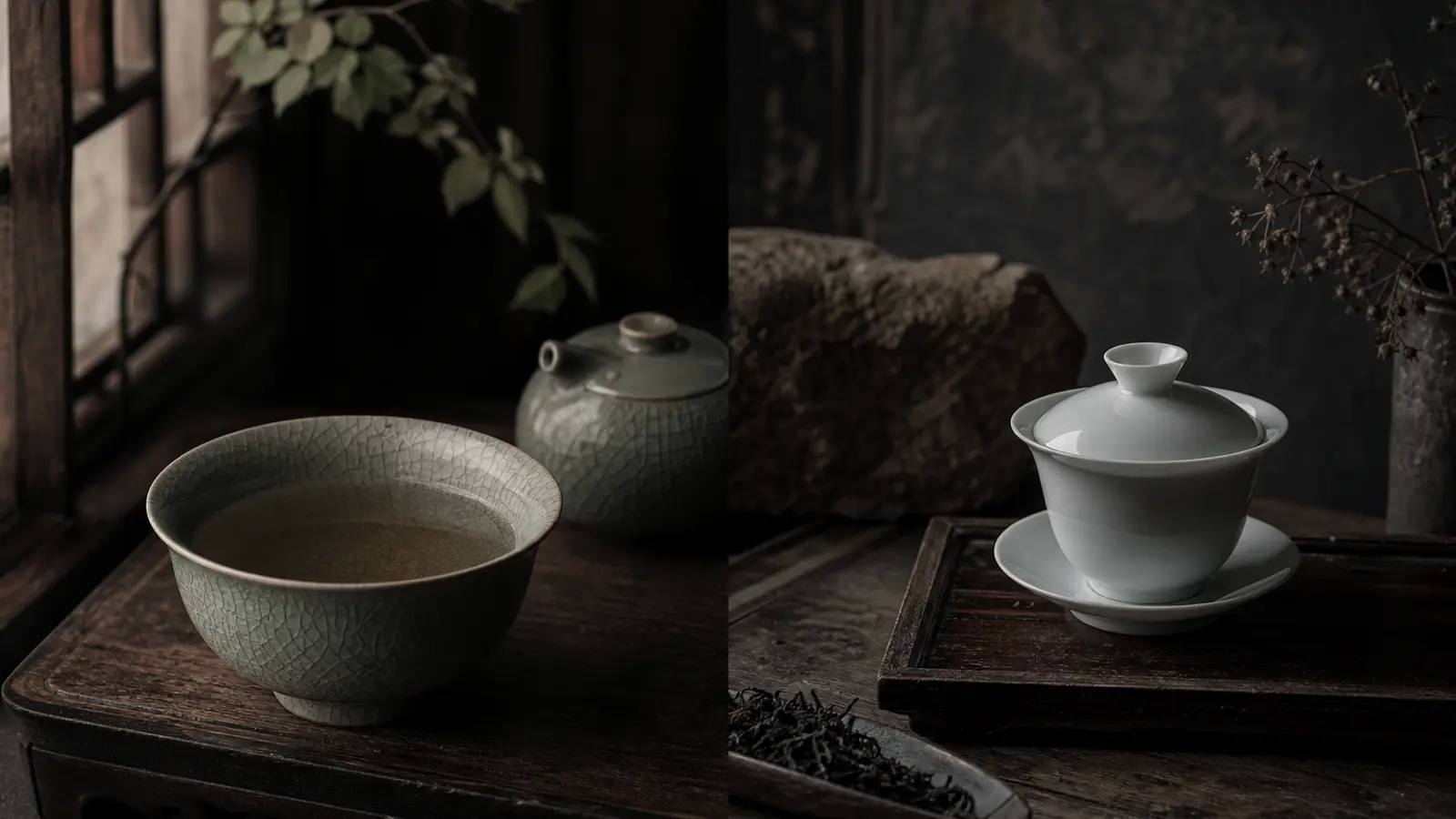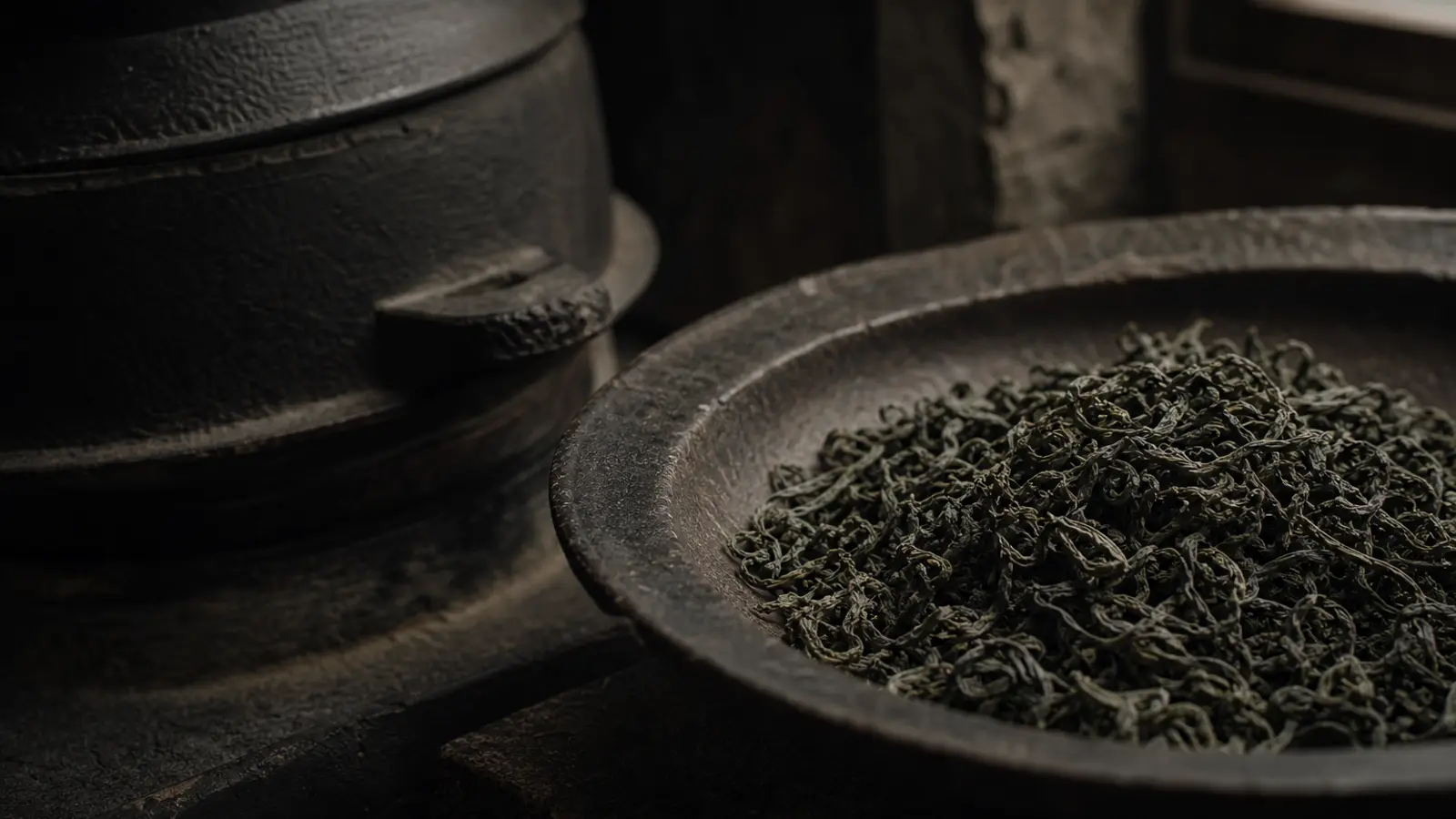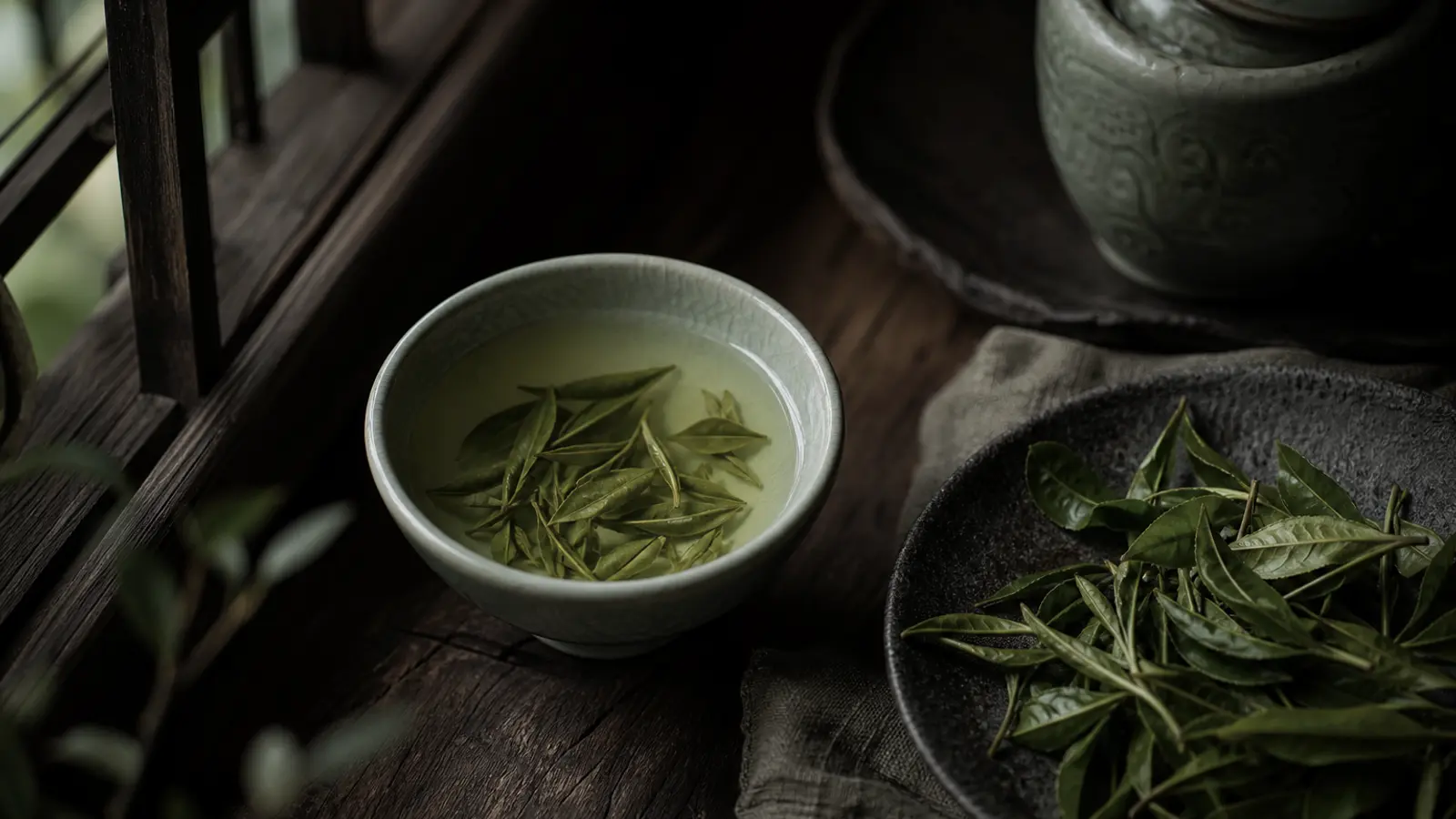
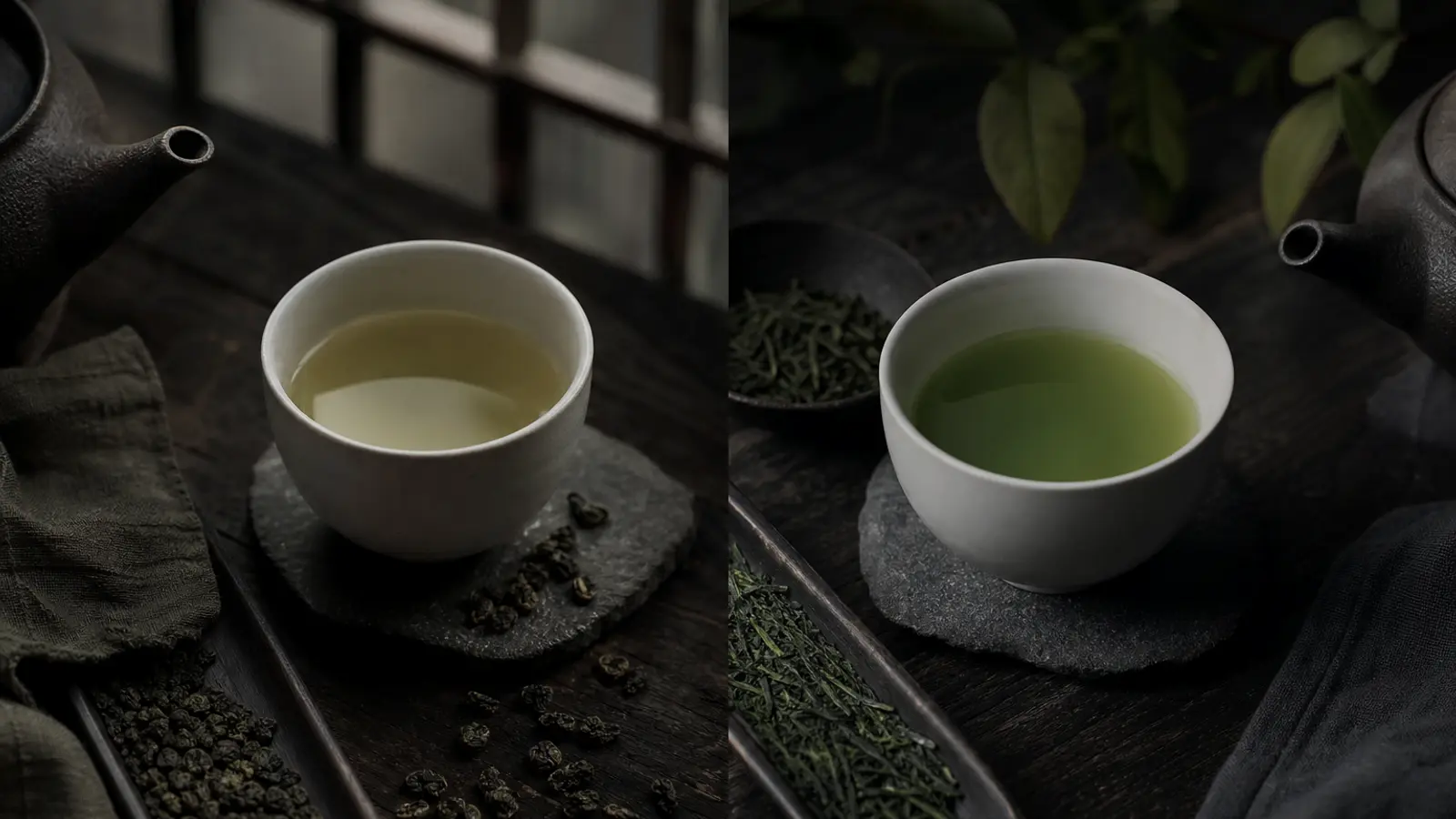
Korean tea and Japanese tea are both green teas made from Camellia sinensis var. sinensis. They share the same raw material category. They share overlapping harvest seasons, overlapping price points, and overlapping cultural weight. But the moment you brew a cup of each side by side, the similarity ends. One tastes like roasted grain and sweet chestnut. The other tastes like the ocean and cut grass. The reason is one decision made in the first minutes after the leaf is picked: how you apply heat to stop oxidation.
That single processing difference — pan-firing (덖음, deokkeum) in Korea versus steaming (蒸し, mushi) in Japan — is the thesis of this comparison. Everything else: cultivar, shading, ceremony, cultural politics, and price flows from there.
The Core Difference: Pan-Fired vs Steamed Green Tea
Korean green tea is pan-fired (roasted in a heated pan to halt oxidation), producing savory, roasted-grain sweetness with gentle body. Japanese green tea is steamed, creating bright vegetal flavors, vivid green color, and higher umami intensity. The processing difference — dry heat versus steam — defines every downstream characteristic.
At a Glance:
| Feature | Korean Green Tea | Japanese Green Tea |
|---|---|---|
| Primary processing | Pan-fired (덖음, deokkeum) | Steamed (蒸し, mushi) |
| Dominant flavor | Roasted grain, chestnut, sweet | Vegetal, marine, umami |
| Shading practice | Rare / not systematic | Core to gyokuro and matcha |
| Ceremony tradition | Darye (다례) — seasonal, mindful | Chado (茶道) — codified, ritualized |
| Sejak / Sencha price | $15–$45 per 100g | $15–$60 per 100g |
| Western availability | Limited but growing | Widely available |
To make green tea, you must denature the oxidative enzymes in fresh leaf quickly after harvest. Heat does this. The question is what kind of heat.
Pan-firing uses a dry, high-temperature wok or drum — typically 250–300°C. The leaf contacts hot metal. Moisture flashes off. Maillard reactions begin. You get roasted, nutty, sometimes toasty flavors layered under the tea’s inherent sweetness. This is how China has processed green tea for centuries, and it’s the tradition Korea inherited and made its own.
Steaming uses moist, pressurized heat — typically 30–90 seconds at around 100°C. No Maillard reactions. Enzymes are denatured but the leaf’s natural chemistry is preserved almost intact. Chlorophyll stays vivid. Volatile aromatic compounds that evaporate in dry heat are retained. The result is a cup that reads as green, vegetal, marine, and — especially in longer-steamed Japanese styles — intensely savory.
Same plant. Same category. Opposite cups. This is what processing actually means in practice.
Korean Green Tea (녹차, Nokcha): Terroir Through Fire
Korean green tea is predominantly grown in the southern provinces: South Jeolla (전라남도), South Gyeongsang (경상남도), and Jeju Island (제주도). The most storied growing area is Hadong (하동), in the Jirisan mountain range, where wild-grown or semi-wild trees — called yasaeng-cha (야생차), wild tea — produce leaf from bushes that may be hundreds of years old.
Elevations in Korean tea regions typically run 200–700m. This is lower than, say, Taiwan’s high mountain oolongs or the highest Darjeeling gardens, but the maritime climate moderated by surrounding mountain ridges creates meaningful growing conditions. Hadong’s steep riverine valleys trap morning mist. Boseong (보성), the largest commercial tea-growing region in Korea, is lower and more industrial but produces reliably clean, accessible nokcha.
Korean Tea Grades
Korean green tea grades by harvest timing, not leaf size or rolling style:
- Ujeon (우전) — “before the rain,” harvested before Gok-u (around April 20). The most prized, most expensive. Tiny, precisely hand-picked buds.
- Sejak (세작) — “thin sparrow’s tongue,” harvested shortly after Gok-u. More leaf volume, still high quality, the most common premium grade.
- Jungjak (중작) — mid-harvest, larger leaves, more body, less delicacy.
- Daejak (대작) — late harvest, full leaves, robust and affordable.
The flavor profile across all grades trends toward roasted grain, chestnut, light smoke, and a persistent natural sweetness. The huigan (回甘) — the returning sweetness that rises after you swallow — is a defining feature of well-made Korean nokcha.
Korean Cultivars
Korean cultivar documentation in English is genuinely thin. This is an area where the record needs filling in. Korea uses a mix of traditional Korean landraces — selections that have grown in the peninsula for centuries — and varieties introduced or bred in the modern era. Notable named cultivars include Samdaori (삼다오리) from Jeju, and Jangwon selections from the government tea research station. Many artisan producers in Hadong work with unimproved seed-propagated wild trees that predate cultivar breeding programs entirely.
What this means in the cup: Korean teas show genuine cultivar diversity that isn’t yet systematically mapped. If you drink widely across Korean growing regions, you encounter real variation — evidence that the gene pool is broader than the documentation suggests.
Japanese Green Tea (緑茶, Ryokucha): Precision Through Steam
Japan’s green tea industry is built on a single cultivar dominating production: Yabukita (やぶきた), which accounts for roughly 75% of Japanese tea plantings. Yabukita was selected in Shizuoka in the 1950s for yield, cold hardiness, and reliable flavor. It delivers the grassy, umami-forward profile that defines mainstream Japanese sencha (煎茶).
The major growing regions are:
- Shizuoka (静岡) — the largest producing prefecture, source of most commercial Japanese green tea
- Uji (宇治) — the historical prestige region near Kyoto, producer of the most celebrated gyokuro (玉露) and matcha (抹茶)
- Kagoshima (鹿児島) — southern production, warmer climate, large volume
- Yame (八女) — Fukuoka prefecture, known for exceptional gyokuro
- Wazuka (和束) — key Uji-region source village
Japanese tea is processed with intense regional and producer-level precision. Steaming time alone varies: asamushi (浅蒸し, light steam, 30–40 seconds) produces a brighter, more delicate cup; fukamushi (深蒸し, deep steam, 60–90 seconds) breaks down the leaf further, producing a thicker, greener, more robust brew. This is the kind of controlled variation that makes Japanese green tea function like an appellation system.
The Shade-Growing Advantage: L-Theanine and Umami
Japan’s most distinctive innovation is shade-growing (遮光, shakou). Before harvest, gyokuro and tencha (the leaf ground into matcha) are shaded from direct sunlight for 2–3 weeks. The plant, deprived of light, cannot photosynthesize efficiently. It stops converting L-theanine into catechins. L-theanine accumulates.
The result: shaded Japanese teas can have L-theanine concentrations 4–5 times higher than unshaded teas. L-theanine is responsible for umami flavor and the calm, focused mental state tea drinkers value. Korea does not systematically shade-grow. This is not a deficiency — it’s a different philosophy. Korean teas express more direct terroir character; Japanese premium teas express more deliberately engineered flavor.
Comparison Table
| Feature | Korean Green Tea | Japanese Green Tea |
|---|---|---|
| Primary processing | Pan-fired (덖음, deokkeum) | Steamed (蒸し, mushi) |
| Dominant flavor | Roasted grain, chestnut, sweet | Vegetal, marine, umami |
| Dominant cultivar | Mixed landraces + bred varieties | Yabukita (~75% of production) |
| Shading practice | Rare / not systematic | Core to gyokuro and matcha |
| L-theanine levels | Moderate | High (especially shaded teas) |
| Key regions | Hadong, Boseong, Jeju | Uji, Shizuoka, Kagoshima, Yame |
| Elevation | 200–700m | 100–600m (varies widely) |
| Ceremony tradition | Darye (다례) — seasonal, mindful | Chado (茶道) — codified, ritualized |
| Cultural status | Recovering (post-colonial disruption) | National identity, deeply embedded |
| Ujeon / Gyokuro price | $60–$120 per 100g | $80–$200 per 100g |
| Sejak / Sencha price | $15–$45 per 100g | $15–$60 per 100g |
| Matcha (Korean vs Uji) | $20–$50 per 100g | $30–$120 per 100g |
| Western availability | Limited but growing | Widely available |
Ceremony and Culture: Different Philosophies, Different Histories
Korean Darye (다례)
Korean tea ceremony — darye — translates loosely as “tea propriety” or “tea etiquette.” It emphasizes seasonal awareness, simplicity, and mindful presence. There is no single codified form; different schools and teachers interpret darye differently. The mood is contemplative rather than performative. You brew what the season calls for. You sit with the cup. The ritual is in the attention, not the choreography.
This flexibility reflects the state of Korean tea culture overall: actively being rediscovered and reconstructed. Korean tea drinking was suppressed during Japan’s colonial administration (1910–1945), when Japanese tea culture was promoted and Korean traditions were marginalized. The post-liberation redevelopment of Korean tea culture has been genuine and ongoing — led by figures like the monk Hyodang Choi Beom-sul (효당 최범술) — but it represents cultural reclamation as much as unbroken tradition. Korean tea drinking carries psychological and political weight that Japanese tea drinking simply doesn’t.
Japanese Chado (茶道)
Japanese tea ceremony — chado, also read sado (茶道) — is one of the most precisely codified ritual arts in the world. Sen no Rikyu (千利休) systematized it in the 16th century around the concept of wabi (侘び) — rustic simplicity as aesthetic ideal. The major schools (Urasenke, Omotesenke, Mushakōjisenke) have maintained continuous lineage and codified every movement: how you turn the bowl, how you fold the cloth, how you enter the room.
Chado is taught formally, practiced formally, and functions as a major cultural export. Millions of Japanese study it as a social accomplishment. It appears in university curricula, corporate training, and tourism. It is the spine of Japan’s global tea identity.
The New Zealand vs France Parallel
The wine parallel I keep returning to for this comparison: Korea versus Japan in tea is like New Zealand versus France in wine.
France has centuries of documented tradition, global market dominance, and the prestige appellation system (Burgundy, Champagne, Bordeaux) that set the reference points everyone else benchmarks against. Japan has this in tea. Uji gyokuro is the Montrachet of the tea world — technically precise, historically deep, internationally recognized.
New Zealand came late to serious wine, had its traditions interrupted or underdeveloped, and produces from a smaller, less-mapped terroir base. But what New Zealand Sauvignon Blanc does — especially from Marlborough — it does in a way that Bordeaux cannot replicate. The character is genuine, the wines are world-class, and the underdog story makes discovery satisfying.
Korean tea, particularly wild-tree Hadong ujeon, has that character. The pan-fired profile is irreproducible by Japanese methods on Japanese soil. It is not a lesser version of Japanese tea. It is its own answer to the same question.
Brewing Parameters: Getting Both Right
Korean and Japanese green teas require different brewing approaches because of their processing differences.
Korean nokcha (pan-fired):
- Water temperature: 70–80°C
- Leaf ratio: 3–4g per 150ml
- First steep: 60–90 seconds in a gaiwan (蓋碗) or Korean darye vessel
- The roasted notes emerge more fully at slightly higher temperatures than Japanese green teas tolerate
Japanese sencha (steamed):
- Water temperature: 70–75°C for standard sencha; 60°C for gyokuro
- Leaf ratio: 3–5g per 100ml (gyokuro uses more leaf)
- First steep: 60 seconds for sencha; 90–120 seconds for gyokuro
- Cooler water preserves the umami and prevents astringency
The practical implication: if you make Korean nokcha the way you make Japanese sencha, you lose the roasted character. If you make Japanese sencha the way you make Chinese green tea — hot and fast — you lose the structure and get bitterness. Both reward attention to temperature.
Which Should You Explore First?
If you come from a background of drinking Chinese green teas — Dragon Well (龍井, Longjing), Bi Luo Chun (碧螺春) — Korean nokcha will feel like familiar territory. The pan-fired processing creates related flavor compounds. Start with a sejak from Boseong to calibrate, then work toward a Hadong ujeon to understand what old-tree character adds.
If you have no prior green tea reference, Japanese sencha is the more approachable entry point. The flavors are vivid and distinct, the brewing parameters are widely documented, and the product availability in Western markets is substantially better.
If you already drink Japanese green tea and want to understand what the pan-fired tradition offers, a side-by-side of Korean sejak and Japanese sencha brewed simultaneously — same temperature, same ratio, same timing — makes the processing difference immediate and visceral. You’ll taste the thesis of this entire article in one session.
Both traditions reward exploration. They are not competing for the same cup. They are two coherent answers to one question, shaped by geography, history, and the first decision made when the freshly picked leaf hits the heat.