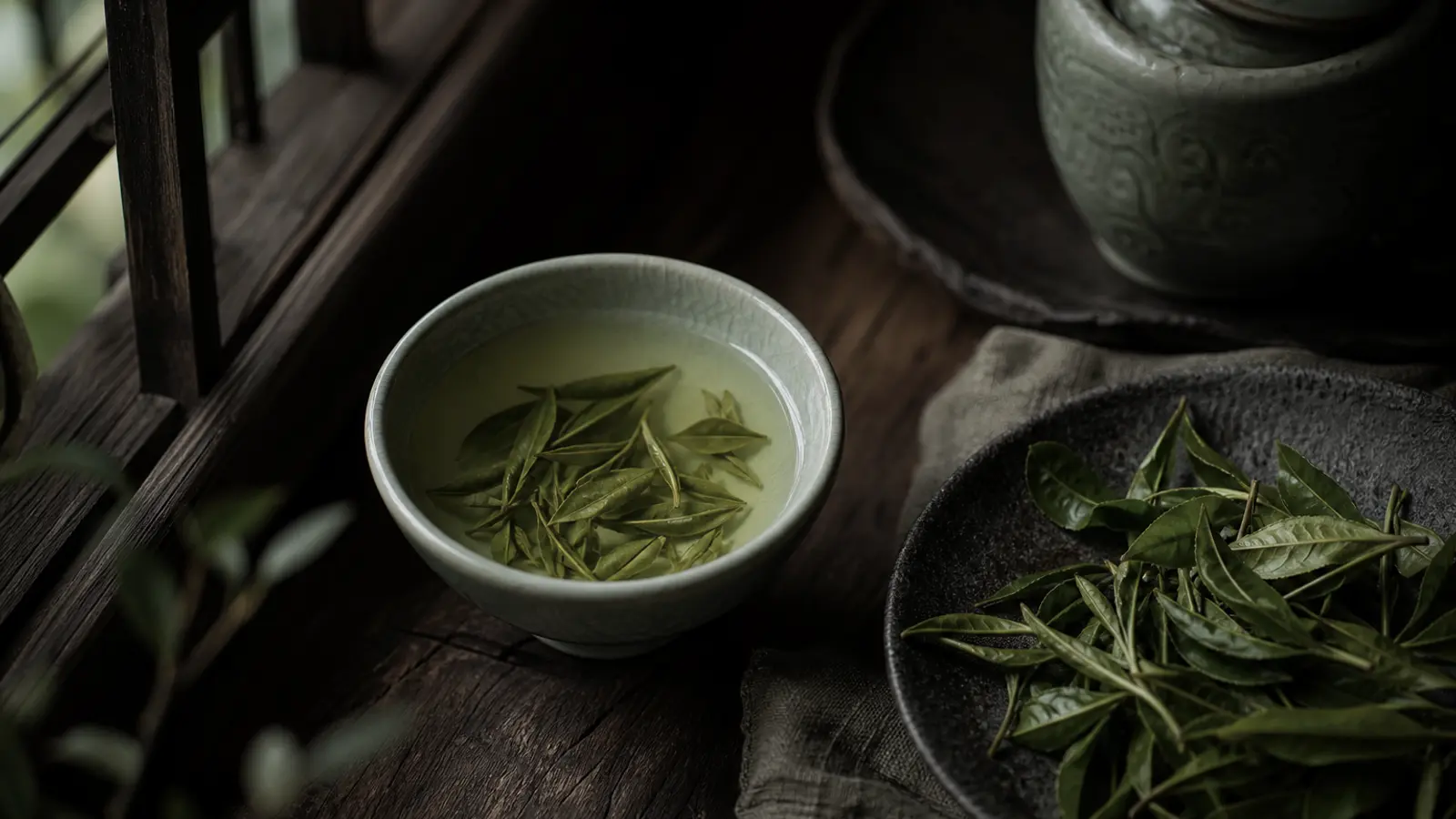
Korean green tea — nokcha (녹차, 綠茶) — is tea from Camellia sinensis produced primarily in southern Korea using a traditional pan-firing technique called deokkeum (덖음) that creates a roasted chestnut and sweet grain character unavailable from Chinese or Japanese green tea. Korea produces roughly 4,000 tons annually across three distinct terroirs: Boseong, Hadong, and Jeju.
Korean green tea is one of the most underappreciated teas on earth.
That’s not a marketing claim. It’s a structural reality. Korea produces approximately 4,000 tons of tea per year — roughly 0.06% of global production. China produces 3 million tons. Japan produces 80,000 tons. The scale difference means Korean tea barely registers in international markets, which means almost nobody outside Korea and a small circle of specialist drinkers has encountered it. The available literature is thin. The search results are thinner. Most Western tea drinkers have never tasted Korean green tea and don’t know what they’re missing.
What they’re missing is this: a tea tradition that is older than Japan’s, nearly destroyed by colonial occupation, rebuilt through deliberate cultural will, and now producing green tea of a character available from no other origin on earth. Pan-fired by hand in iron cauldrons using a technique passed down through generations. Graded by harvest timing with a precision that mirrors the finest wine classifications. Grown across three terroirs — Boseong (보성), Hadong (하동), and Jeju (제주) — each as distinct from each other as Burgundy from Bordeaux from the volcanic slopes of Etna.
I haven’t tasted Korean green tea yet. I write that directly because this site marks the difference between firsthand experience and research. My wife is Korean. My business operates in the Korean market. I read Korean-language tea sources and navigate Korean artisan networks in the original language. The research foundation for this article is deep. The firsthand tasting notes will come — and when they do, this article will be updated with specific session data. Until then, this is Tier 2 content: informed research, not personal experience.
That honesty stated, here is everything the research shows.
What Makes Korean Tea Korean
Korean green tea — nokcha (녹차, 綠茶) — is defined by two elements that distinguish it from Chinese and Japanese green tea: the processing method and the harvest grading system.
Pan-Firing: The Sound of Korean Tea
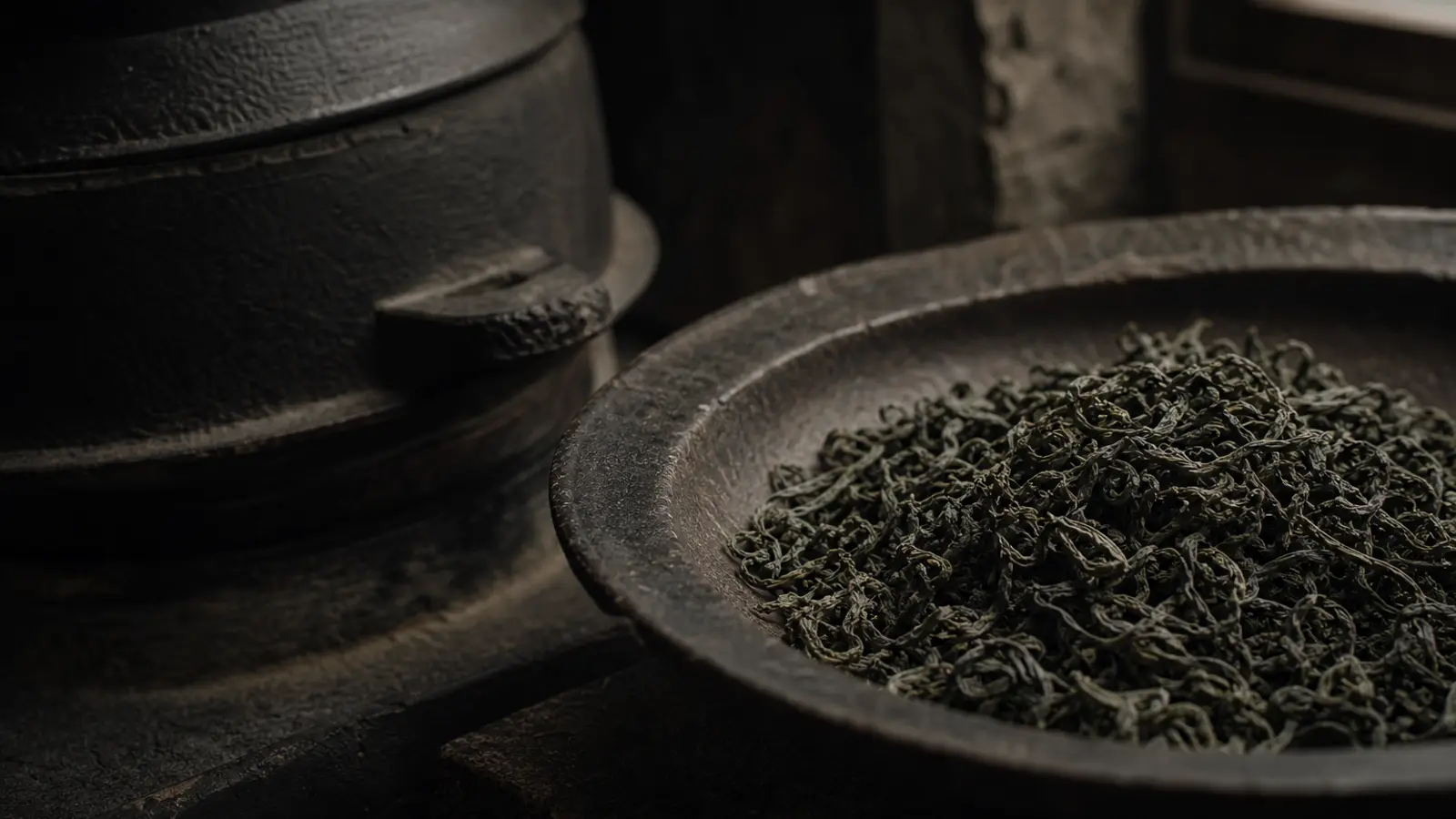
The traditional Korean processing method is called deokkeum (덖음) — pan-firing fresh tea leaves by hand in a heated iron cauldron called a gamasot (가마솥).
The process is visceral. A fire heats the thick iron cauldron to approximately 250-300°C. The tea maker drops a handful of fresh leaves onto the scorching surface and immediately begins pressing and turning them with bare hands — palms and fingers working against the hot metal in rapid, rhythmic movements. The leaves hiss. The kitchen fills with a sweet, nutty aroma as the heat halts oxidation and begins the Maillard reaction that produces the characteristic Korean roasted chestnut character.
The firing is brief — 30 to 60 seconds per round. Too long and the leaves char. Too short and the oxidation continues, producing bitterness and instability. The maker’s hands are the instrument and the thermometer simultaneously. After each firing round, the leaves are removed, cooled, and rolled by hand to shape them and break cell walls. Then fired again. The cycle repeats three to five times, each round reducing moisture and deepening the roast character.
This is not factory work. It cannot be meaningfully mechanized at the artisan level because every batch of fresh leaves is different — different moisture content, different leaf size, different ambient temperature — and the maker adjusts in real time by feel. Master tea makers in Hadong (called dain, 다인) have processed thousands of batches across decades. Their hand calibration is a form of knowledge that exists nowhere except in the hands themselves.
The result: Korean pan-fired green tea has a roasted chestnut, sweet grain, and toasted sesame character that neither Chinese pan-fired tea (which uses a lighter touch at lower temperature) nor Japanese steamed tea (which produces a completely different vegetal-marine profile) can replicate. The deokkeum technique produces a warmth in the cup — a comforting quality that makes Korean green tea feel more like a hearth than a garden.
The second method — steaming (jeungje, 증제) — was adopted from Japan during the modern era and is used primarily in large-scale Boseong production. Steamed Korean green tea has a more vegetal character, closer to Japanese sencha but with subtle differences from Korean cultivar and terroir. Among serious Korean tea drinkers and producers, deokkeum is considered the authentically Korean method. Its revival is part of the broader cultural reclamation of Korean tea traditions that were suppressed during the Japanese colonial period.
For the full processing guide: How Korean Tea Is Made: Pan-Firing and the Art of Deokkeum.
The Four Grades: Timing Is Everything
Korean green tea is graded by harvest timing. Earlier picking produces smaller leaves with higher amino acid concentration, more sweetness, less astringency — and dramatically lower yield, which drives the price.
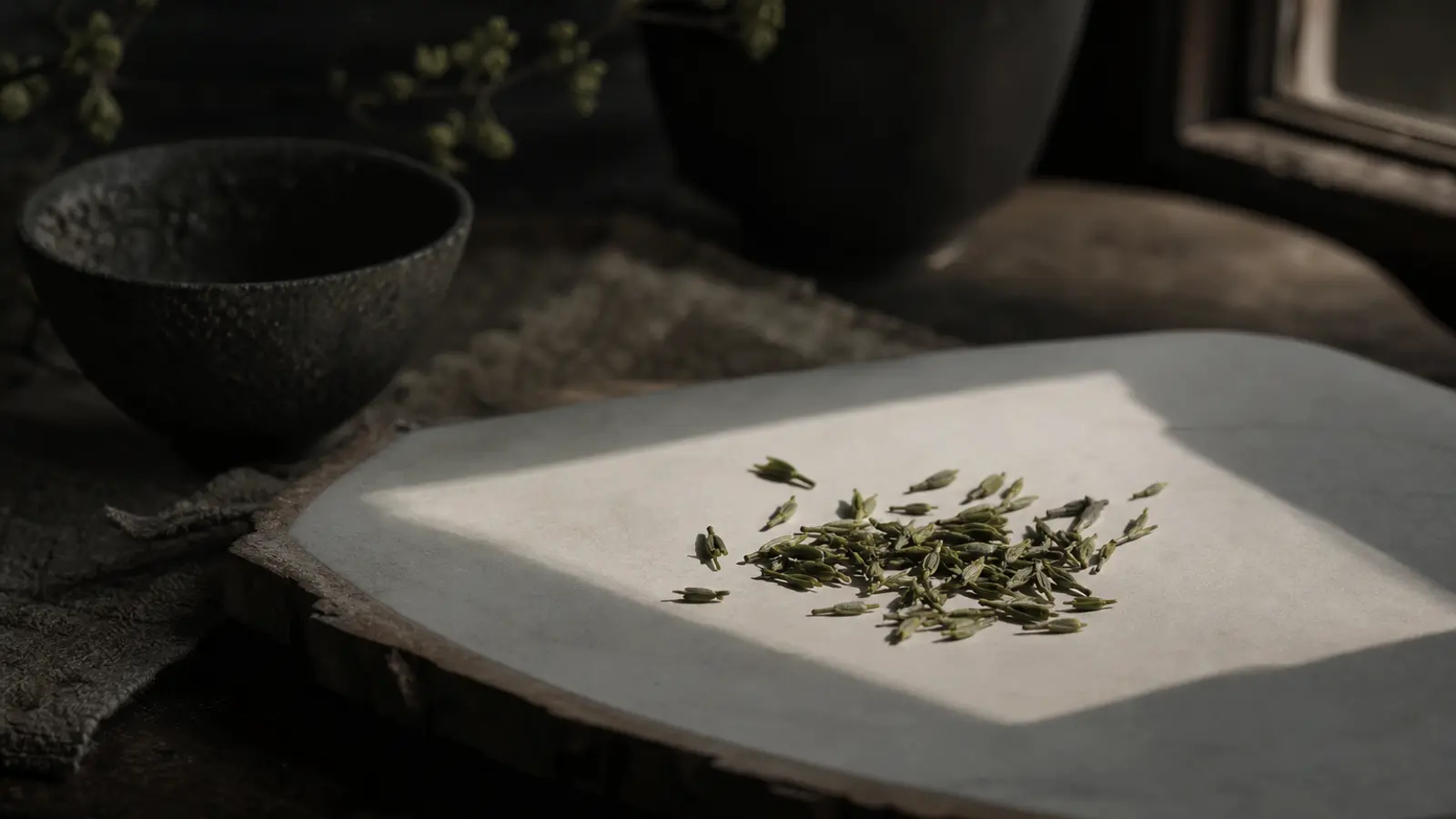
Ujeon (우전, 雨前, “Before Rain”) — harvested before Gogu (곡우, 穀雨, April 20). The earliest, most precious picking. Only the tiniest buds — sometimes just the bud tip before the first leaf unfurls. Ujeon is to Korean tea what Grand Cru is to Burgundy: a designation that signals the most concentrated, most limited, most expensive expression of the terroir. The flavor is pure sweetness and umami — low astringency, high amino acid content, a lingering aftertaste that tastes like spring distilled. Production is extremely limited, representing perhaps 5-10% of any farm’s annual output. Wild-grown ujeon from named Hadong artisans can exceed $150 per 50 grams.
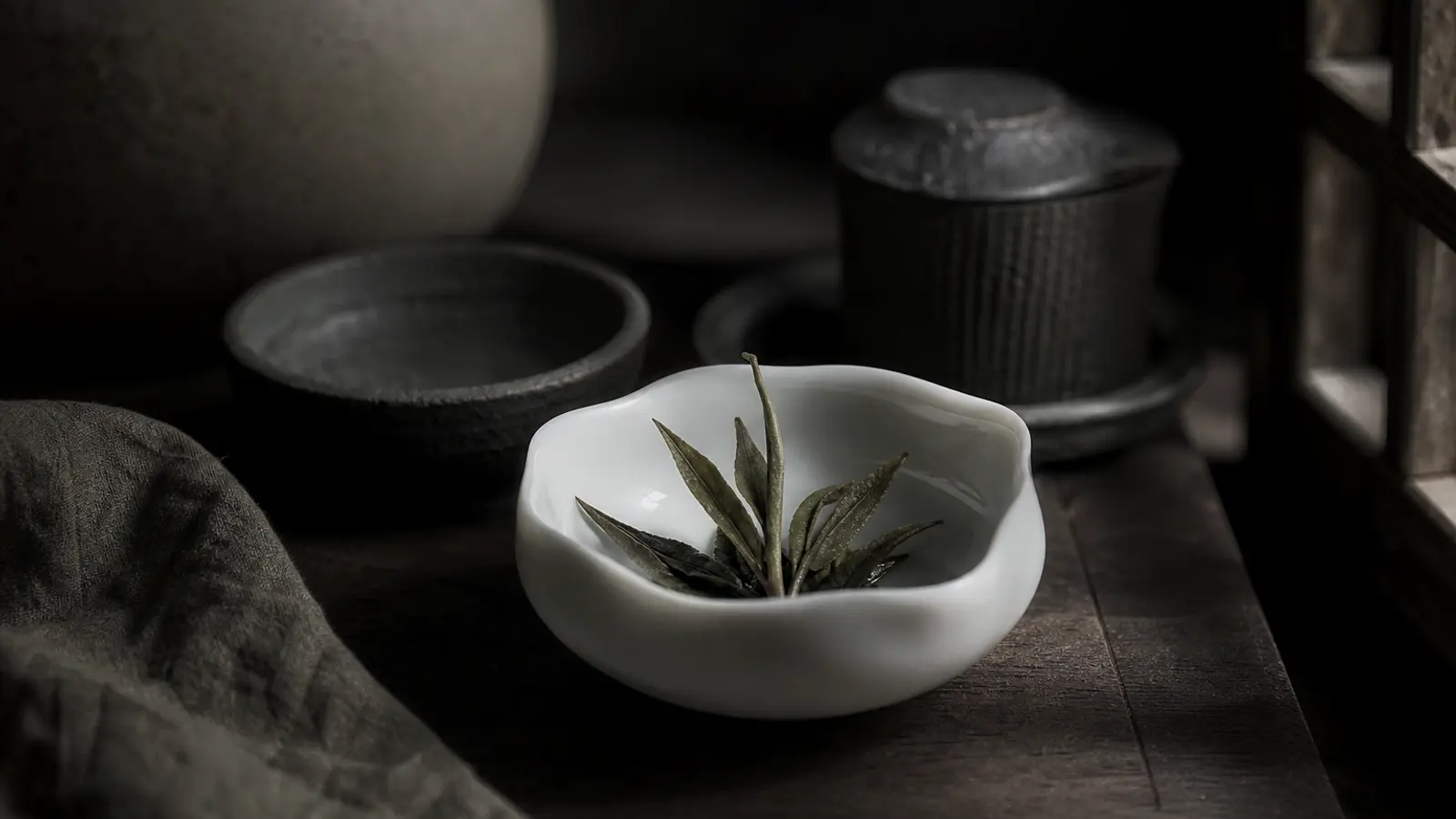
Sejak (세작, 細雀, “Slender Sparrow”) — harvested late April to early May. One bud and one or two small leaves. The premium everyday grade. More body and complexity than ujeon with retained sweetness. This is the grade I’d recommend to anyone trying Korean tea for the first time — it shows what Korean green tea can do without requiring the investment of ujeon. The “sparrow” in the name refers to the leaf size: slender as a sparrow’s tongue. Price: $30-60 per 50 grams for artisan production.
Jungjak (중작, 中雀, “Medium Sparrow”) — harvested in May. Larger leaves, more vegetal character, moderate astringency. Good daily drinking tea that represents honest Korean green tea character without premium pricing. Price: $15-30 per 50 grams.
Daejak (대작, 大雀, “Big Sparrow”) — late-season harvest. The coarsest leaves, strongest flavor, most affordable grade. Used for everyday consumption and for some commercial blends. Price: $5-15 per 50 grams.
The grade names and their sparrow-tongue metaphor reflect a cultural precision about harvest timing that mirrors the Mingqian/Yuqian system in Chinese tea and the shincha/ichibancha system in Japan. But the Korean system is more granular than either — four named grades versus two in the Chinese system — and the price differential between ujeon and daejak (10-30x) is steeper than the equivalent spread in most Chinese or Japanese green tea.
For the detailed comparison: Ujeon vs Sejak: Understanding Korean Tea Grades.
Three Terroirs, Three Characters
Korea’s three tea regions are concentrated in the southern part of the peninsula, where the climate is warm enough to support Camellia sinensis. Each produces green tea with distinct character shaped by soil, elevation, climate, and production tradition.
Boseong (보성) — The Green Heart
Jeollanam-do province. Rolling emerald hillsides that produce roughly 40% of Korea’s total tea output. This is Korea’s tea factory — the Napa Valley equivalent, where large plantations and the photogenic terraced rows define the landscape. Daehan Tea Plantation (대한다원) is the most photographed tea landscape in Korea.
Terroir: 50-400m elevation. Maritime subtropical climate influenced by the warm Kuroshio Current. Moderate rainfall (1,300-1,500mm). Decomposed granite soil, acidic.
Character: Boseong tea — particularly from larger plantations using the steaming method — tends toward clean, bright, accessible green tea. Consistent quality. The pan-fired artisan producers in Boseong make more interesting tea, but the region’s identity leans commercial. The terroir produces dependable, approachable Korean green tea that works well as an introduction to the category.
Wine parallel: Boseong is the Champagne analogy — dominated by large houses producing consistent, recognizable product, with grower-producers making more distinctive small-batch work underneath the commercial canopy.
Full terroir profile: Boseong: The Green Heart of Korean Tea.
Hadong (하동) — The Heritage Mountain
Gyeongsangnam-do province, on the slopes of Jirisan Mountain (지리산). Korea’s oldest tea region — wild tea plants dating back over a thousand years to seeds planted during the Silla Dynasty in 828 CE. Where Boseong is the factory, Hadong is the soul.
Terroir: 200-700m elevation on Jirisan’s southern slopes. Continental-maritime transitional climate with colder winters than Boseong. Rocky granitic soil mixed with forest humus. The growing conditions are harder here — colder, rockier, less uniform. The tea fights for survival. That stress concentrates the flavor.
Character: Hadong tea is defined by wild-grown production (yasaeng-cha, 야생차). The tea plants don’t grow in neat plantation rows. They’re scattered through mountain forest — individual plants with deep root systems, minimal human intervention, no chemical inputs. The result is tea with more concentration, more complexity, and a wild character called sanya giwun (산야기운) — the Korean equivalent of the Chinese shan ye qi yun (mountain-wild atmosphere) — that plantation tea cannot replicate.
Hadong artisans predominantly use the traditional deokkeum pan-firing method, often in small batches hand-processed in family workshops. Each maker’s style is distinct. This is terroir in its purest expression — place, plant, and human hand.
Wine parallel: Hadong is to Boseong what old-vine hillside Burgundy is to flat-vineyard Mâconnais. Same grape. Same region. Same country. Completely different concentration, completely different price, completely different experience.
Full terroir profile: Hadong: Korea’s Oldest Tea Mountain.
Jeju (제주) — The Volcanic Island
Jeju Island, off Korea’s southern coast. A volcanic landscape where basaltic lava rock has decomposed into porous, mineral-rich soil that produces tea with a character unavailable from the mainland.
Terroir: 200-600m elevation on the mid-slopes of Hallasan (한라산, Korea’s highest peak). Oceanic subtropical climate — the warmest region in Korea, rarely freezing. High humidity year-round. The soil is entirely volcanic: basalt decomposed into a mineral-rich, extremely well-drained growing medium.
Character: The volcanic soil gives Jeju tea a mineral quality distinct from mainland Korean tea. It’s a subtle difference — a stony undertone beneath the green character, a hint of the volcanic geology transmitted through the root system. The parallel to Wuyi’s rocky terroir is imprecise but suggestive: in both cases, unusual geology creates mineral expression in the cup that neighboring regions with different soil cannot replicate.
Jeju’s tea landscape is dominated by Osulloc, the Amorepacific subsidiary that operates the island’s largest plantations and the Osulloc Tea Museum — one of Jeju’s most-visited tourist attractions. The branding is polished, the quality is consistent, and the experience is curated. Beyond Osulloc, independent farms on Jeju’s mid-slopes produce more distinctive, terroir-expressive teas that few outside Korea have tasted.
Wine parallel: Jeju is the Santorini of Korean tea — volcanic island terroir, tourism-heavy, dominated by one major producer, but with authentic character underneath the commercial surface for those who look beyond the gift shop.
Full terroir profile: Jeju: Volcanic Island Tea at the Edge of Korea.
Korean vs Japanese: The Processing Fork
Korea and Japan both produce primarily green tea. Both occupy premium market positions. Both have deep cultural tea traditions. But the teas taste fundamentally different, and the reason is the processing fork: Korea pan-fires, Japan steams.
Pan-firing (deokkeum) applies direct heat to the leaf surface, producing the Maillard reaction — the same browning chemistry that creates the crust on bread, the sear on meat, the toasted character in roasted coffee. The result is warmth: chestnut, grain, sesame, comfort.
Steaming (mushi, 蒸し in Japanese) applies moist heat that preserves the leaf’s green compounds — chlorophyll, amino acids — without the browning reaction. The result is freshness: grass, seaweed, marine, umami.
Same plant. Same category. Two completely different flavor worlds created by how heat is applied in the first minutes after picking. A Korean sejak and a Japanese sencha side by side is one of the most instructive tastings in all of tea — it isolates the processing variable and makes it audible.
The comparison goes deeper than flavor. Korean tea culture (darye, 다례) emphasizes seasonal simplicity and mindful restraint. Japanese tea culture (chado, 茶道) emphasizes codified movement and ritual precision. Korean teaware (celadon, buncheong — semi-porous, textured, accepting of imperfection) reflects a different aesthetic than Japanese teaware (raku, arita — either deliberately rough or precisely refined, never in between). The processing fork is one expression of a broader cultural divergence in how two neighboring countries approach the same leaf.
For the full comparison: Korean Tea vs Japanese Tea: Pan-Fire Meets Steam.
Brewing Korean Green Tea
Korean green tea is forgiving compared to Japanese green tea (where a few degrees of temperature error produces bitterness) but still rewards attention to parameters.
Gongfu style:
| Parameter | Recommendation |
|---|---|
| Leaf amount | 4-5g per 100ml |
| Water temperature | 70-75°C (ujeon), 75-80°C (sejak/jungjak) |
| First steep | 15-20 seconds |
| Progression | +10 seconds per steep |
| Expected steeps | 4-6 |
The lower dose and cooler temperature (compared to pu-erh or oolong parameters) reflect Korean green tea’s delicacy. Overdosing or overheating produces bitterness from excessive catechin extraction — the same principle that applies to all green tea but amplified by the high-quality leaf material that artisan Korean production uses.
Korean darye style:
The traditional Korean method uses a side-handle teapot (dagwan, 다관) and a cooling pitcher (sugu, 숙우). Boiling water is poured first into the sugu, which drops the temperature to the correct range through the transfer. From the sugu, the cooled water is poured into the dagwan containing the leaves. Steep 60-90 seconds. Pour into cups through the sugu. The deliberate temperature reduction through vessel transfer is the distinctively Korean contribution to brewing methodology.
Vessel choice:
Korean green tea in a Korean vessel is the full experience. A celadon (cheongja, 청자) tea set connects the tea to 1,000 years of Korean ceramic tradition. A buncheong (분청) tea bowl adds earthy texture that complements the pan-fired grain character. Even a simple white porcelain gaiwan works well — the neutral vessel lets the deokkeum roast character speak clearly.
Why Korean Tea Matters
This section exists because someone will ask — or some part of you is asking — why bother with Korean tea when Chinese and Japanese green teas are more available, more documented, and often cheaper.
Three reasons.
Character. The deokkeum pan-firing technique produces a warmth and grain sweetness that no Chinese or Japanese green tea replicates. If your palate prefers warm over cool, roasted over vegetal, comfort over brightness — Korean green tea may be closer to your natural preference than any green tea you’ve tried before.
Traceability. Korean tea production operates at artisan scale. When you buy sejak from a named Hadong producer, you can often trace the tea to a specific family, specific mountain slope, specific harvest day. The artisan identity is strong and the production volumes are small enough that the maker’s hand is present in every batch. This level of traceability is possible in Chinese tea but rare. In Japanese tea, it’s common at the premium level. In Korean tea, it’s the norm across the entire artisan tier.
Cultural meaning. Korean tea tradition was nearly destroyed during the Japanese colonial period (1910-1945). What exists today is not an unbroken ancient practice — it’s a tradition rebuilt through deliberate cultural will. Buying and drinking Korean tea supports a recovery that is still in progress. For the Korean diaspora and for anyone who values cultural preservation, Korean tea carries a significance that transcends the beverage.
I grew up adjacent to this culture. My wife’s family is part of it. The Korean sourcing networks that Steep Atlas accesses exist because of these relationships. This is not an objective, dispassionate analysis of a market category. It’s a map drawn by someone with a personal stake in the territory. I think that makes it more useful, not less — provided the bias is stated, which it now has been.
Where to Go From Here
If Korean tea interests you, the path through Steep Atlas’s Korean content is deep:
The three terroir profiles cover each region in detail: Boseong, Hadong, Jeju.
Ujeon vs Sejak breaks down the grade system with pricing context for each tier.
Hwangcha: Korea’s Forgotten Yellow Tea covers the oxidized Korean tea that lives between green and oolong.
Korean Tea vs Japanese Tea is the side-by-side comparison for anyone coming from Japanese green tea.
The Korean hub page links everything — tea, pottery, ceremony, history — in one place.
Frequently Asked Questions
What does Korean green tea taste like?
Korean green tea — particularly pan-fired (deokkeum) production — has a roasted chestnut, sweet grain, and toasted sesame character that distinguishes it from Chinese and Japanese green tea. It’s warmer and more comforting than the vegetal-marine character of Japanese sencha, and gentler than the nutty brightness of Chinese Longjing. The better the grade (ujeon > sejak > jungjak > daejak), the sweeter and less astringent the tea.
Is Korean tea the same as Japanese tea?
No. Although both produce primarily green tea, the processing methods differ fundamentally. Korean traditional processing is pan-fired (deokkeum, 덖음), which produces a roasted, warm character. Japanese processing is steamed (mushi, 蒸し), which produces a vegetal, marine character. The flavor profiles are as different as oak-aged Chardonnay is from unoaked — same grape, different winemaking, different result.
Why is Korean tea so expensive?
Korean tea production is tiny (4,000 tons/year vs China’s 3 million tons). Labor costs are higher than in China. Artisan production — hand-picking, hand-processing in small batches — is labor-intensive. And the premium grades (ujeon, sejak) represent a small fraction of each farm’s annual yield. The pricing reflects genuine scarcity and real labor, not marketing. That said, jungjak and daejak grades offer honest Korean tea character at $5-30 per 50 grams — comparable to quality Japanese sencha.
Where can I buy Korean green tea?
Korean tea is available internationally through Korean e-commerce platforms with English-language interfaces and international shipping, as well as through specialty tea retailers. Korean-language platforms often have better selection and lower prices. We’re building a comprehensive sourcing guide — subscribe to be notified when it publishes.
Can you brew Korean tea gongfu style?
Yes, and it works well. Use 4-5g per 100ml gaiwan, water at 75-80°C, and short steeps starting at 15-20 seconds. Korean green tea produces 4-6 productive steeps in gongfu, with the middle steeps showing the most complexity. The traditional Korean darye method — using a side-handle teapot and cooling pitcher — is the culturally native approach and worth learning alongside gongfu for Korean teas specifically.