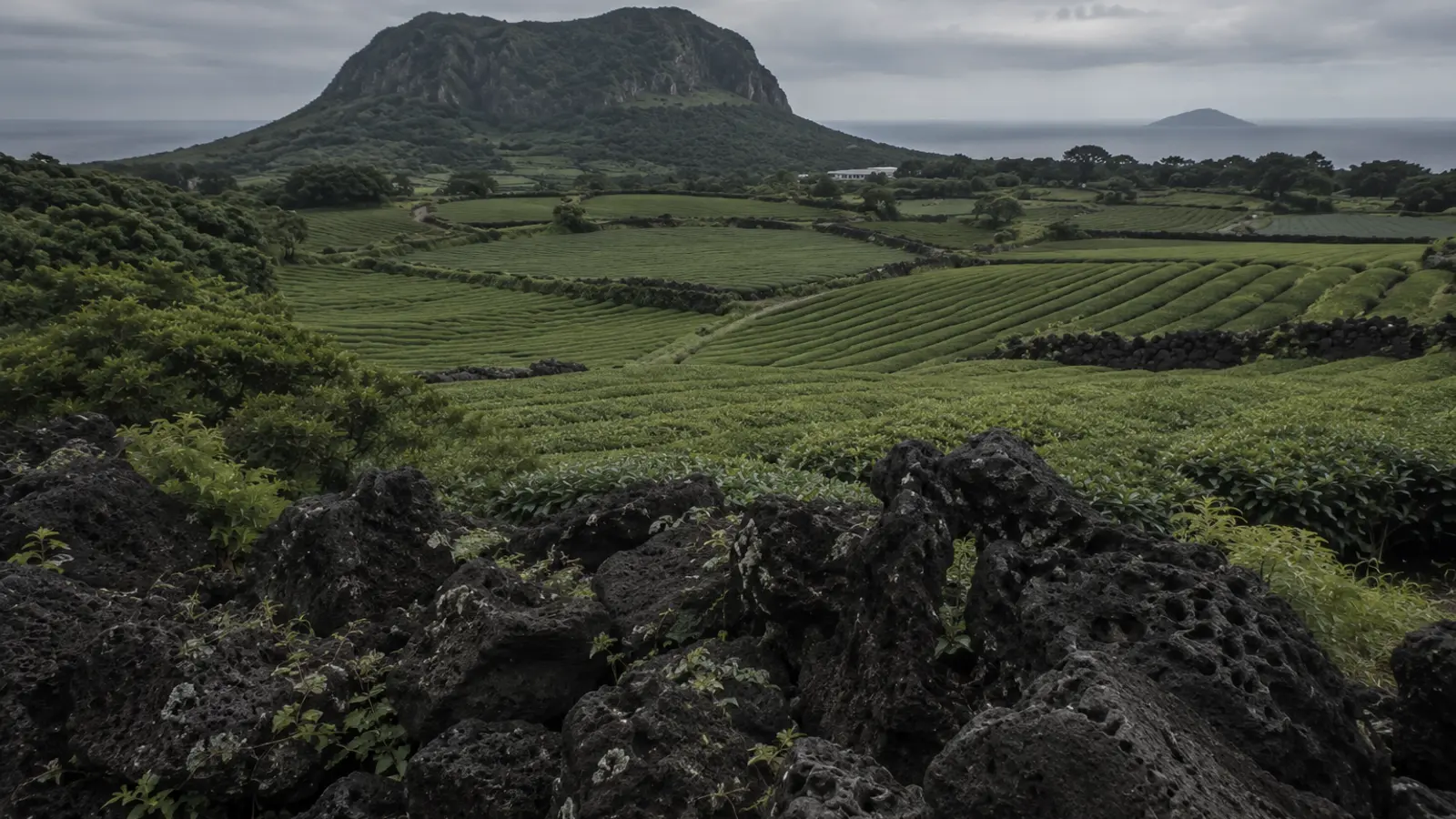
Jeju island tea grows on geology found nowhere else in Korea. The island sits at approximately 33.4°N, 126.6°E — off the southern tip of the peninsula, closer to Shanghai than to Seoul in some ways — and its soil is entirely volcanic. Decomposed basaltic lava, mineral-rich and porous in a way no mainland Korean tea garden can replicate. That single fact shapes everything about Jeju tea: its flavor, its identity, and its market position.
I haven’t yet brewed Jeju teas firsthand as part of my tasting record. What follows draws on research, producer documentation, and the material conditions of the island’s terroir. Where I write from the cup, I’ll say so. Where I’m working from documented evidence, this text carries that weight.
Think of Jeju as the Santorini of Korean tea. A volcanic island, intensely touristed, dominated by one major brand with enormous cultural reach — but underneath the gift-shop experience, there are small producers doing genuinely interesting work with terroir the mainland cannot duplicate.
Geography & Location
Jeju Island (제주도, 濟州島) formed from a series of volcanic eruptions, the last major activity occurring roughly 25,000 years ago. The island’s centerpiece is Hallasan (한라산, 漢拏山), a shield volcano rising to 1,947 meters — the highest peak in South Korea. Tea cultivation spreads across the mid-slopes, primarily between 200 and 600 meters elevation, where the gradient is moderate enough for plantation management but high enough to benefit from cooler night temperatures.
The island spans roughly 73 kilometers east to west and 41 kilometers north to south, giving it a compact geography but meaningful microclimatic variation. The southern coast around Seogwipo (서귀포) is the warmest and most sheltered sector. The northern plains around Jeju City drop slightly cooler. The western Hallim (한림) area sits in a rain shadow that tempers the island’s otherwise heavy precipitation. These distinctions matter for producers who read their gardens closely, though they rarely appear on mass-market tea labels.
Surrounding ocean moderates temperature extremes in both directions. Jeju rarely freezes in winter, which allows tea plants to recover more fully each season than they would under Korean mainland conditions. It also means summer heat builds gradually rather than arriving abruptly — a gentler seasonal rhythm that shapes flush timing and leaf character.
Climate & Elevation
Jeju’s climate classification sits at the edge between humid subtropical and oceanic. Annual rainfall runs between 1,400 and 1,800mm, distributed relatively evenly through the year with a heavier summer monsoon pulse. This consistent moisture load keeps humidity high — rarely a problem for tea plants, which evolved in similarly humid mountain environments.
Wind is constant and strong, particularly on exposed slopes and the island’s western side. Maritime wind influences are significant. They cool the canopy during growing season, increase evapotranspiration, and effectively prevent the stagnant humid conditions that invite fungal disease. Tea plants in exposed positions develop thicker cuticles and compact leaf structure as adaptation.
The temperature advantage over the Korean mainland is substantial. While Boseong (보성) on the mainland averages temperatures low enough to periodically damage tea plants in hard winters, Jeju’s first spring flush typically arrives two to three weeks earlier. This earliness, combined with mineral-rich soil, positions early Jeju green tea as a seasonal product with real horticultural justification behind the premium pricing.
Elevation across the tea zones — 200 to 600 meters on Hallasan’s slopes — provides diurnal temperature variation that concentrates aromatic compounds in the leaf. The combination of warm days, cooler nights, and persistent oceanic moisture creates conditions that multiple producers cite as contributing to the tea’s textural richness, particularly in the first and second flush green teas.
Soil & Terroir
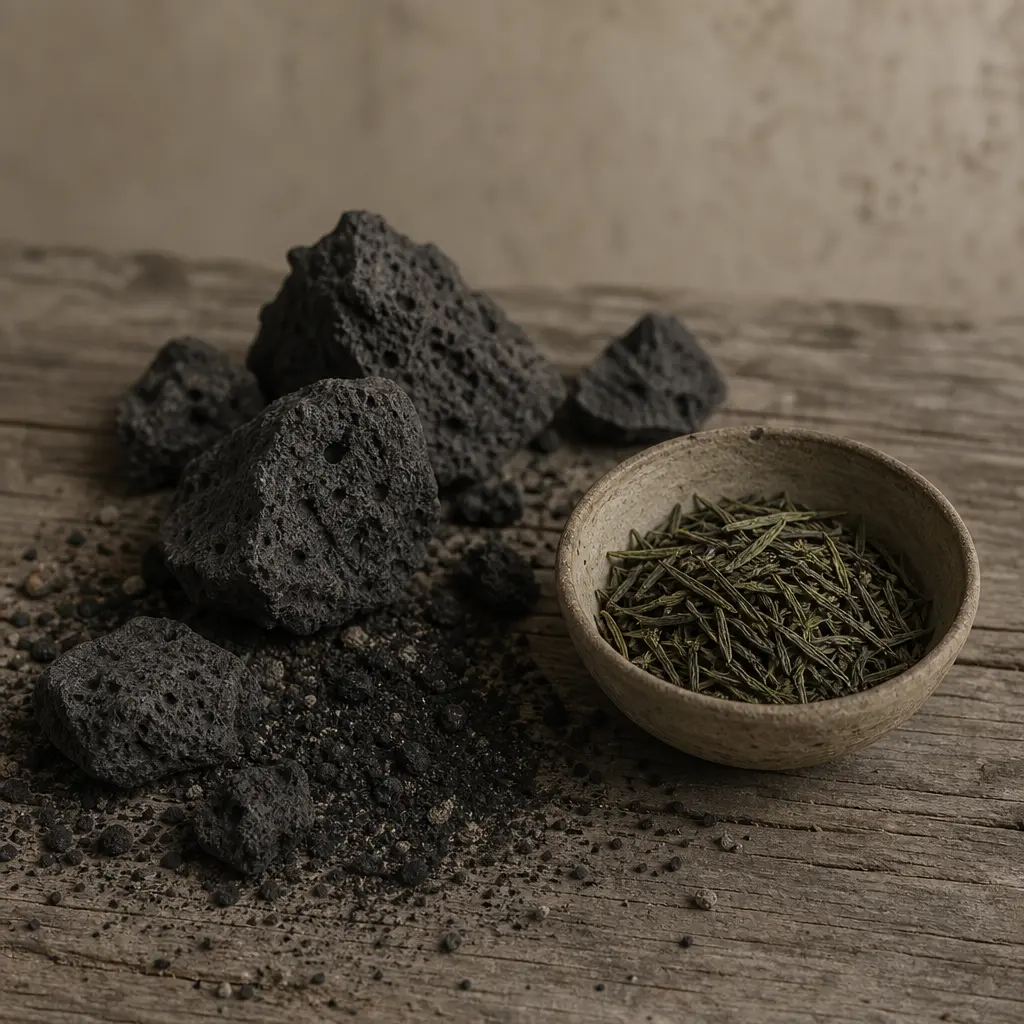
This is where Jeju separates itself from every other Korean tea region.
The island’s soil derives entirely from decomposed basaltic lava. Basalt weathers into mineral-rich, exceptionally porous substrate — high in iron, magnesium, calcium, and silica, with trace elements that sedimentary and granite-derived mainland soils do not provide in the same ratios. The porosity is extreme: water moves through quickly, preventing waterlogging and forcing tea plant roots to extend deeper in search of moisture. Deeper root systems access a broader mineral profile and produce leaves with more complex flavor compounds.
The parallel to Wuyi (武夷) in Fujian is worth noting carefully. Wuyi’s famously minerally yancha (岩茶) grows in fractured volcanic rock where soil is minimal and drainage is near-total. Jeju’s situation is different — there is genuine soil depth here, not bare rock — but the volcanic origin and the porous mineral-rich character create a family resemblance in the cup. Both terroirs produce teas with a savory, stone-like quality that is difficult to attribute to processing alone. This comparison is suggestive rather than precise, but it points toward a real phenomenon.
In wine terms, what happens on volcanic soils is well-documented: Santorini’s Assyrtiko, grown on volcanic pumice, consistently shows a saline mineral character that disappears when the same grape grows on different soils elsewhere in Greece. Etna’s Nerello Mascalese grown on volcanic basalt shows similar structural distinctiveness. The mechanism is not fully settled in the scientific literature — whether it reflects direct mineral uptake by roots, or whether it’s the drainage and soil temperature properties that matter most — but the outcome is observable and reproducible.
For Jeju tea, the volcanic terroir signature is reported consistently across sources: a clean, stony mineral note in the finish, a lighter body than mainland Korean green teas, and an clarity of expression in the broth that distinguishes it from the richer, sometimes more vegetal character of Boseong teas grown on heavier soils.
Key Cultivars & Tea Types
Korean tea production centers overwhelmingly on the indigenous cultivar Camellia sinensis var. sinensis in its Korean-adapted forms, but specific registered cultivars have expanded in commercial operations over the past three decades.
Yabukita (야부기타) arrived from Japan and remains planted in volume across Jeju’s larger estates, including Osulloc’s operations, because of its predictable yield and processing behavior. It produces clean, mild green teas suited to Osulloc’s standardized product lines.
Jeju-specific registered cultivars include Jeju No. 1 (제주1호) and related selections developed through the Jeju Agricultural Research & Extension Services. These cultivars aim to optimize for Jeju’s specific climatic and soil conditions. They tend to produce lighter, more aromatic teas than Yabukita in the island’s conditions — though registered variety documentation is more accessible in Korean-language agricultural publications than in English sources.
Wild-growing tea plants (야생차, yasaengcha) exist in Jeju’s forested areas, descendants of plantings with unclear lineage. Small producers occasionally harvest from semi-wild stands, though volume is extremely limited.
Tea Types Produced
녹차 (Nokcha, green tea) — the commercial backbone. Jeju green tea ranges from mass-market powdered or bagged products in Osulloc’s tourist line to carefully hand-processed loose-leaf teas from small independent farms. The best Jeju green teas are made from first and second flush leaves, pan-fired (덖음차, deokeum-cha) in the Korean tradition, though some producers use steaming methods influenced by Japanese processing.
홍차 (Hongcha, Korean black tea) — a growing category. Jeju’s volcanic soil reportedly contributes a distinctive quality to fully oxidized Korean black tea: lighter bodied than Assam-influenced teas, with a clear, mineral-driven character in the broth. Korean hongcha more broadly has developed a dedicated domestic following over the past decade, and Jeju producers benefit from the terroir story.
발효차 (Balhyo-cha, oxidized and fermented tea) — a historically complex category in Korea, with some production drawing on traditions connected to 보이차 (boji-cha, puer tea) aesthetics. Jeju producers are experimenting more openly in this space, sometimes aging compressed cakes or producing lightly oxidized teas that occupy a middle space between green and fully oxidized.
말차 (Malcha, Korean matcha) — an explicitly growing category, positioned to compete with Japanese matcha at lower price points. Jeju’s warm growing season allows the shading protocols required for high-quality tencha (天茶) — the shade-grown leaf that becomes matcha — and multiple producers have invested in shading infrastructure. The quality ceiling for Jeju malcha is still being established; reports suggest it approaches entry-to-mid Japanese matcha quality at competitive prices, but it hasn’t displaced Japanese matcha in the premium tier yet.
Processing Traditions
Korea’s green tea processing follows the pan-fire tradition (炒青, deokeum-cha), tracing its lineage to Chinese hand-firing methods introduced via historical cultural exchange. Unlike Japanese green tea, which uses steam fixation (蒸青) to lock in vivid green color and a more vegetal, umami-forward flavor, Korean-style pan-fired green tea typically produces a slightly more toasty, nuanced character.
On Jeju, processing operations range from fully mechanized at Osulloc’s scale — where consistency and volume requirements drive automation — to small-batch hand-processing at independent farms, where single-pan artisan work remains economically viable because the product commands premium prices through direct sale or specialty channels.
Spring flush (곡우 전, gogu jeon) — the first harvest before the solar term Gogu (Grain Rain, around April 20) produces the most prized leaves. These are small, tightly furled buds and young leaves, processed immediately after picking. In Jeju’s warmer climate, this flush arrives earlier than on the mainland — sometimes as early as late March in warm years.
Summer and autumn flushes provide bulk volume for Osulloc’s commercial lines. Quality is lower than spring flush but serves the gift-set and mass-market segments.
For hongcha, Jeju producers use full oxidation — leaves are withered, rolled, allowed to oxidize completely, then fired. The volcanic terroir reportedly comes through most distinctly in hongcha because the longer processing time doesn’t mask the mineral baseline the way rapid pan-firing of delicate green teas might.
Characteristic Flavor Signatures
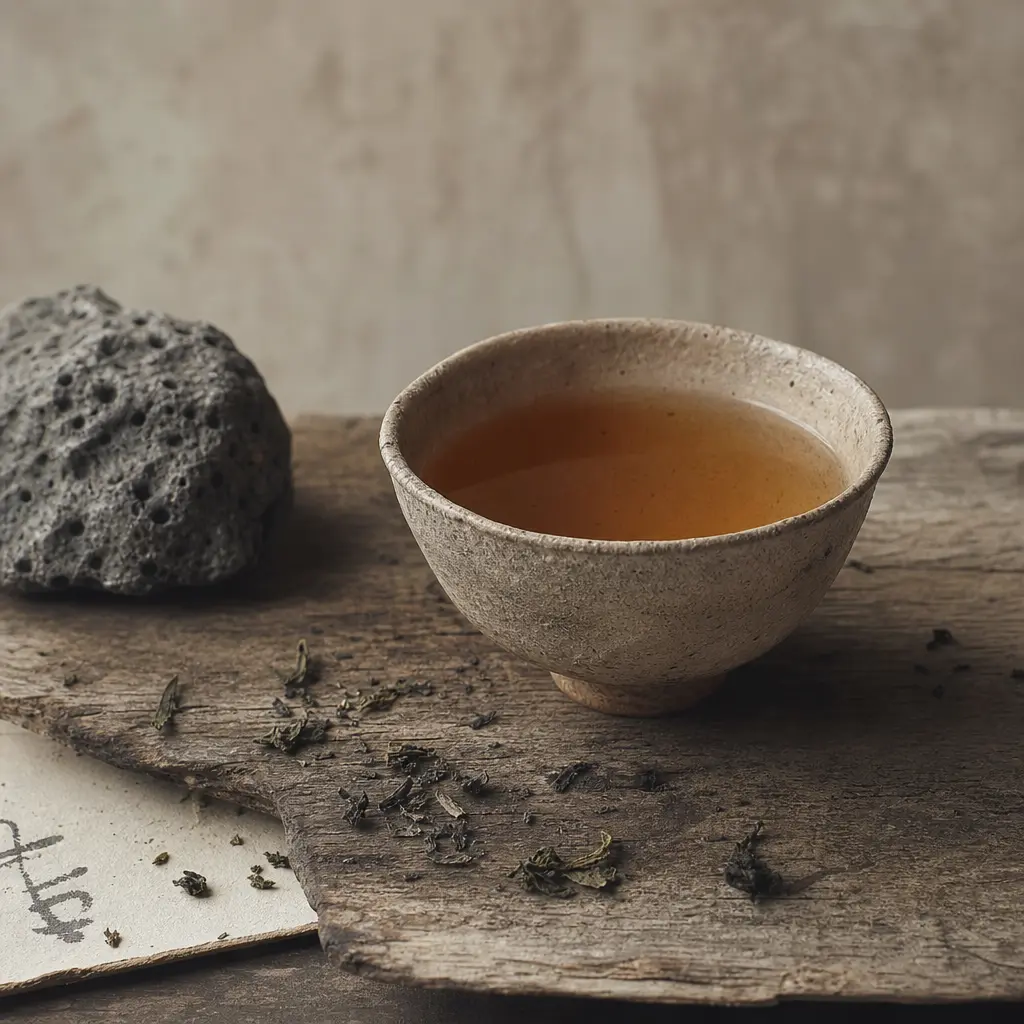
Based on documented producer descriptions, published Korean tea reviews, and the material conditions of the terroir, Jeju green tea is characterized by:
Mineral clarity — a stony, clean quality in the finish that distinguishes it from the sweeter, more rounded character of Boseong 녹차. This appears consistently in descriptions from both Korean and international sources.
Lighter body — the volcanic soil’s drainage creates teas with less of the dense, full-mouthed texture common in green teas from heavier clay soils. Jeju teas tend toward precision over weight.
Oceanic salinity — a subtle salt-air quality in the aroma, particularly in spring flush teas, which multiple sources attribute to the maritime climate and the island’s coastal mineral content moving through the soil.
Clean finish with gentle huigan (回甘) — the returning sweetness that signals a well-grown, well-processed tea. Jeju green teas reportedly show a slower, quieter huigan than the more dramatic sweetness rebound in some mainland Korean teas, but the lingering quality is consistent.
Toasty-grassy balance in pan-fired nokcha — the pan-fire process introduces a gentle roasted note that overlays the fresh grass and marine character of the raw leaf. The balance point differs by producer and harvest.
For Jeju hongcha, the flavor signature shifts: reports describe red fruit (dried cherry, light strawberry), a mineral spine rather than the thick caramel of an Assam-influenced hongcha, and a clean, short-to-medium finish without significant astringency.
Jeju malcha presents differently again — reports suggest brighter, slightly more citric notes than typical Japanese matcha, with less of the umami depth produced by Japan’s longer shading protocols. Whether this represents a limitation or a distinct style is a matter of preference.
Quality Indicators & Authentication
The Jeju tea market splits clearly between two tiers, and navigating the gap requires specific knowledge.
Osulloc’s commercial tier — well-produced, consistent, honest about what it is. The loose-leaf spring teas in Osulloc’s premium lines (above the museum gift-shop baseline) are genuinely made from island-grown tea with real attention to processing. The packaging is designed for gift culture (선물 문화, seonmul munhwa), which means the presentation communicates prestige more than provenance. For someone new to Korean tea, Osulloc provides a reliable, if curated, entry point. For someone looking for terroir expression, it’s the starting point, not the destination.
Independent producer tier — Farms in the Seogwipo area, around Dodu (도두) in the north, and in the Hallim area produce smaller batches with more direct producer-to-leaf traceability. These teas are harder to find, often sold through local Korean channels, and require Korean-language navigation to source. The trade-off — less packaging, less consistency in presentation — comes with more direct access to what the volcanic terroir actually produces when a producer is optimizing for flavor rather than brand coherence.
Quality markers to look for in Jeju nokcha:
- Clear statement of harvest flush (spring, first flush before Gogu, is the premium tier)
- Cultivar identification where available
- Processing method (hand-fired vs. machine-processed)
- Geographic specificity beyond “Jeju Island” — which area, which slope
Red flags:
- “Jeju green tea flavor” powders or blends with non-Jeju base tea
- Ambiguous “Korean tea” labeling repacked as Jeju for the tourist market
- Extreme low prices for claimed spring flush hand-picked teas (the math doesn’t work)
Osulloc’s tea, to its credit, is genuinely Jeju-grown. The branding investment would be undermined by sourcing from the mainland, and the company’s scale of plantation ownership makes that unnecessary. The quality question about Osulloc is not authenticity but whether the product expresses the terroir as fully as it could under a tourism-optimized brand framework.
Price Ranges
Pricing in this section reflects the Korean domestic market and international export channels as reported across multiple retail sources. All prices in USD per 100g unless noted.
Osulloc standard retail line: $8–$18 per 100g for bagged and standard loose-leaf teas. Spring collection premium loose-leaf runs $20–$35 per 100g. Gift sets inflate the price per gram significantly — you are paying for packaging, not tea.
Osulloc premium / limited spring releases: $35–$60 per 100g. These products target the domestic gift market’s upper tier and the growing Korean specialty tea consumer segment. The tea quality at this tier is meaningfully better than the standard line.
Independent Jeju farms (direct purchase): $25–$80 per 100g depending on spring flush timing, processing method, and cultivar. First-flush hand-picked spring teas from well-regarded small producers occupy the $50–$80 range. These prices are competitive with comparable specialty Korean green teas from Hadong and Boseong.
Jeju hongcha: $30–$70 per 100g from quality-focused producers. Less price-compressed than the green tea market because hongcha volume is lower and the domestic audience for Korean black tea is comparatively smaller.
Jeju malcha (malcha for whisking): $15–$45 per 100g. The lower end competes directly with entry Japanese matcha; the upper end represents producers making genuine attempts at ceremony-grade quality. Independent verification of quality at the upper tier is limited outside Korean sources.
International export premium: Add 20–40% to domestic prices for teas reaching international specialty retailers, accounting for distribution, certification, and logistics costs.
Jeju in the Context of Korean Tea Country
Korea’s serious tea geography forms a rough triangle across the peninsula’s south. Hadong (하동) in South Gyeongsang Province claims Korea’s oldest tea cultivation — traditions reportedly stretching to the Silla period, wild-growing plants in the Jirisan (지리산) valleys. Boseong (보성) in South Jeolla Province is the volume center — the most photographed tea landscape in Korea, the plantation rows running up hillsides in patterns that dominate tourism imagery. Jeju sits offshore from both, geologically separate and climatically distinct.
The terroir comparison between Jeju and Boseong is instructive. Boseong’s soils are granite-derived and clay-heavy — they produce teas with fuller body, more obvious sweetness, and less of the mineral sharpness that volcanic geology delivers. Boseong green teas taste of mountains and mist, rich and enveloping. Jeju green teas, in documented description, taste of volcanic stone and ocean air, precise and mineral. Neither is superior in absolute terms; they are expressing genuinely different terroirs, and both are worth serious attention.
What Jeju offers that no mainland Korean region can replicate is the volcanic mineral baseline. That’s the genuine reason to seek it out — not the museum, not the gift boxes, not the Amorepacific branding machine, but the specific flavor that decomposed basaltic lava contributes to a tea plant grown on it for decades.
Osulloc and the Gift Culture Question
It would be incomplete to write about Jeju island tea without confronting the Osulloc (오설록) question directly. The brand is omnipresent: in Korean airports, department stores, Jeju tourist corridors, and corporate gifting catalogs. Giving someone Osulloc tea occupies a similar cultural space to giving Champagne in Western business contexts — it signals taste, resources, and a safe premium choice. The recipient understands immediately that the gift communicates care and status.
This is not, by itself, a criticism. Osulloc built the market for premium Korean tea internationally more than any other single force. The Tea Museum near Amore’s main plantation is genuinely worth visiting as a designed landscape and as an introduction to Korean tea aesthetics — even if the gift shop behind it is optimized for tourist throughput rather than serious purchase decisions.
The museum’s exhibition materials are well-researched. The plantation itself, visible from the museum grounds, demonstrates serious agricultural investment. And some teas in Osulloc’s limited seasonal releases reach quality levels that justify the premium positioning on merit rather than packaging alone.
The issue is one of proportion. For a visitor with limited time on Jeju, the Osulloc experience can consume the entire tea agenda, leaving the impression that Jeju tea is what Osulloc sells. It isn’t. Jeju tea is the volcanic soil, the maritime climate, the individual farmers who know their specific slope’s drainage patterns and adjust their harvest timing accordingly. Osulloc is one — very large, very visible — expression of that place. The smaller expressions are harder to find and worth finding.
The Serious Tea Drinker’s Jeju
For someone approaching Jeju with genuine curiosity about what the volcanic terroir produces:
The first move is separating the tourist circuit from the tea circuit. The Osulloc museum is worth one morning, then set it aside. The more interesting conversations happen in smaller operations — farms around Seogwipo on the southern coast, where the sheltered warmth produces early first-flush teas; the Hallim area on the west; farms accessible through Korean agricultural co-operative networks that don’t advertise internationally.
Finding these farms requires Korean-language navigation — websites, agricultural listings, local introductions. This is the honest reality of accessing small Korean tea producers at any origin, not a Jeju-specific barrier. The infrastructure that has made Boseong accessible to international buyers — international promotion, international shipping, presence in Western specialty tea retail — simply isn’t built for most small Jeju operations yet.
What the volcanic terroir promises is a specific flavor experience: mineral-driven, ocean-touched, light-bodied Korean green tea that expresses a geology unavailable anywhere else in the country. That promise is real and substantiated by the soil composition, the documented flavor profiles, and the material conditions of the island’s terroir.
Jeju island tea, at its best, is not a gift-shop product. It is a serious terroir expression from a small volcanic island where the geological accident of lava fields creates something that cannot be duplicated or standardized away. That’s the version worth seeking.