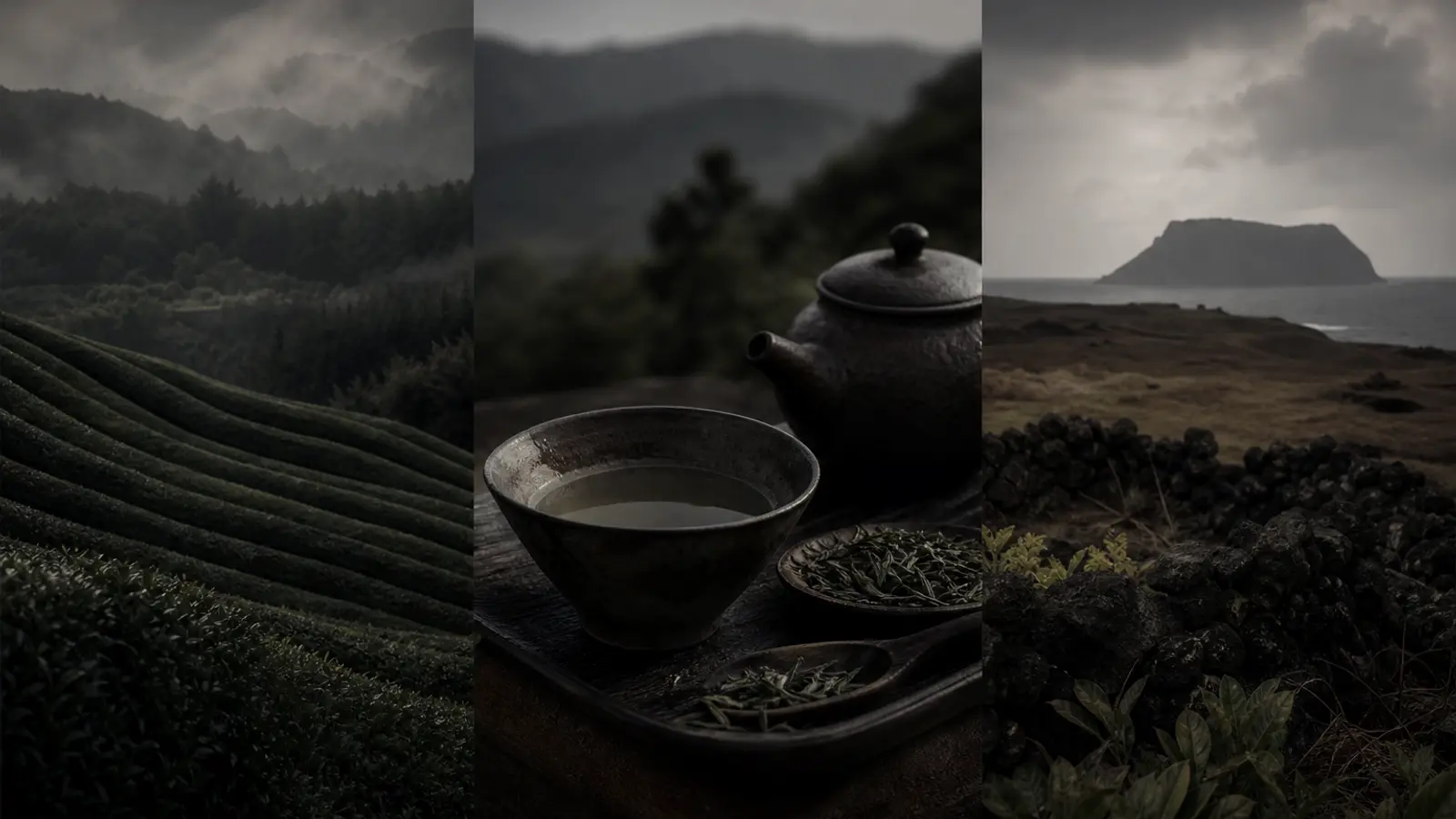
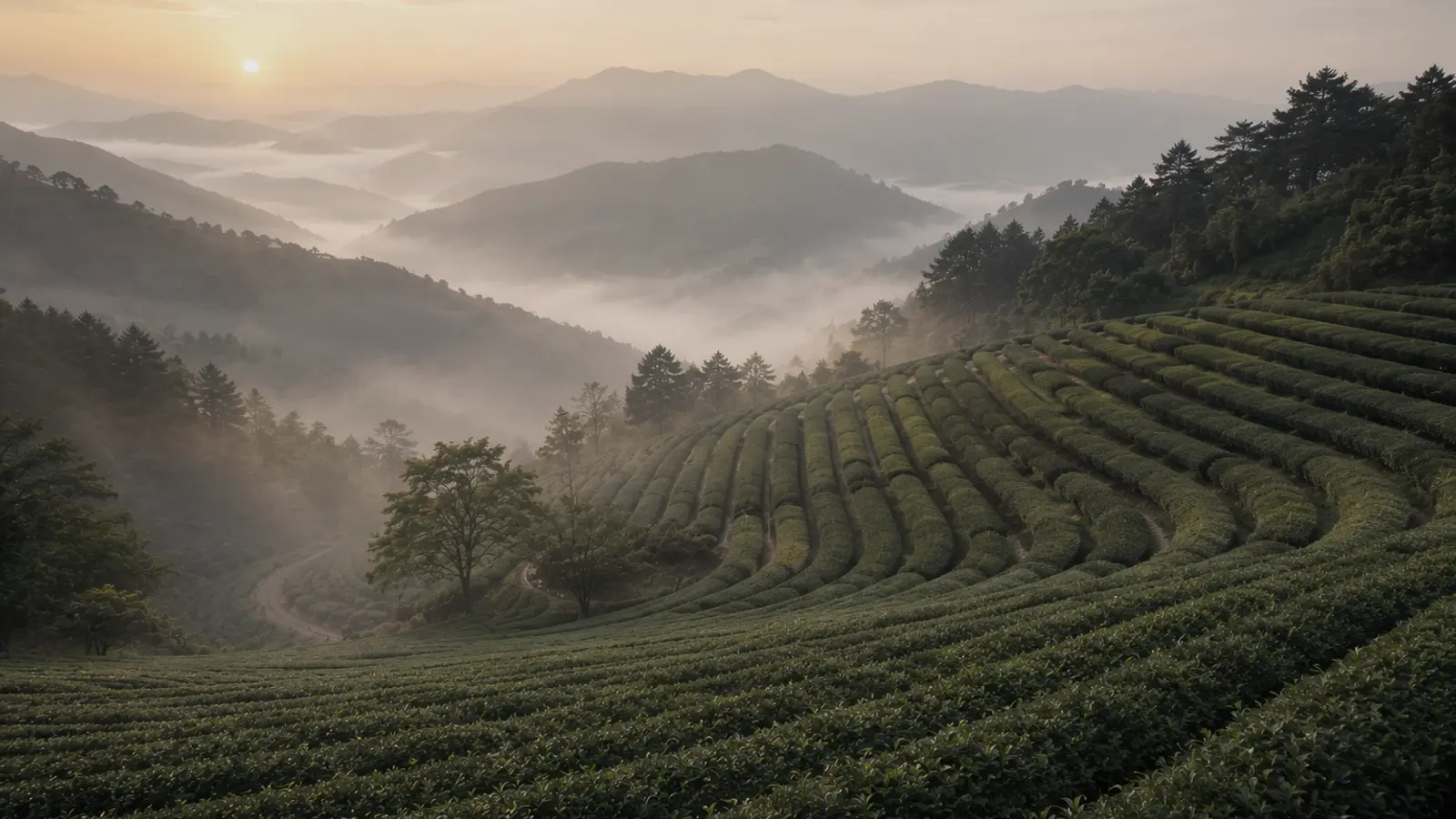
Boseong (보성, 寶城) county sits in Jeollanam-do (全羅南道) province, in the southwestern corner of South Korea, at approximately 34.8°N, 127.1°E. It produces roughly 40% of South Korea’s tea. That single statistic makes it the most consequential address in Korean tea — but the number understates what Boseong actually is: the defining image, the cultural shorthand, the visual that appears every time Korean tea is mentioned in a brochure, a drama set, or a tourism campaign.
I have not yet brewed Boseong tea in a formal tasting session, so the flavor descriptions here draw from published sources, producer documentation, and the existing Korean tea literature. What follows is a rigorous regional portrait, not a personal tasting memoir — and I will write the distinction clearly where it matters.
Geography & Location
Boseong county occupies a narrow coastal zone along the southern edge of the Korean Peninsula. The nearest bodies of water — the South Sea (남해, Namhae) and Korea Strait — sit within 30 kilometers. The landscape is not dramatically mountainous in the manner of Yunnan or Wuyi. The hills are gentle, rarely exceeding 400 meters, and the terrain rolls rather than climbs. This produces the visual signature that defines Boseong: emerald-green terraced rows curving in soft arcs up unhurried slopes, rather than the vertiginous cliff gardens of Chinese high-mountain oolongs.
The most photographed site is the Daehan Tea Plantation (대한다원, Daehan Dawon), established in 1939 and now the largest single plantation in Korea. Its hillsides, particularly in early morning when mist collects between the rows, have become a national tourism symbol. The image is deliberate — Daehan actively cultivates its visual brand — but the landscape itself is genuine. On a clear spring morning, those terraced rows climbing through low cloud represent something specific: a tea culture that grew from a different set of trade routes, a different aesthetic tradition, and a different climate logic than anything east of the Yellow Sea.
Boseong is not the only tea region in South Korea. Hadong (하동) in neighboring Gyeongsangnam-do claims an older, wilder tradition, with tea plants growing in semi-forested conditions that predate organized agriculture. Jeju Island (제주도) offers a volcanic terroir unlike anything on the mainland. But Boseong’s scale and consistency have made it the face of Korean tea both domestically and internationally.
Climate & Elevation
The elevation range — 50 to 400 meters — places Boseong in a different category from most celebrated Asian tea origins. Darjeeling sits at 1,000–2,500 meters. Taiwan’s High Mountain oolongs start above 1,000 meters. Even many Chinese green tea regions occupy hillsides well above 500 meters. Boseong’s relative lowness is not a deficiency; it is a terroir parameter that shapes everything about what the tea becomes.
What compensates for low elevation is maritime influence. The warm Kuroshio Current (쿠로시오 해류) moderates the winters and sustains humidity through the growing season. Winter temperatures rarely fall below -5°C, which is mild for a peninsula that shares a latitude with northern Spain or southern Oregon. Summers are hot and humid. Annual rainfall runs between 1,300 and 1,500mm, well distributed across the year.
The spring growing season — the period of highest quality and most intense harvest activity — arrives early compared to Korea’s interior regions. First flush picking begins in mid-April or slightly before, depending on the year. This maritime earliness mirrors how coastal French wine regions like Muscadet or the Loire tend to advance relative to inland appellation calendars.
Winters cold enough to stress the tea plants — but not cold enough to kill them — are a key quality mechanism. Stress forces the plant to conserve resources, concentrating amino acids, particularly L-theanine, in tender spring growth. The result is leaves with meaningful umami depth, though not at the intensity Japanese cultivars engineered for this quality (like Yabukita or Saemidori) can produce.
Soil & Terroir
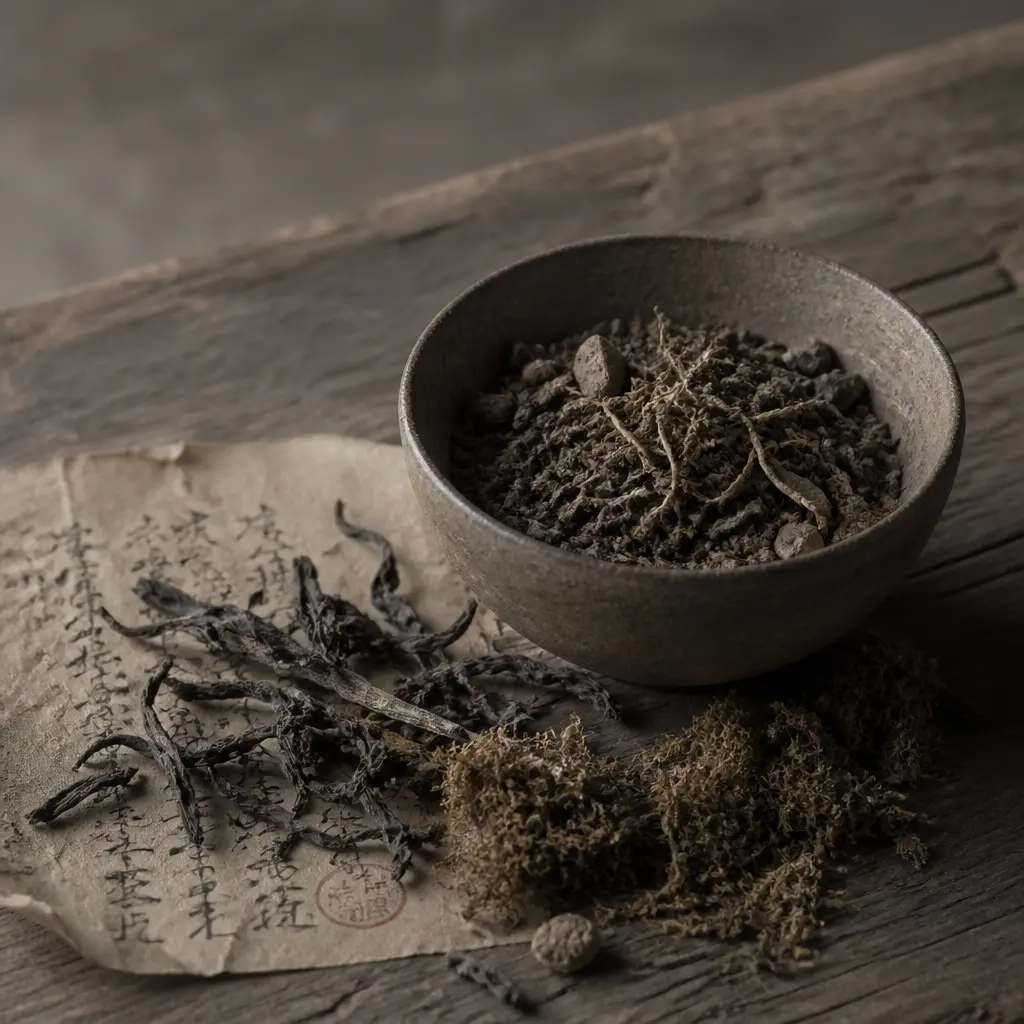
The substrate under Boseong’s tea gardens is decomposed granite with volcanic mineral deposits, acidic in the range of pH 4.5 to 5.5. This is textbook tea soil — well-drained, low in nitrogen relative to phosphorus and potassium, and mineralogically complex enough to contribute genuine terroir character.
Granite decomposition yields soils that drain efficiently while retaining trace minerals over long time horizons. The volcanic component adds micronutrient complexity. The acidity is non-negotiable for Camellia sinensis, which struggles in neutral or alkaline conditions. Boseong’s soil chemistry is not exceptional by global standards — it does not have the dramatic mineral signature of volcanic Jeju or the ancient clay profiles of some Yunnan gardens — but it is solid, consistent, and well-suited to the cultivars grown here.
One underappreciated terroir factor is the frequent low mist that collects in Boseong’s valleys. Extended overcast and diffuse light during the spring growing season slows photosynthesis, reduces catechin production (catechins are the primary astringency compounds), and gives the plant more time to accumulate amino acids. This is the same logic behind Japan’s 茶園覆い (chaen oi) shading technique for gyokuro — except in Boseong, the mist does the shading naturally, rather than through artificial netting.
Key Cultivars & Tea Types
Korean tea cultivation is dominated by local selections of Camellia sinensis var. sinensis, including cultivars developed by the Korea Tea Research Institute (한국차연구소) such as Yabukita-derived lines and locally selected strains. The most widely planted cultivar is simply called 한국재래종 (hanguk jaelae-jong, Korean native variety) — a broad category for plants propagated from seeds rather than cuttings, producing some genetic diversity within a single garden.
The dominant product is 녹차 (nokcha), Korean green tea. Within nokcha, the grading system organized by harvest timing is the primary quality framework.
Korea also produces smaller quantities of:
- 발효차 (balhyo-cha): Fermented and oxidized teas, including Korean-style oolongs and dark teas. These are little-known outside Korea but represent a living tradition with significant depth.
- 황차 (hwangcha, yellow tea): A lightly oxidized or slowly dried category that sits between green and oolong in character. Korean hwangcha has distinct regional character and is gaining attention among specialists.
- 홍차 (hongcha): Korean black tea, produced in small quantities from some Boseong gardens and more extensively in Hadong.
The international market knows almost exclusively the nokcha face of Korean tea. This is a significant limitation for anyone trying to understand what Korean tea actually is.
Processing Traditions
Korean green tea processing follows two distinct paradigms, and understanding the difference is the most important technical literacy for anyone approaching this category.
Pan-Firing: Deokkeum-cha (덖음차)
Pan-firing (덖음, deokkeum) is the traditional Korean method. Freshly picked leaves go into a hot iron pan or wok — a technique structurally similar to Chinese 炒青 (chǎoqīng) processing used for longjing and other Chinese greens. The pan heat denatures the oxidative enzymes that would otherwise darken the leaf. The specific character it produces: roasted, nutty, chestnut-forward aromatics, with a warm toasted quality in the cup and lower chlorophyll-green intensity than steamed teas.
Deokkeum-cha is experiencing genuine revival among artisan producers who view it as the authentic Korean method — distinct from Japanese influence, with its own flavor logic. The comparison to Chinese processing is apt but imperfect; Korean pan-firing temperatures, timing, and repeated hand-rolling cycles create a slightly different texture and flavor profile than the flat-press technique of longjing (龍井) or the rolling technique of biluochun (碧螺春).
Steaming: Jeungje-cha (증제차)
Steaming (증제, jeungje) arrived in Korea through Japanese influence during the colonial period (1910–1945). It denatures enzymes with steam rather than dry heat, producing a leafier, more vegetal result — greener in color, more grassy in aroma, sometimes with the marine or seaweed edge characteristic of Japanese steamed greens.
Steaming is efficient at industrial scale, which is part of why it became dominant during Korea’s commercial tea expansion. Jeungje-cha from Boseong’s larger operations often resembles sencha in profile — referencing Shizuoka as the canonical sencha benchmark — which creates both a market advantage (accessible to consumers who know Japanese green tea) and an identity problem (it can seem derivative rather than distinctly Korean).
The most interesting conversation happening in Korean artisan tea circles is precisely this tension: deokkeum-cha as cultural reclamation versus jeungje-cha’s commercial dominance.
The Harvest Grade System
Korean green tea grades follow a harvest-timing hierarchy that parallels Japan’s shincha/ichibancha system and China’s Mingqian (明前) / Yuqian (雨前) framework. Understanding these grades is essential for navigating any serious Korean tea purchase.
Ujeon (우전) — Before the Rain
Ujeon (우전, 雨前) translates as “before rain,” referring specifically to the Grain Rain solar term (곡우, 穀雨), which falls around April 20 in the Gregorian calendar. Leaves picked before this date — sometimes only a week or ten days of viable harvest — represent the season’s absolute first growth: smallest buds, highest amino acid concentration, most delicate flavor, scarcest quantity.
Genuine ujeon is expensive. Premium examples regularly exceed $100 per 50g, and exceptional single-garden productions reach higher. The window is too short, the labor too intensive, and the volume too small for prices to fall much. This is Korea’s first-growth tea, and pricing reflects that.
Sejak (세작) — Slender Sparrow
Sejak (세작, 細雀) means “slender sparrow” and describes leaves picked in late April, after the ujeon window but before May. The leaves are still young and tender but have developed slightly more body and flavor complexity than the most delicate ujeon. This is the premium everyday grade — high quality, more available than ujeon, and the grade most serious drinkers outside Korea are likely to encounter first.
Jungjak (중작) — Medium Sparrow
Jungjak (중작, 中雀) comes in May. The leaves are broader, the flavor more assertive, the price significantly lower. This is the quality tier that supplies Korea’s tea shops and restaurants — not a compromise tea, but a different expression of the same cultivars at a more mature stage.
Daejak (대작) — Large Sparrow
Daejak (대작, 大雀) is the late harvest, with larger, coarser leaves and the least refined cup profile. It functions as an accessible entry point or a material for blending and everyday consumption.
The four-tier system is clean and logical. Its weakness is that harvest date alone doesn’t account for cultivar, altitude, processing quality, or the producer’s skill — variables that can easily make a well-made sejak outperform a carelessly produced ujeon.
Characteristic Flavor Signatures
Published sources and Korean tea specialists describe deokkeum-cha from Boseong in consistent terms: roasted chestnut on the nose, a warm, slightly sweet cup with low astringency, and a clean finish. Multiple accounts note a softness in the body relative to Japanese greens — less structural tension, more quiet warmth.
Jeungje-cha from Boseong reportedly reads closer to the sencha family: vegetal, bright, sometimes with a sea-air quality, higher in perceptible chlorophyll freshness. The astringency is mild by Japanese standards, given the lower catechin density at Boseong’s elevations relative to mountain-grown Japanese teas.
The 회감 (hoegan) — the Korean equivalent of 回甘 (huígān), the sweet returning aftertaste — is noted as a quality marker in better ujeon and sejak. The L-theanine-derived umami quality (often called 감칠맛, gamchilmat in Korean) is a secondary flavor dimension that separates artisan from commodity in this category.
I am drawing this from documented tasting accounts rather than my own sessions. The descriptions are internally consistent across sources, which suggests they reflect genuine sensory reality — but I will update this profile with firsthand notes when I brew through Boseong teas systematically.
Industrial Scale vs. Artisanal Production
The most useful frame for understanding Boseong’s market structure is a Champagne parallel. Champagne is dominated by large houses — Moët & Chandon, Veuve Clicquot, Taittinger — producing consistent, heavily marketed product at scale. Underneath that commercial canopy, grower-producers (récoltants-manipulants) make smaller-batch wines of much higher site specificity and individual character that rarely reach mainstream visibility.
Boseong works similarly. Daehan Tea Plantation (대한다원) and a handful of other large operations supply the national market, maintain the iconic visual brand, produce consistent quality, and are the version of Boseong most consumers encounter. Their product is not bad — it is reliable, identifiably Korean, and reasonably priced for what it is.
The small family farms and temple gardens represent the récoltant-manipulant tier: teas made in quantities of dozens of kilograms rather than tons, processed with techniques that reflect individual judgment rather than industrial protocol, and rarely exported. This is where Boseong’s ceiling is, and most international buyers never reach it.
The gap between mass-market Korean green tea and artisanal Korean green tea is enormous — possibly larger than the equivalent gap in Chinese or Japanese production, because Korea’s artisan tier is smaller and less export-organized.
Korean Tea Culture: Darye (다례)
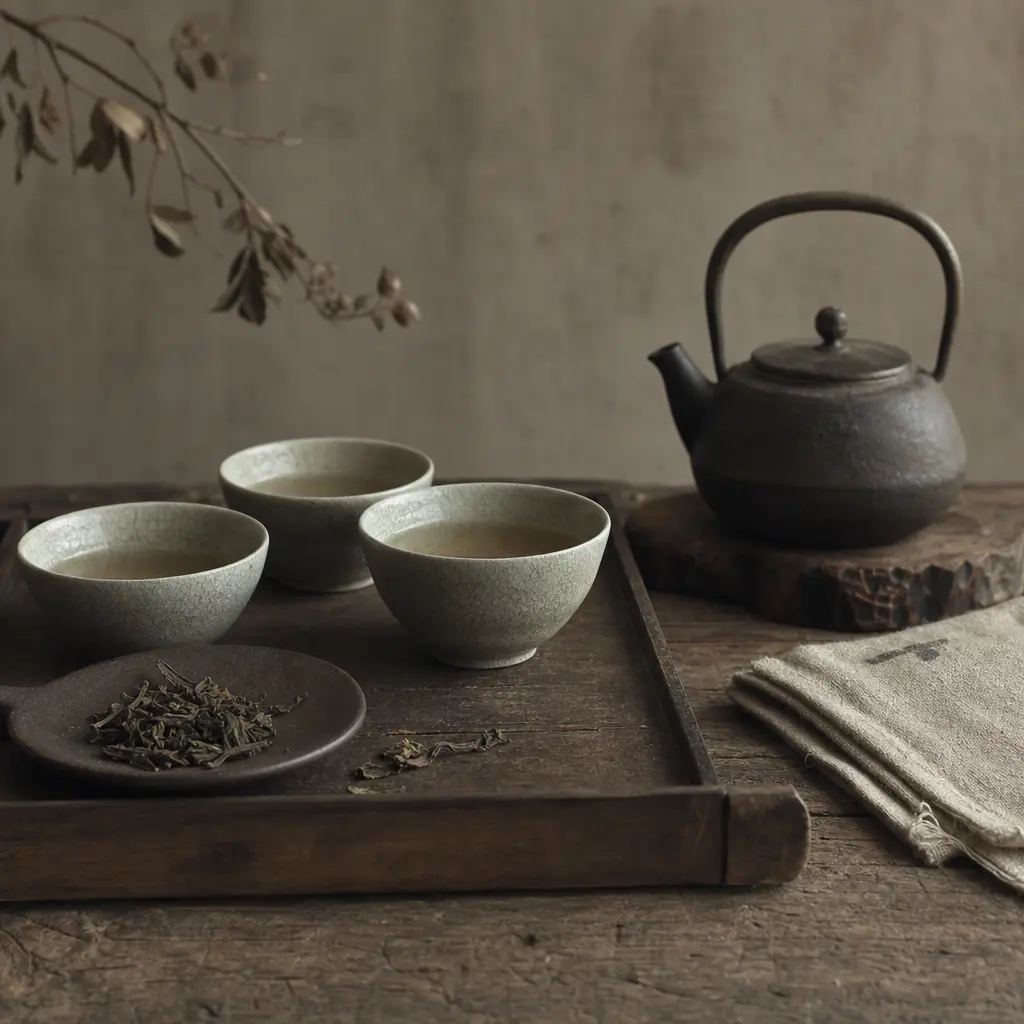
Korean tea ceremony, 다례 (darye), occupies a distinct position in the spectrum of Asian tea formality. Japanese chanoyu is the most codified end of the spectrum: choreographed movement, specific utensil placement, aesthetic principles derived from wabi-sabi philosophy, studied over years through formal schools. Chinese gongfu cha (功夫茶) is technically focused — precise ratios, precise timing, precise water temperature — but relatively informal in social character. Darye sits between these poles: more formalized than everyday Chinese tea drinking, less theatrical than Japanese ceremony.
The aesthetic values in darye are 자연 (jayeon, naturalness), 청정 (cheongjung, cleanliness), and 중용 (jungyong, middle way). The ceremony emphasizes seasonal awareness — the tea, the vessel, the setting should all harmonize with the time of year. Spring darye with ujeon nokcha in a celadon cup (청자, cheongja) is a complete aesthetic statement.
The Buddhist monastic tea tradition, 사찰 다도 (sachal dado), is the oldest living strand of Korean tea culture. Korean Buddhist monks have maintained tea cultivation and ceremony for over a thousand years. The tea masters of the major temple complexes — many in Jeollanam-do, near Boseong and Hadong — are considered the custodians of the most authentic Korean tea practice. Temple tea is not performative; it is meditative and functional, tied to the rhythms of monastic life and seasonal ceremony.
This temple connection gives Korean tea culture a gravity that is easy to miss if you approach it only through tourism marketing or commercial export products. The Champagne comparison breaks down here: Boseong’s artisanal and temple tier is rooted in spiritual practice, not just agricultural tradition.
Quality Indicators & Authentication
Evaluating Boseong tea quality requires attention to several parameters:
Harvest date documentation. Legitimate ujeon should specify picking before April 20. Producers who cannot or will not provide this information are selling grade claims rather than verified quality. Some buyers request harvest date certificates.
Processing method transparency. Deokkeum-cha versus jeungje-cha produces fundamentally different cups. A producer who cannot tell you which method they used is operating at the commodity tier.
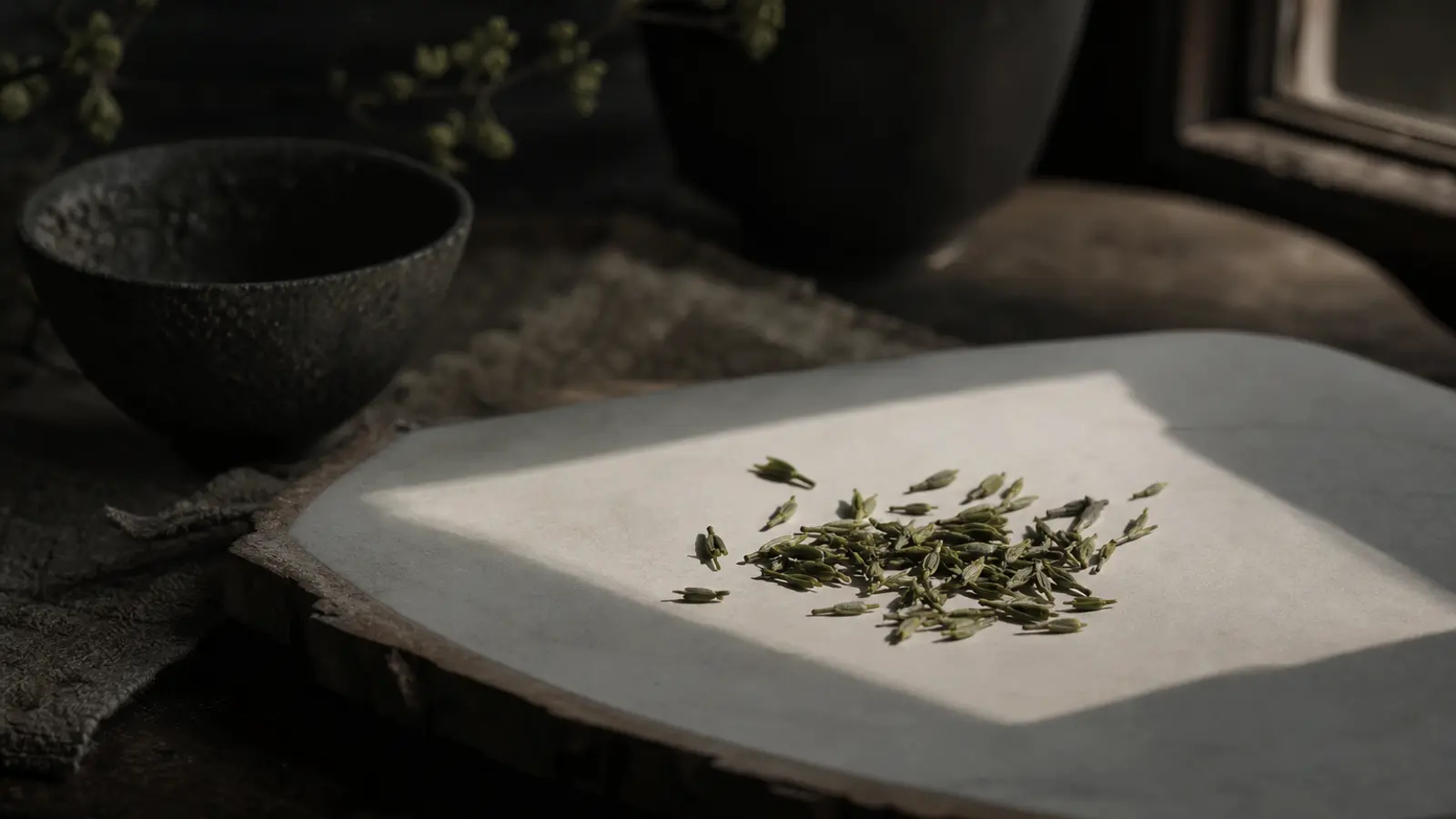
Dry leaf appearance. Premium spring teas from both processing traditions should show tightly rolled or twisted leaves with vibrant green color and minimal stem content. Yellowing, uniform color (sometimes indicating blending or artificial enhancement), or excessive breakage are negative indicators.
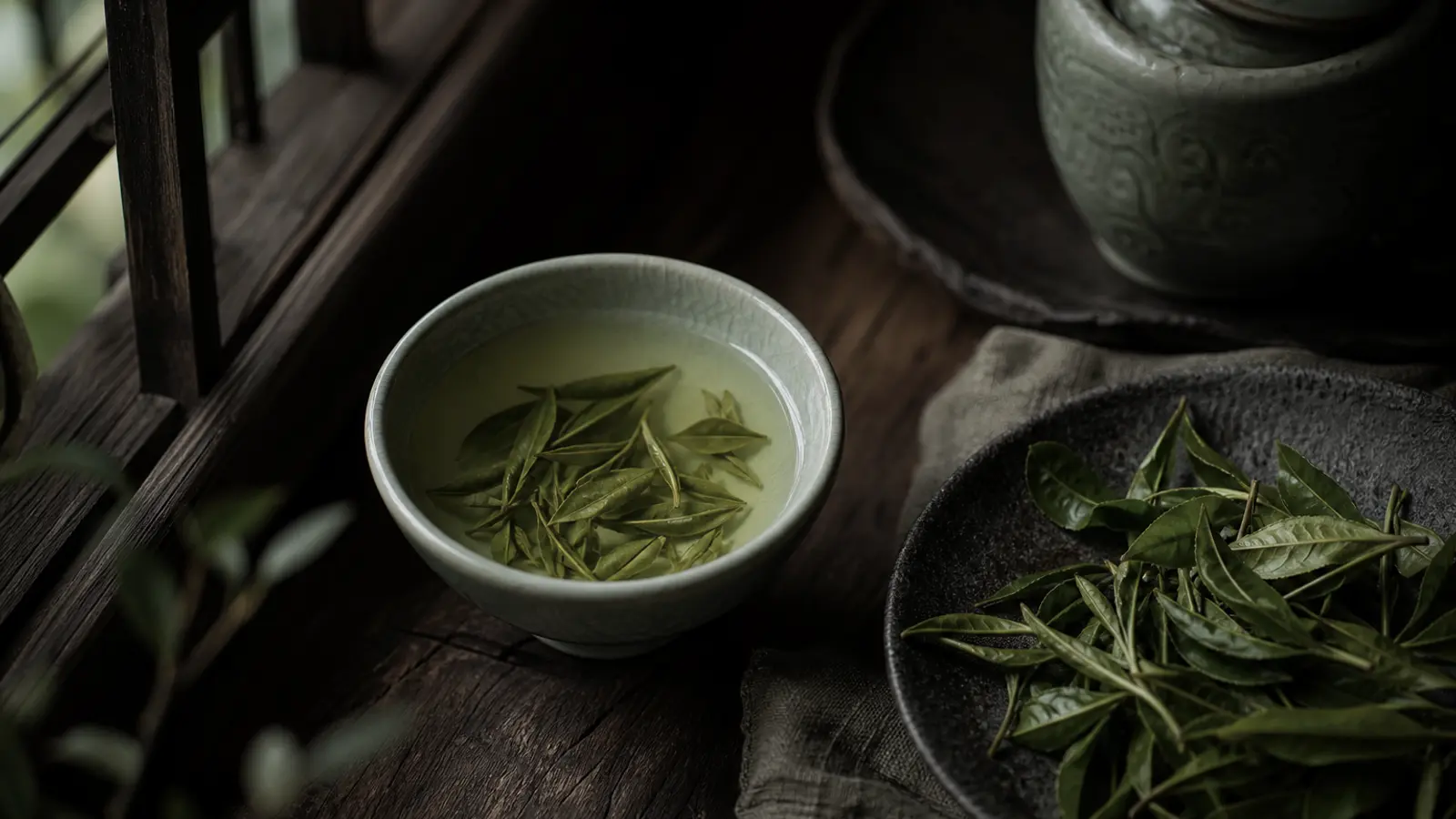
Infusion clarity. Quality nokcha brews to a clear, luminous green-yellow. Cloudiness can indicate processing problems or old leaf.
Origin specificity. “Korean green tea” is a legal category, not a terroir statement. Boseong-specific labeling, ideally with plantation name and harvest grade, is the minimum for quality transparency. The best producers include garden maps, harvest dates, and processing notes.
Price as a baseline signal. Genuine ujeon cannot be produced cheaply. If a product labeled ujeon is priced comparably to commodity green tea, it is either mislabeled or from a year with unusual abundance. Use pricing as a plausibility check, not the sole quality criterion.
Price Ranges
Korean tea is expensive relative to equivalent-quality Chinese and Japanese production. Higher labor costs, smaller total acreage, and a domestic market that sustains premium pricing all contribute.
| Grade | Typical Price Range (USD/100g) |
|---|---|
| 우전 (Ujeon) | $80–$250+ |
| 세작 (Sejak) | $30–$80 |
| 중작 (Jungjak) | $10–$30 |
| 대작 (Daejak) | $5–$15 |
| 발효차 (Balhyo-cha) | $20–$100+ (wide variance) |
These ranges reflect international export pricing. Domestic Korean retail prices are sometimes lower for mid-grade teas but comparable or higher for artisan productions, where the domestic market is the primary buyer. Temple-produced teas rarely enter international commerce and carry premiums that resist easy generalization.
The price differential versus Chinese green tea — where you can find excellent Longjing (龍井) for $20–$50 per 100g and extraordinary examples for $80–$150 — reflects genuine cost-of-production differences, not inflated marketing. Korean ujeon at $150 per 100g and Mingqian Longjing at $100 per 100g occupy different flavor territories but comparable tiers of craft and scarcity.
Boseong Within the Korean Tea Landscape
Boseong does not exist in isolation. Understanding it properly requires knowing where it sits relative to Korea’s other tea origins.
Hadong (하동, 河東) is the counterpoint. Where Boseong is organized, terraced, and commercially developed, Hadong’s Jirisan (지리산, 智異山) mountain gardens are older, wilder, and more associated with the temple-cultivated semi-wild tradition. Hadong’s elevation is higher — some gardens climb above 700 meters — and its tea culture identity is explicitly tied to pre-modern roots. The debate between Boseong and Hadong partisans within Korean tea circles mirrors, loosely, the Champagne-versus-Burgundy polarity: industrial precision and brand recognition versus terroir-specific depth and historical weight.
Jeju Island (제주도) produces tea on volcanic basalt soil under a subtropical climate that diverges meaningfully from both mainland origins. Jeju teas are not a large market segment internationally, but the terroir signature is distinct enough that serious Korean tea exploration requires at least passing familiarity.
Boseong’s dominance — 40% of national production — means it sets the default expectation for what Korean green tea tastes like. This is both its strength and its liability. The best argument for exploring beyond Boseong is that the regional picture is richer than a single origin can represent.
A Note on What Remains to Be Learned
Korean tea is one of the most underexplored major tea traditions in the reference literature. The gap between the sophistication of Korean domestic tea culture — its grades, its ceremony traditions, its artisan producers, its Buddhist monastic roots — and the thin coverage available in English is striking.
My position here is honest: I am building toward direct engagement with Boseong teas through structured sessions, and the cultural access that comes from family connection to Korean culture is a genuine advantage for going deeper. This article is a foundation, not a conclusion. The flavor profiles, the artisan producer landscape, and the specific session parameters for brewing Korean nokcha will be developed as firsthand notes accumulate.
What I am confident in from the existing literature and cultural research: Boseong is a serious origin, not a novelty. Its harvest grade system is rigorous. Its dual processing traditions produce genuinely different teas. Its Buddhist tea culture runs deeper than most international coverage suggests. And the gap between its commodity tier and its artisan tier is wide enough that anyone who has only tried supermarket Korean green tea has not actually tried Korean tea.
That gap is where the interesting work begins.