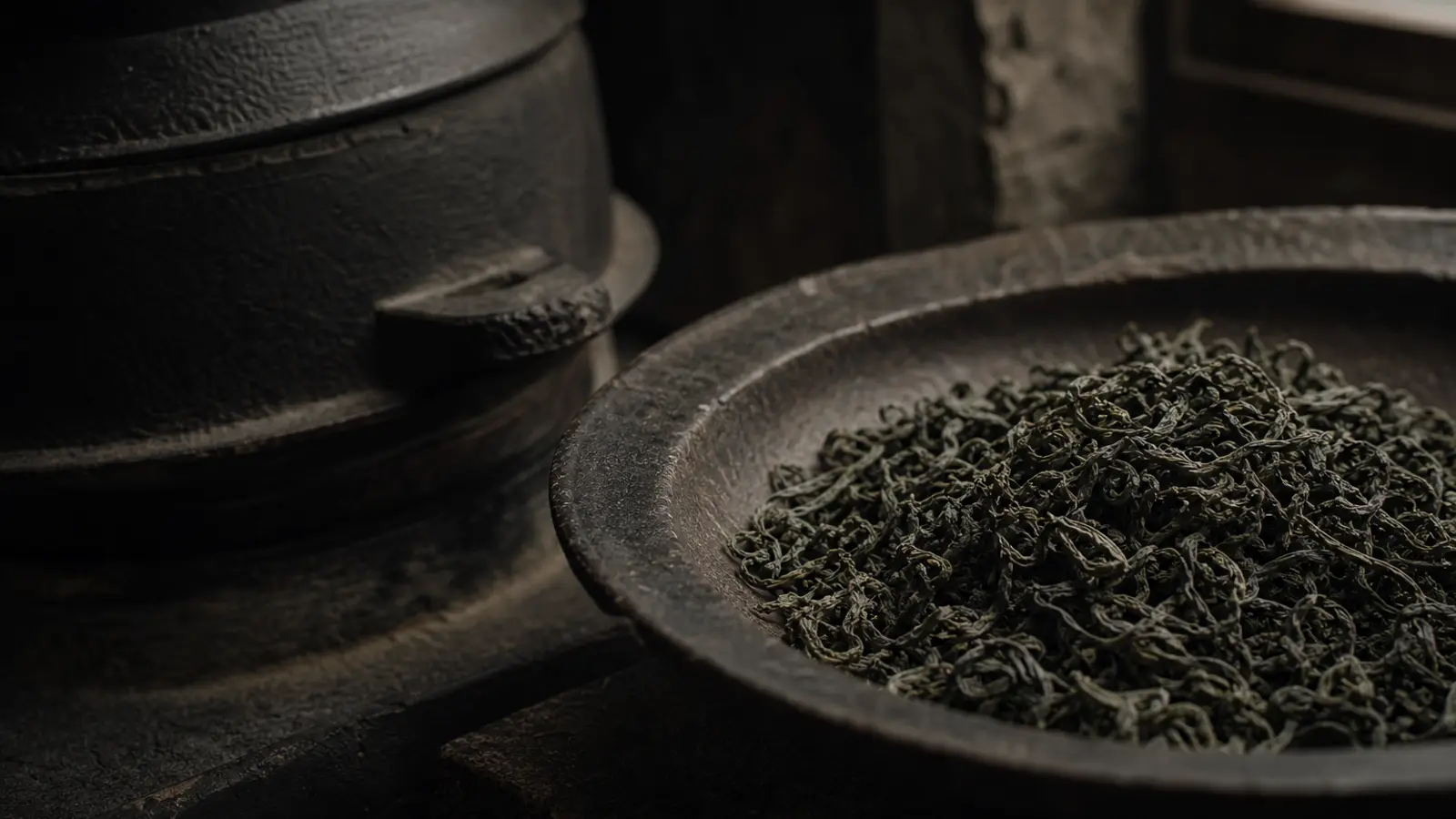
Korean tea is defined by what happens in the first sixty seconds after the leaf meets heat.
Two methods—pan-firing and steaming—halt the oxidation that would otherwise turn fresh green leaves brown and tannic. Each produces a fundamentally different cup from the same raw material. Understanding how Korean tea is made means understanding this divergence: where the methods come from, what they do to the leaf at a cellular level, and what they produce in the bowl.
The Kill-Green Decision
Fresh tea leaves contain polyphenol oxidase, an enzyme that begins converting catechins into darker, more astringent compounds the moment a leaf is damaged or wilted. Kill-green—called sha qing (杀青) in Chinese—is the heat treatment that denatures this enzyme and locks the leaf’s character in place. Every green tea, Korean or otherwise, depends on getting this step right.
In Korea, the term for the pan-firing version of this process is deokkeum (덖음). The tea produced by this method is deokkeum-cha (덖음차). The alternative, adapted from Japanese practice, is jeungje (증제), or steaming.
These two words—deokkeum and jeungje—define the philosophical and sensory split in Korean tea production.
Pan-Firing: Deokkeum and the Gamasot
The Technique
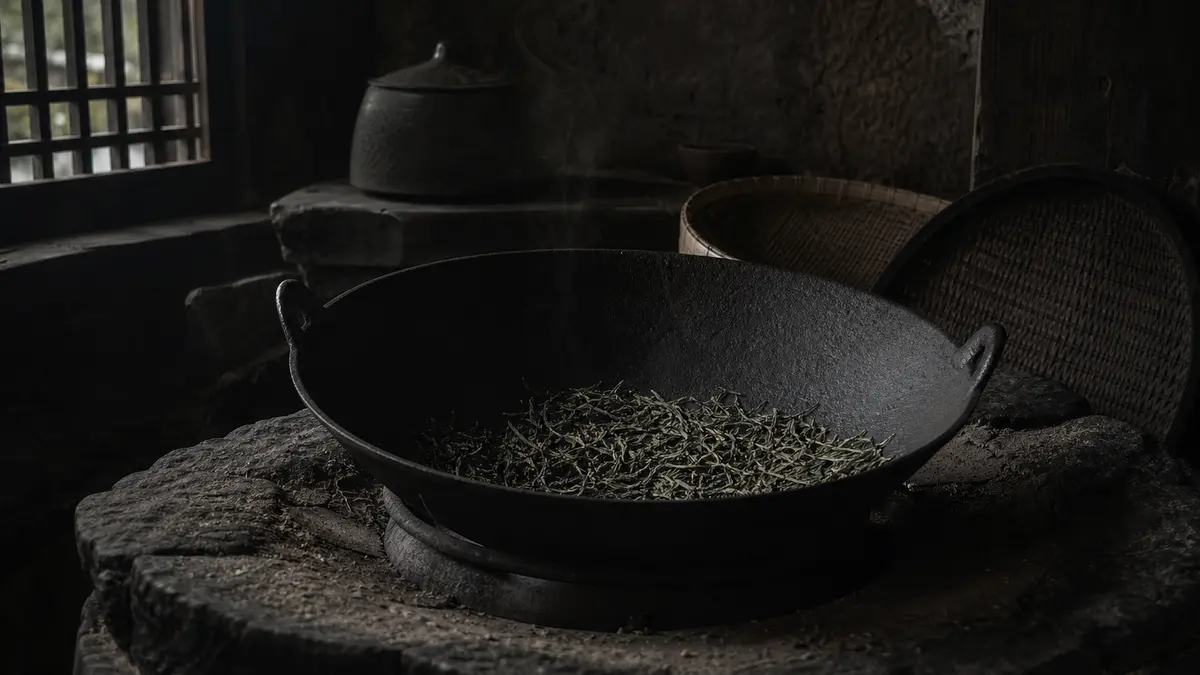
Traditional Korean pan-firing takes place in a gamasot (가마솥), a heavy cast-iron cauldron set over a wood or gas fire. The gamasot is heated to somewhere between 200°C and 300°C (392–572°F) depending on the maker and the leaf condition—experienced producers adjust temperature by feel, by the sound of the leaf in the pan, and by the aroma rising from the cauldron.
The maker presses fresh leaves directly against the hot metal with bare or lightly protected hands, turning and pressing in rapid, rhythmic movements. This direct contact between leaf and hot iron is what separates Korean pan-firing from most Chinese sha qing methods, where a paddle or mechanical drum does the work. In deokkeum, the maker’s hands are the tool. A skilled dain (다인, tea master) in Hadong or Boseong can complete a batch in 30 to 60 seconds of continuous movement.
The goal is to drive moisture out of the leaf quickly enough to stop oxidation without scorching. Get the temperature wrong in either direction and the tea suffers: too hot, and you get bitter char and burned edges; too cool, and oxidation continues, producing an unintended red-tea character in what should be a green.
What It Does to the Leaf
Pan-firing produces a set of chemical reactions that steaming does not. The direct dry heat causes Maillard reactions—the same browning chemistry that gives roasted coffee, bread crust, and toasted grain their depth. In tea, this means pyrazines and furans form alongside the grassy chlorophyll compounds, creating the roasted chestnut and sweet grain aroma that defines Korean green tea made by this method.
The leaf also develops a slight dryness and structural integrity from the direct metal contact, which affects how it rolls and how it releases flavor during brewing.
The Artisan Variable
Pan-firing preserves what I think of as the maker’s hand. Every decision—how hot, how long, how much pressure, how many passes—is made in real time by a human being reading a live process. The result is variable. Two batches of the same leaf, processed by the same maker on different mornings, will not be identical. Temperature swings, leaf moisture content, the maker’s fatigue or attentiveness: all of it shows up in the cup.
This is not a flaw. It is the nature of the method. A deokkeum-cha from a respected master in Hadong (하동) carries that maker’s signature across seasons, the way a wine from a specific domaine carries the fingerprints of its viticulture and cellar decisions. Open-top fermentation in natural wine makes the same trade-off: character and variability over consistency and control.
Steaming: Jeungje and the Modern Method
How Steaming Works
Jeungje (증제) exposes fresh leaves to direct steam—usually for 30 to 120 seconds—at temperatures around 95–100°C. Steam penetrates the leaf rapidly and uniformly, denaturing polyphenol oxidase without the dry heat reactions of pan-firing. The leaf exits the steamer still green, still moist, structurally softened.
This technique was systematized in Japan over centuries and produces the characteristic flavor profile of Japanese sencha (煎茶) and gyokuro (玉露): the marine-vegetal-grassy register known in Japanese as umami-forward, with the bright green color that results from preserved chlorophyll.
Korea adapted this method during the modern era, particularly in large-scale Boseong (보성) production. The economics are clear: steaming is faster, more consistent, and easier to mechanize than hand pan-firing. A steaming line can process volumes that no team of hand-firing artisans could match.
Steamed Korean Tea vs. Japanese Tea
A common assumption is that steamed Korean green tea tastes like Japanese tea. It does not—not exactly. Korean cultivars, particularly the native Camellia sinensis var. sinensis strains common in Hadong, differ from the Japanese cultivars bred for steaming. Korean terroir—the granite and red clay soils, the higher diurnal temperature variation in mountain-grown gardens—produces a different base leaf. The steaming method handles it differently than decades of Japanese refinement have handled Yabukita or Okumidori.
The result is a tea that occupies a middle position: more vegetal and less roasted than deokkeum-cha, but with a slightly earthier, less sharp character than mainstream Japanese sencha. It is accessible and consistent. For many drinkers, particularly those new to Korean tea, steamed Korean green tea is the easier entry point.
After Kill-Green: Rolling, Drying, and Additional Firing
Regardless of which kill-green method a producer uses, the leaf undergoes additional processing before it becomes finished tea.
Rolling (유념, yunyeom) shapes the leaf and breaks cell walls to release flavor compounds. Traditional Korean green tea is often rolled into twisted or slightly balled shapes rather than the flat-needle forms common in some Chinese green teas. More cell-wall damage means faster infusion and more intense early steeps; less damage produces a more gradual release across multiple infusions.
Drying (건조, geonjo) drives residual moisture from the leaf to stabilize it for storage and transport. In traditional production, this may happen in the gamasot at lower temperatures. Larger producers use mechanical dryers with temperature-controlled airflow.
Additional firing rounds are common in artisanal deokkeum-cha. Multiple passes through the gamasot—some producers do three to five rounds, alternating firing and rolling—develop deeper roasted character and gradually build the pyrazine compounds that define the finished tea’s aroma. Each round integrates the flavors further and reduces moisture progressively.
Hwangcha: The Partial Oxidation Path
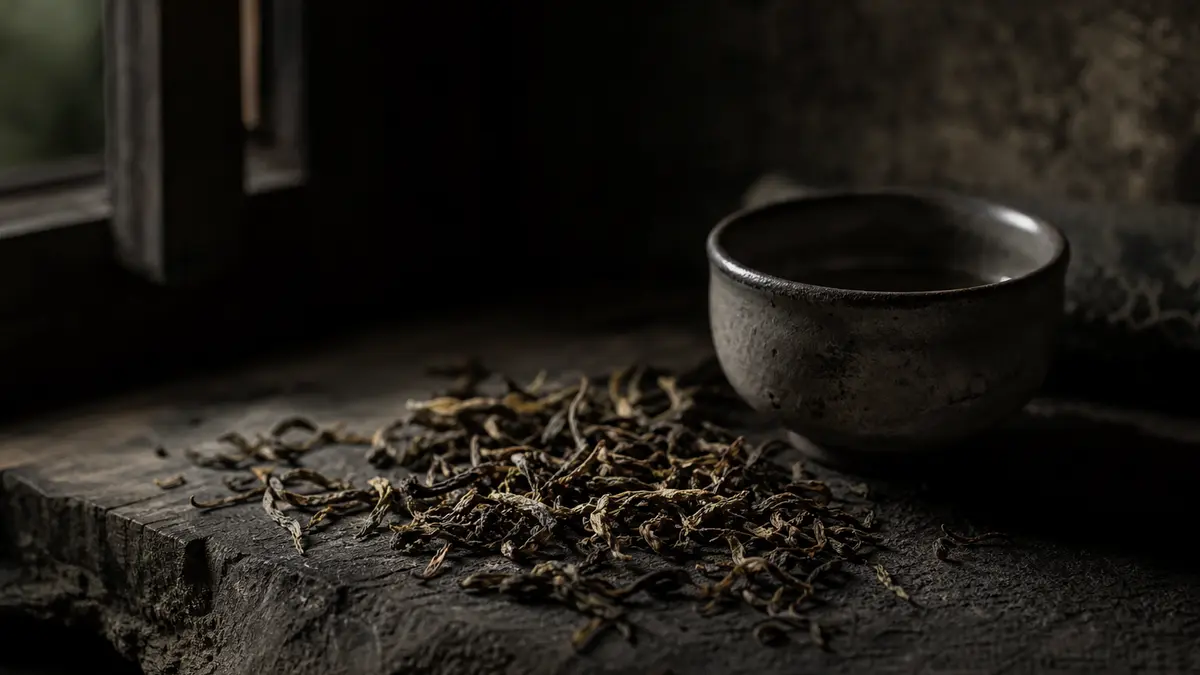
Korean tea processing includes a category that sits outside both standard green tea methods. Hwangcha (황차, “yellow tea”) involves intentional partial oxidation—not the full oxidation of a red tea, but a deliberate pause before or after kill-green that allows enzymatic browning to develop sweetness and reduce astringency.
This is not the same as Chinese yellow tea (黄茶), which uses a smothering (men huang, 闷黄) process. Korean hwangcha’s oxidation step varies by producer, which makes it one of the more variable categories in Korean tea. The result sits between green and black: warmer in color, smoother in texture, with honey and dried fruit notes that neither deokkeum-cha nor steamed Korean green tea typically produces.
The Two Methods Side by Side
| Deokkeum-cha (Pan-fired) | Jeungje (Steamed) | |
|---|---|---|
| Kill-green method | Direct contact with hot iron cauldron | Steam at 95–100°C for 30–120 sec |
| Heat type | Dry heat (200–300°C metal) | Moist heat |
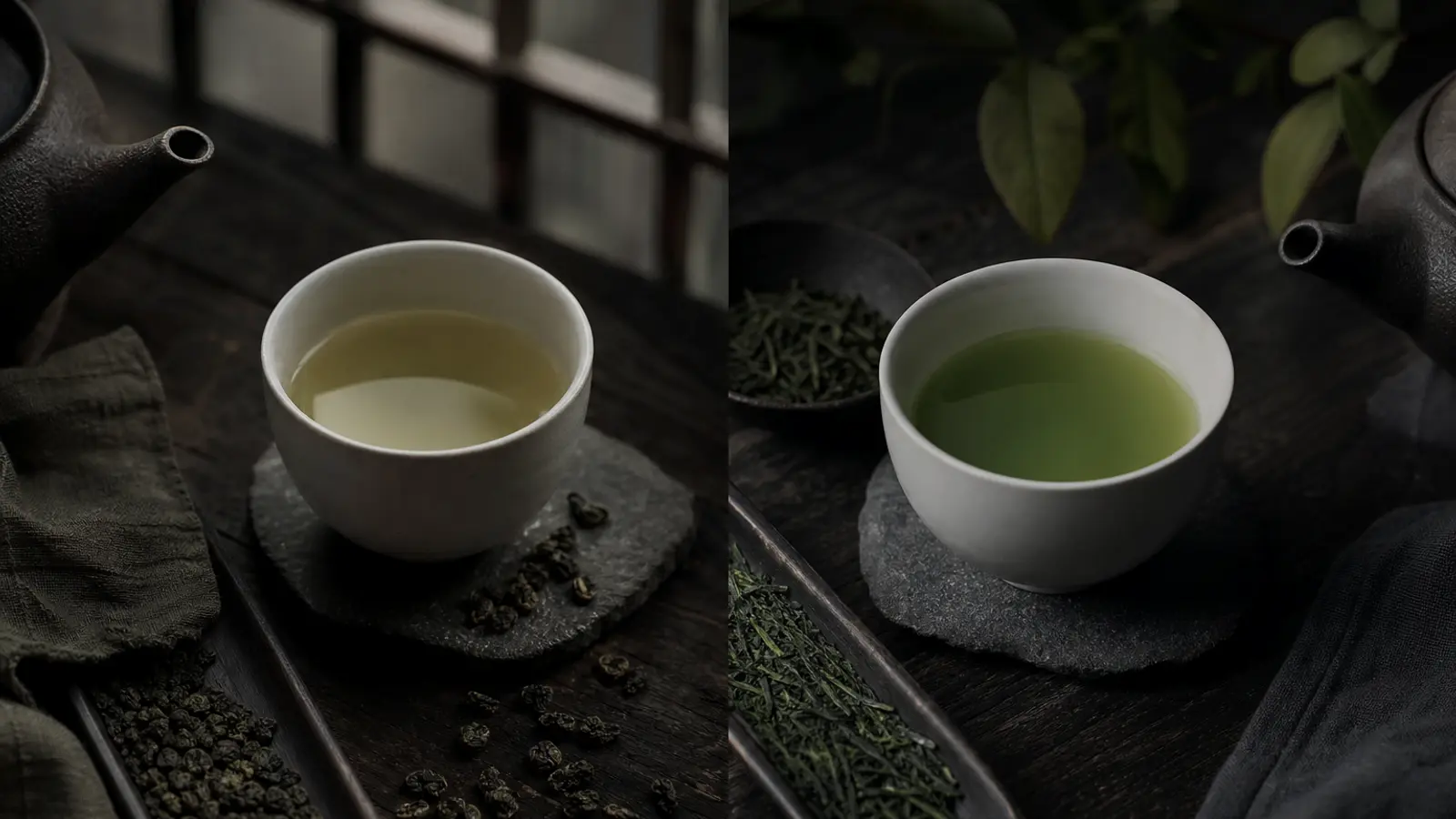
| Primary aroma | Roasted chestnut, sweet grain | Vegetal, marine, grassy |
| Color | Slightly darker green, some browning | Bright, vivid green |
| Consistency | Variable (artisan-dependent) | Consistent (mechanizable) |
| Scale | Small-batch artisanal | Large-scale commercial |
| Regional association | Hadong | Boseong (large production) |
| Closest analog | Chinese sha qing green tea | Japanese sencha |
Why the Method Matters for Brewing
Understanding how Korean tea is made changes how you brew it.
Pan-fired deokkeum-cha responds well to slightly lower water temperatures—around 70–80°C—which preserves the delicate sweet grain and chestnut aromatics without amplifying any astringency from the roasting. A gaiwan (蓋碗) or small ceramic bowl works well. First steep at 5–7 grams per 100ml, 30–45 seconds; adjust up from there.
Steamed Korean green tea, like Japanese sencha, is more forgiving at 70–75°C but can handle a slightly higher leaf-to-water ratio in shorter steeps. The vegetal character softens as you cool the water.
Both categories reward attention to the leaf condition and the water quality. High-mineral water flattens the subtleties that differentiate pan-fired from steamed. Soft water—under 50 ppm total dissolved solids—lets the method’s signature express itself.
The Maker’s Craft
What makes deokkeum compelling beyond its flavor is what it asks of the person making it. There is no machine that can replicate the tactile feedback of pressing leaf against hot iron and reading, through the palms, whether the moisture is releasing correctly. The gamasot does not have a dashboard. The training that produces a skilled dain (다인) in Hadong takes years, not months.
Korean tea culture has preserved this method not because it is efficient, but because it produces something that efficiency cannot: a direct transmission of craft from hand to cup. The variability is the point. A deokkeum-cha that varies slightly across seasons tells you something real about the leaf, the climate, and the maker’s response to both.
Steaming has its place. Consistency is not a failure—it is what makes Korean tea accessible to a global market and what keeps large-scale gardens economically viable. But if you want to understand what Korean tea is, at its most distinctly itself, start with a hand-fired deokkeum-cha from a small producer in Hadong. Brew it at 75°C. Pay attention to what comes through the steam before you even pour.
That is the maker’s hand. That is deokkeum.