Hou yun (喉韻) is one of the most discussed and least understood concepts in serious tea tasting. Translated literally as throat resonance or throat rhyme, it describes a cool, sweet, or faintly mentholated sensation that persists deep in the throat after swallowing — not on the tongue, not in the mouth, but specifically in the throat. It lingers. In exceptional teas, it lingers for a long time.
I first noticed hou yun clearly during a session with a well-aged Yiwu sheng, several steeps in. I had swallowed and set down the cup, and there it was — a quiet, cooling presence in my throat that continued for several minutes without any tea in my mouth at all. That is hou yun. Once you locate it, you cannot unfeel it.
What Hou Yun Actually Means
The character 喉 means throat. The character 韻 means resonance, rhyme, or lingering tone — the same word used in classical Chinese poetry to describe the way a rhyme scheme gives a poem its lasting echo. Together, hou yun describes a sensation that continues to sound in the throat after the tea itself is gone.
This is not a metaphor. Practitioners use it as a precise sensory descriptor, and the best translation I have found is the wine concept of finish or length — the way a great Burgundy leaves a complex resonance on the palate that persists for 30 seconds, a minute, sometimes longer after the glass is empty. Hou yun is the tea equivalent, but anatomically specific: it lives in the throat, not the palate.
Hou Yun vs. Huigan: A Critical Distinction
These two terms are often conflated. They are not the same thing.
Huigan (回甘) is sweetness returning after bitterness. You swallow a bitter tea, and within 15–30 seconds, a wave of sweetness rises back up from the throat into the mouth. It is a taste event — a chemical interaction between bitter compounds and saliva that produces a retronasal sweetness. Huigan is about flavor reversal.
Hou yun is not about flavor reversal. It is about resonance — a sensation that continues to emanate from the deep throat, often with a cool, almost mentholated quality, regardless of whether the tea was bitter. Think of the distinction this way: huigan is the taste echo, hou yun is the throat echo. They can occur together, and in the best Yiwu-style sheng they often do, but they are separate phenomena operating in separate anatomical locations.
A tea can produce strong huigan with negligible hou yun. A tea can produce moderate huigan with remarkable hou yun. Learning to separate them in your attention is part of developing a tasting vocabulary.
How to Detect Hou Yun
Most drinkers miss hou yun because they are still paying attention to their tongue and palate after swallowing. Hou yun requires redirecting attention downward.
Here is the method I use:
- Swallow the tea completely. Do not let any liquid linger in the mouth.
- Breathe out slowly through the nose. This clears retronasal aroma so it does not compete for attention.
- Shift your focus to the deep throat — the area behind the larynx, roughly where the pharynx meets the esophagus. Not the back of the tongue. The throat.
- Hold attention there for a full 30 seconds. Do not talk, do not pick up the cup, do not analyze anything else.
- Notice what is present. Is there a sensation at all? Does it feel cool? Sweet? Does it expand or contract?
What you are looking for is a quality that persists without diminishing for at least that first 30-second window. Ordinary tea produces something brief — a warmth, a passing sweetness — that dissolves quickly. Quality hou yun has duration and a sense of depth, as though the throat itself is generating the sensation rather than just registering residual liquid.
Duration as the Quality Marker
Duration is how practitioners distinguish hou yun quality:
| Duration | Quality Level |
|---|---|
| Less than 30 seconds | Negligible / absent |
| 30–60 seconds | Ordinary |
| 1–3 minutes | Good material |
| 3–5 minutes | Very good material |
| 5–10 minutes | Exceptional |
| 10–15 minutes | Elite old-growth arbor |
The 10–15 minute range is not common. I have experienced it in a session with a high-grade Yiwu gushu (古樹, old arbor) sheng and once with a serious Da Hong Pao (大紅袍). In both cases, I had set down my cup, walked to the kitchen, returned, and the throat resonance was still present. That is a different category of tea.
Which Teas Produce the Best Hou Yun
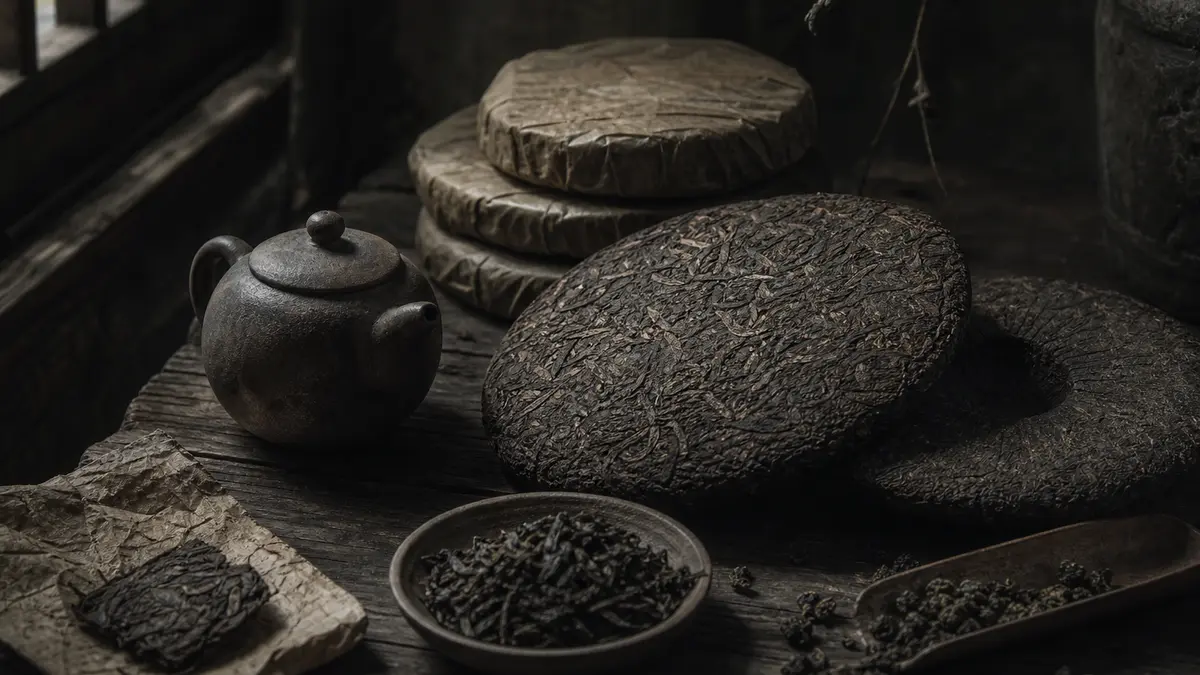
Hou yun is most strongly associated with what I think of as the softer, more aromatic styles of sheng pu-erh (生普洱) — specifically:
Yiwu (易武): The archetype. Yiwu teas from old arbor trees are known for producing hou yun that builds through a session and lingers long after. The combination of low bitterness, floral sweetness, and deep throat resonance makes Yiwu the reference point for this quality.
Jingmai (景邁): Jingmai’s old arbor material shares the thick, aromatic character that produces strong hou yun, along with a distinctive floral quality that amplifies the sensation.
Bingdao (冰島): Considered by many collectors to produce some of the most intense hou yun available, Bingdao sheng is extremely expensive precisely because this quality is so pronounced. Genuine Bingdao material from the core village can sustain throat resonance well past the 10-minute mark.
Yancha (岩茶): Rock oolongs from Wuyi, particularly aged or high-grade Da Hong Pao, Rou Gui (肉桂), and Shui Xian (水仙), frequently produce strong hou yun. The mineral depth from the rocky terrain seems to translate directly into throat resonance.
Highly processed or lower-quality teas — machine-harvested plantation material, fannings, most commodity sheng — rarely produce hou yun worth noting. The sensation requires something in the raw material: likely a combination of specific amino acids, polyphenol profiles, and aromatic compounds that are concentrated in old-growth trees and carefully processed leaf.
Tracking Hou Yun Through a Gongfu Session
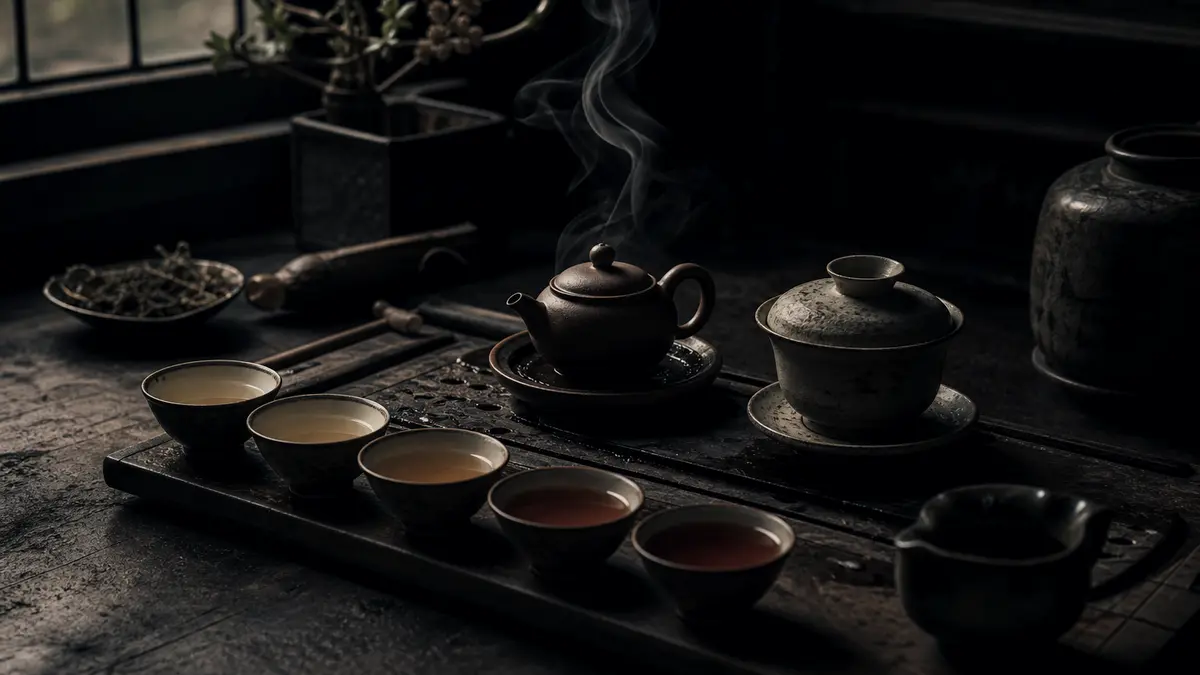
One of the gifts of gongfu brewing (功夫茶) — multiple short steeps with a high leaf-to-water ratio — is that it lets you track hou yun as it evolves across a session.
The typical pattern I observe with quality Yiwu-style sheng:
- Steeps 1–2: The tea is still opening. Hou yun may be faint or absent. Focus on the flavors themselves.
- Steeps 3–5: Hou yun begins building. By steep 4 or 5, a good session should show clear throat resonance persisting 2–3 minutes between cups.
- Steeps 5–7: Peak intensity. This is where elite material separates from good material. The hou yun at this stage should feel almost structural — like the throat is holding a note.
- Steeps 8–12: Gradual fade. The hou yun duration shortens, but in excellent material it never fully disappears until the leaf is exhausted.
- Late steeps: A tea that has completely lost hou yun by steep 8 suggests it was pushing its limits early. A tea that still shows 60–90 seconds of throat resonance at steep 10 has reserves.
Using this framework across multiple sessions builds a comparative sense of what your teas can do. I keep simple session notes — steep number, hou yun duration in seconds, character (cool, sweet, mineral) — and over time they become a useful map of what a tea is actually made of.
Why Hou Yun Matters
Hou yun is not just an esoteric concept for enthusiasts. It is a functional quality marker. Because it depends on the underlying chemistry of the leaf rather than surface-level aroma or initial flavor, it is harder to fake or manipulate through roasting, blending, or flavoring. A tea that produces genuine, lasting hou yun is, almost by definition, made from quality material.
That does not mean every great tea must have spectacular hou yun, or that the absence of hou yun disqualifies a tea. A beautifully vibrant green tea or a delicate white may not prioritize this quality. But for sheng pu-erh evaluation and yancha evaluation, hou yun is one of the most reliable indicators of material quality precisely because it is not easily faked.
Learning to detect it takes time. The 30-second attention exercise above is the starting point. From there, steeping quality Yiwu or Jingmai material — where hou yun is expected and typically present — gives you a baseline to calibrate against. Once you have felt genuine, sustained throat resonance, you will recognize its absence in lesser teas immediately.
That is what makes hou yun valuable as a concept: not mysticism, but a specific, learnable, reproducible sensory skill that directly reflects what is in the cup.