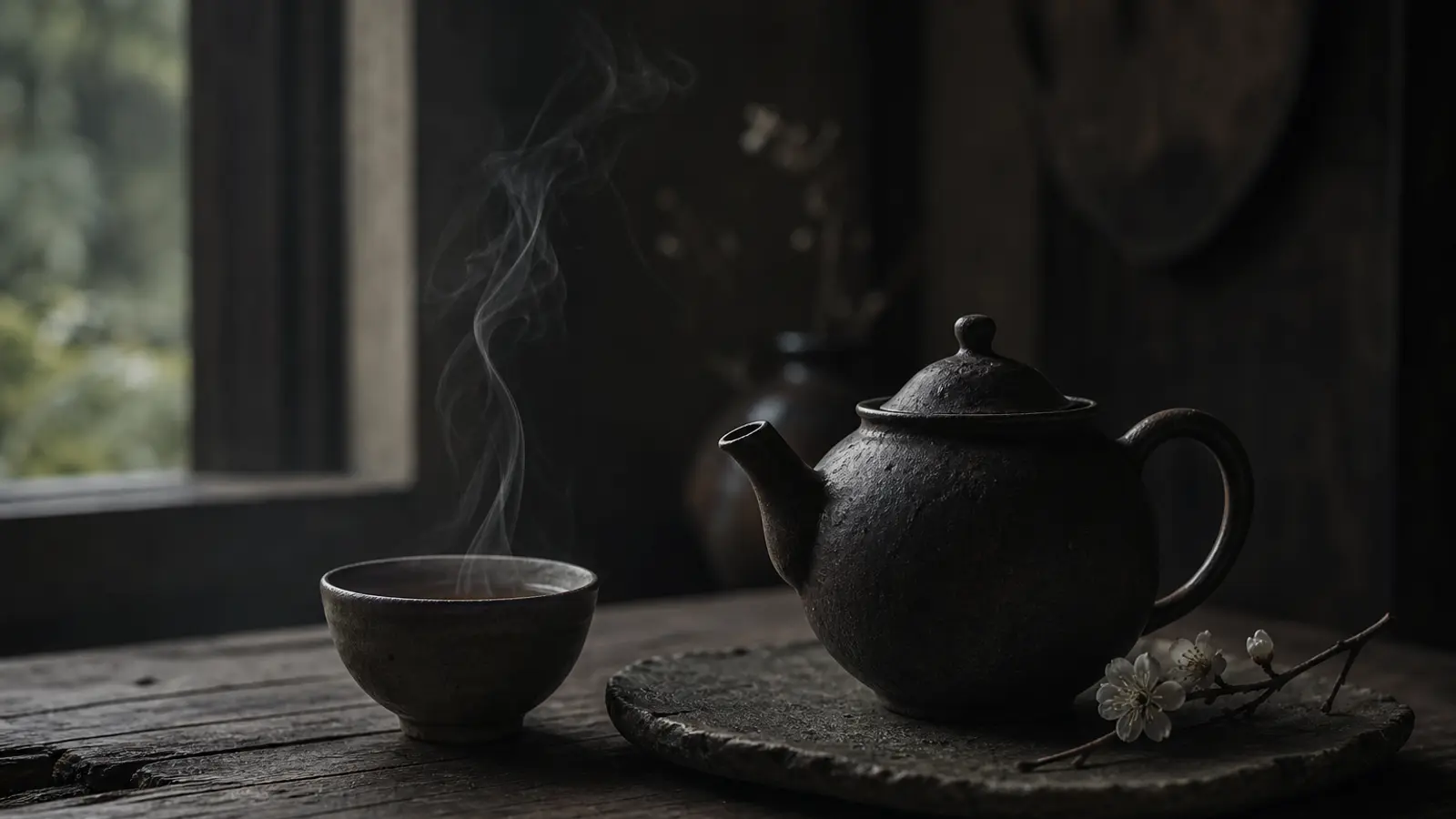
Korean Buddhist temple tea is the oldest continuous thread of tea culture on the peninsula. While court tea rose and fell with dynastic fashion, while colonial occupation disrupted nearly everything, while war leveled cities and scattered communities — monks kept boiling water and steeping leaves. The practice called 사찰 다도 (sachal dado, temple tea ceremony) has survived for over a millennium not because anyone marketed it or revived it as heritage tourism, but because it was useful. Tea kept monks awake during meditation. Preparing it with attention was itself a form of meditation. These two facts were enough to sustain a tradition across ten centuries of upheaval.
I came to Korean Buddhist temple tea from gongfu practice — a different tradition, a different culture, but the same underlying mechanism. A cup gives your hands something to hold. Preparation gives your attention something to track. Warmth gives your body something to feel. The resonance between these practices is not coincidental. It points to something fundamental about what tea does when you pay attention to it.
How Tea Arrived in Korean Temples
Tea came to Korea from China, carried by Buddhist monks traveling between the two kingdoms during the Silla Dynasty (신라, 57 BCE–935 CE). The historical record points to the monk 대렴 (Daeryeom), who reportedly brought tea seeds from Tang Dynasty China during the reign of King Heungdeok (흥덕왕) around 828 CE. According to the Samguk Sagi (삼국사기, History of the Three Kingdoms), the king ordered the seeds planted on 지리산 (Jirisan), the mountain that still anchors Korean tea production today.
By the Goryeo Dynasty (고려, 918–1392), tea had become deeply embedded in both court and temple life. 연등회 (yeondeunghoe, lantern festivals) and 팔관회 (palgwanhoe, harvest festivals) featured elaborate tea rituals. Buddhist monasteries were the intellectual and cultural centers of Goryeo Korea, and tea was woven into monastic daily life — offered to the Buddha, shared among monks, served to visitors.
This is the period when Korean tea culture reached its broadest influence. Tea wasn’t a monastic specialty. It was everywhere.
The Joseon Decline and the Temples That Held On
Everything changed with the Joseon Dynasty (조선, 1392–1897). The new ruling philosophy was Neo-Confucianism, and Buddhism was systematically suppressed. Temples were pushed out of cities and into the mountains. Monastic lands were confiscated. The elaborate court tea culture of Goryeo faded as Confucian scholars favored alcohol over tea in their social rituals.
But here is the critical point: the temples didn’t stop making tea. They couldn’t. Tea and meditation had become functionally inseparable. The caffeine and L-theanine in green tea — the combination that produces calm alertness without jitteriness — supported the long hours of seated meditation (참선, chamseon) that defined Seon (선, Korean Zen) Buddhist practice. The practical chemistry kept the tradition alive when cultural fashion abandoned it.
While Joseon court culture moved on, mountain temples like 쌍계사 (Ssanggyesa) in Hadong continued cultivating tea gardens, processing leaf, and conducting tea ceremony as part of daily monastic rhythm. This unbroken continuity is what makes Korean Buddhist temple tea historically remarkable. It wasn’t revived. It persisted.
茶禪一味: Tea and Zen Are One Taste
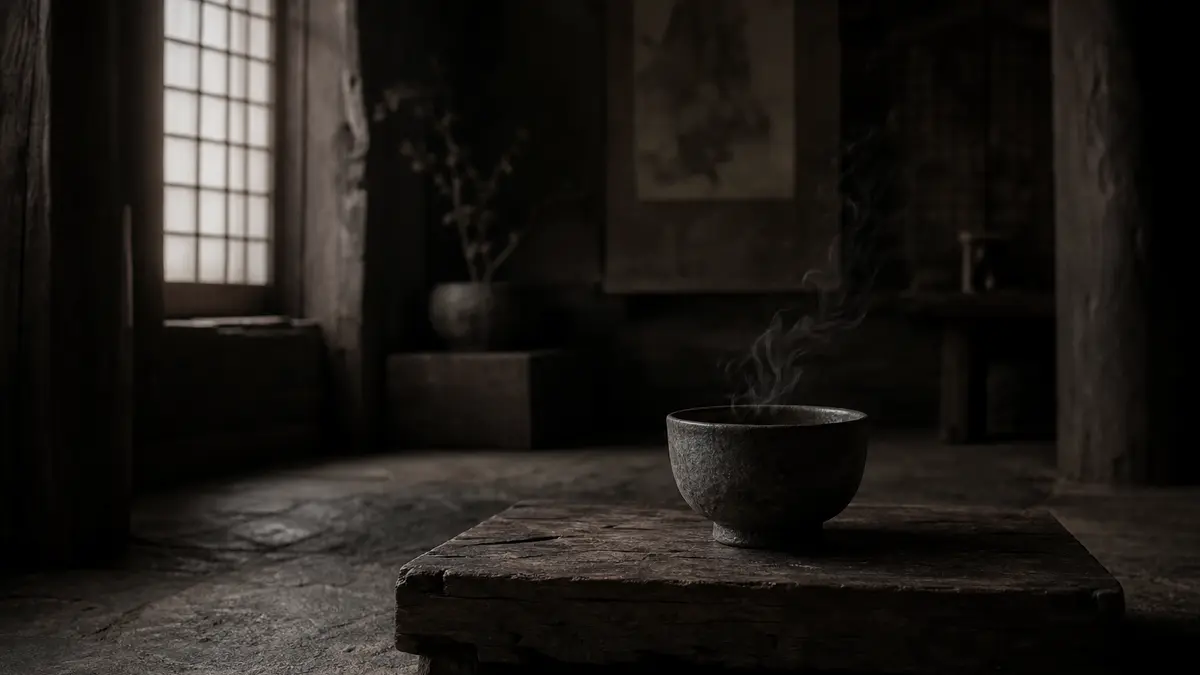
The phrase that captures the philosophy of Korean Buddhist temple tea is 다선일미 (daseon-ilmi), written 茶禪一味 in Chinese characters. Tea and Zen are one taste. This isn’t poetic decoration. It’s a technical claim about attention.
In Seon Buddhist practice, meditation is training in sustained, non-judgmental awareness. You sit. You notice your breath. When your mind wanders, you return it. The practice is radically simple and radically difficult.
Temple tea ceremony applies the same quality of attention to a physical task. You heat water. You warm the teapot. You measure leaf. You pour. You wait. You pour again. Each action receives the same deliberate, unhurried focus that seated meditation gives to breathing. The movements are neither rushed nor performative — a distinction that matters. This isn’t a performance of mindfulness. It’s the thing itself.
The integration goes deeper than analogy. In the monastic schedule, tea often follows seated meditation directly. The transition from cushion to tea table is continuous. The awareness cultivated in stillness is carried into motion. The cup becomes the breath becomes the cup.
What Korean Buddhist Temple Tea Looks Like in Practice
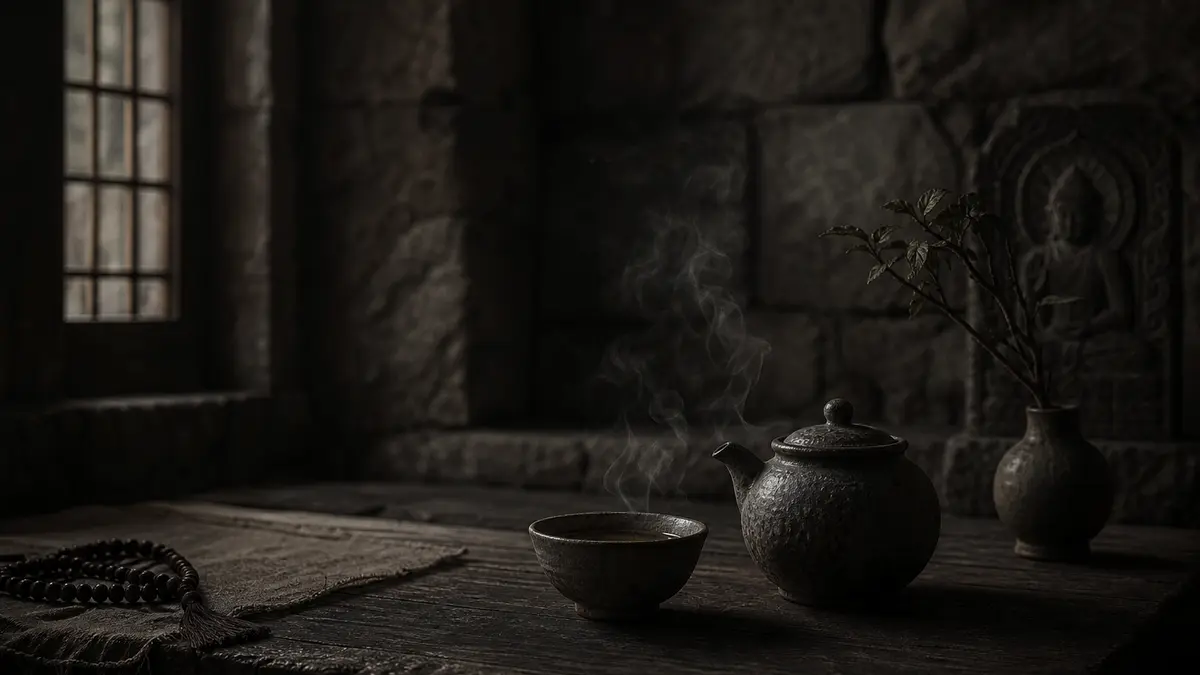
Temple tea ceremony is simpler than Japanese 茶道 (chadō/chanoyu) but more structured than everyday Korean 다례 (darye). There is no matcha, no bamboo whisk, no choreographed sequence of dozens of precise movements. There is a monk, a 다관 (dagwan, side-handle teapot), cups, hot water, and leaf.
The tea is typically Korean green tea — 세작 (sejak, small/delicate leaf) or 중작 (jungjak, medium leaf) grade, harvested from the second or third flush. These are modest teas. Not competition-grade first-flush 우전 (ujeon). The point is not to showcase exceptional leaf. The point is to pay attention while preparing whatever leaf you have.
The Movements
- Water is heated. Not to a roiling boil for green tea — typically around 70–80°C, sometimes cooled by pouring between vessels.
- The teapot and cups are warmed with hot water, then emptied.
- Leaf is placed into the teapot. Usually 3–5 grams for a small dagwan.
- Water is poured over the leaf slowly, without splashing.
- The tea steeps briefly — 30 seconds to a minute for the first infusion.
- Tea is poured into cups with even distribution.
- The cup is received with both hands.
- Silence is typical throughout.
The monk’s hands move with what I can only describe as a specific quality of calm — not slow-motion, not theatrical, just settled. If you’ve watched someone who has performed the same action ten thousand times, you recognize it. There’s no thought visible between intention and movement.
What It Is Not
Temple tea ceremony is not a tea tasting. There is no discussion of flavor notes, no comparison of infusions, no evaluation of the leaf. The tea is drunk, not analyzed. This is perhaps the sharpest distinction from both Chinese gongfu and the Western specialty tea approach. The attention is on the experience of drinking, not on the properties of the drink.
초의 선사: The Monk Who Saved Korean Tea
No account of Korean Buddhist temple tea is complete without 초의 선사 (Choui Seonsa, 1786–1866). Choui was a Seon monk, a scholar, a calligrapher, and — most consequentially — a tea evangelist during the period when Korean tea culture was at its lowest ebb.
Choui spent much of his life at 대둔사 (Daeheungsa, also known as Daedunsa) in 해남 (Haenam), at the southern tip of the Korean peninsula. He cultivated tea, practiced tea ceremony, and — crucially — wrote about it. His two major works secured the literary and philosophical foundation for Korean tea culture:
- 동다송 (Dongdasong, 東茶頌, “Song of Korean Tea”) — a long poem documenting Korean tea cultivation, processing, and preparation methods. It’s practical and specific, covering water quality, firing techniques, and seasonal harvest timing.
- 다신전 (Dasinjeon, 茶神傳, “Classics of Tea Spirit”) — a distillation of Chinese tea classics, adapted and interpreted through Korean Buddhist sensibility.
These texts did something essential: they created a written record of Korean tea practice during a period when that practice was contracting. Without Choui’s documentation, the specific methods and philosophy of Korean tea preparation might have survived only as oral tradition within isolated mountain temples — vulnerable to the disruptions of the 20th century that were coming.
Choui also maintained friendships with prominent Joseon scholars and artists, including 추사 김정희 (Chusa Kim Jeong-hui), one of the greatest Korean calligraphers. Through these relationships, tea filtered back into intellectual culture even during the Joseon period. Choui didn’t just preserve temple tea. He built bridges between monastic tea practice and the wider Korean cultural world.
효당 최범술 and the Postwar Restoration
The 20th century brought Japanese colonial occupation (1910–1945) and then the Korean War (1950–1953). Korean tea gardens were damaged or abandoned. Temple communities were disrupted. The already fragile thread of Korean tea culture was strained nearly to breaking.
효당 최범술 (Hyodang Choi Beomseol) was the monk who picked up the thread after the war. Based in the Hadong (하동) region — the same area where those first tea seeds were reportedly planted over a thousand years earlier — Hyodang worked to re-establish tea cultivation and reconnect temple tea practice with the broader Korean public.
His efforts, combined with those of other tea advocates in the latter half of the 20th century, led to the gradual restoration of Korean tea culture that continues today. The wild and semi-wild tea gardens of Hadong, many growing on the slopes of Jirisan, owe their current vitality in part to Hyodang’s postwar dedication.
Temple Tea Experiences for Visitors
Many Korean Buddhist temples now offer 템플스테이 (tempeulseutei, temple stay) programs that include tea ceremony as part of a broader immersion in monastic life. These programs typically run one to three days and include meditation, chanting, communal meals, and tea.
Temples Known for Tea Culture
- 쌍계사 (Ssanggyesa) in Hadong, South Gyeongsang Province — historically the most important Korean tea temple. Located near the oldest tea fields in Korea. This is ground zero for Korean tea history.
- 불국사 (Bulguksa) in Gyeongju, North Gyeongsang Province — a UNESCO World Heritage site and one of Korea’s most visited temples. Temple stay programs here include tea ceremony components.
- 해인사 (Haeinsa) in Hapcheon, South Gyeongsang Province — home of the Tripitaka Koreana. Tea ceremony is part of the temple stay experience.
These programs are accessible to international visitors. The Templestay program (templestay.com) is administered by the Jogye Order of Korean Buddhism (대한불교조계종) and provides English-language booking and guidance. Costs are modest — typically $30–70 USD for a one-night stay including meals and all activities.
The tea you’ll drink in these settings won’t be the finest Korean green tea available. It will be honest temple tea — jungjak or possibly sejak grade, prepared simply in a dagwan, served in small cups. The value isn’t in the leaf. It’s in the context.
Temple Tea as Structured Attention
I want to be direct about why this practice matters beyond historical interest.
Temple tea ceremony is meditation with a prop. That’s not dismissive — it’s precise. Seated meditation asks you to sustain attention on nothing external: breath, sensation, awareness itself. This is powerful and difficult. Many people struggle with it. The mind needs something to grab.
Tea gives it something to grab. The warmth of the cup in your hands. The color of the liquor. The scent rising from the surface. The specific temperature on your lips. These are real sensory inputs that anchor attention in the present moment without requiring the sustained effort of object-less awareness.
This is the same mechanism behind gongfu brewing as a daily practice. Different tradition, different aesthetics, different tea — but the same underlying function. Pour water. Watch it fall. Feel the heat through ceramic. Smell what the leaves release. The structure of the task creates a container for presence.
The Korean temple tradition names this explicitly. 다선일미 — tea and Zen are one taste. The practice of making tea with attention is not a preparation for meditation, not a break from meditation, not a supplement to meditation. It is meditation. The Zen masters who articulated this weren’t being poetic. They were being technical.
The Thread Continues
Korean Buddhist temple tea has survived because it is useful. Not culturally useful — personally useful. A monk facing four hours of seated meditation in a cold mountain temple needs something that sustains alertness without agitation. Green tea does that. A practitioner cultivating moment-to-moment awareness needs activities that support that cultivation. Tea preparation does that.
The tradition endured Joseon suppression, colonial occupation, and war — not because anyone decided it was worth preserving as heritage, but because the monks who practiced it kept needing it. Choui wrote his texts not to create a museum of tea culture but to share a living practice. Hyodang replanted tea gardens not for tourism but because the temples needed tea.
This is what makes Korean Buddhist temple tea different from a revived tradition. It was never fully interrupted. The thread stretched thin — sometimes desperately thin — but it never broke. A thousand years of monks boiling water in mountain temples, steeping leaves in ceramic pots, sitting in silence with warm cups in their hands.
The practice is available to anyone who wants to sit down and pay attention.