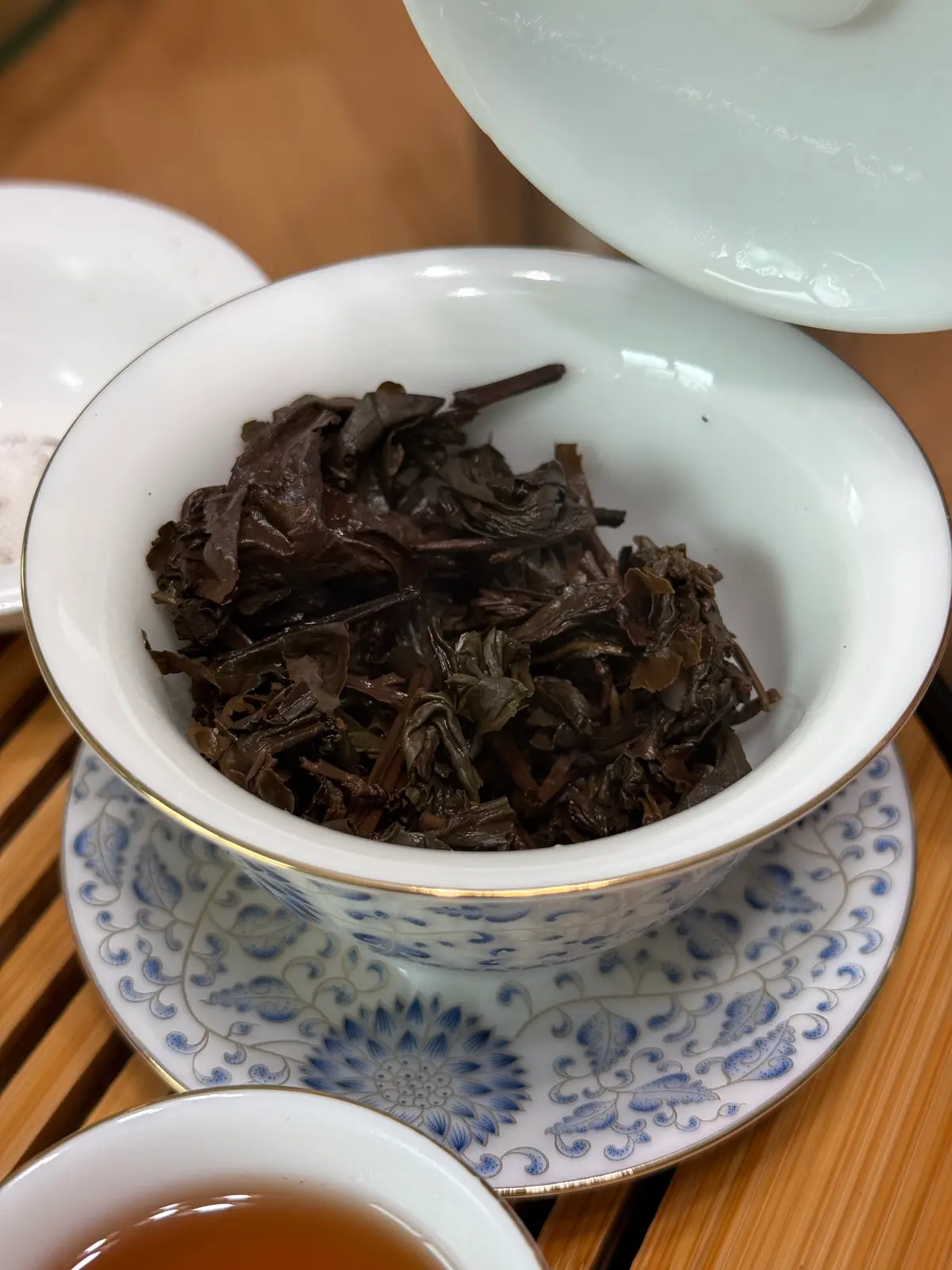
I tasted this the same day as the 2004 Chang Tai Yi Wu — my first cake, the tea that made the hobby permanent. This Zhong Cha 8001 was a sample given alongside the purchase. Same era, similar age, same dry storage. The difference: the Chang Tai is single-origin Yi Wu. This Zhong Cha is a CNNP factory blend — multi-region Yunnan leaf pressed under the classic Zhong Cha red-label wrapper. In wine terms, single vineyard versus assembled cuvée. Same appellation. Different philosophy.

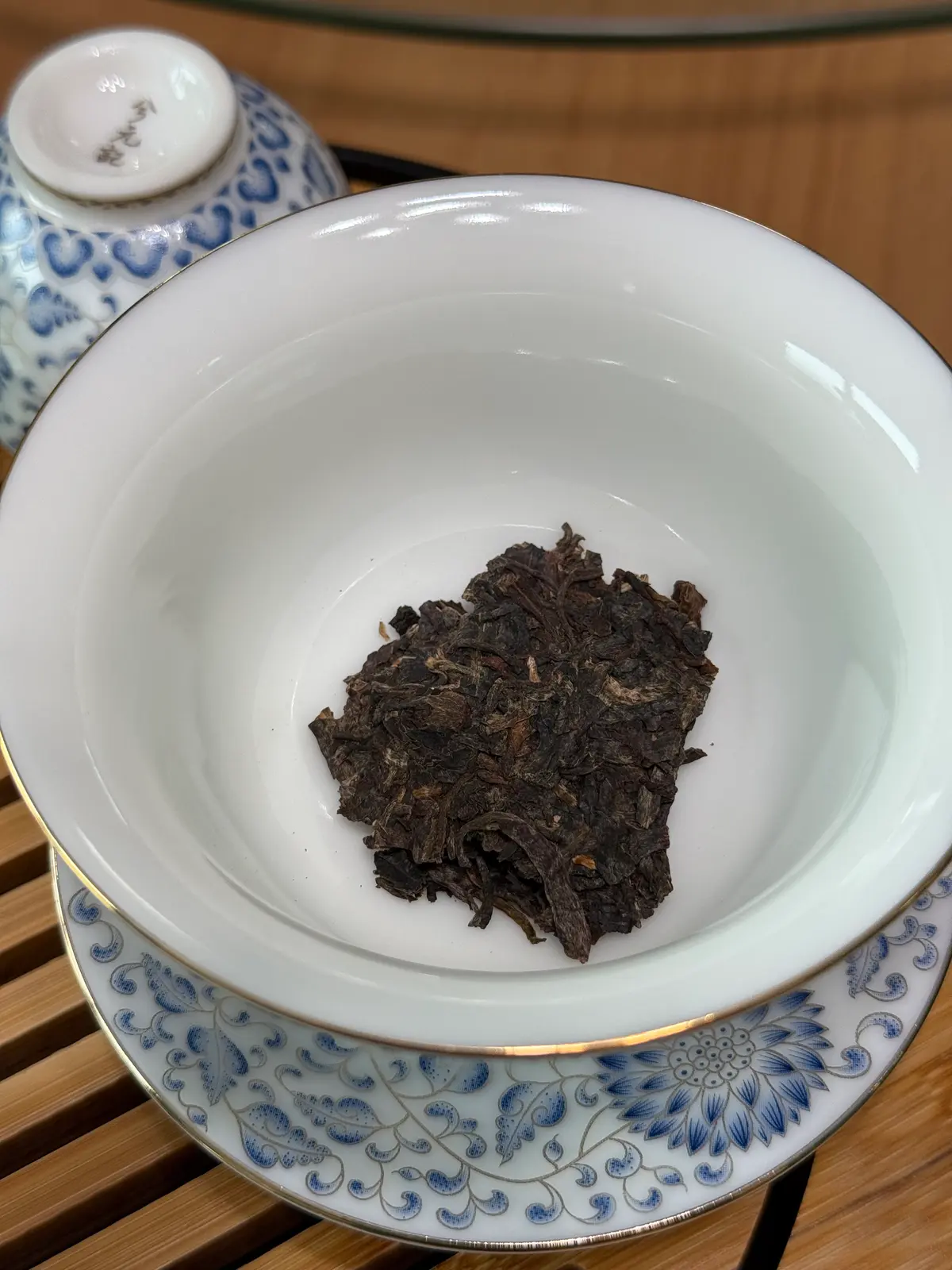
Dry Leaf
CNNP factory cake, 2006 pressing. The Zhong Cha (中茶) eight-character logo on the wrapper — one of the most recognizable marks in pu-erh history. Recipe 8001 uses ancient tree material blended from multiple Yunnan growing regions for complexity. Twenty years of dry storage.

The Session
The first steep was gentle — dates, sweetness, a quiet opening that didn’t announce itself the way the Chang Tai had. Then the second steep hit deeper, dramatically stronger. The liquor poured light and bright — cleaner than I expected for a 20-year tea. That brightness confirmed what the absence of mustiness had suggested: this tea was properly dry-stored. No dampness, no mold, no shortcuts.
And there, behind the dates — peach. Hiding. Not the full, ripe stone fruit that defined my 2006 and 2003 Yi Wu shengs. A suggestion. A brightness trying to push through from underneath the aged character. CNNP blends from multiple origins — the peach likely comes from lighter terroir material in the blend, possibly Yibang or Mangzhi. Single-origin Yi Wu gives pure dates at this age. This blend gives dates with a ghost of peach behind them. You taste the blend.
Steep 3 introduced something new: cinnamon and licorice. A warm spice register that the Chang Tai Yi Wu didn’t have. This is 樟香 (zhāng xiāng, camphor) transitioning into 辛香 (xīn xiāng, spice) — part of the same aromatic family as the 편백나무 I detect across so many teas, but expressed differently through this particular blend of aged material.
Then steep 4 changed the session. Bitterness. Tannins. The Chang Tai Yi Wu at 22 years had zero bitterness — everything converted, everything smooth. This Zhong Cha at 20 years still carries bitterness. That difference tells a terroir story: the blend includes leaf from more astringent growing regions — likely Bulang or Menghai area material — where the polyphenol content is higher and takes longer to age out. Yi Wu is naturally the sweetest, smoothest Yunnan terroir. Other mountains carry more fight. This blend has fight left in it at 20 years.
Steep 6 brought the surprise. Smokiness. Peat. The same family of compounds you find in an Islay single malt — phenolic, dark, unmistakable. This is 烟香 (yān xiāng, smoke fragrance), imparted by wood-fired wok processing during the kill-green (杀青) phase. Some factories in the mid-2000s used traditional wood-fired woks rather than gas or electric. The smoke enters the leaf and hides for decades, then re-emerges as the other flavor compounds exhaust. I didn’t know tea could taste like scotch. Now I do.
I broke for lunch. Came back for steeps 8-9. The sweetness had started returning — jujube, peach pushing through the bitterness and licorice. Something was building.

Then steeps 11-13 delivered the ending I didn’t expect.
The bitterness was gone. Completely gone. In its place: deep caramel-jujube sweetness. Rich, warm, fully formed — like the dates from the opening steeps had gone underground, gathered everything the session had thrown at them, and re-emerged transformed. This was huigan. Not the rapid bitterness-to-sweetness conversion of Bulang terroir that happens within a single swallow. Not the gentle sustained sweetness of the Chang Tai. This was a huigan that took thirteen steeps to complete. The longest arc in my entire collection.
The tea spent ten steeps demanding patience. Bitterness, tannin, smoke, more bitterness. And at steep 11, the payoff. The sweetness that arrived was deeper and more complex than anything the early steeps had offered — because the palate had been through the bitterness and the smoke and the tannin, and everything that came after registered against that memory. This is the same mechanism I learned from the Meng Song shou — bitterness primes the palate for sweetness — but stretched across an entire session rather than three steeps.
I would have missed this entirely if I’d stopped at steep 6. The tea wasn’t done at steep 6. It wasn’t even done at steep 9. It needed thirteen steeps to tell its full story. If I’d judged it at the smoky, bitter midpoint, I would have written “interesting but not for me.” At steep 13, the verdict is different.
Flavor Profile
The front is dates with peach hiding behind — lighter and more florally complex than the Chang Tai’s pure dates-and-caramel. The mid is a three-act journey: cinnamon-licorice into bitterness-tannin into Islay smokiness. The finish — the real finish, not steep 6 but steep 13 — is deep caramel-jujube sweetness with the memory of everything the session traveled through still coloring the edges. The full arc across thirteen steeps is the most dramatic flavor transition in the collection.
Mouthfeel & Huigan
Smooth in the early steeps, tannic grip at steep 4 through the mid-session, then smoothing again as the tannins exhausted by steep 10. Full circle — the mouthfeel mirrored the flavor arc, moving from silk to grip and back to silk.
The huigan is the story. Thirteen steeps. Sweetness at the opening, pushed underground by bitterness and tannin and smoke for six steeps, then emerging transformed at steep 11. This is the most patient huigan mechanism I’ve experienced. The Chang Tai’s huigan was continuous — sweetness from first sip to last. The Bulang Ban Zhang’s huigan was rapid — bitterness converting within a swallow. This Zhong Cha’s huigan is architectural — it uses the entire session as its canvas. The bitterness wasn’t a flaw. It was the setup.
Qi Notes
Not strongly noted. The session’s focus was on the flavor journey.
Value Assessment
A sample, not a purchase — no direct price evaluation. For context, CNNP 8001 cakes from the mid-2000s with verified dry storage trade in the range of comparable factory productions of the era, below the premium of named single-origin cakes but above commodity blends.

Verdict
At steep 6, this tea was “not bad at all.” At steep 13, this tea earned genuine respect.
The lesson: don’t judge a blended factory cake at the midpoint. The bitterness, the tannin, the Islay scotch smokiness — none of it was the destination. It was all setup for the deep caramel-jujube sweetness that only arrived when the bitter compounds had fully exhausted and the huigan had thirteen steeps of runway to build on.
Single-origin Yi Wu is still home. The Chang Tai delivered immediate, sustained, architectural sweetness — the dates-and-caramel warmth that this palate was built for. This Zhong Cha asked for more patience and delivered a different kind of reward — the earned sweetness that only comes after you’ve sat through bitterness and smoke and questioned whether the tea had anything left to give.
Two philosophies. The Yi Wu single vineyard gives you everything from the first steep and deepens it. The CNNP blended cuvée makes you wait thirteen steeps and then surprises you with something the single vineyard couldn’t produce — because you can’t earn sweetness through bitterness if there was never any bitterness to begin with.
Would I buy a cake of this? No. The Chang Tai is home. But this sample taught something the Chang Tai couldn’t: that patience across a full session can transform a tea’s verdict completely. The steep-6 version of this review and the steep-13 version of this review are two different articles about two different teas. They’re both this tea. It just needed all thirteen steeps to show me both.
This tea's strongest axis is Flavor Transition (9/10). Also notable: Steep Endurance. Notably low: Mineral.