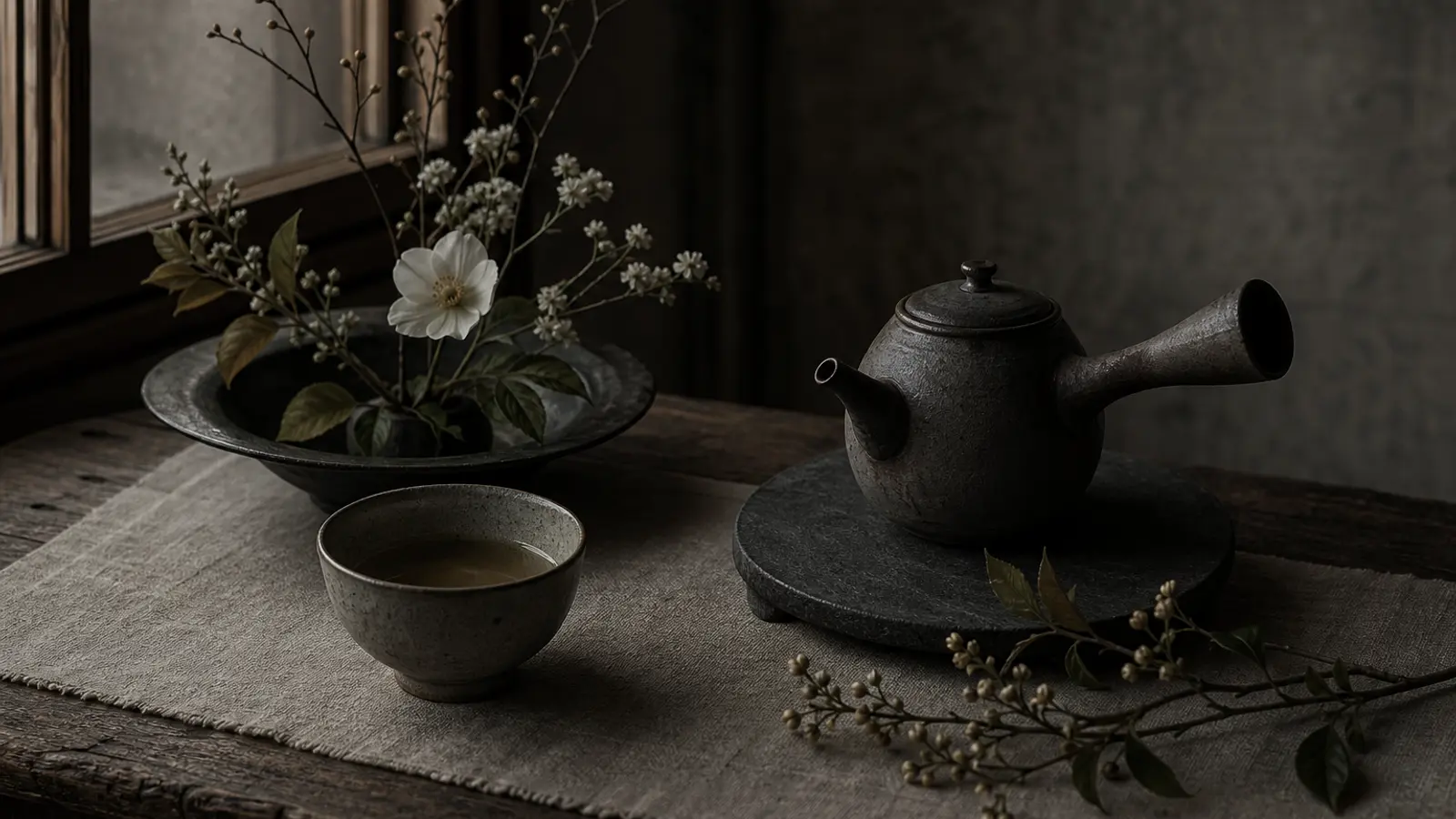
The Korean tea ceremony and Chinese gongfu cha look nothing alike from the outside. One moves slowly, reverently, surrounded by seasonal flowers and silence. The other is almost aggressive in its efficiency — rapid pours, discarded steeps, a practitioner leaning forward to assess aroma from a small vessel held at nose height.
But spend an hour with either practice, and you arrive at the same place: a room that has gotten very quiet, a mind that has stopped rehearsing tomorrow, and a cup of something that deserves your full attention.
These are two different philosophies about what tea is for. Understanding both will make you better at each.
What Is the Difference Between Korean Tea Ceremony and Chinese Gongfu?
Korean darye (다례) is a contemplative, Confucian-rooted ceremony emphasizing stillness, respect, and the meditative quality of the tea moment. Chinese gongfu (功夫茶) is a technique-driven practice focused on extracting maximum flavor through precise parameters — water temperature, steep timing, vessel selection. Darye is philosophy; gongfu is craft.
What Is the Korean Tea Ceremony?
The Korean tea ceremony — 다례 (darye, tea ritual) or 다도 (dado, the way of tea) — is a practice of preparing and sharing tea with deliberate, unhurried attention. The act of making tea is the practice. The calm you feel afterward is not a side effect; it’s the goal.
Darye has roots in Buddhist monastery culture, where monks prepared tea as part of meditation discipline, and in Confucian court tradition, where formal tea presentation was part of social ritual. The contemporary form, revived and codified through the twentieth century, draws from both streams — the monastic quietude and the formal structure.
The key concept is 행다 (haengda, literally “performing tea”). Haengda is not performance in the theatrical sense. It means the full enactment of tea preparation as a complete act, requiring your body, your attention, and your intention. Nothing is rushed. Nothing is skipped.
This stands in direct contrast to how most of us interact with beverages.
What Is Chinese Gongfu Cha?
功夫茶 (gongfu cha, literally “tea with skill” or “tea with effort”) is a method of preparing tea that uses small vessels, precise technique, and multiple rapid steeps to extract maximum complexity from quality leaf. The name shares its etymology with the martial art: gong (工/功) means skill developed through sustained effort; fu (夫/夫) implies mastery and time invested.
Where Korean darye says the process is the point, gongfu cha says the tea in the cup is the point — and the process exists to serve the tea. The practitioner’s job is to become technically invisible, creating conditions that let the leaf speak without interference.
This produces a radically different aesthetic. A gongfu session with high-quality yan cha (岩茶, cliff oolong from Wuyishan) involves eight to twelve steeps, each tasted comparatively, each revealing something the previous didn’t. The practitioner is an analyst as much as a ritualist.
Different Goals, Different Vessels
| Korean Darye (다례) | Chinese Gongfu Cha (功夫茶) | |
|---|---|---|
| Primary Goal | Stillness; the act of making tea | Flavor extraction; the tea in the cup |
| Main Vessel | 다관 (dagwan, side-handle teapot) or 다완 (daewan, wide bowl) | 蓋碗 (gaiwan, lidded bowl) or Yixing teapot |
| Cup Style | Individual cups with 잔받침 (cup saucers) | Small cups, often shared; sometimes aroma cups |
| Primary Teas | 녹차 (nokcha, Korean green tea); 세작, 우전 grades | Full spectrum: pu-erh (普洱), yan cha, oolong, sheng |
| Steep Count | Typically 1–3, sometimes just one | 6–12+ steeps from a single portion of leaf |
| Water Temperature | 60–75°C for premium nokcha | Variable by tea: 80°C for green, 95–100°C for pu-erh |
| Pace | Slow, deliberate, unhurried | Efficient; some steps are rapid by design |
| Aesthetic | Seasonal flowers, formal arrangement, silence | Practical; waste water expected; tray as work surface |
| Lineage | Buddhist monastery + Confucian court | Southern Chinese (Chaozhou/Fujian) folk practice |
Korean Vessels: The Dagwan and Daewan
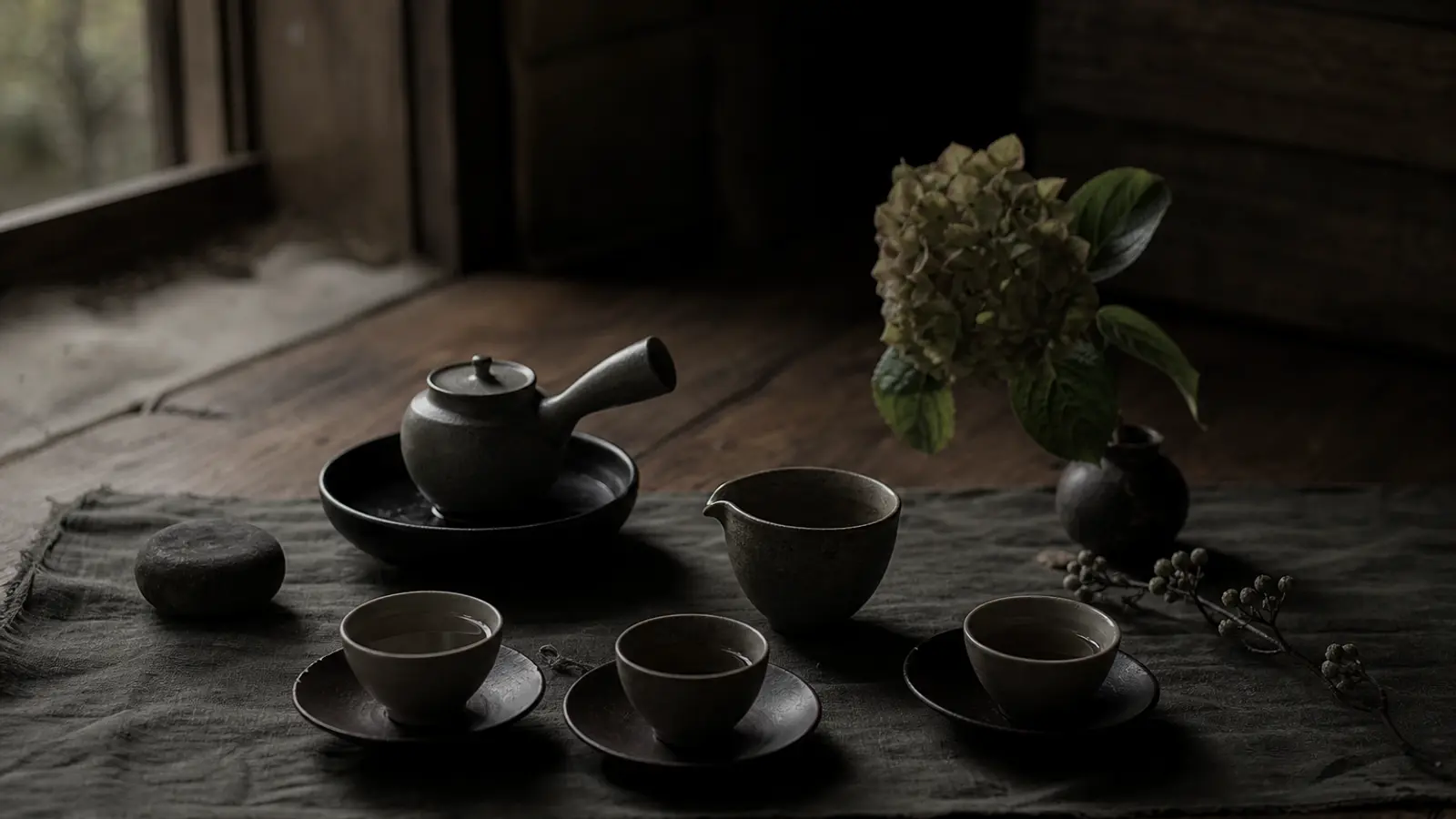
The 다관 (dagwan) is a small side-handle teapot — the handle projects perpendicular to the spout rather than arching over the top, which allows a single-hand pour that Korean ceremony treats as a gesture in itself. The side handle keeps your palm away from the hot body while enabling precise control of the pour angle.
The 다완 (daewan) is a wide, shallow bowl — not so different from a Japanese chawan — used for direct bowl brewing. Loose leaf goes into the bowl with hot water, then the tea is poured through a strainer into individual cups. This method is older, simpler, and produces a particular kind of intimacy: the drinker is close to the leaf, nothing mediating.
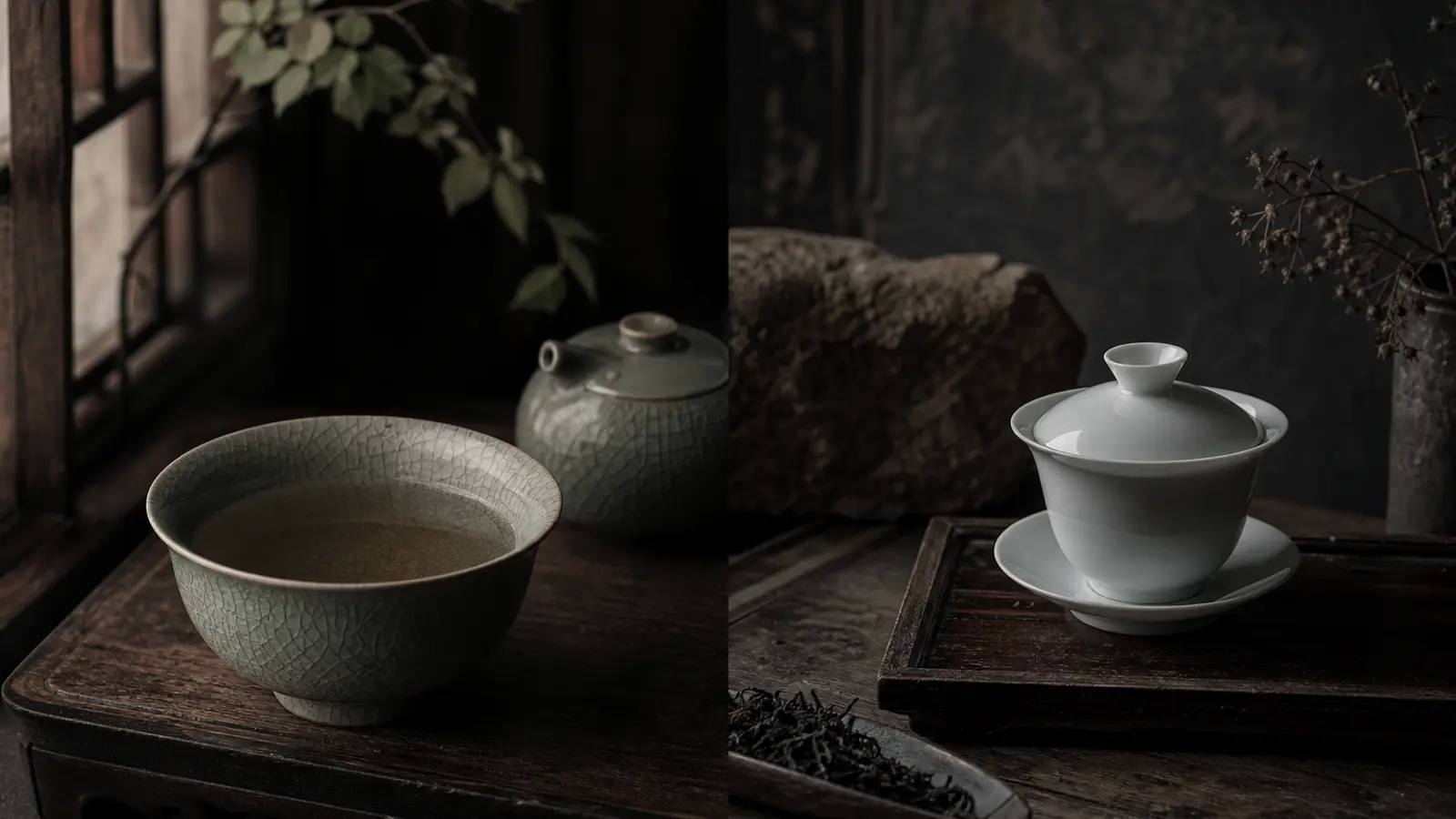
Korean vessels tend toward celadon (청자, cheongja) or buncheong ware (분청사기, buncheong sagi) — unglazed or lightly glazed surfaces with natural earthy character. The aesthetic is restrained. Nothing shouts.
Chinese Vessels: Gaiwan and Yixing
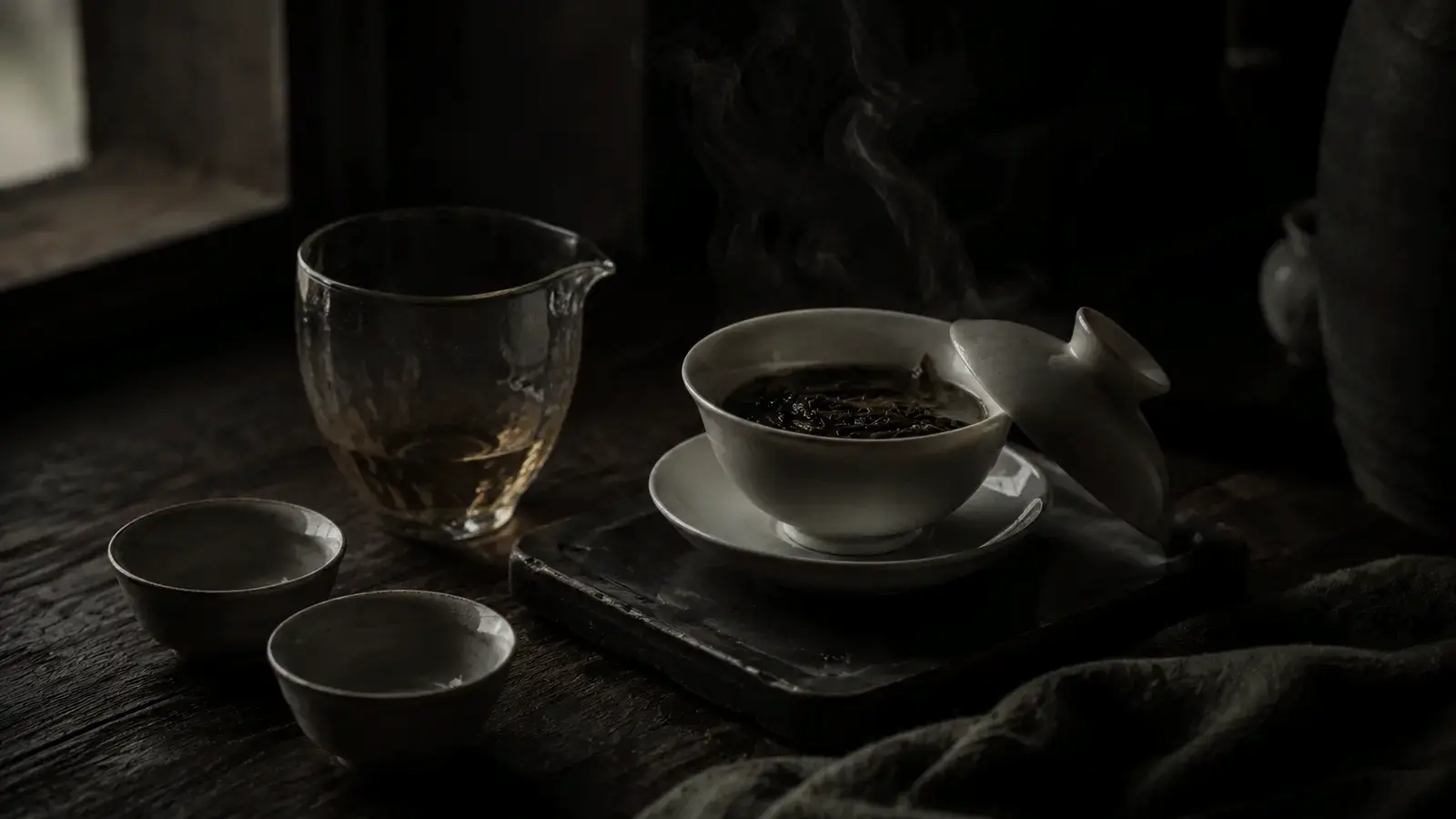
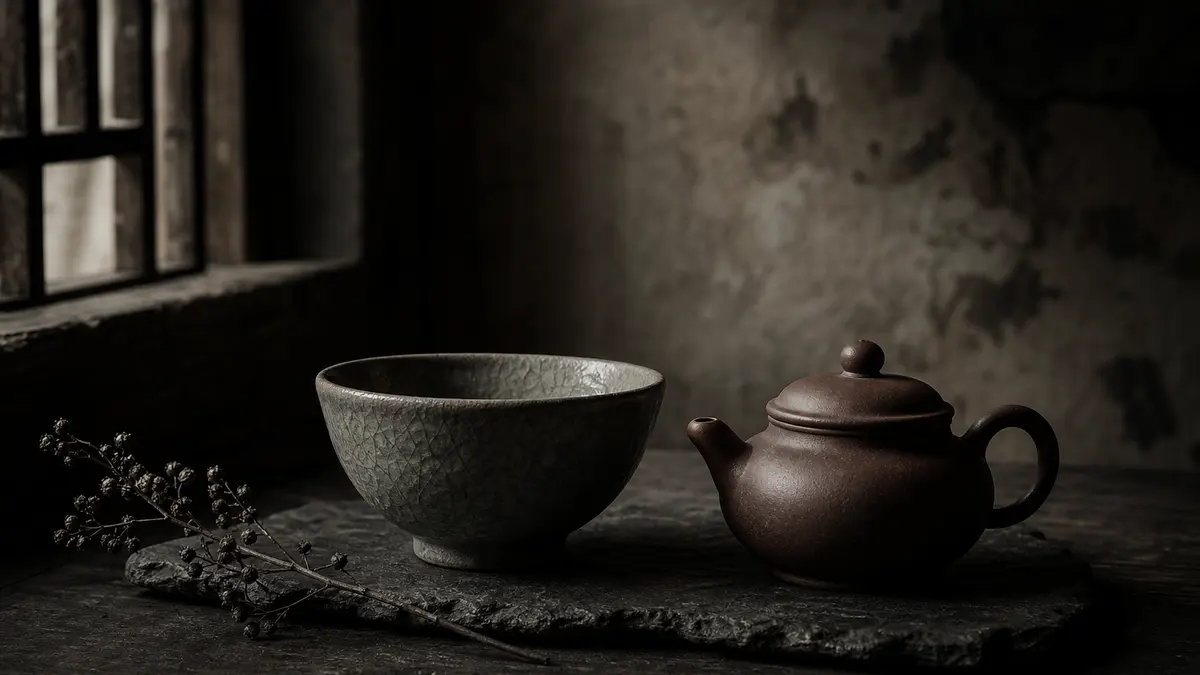
The 蓋碗 (gaiwan, lidded bowl) is arguably the most practical tea vessel ever designed. Three pieces — bowl, lid, saucer — serve as brewing vessel, strainer, and handle simultaneously. You can taste the tea between steeps by smelling the lid. You can adjust steep time down to seconds. It works for every tea category and reveals the leaf without editorializing.
The Yixing teapot (宜興茶壺, made from Jiangsu Province’s purple clay) is the opposite of neutral. Over years of use, a well-seasoned Yixing teapot develops a patina that actively enhances compatible teas — pu-erh (普洱茶, pǔ’ěr chá) and certain oolongs particularly benefit. But this is a specialized tool; you dedicate a Yixing to one tea type and use it consistently. The gaiwan remains the everyday instrument.
Different Teas, Different Philosophies of Leaf
What Korean Ceremony Drinks
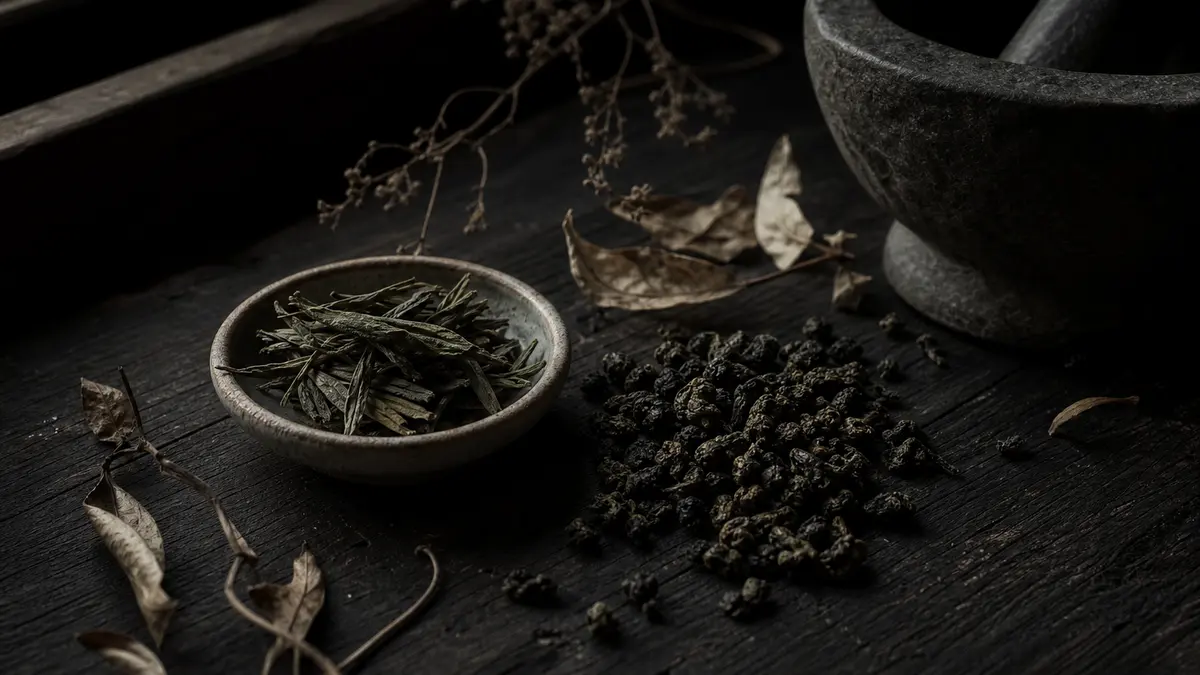
Korean ceremony is built around 녹차 (nokcha, Korean green tea). The most prized grades are 우전 (ujeon, pre-Grain Rain harvest, before April 20 on the solar calendar) and 세작 (sejak, small sparrow’s beak, first harvest after ujeon). These come primarily from 보성 (Boseong), the largest tea-growing county in South Korea, and 하동 (Hadong), a region with older cultivated trees along the southern slopes of Jirisan.
Ujeon and sejak brewed at 65–70°C produce a pale yellow-green liquor with a characteristic 향 (hyang, fragrance) that is grassy, oceanic, and faintly sweet — closer to Japanese gyokuro in structure than to Chinese green teas. The caffeine load is moderate; the theanine content is high. This combination creates focused alertness without jitter — which explains, biochemically, why sitting with a bowl of sejak for an hour genuinely calms the nervous system.
The ceremony rarely demands a specific tea, but in practice, a bitter or astringent leaf would undercut the practice’s intention. The tea should support stillness, not fight it.
What Gongfu Cha Drinks
Gongfu cha reaches its fullest expression with three tea categories:
Sheng pu-erh (生普洱, raw pu-erh from Yunnan): complex, evolving across steeps, with the kind of depth that rewards the gongfu practitioner’s analytical attention. A 2012 cake from a named mountain shows you something new in steep four that wasn’t present in steep two. This is the point.
Yan cha (岩茶, Wuyi cliff oolong): mineral, roasted, layered. The classic 大紅袍 (Dà Hóng Páo, Big Red Robe) or 肉桂 (Ròuguì, Cinnamon) yan cha demands brewing at 95–100°C with short steeps to avoid overwhelming bitterness. Get the technique right and the tea delivers fifteen minutes of evolving flavor across multiple cups. Get it wrong and it’s just astringent.
Taiwan high mountain oolong: 梨山 (Lishan), 阿里山 (Alishan), or 高山烏龍 (high mountain oolong) at 85–90°C, three to five grams in a 100ml gaiwan, five to eight steeps of increasing length. This is a gentler entry to gongfu cha — forgiving, floral, and immediately rewarding.
The gongfu approach also works for wulong (烏龍) from Fujian, white teas from Fuding, and even some Japanese greens brewed in a gaiwan — though each requires adjusting temperature and steep times to avoid harsh extraction.
The Aesthetics of Stillness vs. Precision
Watching a Korean tea ceremony, you notice the arrangement first. A seasonal flower, simply placed. The teapot set at a particular angle. Water poured in a slow, steady arc that is itself a kind of calligraphy. The cups distributed with both hands, a slight bow. Nothing extraneous. The 정적 (jeongjeok, stillness) is built into the staging before anyone drinks anything.
This is not incidental. Korean darye works by placing the practitioner inside a structure that requires full presence. You cannot absent-mindedly perform haengda. Every movement has a form. Deviate from the form and you know immediately, because the form is that specific. The structure creates the stillness rather than assuming it.
Gongfu cha achieves the same presence through a different mechanism: consequence. If you under-steep by ten seconds, you miss something. Over-steep by twenty seconds, and you’ve lost the balance of this particular steep and the next one will compensate — which means you’re thinking three moves ahead. The practitioner’s mind stays present because the tea demands it.
The wine parallel is useful here. Korean darye is like Old World winemaking philosophy: the terroir, the tradition, the unbroken chain of practice express themselves through the winemaker’s restraint. Chinese gongfu cha resembles New World philosophy: the winemaker’s technique is the variable, intervening precisely to coax the best from raw material. Both produce excellence. Both have their appropriate occasions.
Where They Overlap
The distinction between darye and gongfu cha becomes less sharp when you sit with both practices long enough.
Korean ceremony’s insistence on correct water temperature — precise enough to require thermometers in serious practice — is exactly the same concern that drives gongfu cha’s obsession with extraction variables. Both practices use small, handleless cups that require both hands and a slight bow to receive — a posture that forces deceleration. Both treat the first steep differently from subsequent ones, even if Korean ceremony typically goes to a second steep only informally.
Both traditions also produce, reliably and without pharmaceutical assistance, a quality of mental quiet that most people spend significant money and effort trying to achieve through other means. A 45-minute darye session. An hour of gongfu steeping through a pu-erh cake. Either one delivers forced presence, sensory absorption, and a structured container for stillness.
This is not mysticism. It’s attention mechanics. You cannot think about work emails while simultaneously evaluating whether the third steep of a yan cha is showing more or less mineral character than the second. The sensory task occupies the foreground of consciousness. Everything else recedes. This is what meditation claims to offer, and both tea traditions deliver it through a different path.
A Cross-Cultural Practice: Using Both
There is no rule requiring you to practice one tradition exclusively. The principles are compatible and the cross-pollination produces something interesting.
I brew using gongfu technique — precise temperatures, gram weights measured on a scale, short and sequenced steeps — but I’m increasingly drawn to Korean vessels. Korean celadon cups change the sensory experience of a Chinese oolong in ways that are genuinely worth exploring. The cooler color temperature of the celadon glaze against the amber liquor of a roasted Muzha tieguanyin (木柵鐵觀音) creates a visual contrast that slows the tasting pace, which is exactly what gongfu’s rapid-pour rhythm sometimes doesn’t.
Korean buncheong cups with a Wuyi yan cha session make objective sense: the unglazed or lightly-glazed stoneware absorbs heat at a rate that keeps the tea in the optimal drinking temperature range for longer than thin porcelain. This is not tradition — it’s informed improvisation.
The reverse works too. Applying gongfu’s attention to extraction parameters to Korean nokcha — weighing the leaf to 3g per 80ml, controlling temperature to within 2°C of 68°C, running three steeps timed to 45 / 60 / 90 seconds — produces consistently better results than the informal approximations that sometimes pass for Korean tea preparation.
Both traditions benefit from what the other demands.
Getting Started: What You Actually Need
For Korean Darye
A functional entry-level Korean tea setup:
- 다관 (dagwan) — a side-handle teapot, 150–200ml capacity. Korean ceramics from Icheon or Boseong-area kilns are ideal; Japanese kyusu are acceptable substitutes until you source Korean pieces.
- Individual cups — 60–80ml, with 잔받침 (cup saucers). Four cups serves a standard gathering.
- Kettle with temperature control — a variable-temperature electric kettle accurate to ±2°C. For sejak and ujeon, you need 65–70°C reliably.
- Korean green tea — start with 세작 (sejak) grade from Boseong or Hadong. Ujeon is the prestige grade but is expensive and harvested in small quantities; sejak is the practical everyday choice.
- A tray or cloth — for arrangement. This is where the seasonal element enters: a small branch, a stone, a single flower.
Cost of entry is modest. A functional dagwan from a Korean online market runs $20–50. Decent sejak from a reliable source is $15–35 per 50g. The temperature-controlled kettle is the real investment — expect $40–80 for something genuinely precise.
For Chinese Gongfu Cha
- 蓋碗 (gaiwan) — 100–120ml, white porcelain to start. White shows the liquor color accurately.
- Small cups — 30–45ml, two to four cups.
- Tea tray — you will spill rinse water and waste pours. A tray with a drainage reservoir is not optional.
- Kettle with temperature control — same requirement as above, but you’ll use a wider range: 80°C for green and white teas, 90–95°C for oolong, 95–100°C for pu-erh and yan cha.
- A starting tea — I recommend a Taiwan high mountain oolong for your first gongfu sessions. It’s forgiving, delicious immediately, and teaches you what multiple steeps reveal without punishing minor technique errors the way pu-erh does.
Which Practice Is Right for You?
This is the wrong question. Both are right for different evenings.
When I need the day to stop — when the gap between events closes and I want to create a defined boundary — I reach for the structure of Korean ceremony. The formal arrangement, the single bowl of sejak, the unhurried pour. One cup. Done. The practice is the point and it takes exactly as long as it takes.
When I’m curious — when I have a cake of sheng pu-erh from a village I want to understand better, or when a new yan cha has arrived and I want to work through its steeps analytically — gongfu is the method. Multiple rounds. Notes taken or just held in memory. The tea is the point and the technique is in service of discovery.
The traditions answer different questions. Korean darye asks: can you be fully here, making tea? Chinese gongfu cha asks: what does this leaf have to show you?
Both questions lead somewhere worth going.
Comparison Summary
| Dimension | Korean Darye (다례) | Chinese Gongfu Cha (功夫茶) |
|---|---|---|
| Core Philosophy | The act of making tea is the practice | Technique serves the tea in the cup |
| Practitioner’s Role | Ritualist; form is the vehicle | Analyst/craftsperson; technique is the vehicle |
| Pace | Slow by design | Efficient; rapid pours are correct |
| Typical Duration | 30–60 minutes for 1–2 steeps | 45–90 minutes for 8–12+ steeps |
| Primary Tea Category | Korean green tea (nokcha) | Oolong, pu-erh, yan cha |
| Key Vessels | 다관, 다완, 잔받침 | 蓋碗, Yixing teapot, small cups |
| Aesthetic Model | Seasonal harmony, restraint, stillness | Precision, inquiry, iteration |
| Entry Difficulty | Moderate (form must be learned) | Moderate (variables must be managed) |
| What It Gives You | Structured stillness; presence through form | Focused presence; attention through consequence |
| Best Occasion | Ending the day; marking a transition | Exploring a specific tea; extended quiet |
Two paths. The same quiet at the end.