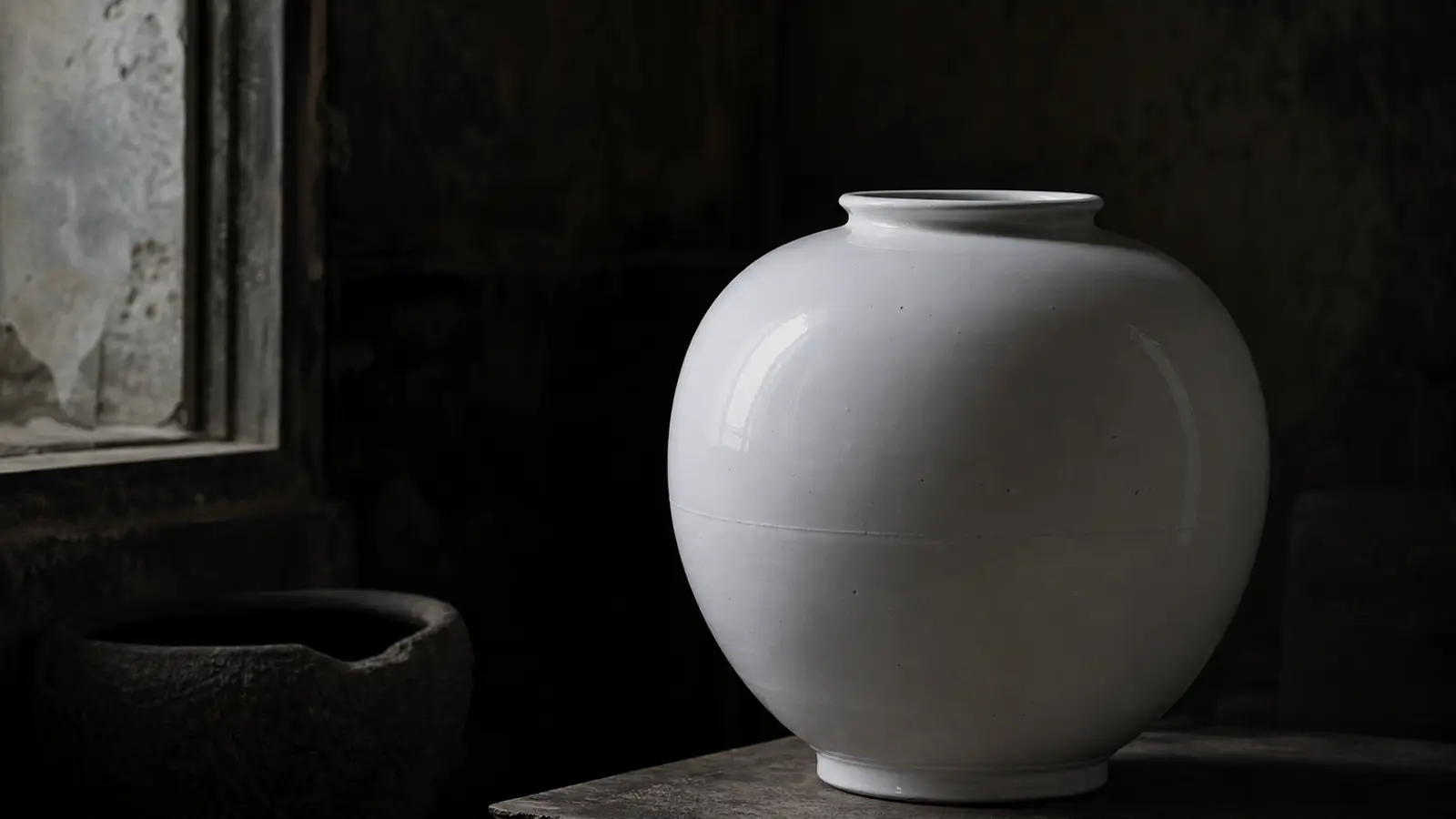
A Korean moon jar (달항아리, dalhanari) sold at Christie’s in 2023 for $4.56 million. Another crossed the block in 2026 for $3.186 million. Neither was flawless. Both were slightly lopsided, faintly asymmetrical, visibly seamed where two halves of clay met centuries ago. That is precisely why they commanded those prices.
The moon jar is the most recognizable Korean ceramic form — and one of the most misunderstood objects in the history of decorative art. Its value doesn’t come from technical perfection. It comes from what the imperfection means.
What Is a Korean Moon Jar?
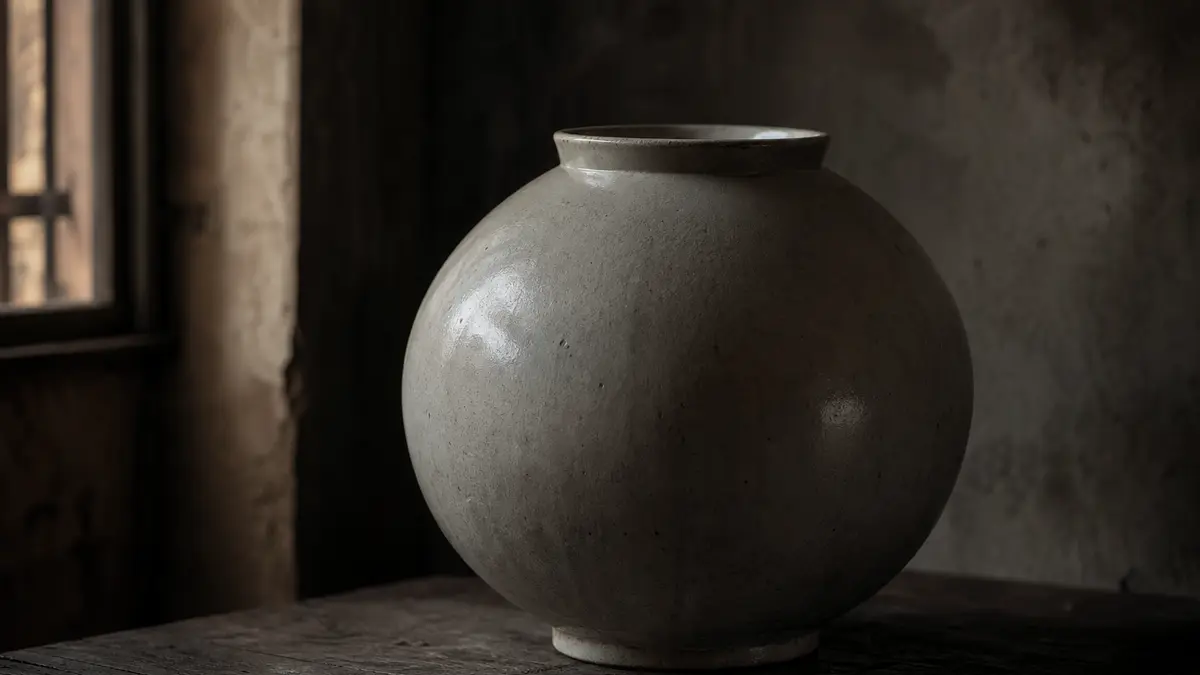
The moon jar is a large, spherical white porcelain vessel produced primarily during Korea’s Joseon dynasty (조선, 1392–1897). The name dalhanari — 달 meaning moon, 항아리 meaning jar — describes the shape exactly: round and luminous as a full moon, typically ranging from 35 to over 45 centimeters in height.
The construction method is specific and non-negotiable. A potter throws two separate hemispheres on the wheel, fires or partially dries them, then joins them at the equator with slip. The seam is never invisible. It rises slightly, shifts a few millimeters off-center, pulls the form into gentle asymmetry. The jar leans. It breathes. It looks like something a human being made, which is the entire point.
This method is uniquely Korean. Chinese potters of the same era did not make this form. Japanese potters did not make it. The moon jar emerged from the specific aesthetic and philosophical climate of Joseon Korea, and it has never been replicated with the same intention anywhere else.
The Joseon Aesthetic: White Against the World
To understand the moon jar, you need to understand what Joseon Korea was reacting against.
The dynasty that preceded it, Goryeo (고려, 918–1392), produced some of the most technically refined ceramics in human history. Goryeo celadon (청자, cheongja) — jade-green, inlaid with delicate cranes and cloud patterns, glazed to a depth that seems lit from within — was so prized that Chinese envoys wrote home about it with barely concealed envy. Goryeo valued sophistication. The aesthetic was aristocratic, ornate, and explicitly competitive with Chinese court culture.
Joseon turned the dial to zero.
The new dynasty was founded on Neo-Confucian principles that treated decoration as moral hazard. Excess was not merely ugly; it was ethically suspect. Joseon court officials were expected to own white porcelain (백자, baekja), not colorful ceramics. The royal kilns at Bunwon (분원) near Seoul — the official kilns that produced ceramics for the court — made white. Only white. The Joseon court literally banned the use of decorated ceramics at certain points in the dynasty.
The moon jar is the fullest expression of this philosophy. No decoration. No carving. No inlay. No color. Just white — and not a brilliant, optical white, but the warm, milky, slightly irregular white of a clouded winter sky.
Sobakham (소박함): The Aesthetic Behind the Object
Korean has a word for what the moon jar is: 소박함 (sobakham).
It translates roughly as understated simplicity, but the English doesn’t capture the moral weight of the Korean. Sobakham is not minimalism as an aesthetic choice, the way a Scandinavian designer might strip a chair to its lines. It is deeper than that — a conviction that honest, unadorned things are closer to truth than decorated ones. That simplicity is a form of dignity.
A moon jar embodies sobakham completely. It does not try to impress you. It sits there, round and white and slightly lopsided, and asks nothing. The beauty arrives later, quietly, as your eyes settle into the surface and you begin to notice the glaze variations, the faint warmth in the white, the way the seam traces an imperfect equator around the form.
This is not easy to make. Technically, a moon jar is extremely difficult — the two halves must be joined precisely enough that the jar doesn’t crack during firing, while remaining loose enough that the join shows its own character. The kiln temperature, the clay composition, the glaze application, the cooling rate: every variable affects the final surface. What looks effortless is the result of demanding craft discipline.
Scarcity: The Numbers That Matter
Approximately 20 Joseon moon jars measuring over 40 centimeters survive worldwide.
That number deserves a moment. Not 200. Not 2,000. Twenty.
Many of those are in Korean national collections — the National Museum of Korea holds several, the Leeum Samsung Museum of Art in Seoul holds others. Some are in international institutional collections. A small number enter the private market in any given generation, which is why Christie’s auction results make headlines.
The scarcity is not entirely accidental. Moon jars are large, thin-walled, and heavy. They were made for use — holding water, grain, or fermented foods — not as precious display objects. Many were damaged in the upheavals that repeatedly reshaped the Korean peninsula. Others were collected and exported during the Japanese colonial period (1910–1945), when significant volumes of Korean cultural property left the country. The survivors that remain in Korean collections are designated National Treasures (국보, gukbo) or Important Cultural Properties (보물, bomul) — they cannot be exported.
The 20 or so that exist outside protected collections represent the entire market. For collectors, museum acquisition committees, and serious institutions, a moon jar coming to auction is a generational event.
The Auction Record: What $4.5 Million Buys
The 2023 Christie’s sale at $4.56 million set a new benchmark for Korean ceramics at Western auction. The 2026 sale at $3.186 million confirmed that the market — while subject to fluctuation — treats these objects as legitimate major-art assets, not specialty collectibles.
For context: a comparable Goryeo celadon with significant provenance might achieve $1–3 million at auction. The moon jar commands a premium that reflects both scarcity and the specific weight of contemporary Korean cultural identity. As Korean cultural influence has expanded globally — in film, music, food, fashion — Korean art institutions and diaspora collectors have increasingly competed for objects that represent Korean distinctiveness, not Korean adjacency to Chinese or Japanese traditions.
The moon jar is distinctly Korean. No other culture made it. In an art market that often struggles to assign value outside established Western and East Asian hierarchies, the moon jar’s unambiguous cultural specificity is part of its asset profile.
Think of it like a single-vineyard old-vine Burgundy from a producer who made very few bottles and stopped making wine three centuries ago. The value isn’t purely about what’s in the glass. It’s about what the object proves — about a place, a time, a way of understanding beauty — and the fact that you cannot replace it.
The Seam Is the Point
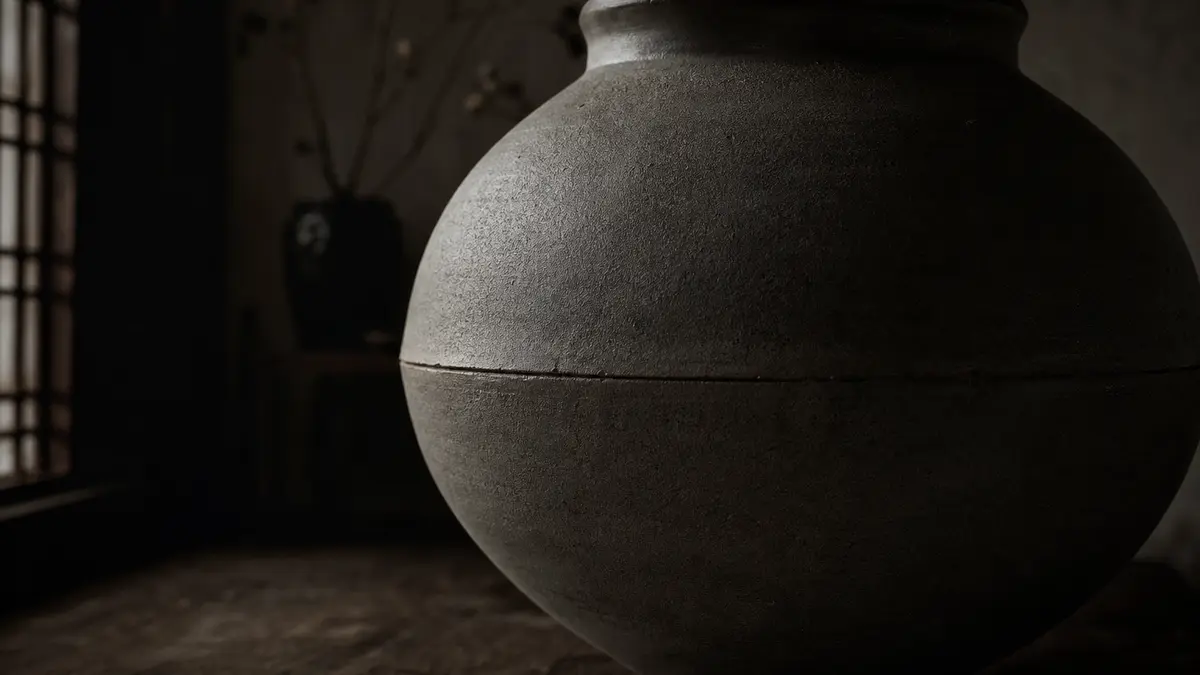
Collectors, critics, and museum curators return again and again to the seam.
The visible join where the two hemispheres meet is not a technical failure that artisans tolerated. It is the formal element that makes the object honest. A perfectly spherical jar, with no visible seam, would be a different object with a different meaning — a demonstration of technical control, closer in spirit to Goryeo celadon than to Joseon sobakham.
The seam says: two pieces of clay, thrown by human hands, joined imperfectly, survived the fire. The slight asymmetry the joining creates — a jar that tilts a few degrees, that is fractionally wider on one side — is what distinguishes this object from a manufactured sphere. It gives the jar a presence that perfect objects typically lack.
This has been recognized by artists across generations. The British potter Lucie Rie studied Korean ceramics closely. The abstract expressionist painter Mark Rothko reportedly owned photographs of moon jars. In contemporary Korean art, the moon jar is explicitly invoked as a symbol of Korean identity — referenced in installation art, fashion, architecture, and design. Contemporary Korean potters continue to make moon jars as both homage and personal statement, working within the form’s constraints while finding their own voice within it.
Moon Jars and Korean Teaware: The Same Root
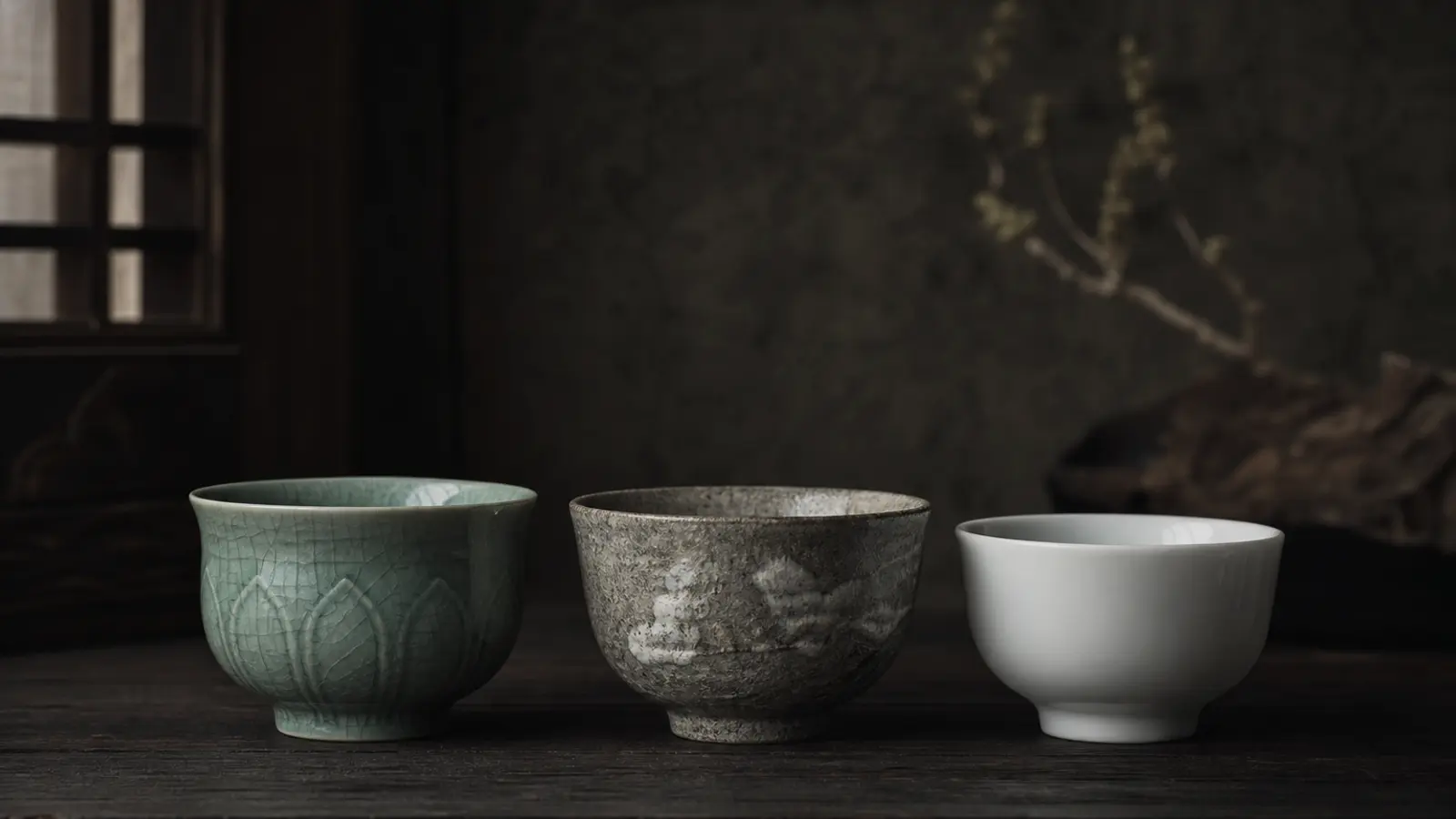
If you have encountered Korean teaware — the thick, slightly rough 분청 (buncheong) bowls, the matte 백자 tea sets, the cups that feel hand-shaped rather than thrown — and wondered why they feel so different from Japanese or Chinese teaware, the moon jar is your answer.
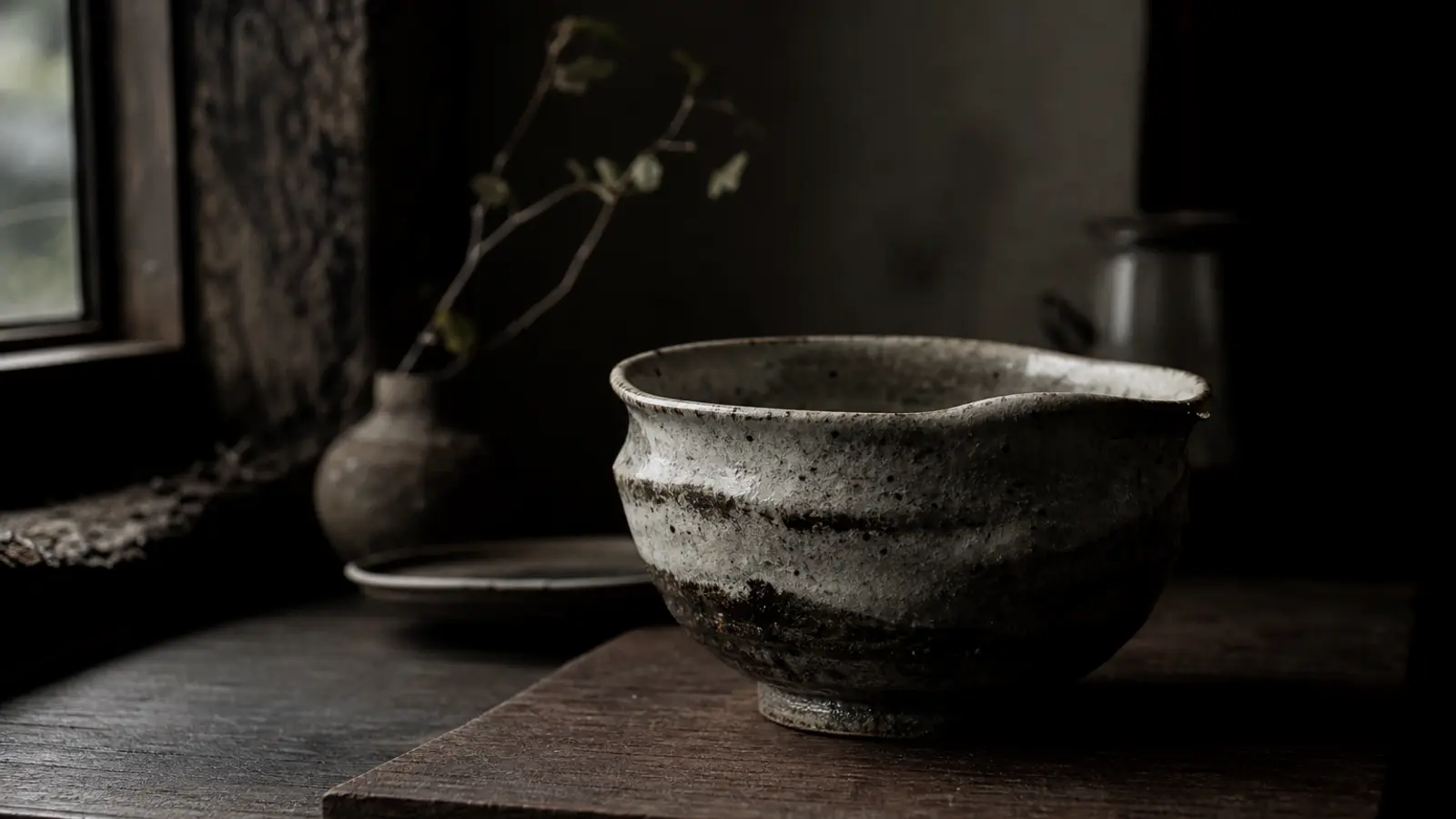
Buncheong (분청사기) and white porcelain teaware share the same aesthetic DNA as the moon jar. The same sobakham, the same refusal of excess, the same comfort with imperfection. A buncheong tea bowl is not roughly made because the potter lacked skill. It is made to feel like an honest object, close to its material origins, close to the hand that formed it.
Where Japanese wabi-sabi (侘び寂び) aesthetics tend toward deliberate roughness as a cultivated aesthetic stance — a refined appreciation of rusticity — Korean sobakham is less self-conscious. It is more direct. The bowl is like this because this is how bowls should be. The moon jar is round and white and slightly lopsided because that is what a moon jar is.
Understanding this lineage changes how you hold a Korean tea bowl. The weight of it, the texture under your thumb, the way the rim is slightly uneven — these are not accidents. They are the continuation of the same intention that produced the moon jar four centuries ago.
Joseon White Porcelain in Global Context
Joseon white porcelain (백자) is one of the great ceramic traditions of the pre-modern world, and it remains undervalued in Western art history relative to its actual achievement.
The Bunwon royal kilns operated under strict court control from roughly the 15th through the 19th centuries. The best materials — specific white-firing clays, refined glazes, carefully controlled kiln temperatures in the range of 1,250–1,300°C — were reserved for court production. The potters were technically accomplished professionals working within a demanding system.
Moon jars came from this tradition but represent a specific subset of it: large, undecorated vessels made when the Joseon aesthetic was most purely itself, roughly the 17th and 18th centuries. This is when sobakham was not just a court philosophy but a living cultural atmosphere — when the preference for white and simple had been internalized deeply enough to produce objects of genuine formal power.
The comparison to old-vine Burgundy holds further: just as the greatest Pinot Noir comes from specific places in specific decades when everything aligned, the greatest moon jars come from a specific period when a particular culture’s aesthetic convictions were coherent enough to generate objects of lasting force.
Why the Moon Jar Matters Now
There is a broader argument worth making.
In a global art market that has spent decades recognizing previously undervalued traditions — African sculpture, pre-Columbian ceramics, Southeast Asian bronzes — Korean ceramics remain underrepresented in major Western institutional collections. The moon jar’s auction trajectory is part of a correction.
It is also part of a larger Korean cultural moment. Korean cinema, television, food, and music have fundamentally changed their global profile in the last decade. The cultural infrastructure that supported those industries — a deep tradition of craft, aesthetics, and cultural production — is now receiving more attention. The moon jar is not a symbol that was manufactured for export. It is one that was there all along, waiting for the moment when the context was right for it to be seen clearly.
For anyone interested in Korean teaware, ceramics, or the philosophy of material culture, the moon jar is not optional background knowledge. It is the foundation. Everything else — the tea bowls, the celadon, the buncheong — makes more sense once you understand what a culture that could produce this object values, and why.
The jar sits there, round and white and slightly lopsided. It does not try to impress you. That is the whole argument.