Dancong oolong (单丛 dāncóng) is classified by aroma type (香型 xiāngxíng) — named fragrance families where each represents a specific cultivar or clone producing a dominant aromatic character. If you think of wine regions as organized by grape variety, dancong aroma types function the same way: the same mountain, the same general processing method, but radically different teas depending on which bush the leaves came from.
Phoenix Mountain (凤凰山 Fènghuáng Shān) in Guangdong Province hosts over 80 named cultivars. The conventional framework groups them into roughly ten major aroma types. Learning these ten names is the single most useful thing you can do to navigate the dancong landscape, because a menu listing “dancong oolong” tells you almost nothing. The aroma type tells you nearly everything.
This guide covers each of the ten major fragrance families — what they smell and taste like, how rare they are, and which ones make sense as entry points.
How Dancong Classification Works
Most Chinese teas are classified by processing method (green, oolong, black) or by geographic origin (Wuyi, Anxi). Dancong uses a third axis: the aromatic signature of the cultivar itself. Every aroma type name describes what the tea is supposed to smell like — orchid, almond, osmanthus, ginger flower.
This isn’t marketing poetry. The aromatic compounds genuinely differ between cultivars because each clone has a distinct chemical profile that processing then amplifies. A skilled producer coaxes out the cultivar’s natural fragrance through precise withering, oxidation, and roasting. The aroma type is both a cultivar identifier and a sensory promise.
One critical note: within each aroma type, quality varies enormously. A cheap Mi Lan Xiang and a premium Mi Lan Xiang from old trees on Wudong Mountain (乌岽山 Wūdōng Shān) are technically the same aroma type but worlds apart in complexity. The aroma type tells you the direction of flavor; elevation, tree age, and craftsmanship determine how far the tea travels in that direction.
The Ten Major Dancong Aroma Types
1. Mi Lan Xiang (蜜兰香) — Honey Orchid Fragrance
The most famous dancong variety and the one most people encounter first. Mi Lan Xiang delivers sweet orchid florality layered with lychee and raw honey. It’s immediately appealing — no acquired taste required.
Think of Mi Lan Xiang as the Cabernet Sauvignon of dancong: widely planted, broadly available, and ranging from simple everyday versions to profound old-tree expressions. Entry-level examples run $8–15 per 100 g; premium Wudong old-tree versions climb past $40–80 per 100 g. If you’re buying your first dancong, this is the safe bet.
Primary aromatics: Orchid, lychee, honey, stone fruit.
2. Ya Shi Xiang (鸭屎香) — Duck Shit Aroma
The name is deliberately unappealing. The tea is extraordinary. Ya Shi Xiang has become the most sought-after dancong variety internationally, and for good reason: it’s intensely floral with gardenia and honeysuckle riding a clean, almost mineral body.
The origin story — widely repeated, possibly embellished — holds that a farmer in the Pingkeng (坪坑 Píngkēng) area named his cultivar “duck shit” to discourage neighbors and competitors from seeking out his trees. The strategy failed spectacularly. The name stuck, the tea’s reputation exploded, and Ya Shi Xiang now commands premium prices.
Recent efforts have rebranded it as Yín Huā Xiāng (银花香, “Silver Flower Fragrance”), but the duck shit name has proven resilient in both Chinese and international markets. People remember it.
Primary aromatics: Gardenia, honeysuckle, jasmine, mineral finish.
3. Gui Hua Xiang (桂花香) — Osmanthus Fragrance
If you’ve walked through a Chinese city in autumn and caught the perfume of osmanthus trees (桂花 guìhuā), you know this scent: warm, honeyed, apricot-adjacent, unmistakable. Gui Hua Xiang captures that character in a cup.
This is a sweet, rounded dancong without sharp edges. It reads as cozy and autumnal. Not as widely available as Mi Lan Xiang, but not rare either. A good middle-ground dancong for someone who finds intensely floral teas overwhelming.
Primary aromatics: Osmanthus flower, apricot, warm honey.
4. Xing Ren Xiang (杏仁香) — Almond Fragrance
The oddball of the dancong family. Where most aroma types lean floral or fruity, Xing Ren Xiang goes nutty — marzipan, toasted almond, and a faint bitterness reminiscent of almond skin. It’s unusual and divisive. Some people adore the savory-sweet interplay; others find it muted compared to the floral types.
Xing Ren Xiang is less commonly exported and can be harder to source. When you find a good one, the almond character is unmistakable and unlike anything else in the oolong world.
Primary aromatics: Marzipan, toasted almond, almond blossom.
5. Jiang Hua Xiang (姜花香) — Ginger Flower Fragrance
An important distinction: this is ginger blossom, not ginger root. Jiang Hua Xiang is aromatic, not pungent. The hedychium ginger flower (姜花 jiānghuā) produces a warm, spicy-floral perfume — imagine orchid crossed with white pepper and you’re approaching it.
This aroma type bridges the floral and spicy categories. It’s complex enough to hold attention across many steeps and rewards the patient gongfu (功夫 gōngfu) approach. Availability is moderate; it’s not as rare as some entries on this list, but not a staple either.
Primary aromatics: Ginger blossom, white pepper, tropical floral.
6. Zhi Lan Xiang (芝兰香) — Orchid Fragrance
If Mi Lan Xiang is orchid plus honey, Zhi Lan Xiang is orchid alone — cleaner, more austere, more refined. The name references the Chinese orchid (芝兰 zhīlán), a classical symbol of quiet elegance.
This is a more subtle tea than Mi Lan Xiang and sometimes reads as underwhelming to beginners who expect dancong to hit hard. With attention, its elegance reveals itself: a high, clear floral note without the sweetness that Mi Lan Xiang uses as a safety net. I’d call it an intermediate dancong — best appreciated after you’ve calibrated your palate on more obvious types.
Primary aromatics: Pure orchid, lily, clean floral.
7. Yu Lan Xiang (玉兰香) — Magnolia Fragrance
Broad, creamy, and waxy — the aromatic signature of magnolia (玉兰 yùlán). Yu Lan Xiang has a heavier floral character than the orchid types, with more body and a lush mouthfeel. Think of the difference between a Riesling and a Viognier: both floral, but the latter is rounder and more voluptuous.
Good Yu Lan Xiang delivers magnolia’s sweet, slightly lemony waxiness. It’s not among the most common dancong varieties but appears regularly enough in specialist shops.
Primary aromatics: Magnolia, waxy sweetness, lemon blossom, cream.
8. Ye Lai Xiang (夜来香) — Tuberose / Evening Fragrance
Named for the night-blooming tuberose (夜来香 yèláixiāng), whose intensely sweet perfume fills the evening air. This is one of the most powerfully scented dancong aroma types — heady, almost narcotic florality.
Ye Lai Xiang is not for the faint of palate. The sweetness is intense and can feel overwhelming if you’re coming from greener, lighter oolongs. But if you enjoy tuberose, gardenia, or ylang-ylang in perfume, this dancong will make immediate sense.
Primary aromatics: Tuberose, night-blooming jasmine, intense sweetness.
9. Rou Gui Xiang (肉桂香) — Cinnamon Fragrance
A potential source of confusion: Rou Gui Xiang dancong shares its name with Wuyi Rou Gui (武夷肉桂), one of the most famous Yancha. They are completely different teas. Different cultivar, different mountain, different processing tradition, different province.
Dancong Rou Gui Xiang delivers cinnamon bark spiciness — warm, dry, woody — on a structure that’s lighter and more aromatic than its Wuyi namesake. It’s a niche type, less commonly encountered and sometimes grouped into broader “spicy” subcategories.
Primary aromatics: Cinnamon bark, warm spice, woody sweetness.
10. Huang Zhi Xiang (黄枝香) — Gardenia Fragrance
Huang Zhi Xiang refers to the gardenia (黄栀 huángzhī) and produces a sweet, high-toned floral with a notably clean finish. Some overlap exists with Ya Shi Xiang’s gardenia character, but Huang Zhi Xiang tends to be sweeter and less mineral.
This is one of the older recognized aroma types and is well-represented on Phoenix Mountain. Good examples deliver gardenia’s creamy sweetness without cloying, and they tend to hold up well across many infusions.
Primary aromatics: Gardenia, clean sweetness, white floral.
Dancong Aroma Types Comparison Table
| Aroma Type | Chinese | Primary Character | Rarity | Price Tier (per 100 g) | Beginner-Friendly? |
|---|---|---|---|---|---|
| Mi Lan Xiang | 蜜兰香 | Orchid, honey, lychee | Common | $8–80 | Yes |
| Ya Shi Xiang | 鸭屎香 | Gardenia, honeysuckle, mineral | Common–Moderate | $12–100+ | Yes |
| Gui Hua Xiang | 桂花香 | Osmanthus, apricot, honey | Moderate | $10–50 | Yes |
| Xing Ren Xiang | 杏仁香 | Marzipan, toasted almond | Uncommon | $12–60 | No |
| Jiang Hua Xiang | 姜花香 | Ginger blossom, white pepper | Moderate | $12–60 | Somewhat |
| Zhi Lan Xiang | 芝兰香 | Pure orchid, lily | Moderate | $10–50 | No |
| Yu Lan Xiang | 玉兰香 | Magnolia, cream, lemon | Moderate–Uncommon | $12–60 | Somewhat |
| Ye Lai Xiang | 夜来香 | Tuberose, intense sweetness | Uncommon | $15–70 | No |
| Rou Gui Xiang | 肉桂香 | Cinnamon bark, warm spice | Uncommon | $12–50 | No |
| Huang Zhi Xiang | 黄枝香 | Gardenia, clean sweetness | Moderate | $10–50 | Yes |
Price ranges reflect the international retail market for mid-quality examples to premium old-tree material. Prices within China, particularly in Chaozhou (潮州 Cháozhōu), can be lower for everyday grades and significantly higher for rare old-tree selections from Wudong.
Beyond the Ten: What the Framework Doesn’t Capture
The ten-type system is a simplification. Phoenix Mountain hosts well over 80 documented cultivars, and some producers recognize additional aroma types — peach (蜜桃香 mìtáo xiāng), pomelo flower (柚花香 yòuhuā xiāng), and others. Some sources list eight major types rather than ten, folding certain categories into broader groups.
Then there’s the question of blending. Strict dancong tradition calls for single-cultivar production (单丛 literally means “single bush” or “single clump”), but commercial reality means that lower-tier dancong is sometimes blended from multiple cultivars within the same aroma family. A budget Mi Lan Xiang might include leaves from several honey-orchid-adjacent clones rather than one specific tree or grove.
Old-tree dancong (老丛 lǎocóng) from individual trees on Wudong Mountain adds another layer. These teas transcend their aroma type classification — a 200-year-old Mi Lan Xiang tree may produce something so complex that “honey orchid” barely scratches the surface. At that level, the individual tree matters more than the category.
How to Brew Dancong for Aroma
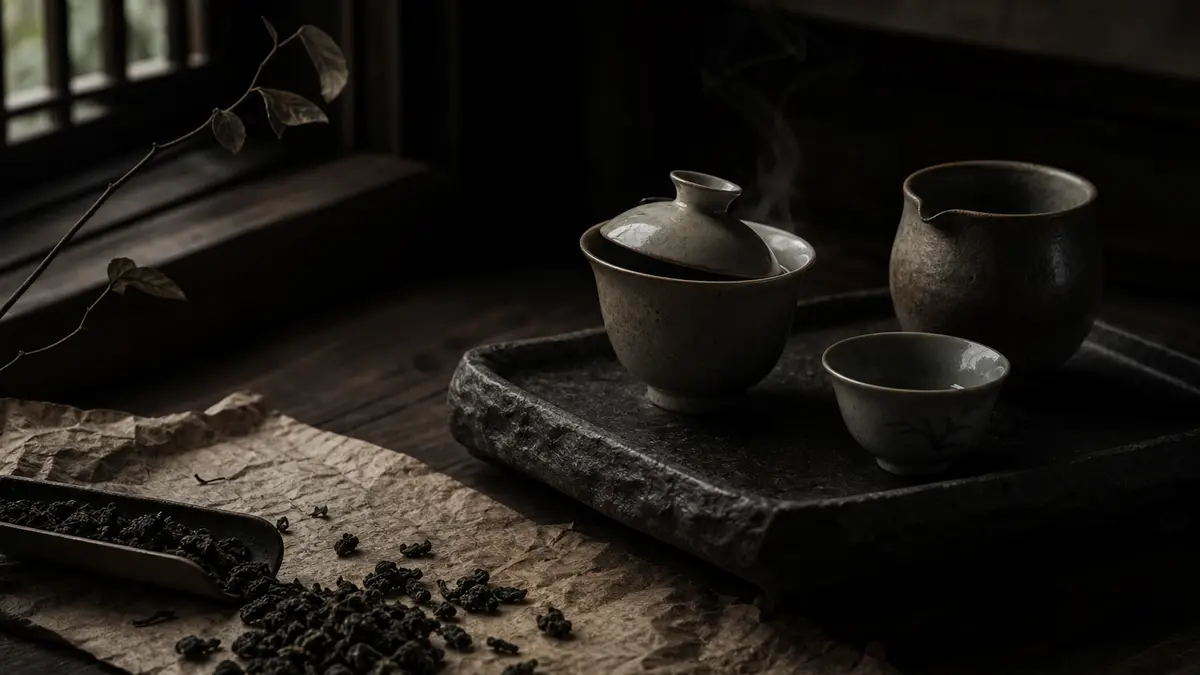
Dancong is a gongfu tea. Brewing it grandpa-style or in a large mug mutes the aromatic complexity that defines the entire classification system — which rather defeats the purpose.
A gaiwan (蓋碗) in the 90–110 ml range is ideal. Standard parameters:
- Use 7–8 g of leaf per 100 ml vessel.
- Rinse once with water at 95–100°C (203–212°F).
- First infusion: 10–15 seconds.
- Extend each subsequent steep by 5–10 seconds.
- Expect 8–12 good infusions from quality material.
The first thing you should do with each infusion is smell the wet leaves and the empty cup (闻香杯 wénxiāng bēi, the aroma cup, if you have one). Dancong’s aroma type classification was built on fragrance, and the lid of the gaiwan after pouring is where the cultivar’s signature announces itself most clearly.
Water temperature matters more with dancong than with many other oolongs. Too cool and the aromatics stay locked in the leaf. Most dancong, especially the darker-roasted styles, wants full boiling or very near it.
A Note on What Comes Next
I have eight different dancong varieties currently in transit for tasting and comparison. Once those sessions are complete, this guide will be updated with firsthand aroma type comparisons, specific tasting notes, and brewing observations across the varieties. Consider this the structural framework; the sensory detail is incoming.
In the meantime, if you’re new to dancong, start with Mi Lan Xiang or Ya Shi Xiang. Both are widely available, reasonably priced at entry level, and expressive enough to demonstrate why this mountain’s classification system revolves around fragrance rather than geography or processing. Once you’ve calibrated your palate on those two, the rest of the aroma types will make intuitive sense — you’ll understand what the system is tracking, and each new type will snap into place relative to what you already know.
Dancong rewards the collector’s mindset. Each aroma type is a different expression of the same mountain, the same craft tradition, and the same obsessive attention to cultivar-specific character. Few tea categories offer this much structured diversity from a single origin.