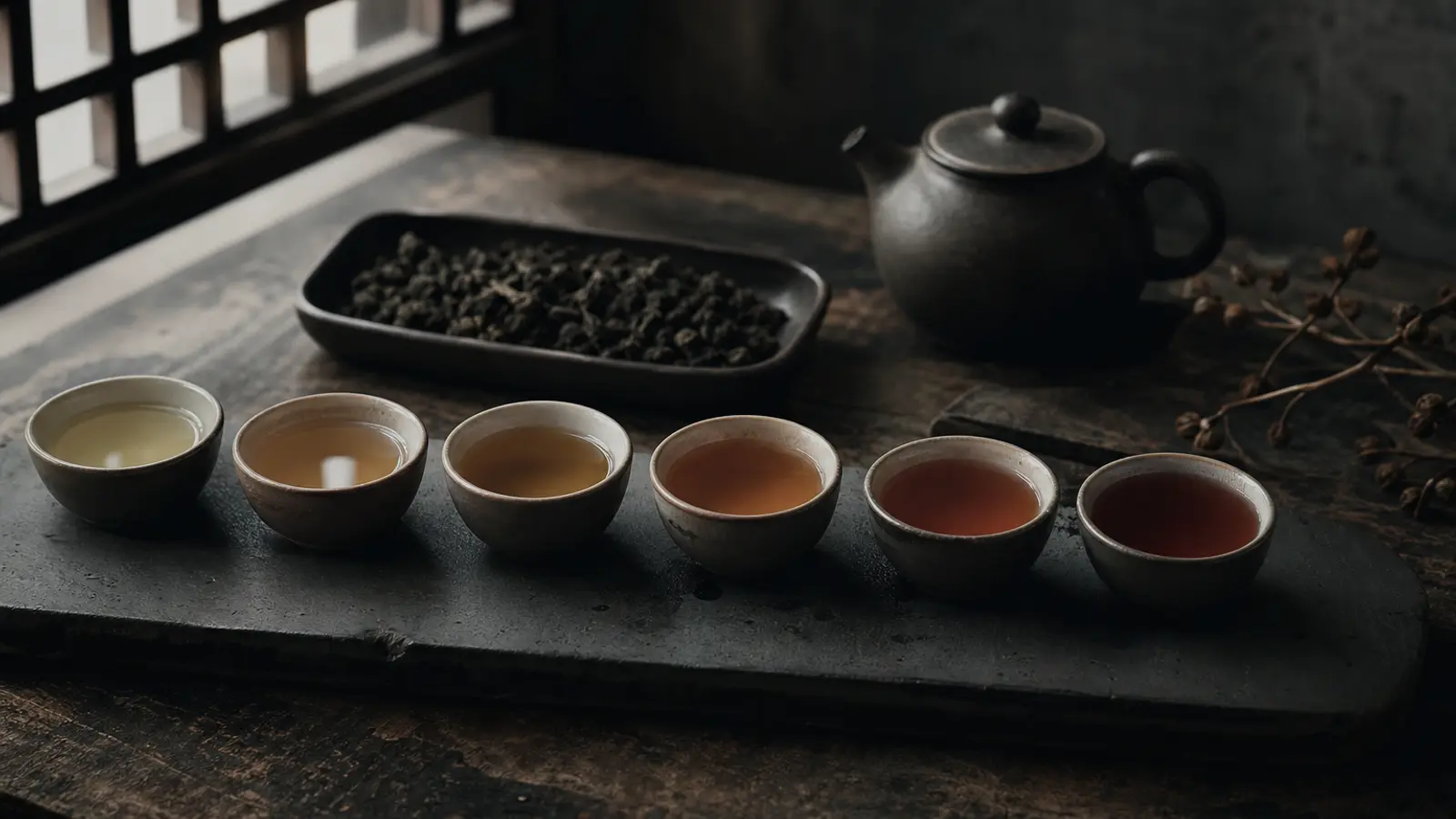
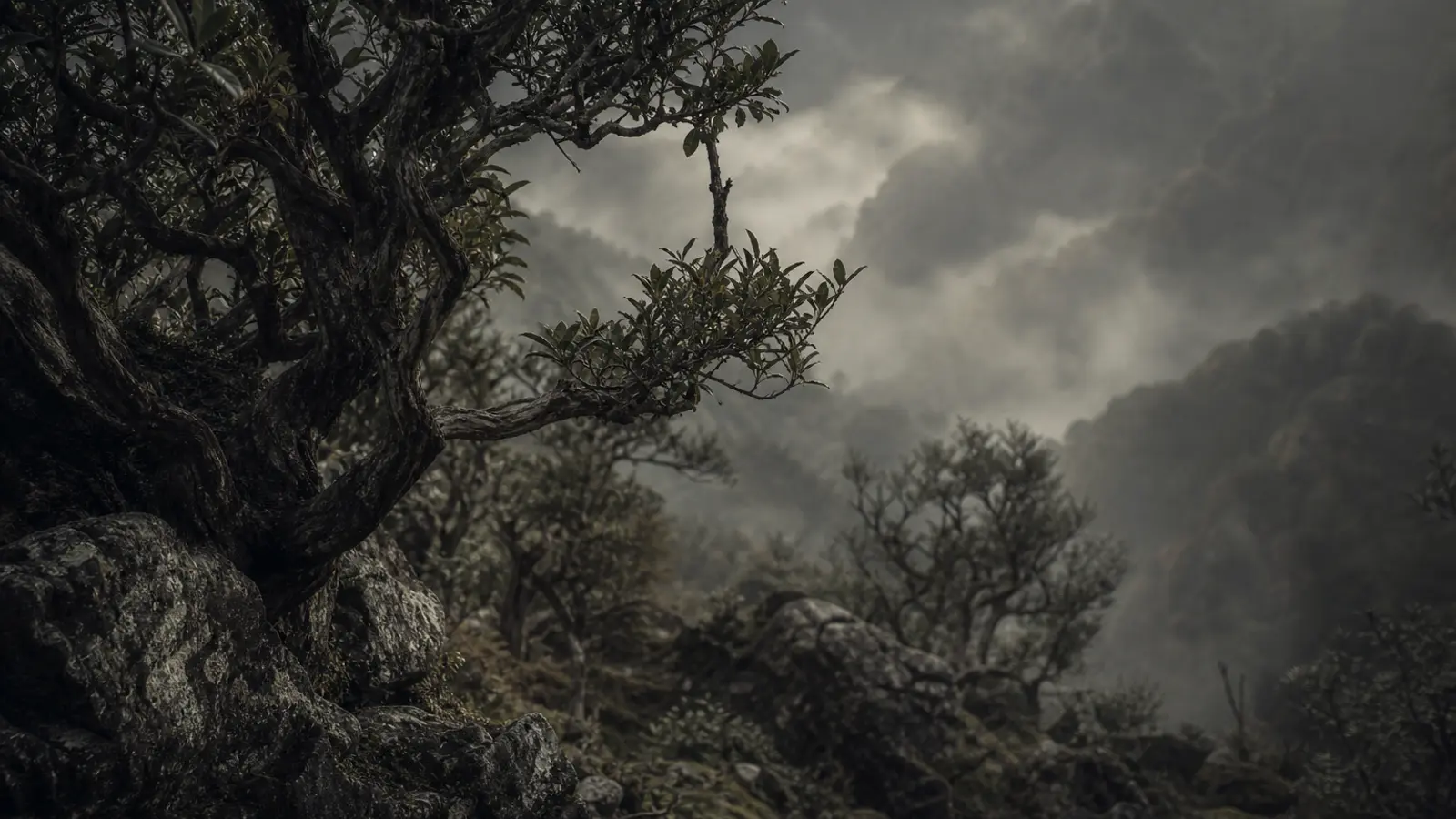
Dancong (单丛, literally “single bush”) oolong from Phoenix Mountain (凤凰山, Fènghuáng Shān) in Guangdong province is among the most aromatically extraordinary tea on earth. Individual trees in ancient mountain gardens each produce a unique aromatic identity — one bush’s tea smells like gardenias, the neighboring bush smells like almonds, and a third smells like ginger flowers. These are not added flavors. They are natural aromatic compounds expressed by specific genetic clones growing in specific micro-terroirs over centuries of selection.
If you know wine, think of dancong oolong as the single-vineyard Gewürztraminer of the tea world — intensely site-specific, aromatically singular, produced in small quantities by dedicated families, and virtually unknown to most of the drinking world. Except dancong’s aromatic range is wider than any single grape variety. And the best material comes from trees that were already old when Columbus sailed.
This guide covers the geography, aroma classification system, processing, and brewing parameters for dancong tea. I should be direct about one thing: I have not yet conducted firsthand tasting sessions with dancong. This article is built on extensive research, and it will be updated with specific session data and aroma-type comparisons once I’ve had proper time with the leaf. I believe in marking that boundary clearly.
What Makes Dancong Oolong Different
Most oolong categories are defined by region and processing method. Tieguanyin is a cultivar and a style. Da Hong Pao is a place and a legend. Dancong is something else entirely: a classification system built around individual trees and their aromatic fingerprints.
The word 单丛 (dān cóng) means “single bush” or “single cluster.” Historically, when a tree on Phoenix Mountain produced leaves with an exceptional and distinctive aroma, that tree was harvested and processed separately — never blended with its neighbors. The resulting tea carried a name describing its dominant scent: honey orchid, osmanthus, almond, ginger flower. Over generations, farmers propagated these exceptional trees through cuttings, creating clonal lines that preserved the mother tree’s aromatic character.
This is natural selection guided by human curation. Families on Phoenix Mountain have maintained specific clonal lines for hundreds of years, the way Burgundian families maintain specific vineyard parcels. The parallel is precise: both systems are built on the belief that place and genetics together create something irreplaceable.
Today, “dancong” refers both to the original single-tree harvests (increasingly rare and expensive) and to the broader category of clonally propagated cultivars grown across Phoenix Mountain and surrounding areas. The principle endures: each named aroma type (香型, xiāngxíng) represents a distinct cultivar processed to highlight its natural aromatic identity.
Geography and Terroir of Phoenix Mountain
Where Phoenix Mountain Sits
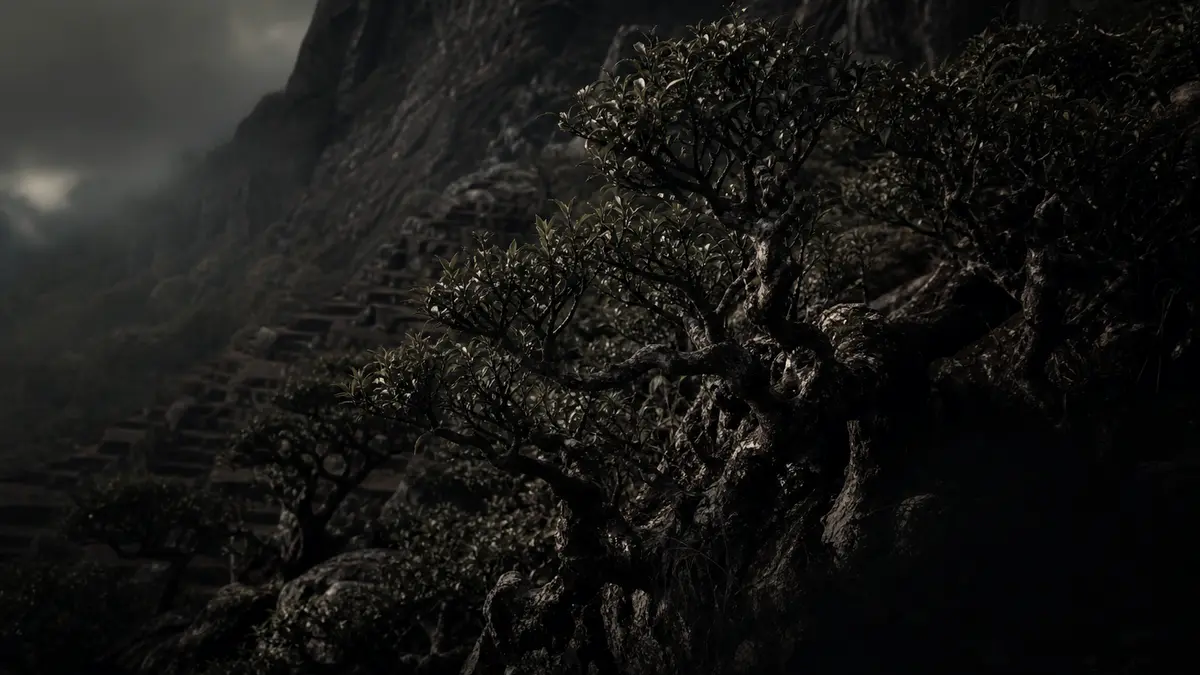
Phoenix Mountain sits in the northeast of Guangdong (广东) province, within the administrative area of Chaozhou (潮州, Cháozhōu). This is not Fujian, not Yunnan, not the regions most Western tea drinkers associate with Chinese oolong. Guangdong has its own deep tea tradition, and Chaozhou is its epicenter — the city is also the birthplace of gongfu tea brewing (工夫茶, gōngfū chá), and dancong is the tea that tradition was built around.
The mountain itself is a series of ridges and peaks with tea gardens ranging from roughly 400 to 1,100 meters elevation. Tea has been cultivated here for over 700 years, with some individual trees reliably dated at 500–600 years old. These ancient trees, called lao cong (老丛, “old bush”), represent the highest tier of dancong production.
Elevation and the Gaoshan Distinction
As with many tea regions, elevation matters enormously on Phoenix Mountain. Gardens above 800 meters are classified as gaoshan (高山, “high mountain”) dancong, and they command significantly higher prices. The reasons are familiar to anyone who understands altitude effects on tea: cooler temperatures slow leaf growth, concentrating aromatic precursors. Greater diurnal temperature swings — warm days, cold nights — stress the plant in ways that increase the synthesis of volatile compounds. Persistent cloud cover at higher elevations filters UV light and raises ambient humidity.
The result is leaf that is more aromatically dense and complex than material grown at lower altitudes. This is not subjective opinion — it tracks with measurable differences in volatile compound concentration. The wine parallel here is direct: high-altitude vineyards in the Andes or the Mosel produce wines with more aromatic intensity and better acid structure than their lowland neighbors, for the same biophysical reasons.
Below 400 meters, the tea is generally sold as Fenghuang Shuixian (凤凰水仙) — a broader, less specific designation. It’s not bad tea. But it lacks the concentrated aromatic identity that defines dancong at its best.
Micro-Terroir and the Single-Bush Logic
Phoenix Mountain’s terrain is not uniform. It is a jumble of slopes, gullies, rock faces, and microclimates. Two trees growing 20 meters apart may experience different soil drainage, sun exposure, and wind patterns. This micro-terroir variation, combined with genetic diversity among ancient seed-grown trees, is what originally produced the extraordinary range of aromatic types that define the dancong system.
Think of it like a mosaic vineyard in Burgundy’s Côte d’Or — except instead of pinot noir expressing differently across adjacent plots, you have distinct tea cultivars, each with its own aromatic signature, shaped by the particular patch of mountain where it grows. The interaction between genetics and site is the whole point.
The Aroma Type System (香型, Xiāngxíng)
The classification of dancong oolong by aroma type is the most important concept to understand. It is both the naming convention and the quality framework. Each xiāngxíng represents a distinct cultivar (or closely related clonal group) characterized by a dominant aromatic compound or aromatic family.
Here are the major aroma types:
Mì Lán Xiāng (蜜兰香) — Honey Orchid
The most famous and widely available dancong type. Honey orchid is the entry point for most drinkers, and it’s a superb one. The aromatic profile centers on — unsurprisingly — honey sweetness layered with orchid-like florals. It tends to be the most forgiving in brewing and the most consistent in quality across price points.
Yā Shǐ Xiāng (鸭屎香) — Duck Shit Aroma
The name is a marketing disaster and a masterpiece simultaneously. Legend says farmers deliberately chose an unappealing name to discourage outsiders from seeking out the cultivar. Whatever the origin of the name, the tea is extraordinary — intensely floral with gardenia, honeysuckle, and stone fruit character. Ya Shi Xiang has exploded in popularity over the past decade, particularly in international markets where the name is a conversation starter. Some producers now market it under the more polite name “Silver Flower Aroma” (银花香, Yín Huā Xiāng), though the original name persists.
Guì Huā Xiāng (桂花香) — Osmanthus
Named for osmanthus (桂花, guìhuā), the tiny golden flower with an unmistakable honeyed, apricot-like scent used throughout Chinese cuisine. This dancong type delivers that same warm, rounded floral character.
Xìng Rén Xiāng (杏仁香) — Almond
A striking departure from the floral types. Almond dancong presents a toasty, nutty aromatic profile closer to marzipan or roasted almonds. The experience of smelling a naturally produced tea that registers as “almond” with no almond anywhere near the processing is a useful lesson in how complex tea biochemistry really is.
Jiāng Huā Xiāng (姜花香) — Ginger Flower
Not ginger root. Ginger flower (hedychium) has a sweet, spicy, tropical fragrance entirely distinct from the sharp heat of culinary ginger. This aroma type is less common but prized for its exotic, layered character.
Zhī Lán Xiāng (芝兰香) — Orchid
A broader orchid category, sometimes overlapping with Mi Lan Xiang but generally considered to have a more refined, less honey-forward profile. Pure floral intensity.
Yù Lán Xiāng (玉兰香) — Magnolia
Named for the yulan magnolia (玉兰花). Creamy, lightly sweet, with a distinct waxy floral quality. Less common in export markets.
Yè Lái Xiāng (夜来香) — Tuberose
Named for tuberose (夜来香, literally “evening fragrance”), a night-blooming flower with an intensely sweet, almost narcotic scent. This is one of the more heady, perfumed dancong types.
Ròu Guì Xiāng (肉桂香) — Cinnamon
Not to be confused with Wuyi Rou Gui, which is a different cultivar from a different mountain entirely. Cinnamon dancong shares the warm spice note but expresses it through Guangdong genetics and Phoenix Mountain terroir — a different tea altogether.
This list is not exhaustive. Dozens of named aroma types exist, and local farmers continue to identify new variations. But these nine cover the vast majority of dancong available in international markets.
Processing Dancong Oolong
Dancong processing follows the broad oolong framework — withering, bruising, oxidation, kill-green (杀青, shāqīng), rolling, and drying — but with specific parameters that distinguish it from Fujian or Taiwanese methods.
Oxidation Level
Dancong typically undergoes medium-to-high oxidation, generally in the 50–70% range. This is heavier than most Taiwanese high-mountain oolongs (which often sit at 15–30%) but similar to or slightly lighter than heavily roasted Wuyi yancha. The higher oxidation develops the deep, complex aromatic compounds while maintaining enough green character to preserve freshness.
The Bruising Step (摇青, Yáoqīng)
The bruising step — literally “shaking the green” — is where dancong’s aromatic complexity is made or broken. During yaoqing, partially withered leaves are tumbled or shaken in bamboo drums or trays, causing controlled cellular damage at the leaf edges. This damage triggers enzymatic reactions that convert stored precursors into volatile aromatic compounds.
Dancong requires precise calibration of this step. Too little bruising and the aromatics remain locked in the leaf, producing a flat, one-dimensional tea. Too much and oxidation runs past the target, degrading the delicate top notes into generic “dark oolong” character. The window is narrow, and experienced dancong makers adjust based on cultivar, leaf maturity, weather conditions, and their own sensory judgment in real time.
Strip-Rolling
Unlike Taiwanese oolongs, which are typically ball-rolled into tight pellets, dancong is strip-rolled — the leaves are twisted and elongated into thin, dark strips. This shape affects both aesthetics and infusion dynamics: strip-rolled leaves open faster and release flavor more quickly than ball-rolled leaves, which is one reason dancong demands such short steep times.
Roasting (焙火, Bèihuǒ)
Most dancong receives light-to-moderate charcoal roasting after the initial drying. Roasting serves multiple purposes: it stabilizes the tea for storage, reduces residual moisture, and adds a layer of toasty warmth that integrates with the natural aromatics. Heavy roasting exists but is less common — the goal with dancong is generally to showcase the cultivar’s inherent fragrance, not to build a roast-dominant profile.
Some dancong is sold with minimal roast as qīngxiāng (清香, “clear fragrance”) style, emphasizing the raw floral top notes. Other material receives a deeper nónɡxiānɡ (浓香, “rich fragrance”) treatment. Both styles have their advocates, and both can be excellent.
How to Brew Dancong Oolong
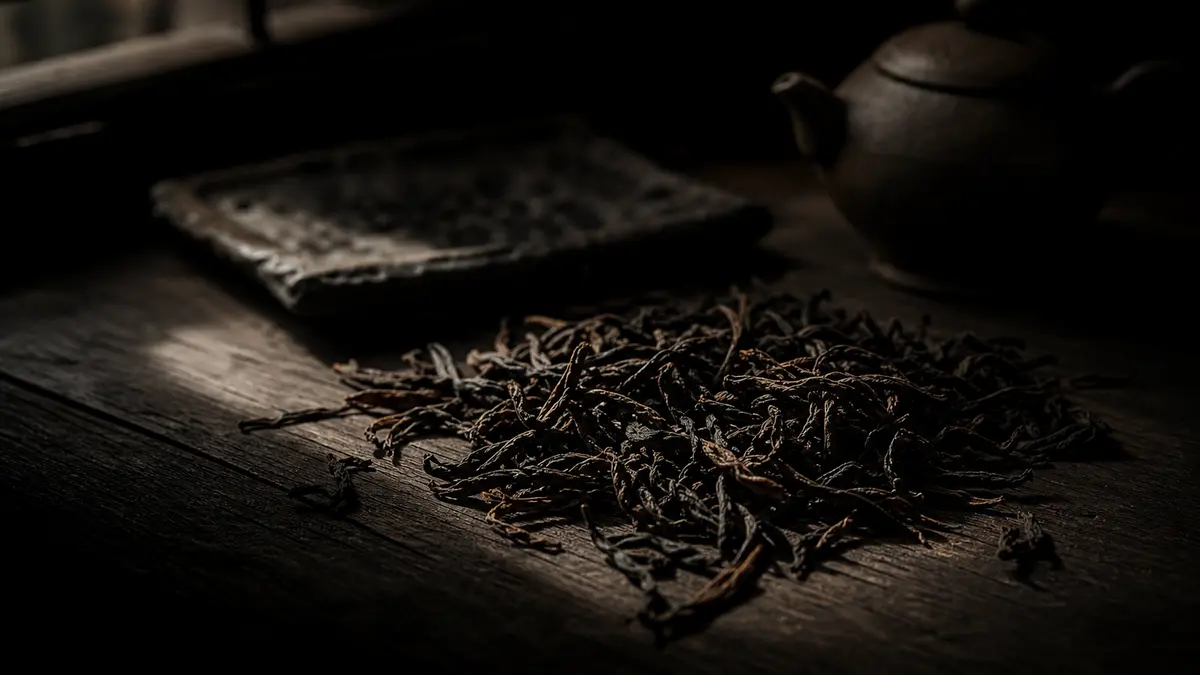
Dancong is, by wide consensus, the most demanding oolong to brew well. The aromatic compounds that make it special are volatile — they release rapidly and can be overwhelmed by astringency if extraction isn’t carefully controlled. The margin for error is thin.
Essential Parameters
| Parameter | Recommendation |
|---|---|
| Water temperature | 95–100°C |
| Leaf-to-water ratio | 7–8 g per 100 ml |
| Vessel | Gaiwan (盖碗) or small Chaozhou clay pot |
| First steep | 5–8 seconds |
| Subsequent steeps | Add 3–5 seconds per round |
| Expected steep count | 10–15 steeps for quality material |
| Rinse | One brief rinse, 2–3 seconds |
Why Flash Steeping Matters
The defining mistake with dancong is steeping too long. Even 5 extra seconds on an early infusion can shift the cup from “transcendent floral perfume” to “tannic and bitter with floral notes buried underneath.” The astringency is there in the leaf — dancong cultivars are not bred for low tannin content. The art is in extracting the aromatics before the tannins catch up.
Pour fast. The moment water hits the leaf, start counting. By the time you reach 5 seconds, you should already be decanting into a fairness pitcher (公道杯, gōngdào bēi) or directly into cups. With practice, this becomes intuitive. Early on, use a timer.
The Session Arc
Quality dancong rewards patience across many steeps. The aromatic profile doesn’t stay static — it evolves. Based on published tasting accounts and extensive sourcing research, the general progression follows this pattern:
- Steeps 1–3: Intense top-note aromatics dominate. This is where the xiāngxíng announces itself most clearly — the gardenia, the honey, the almond, whatever the cultivar promises. The liquor is often lighter in body, almost ethereal.
- Steeps 4–7: The aromatics settle and deepen. Stone fruit, mineral notes, and a broader sweetness emerge. Body increases. This is often the most balanced phase.
- Steeps 8–12: Huigan (回甘, returning sweetness) becomes the lead character. The top notes recede, replaced by a lingering, almost creamy sweetness and a clean mineral finish. Steep times extend significantly.
- Steeps 13+: Gentle sweetness and minerality. The tea is winding down but still pleasant.
I want to note that this arc is assembled from published tasting records and conversations with experienced dancong drinkers, not from my own sessions. I’ll update this section with firsthand data once I’ve had proper time with the leaf.
Vessel Choice
Chaozhou-style gongfu brewing uses tiny pots and cups — traditionally, unglazed Chaozhou clay pots (sometimes as small as 60–80 ml) with equally tiny cups. This is the context dancong was born in, and it works beautifully: the small volume and fast pours keep extraction precise.
A porcelain gaiwan (盖碗) of 100–120 ml works well and has the advantage of neutrality — it won’t absorb or add anything, letting the cultivar’s aromatic identity speak without interference. For a tea that’s all about fragrance, that transparency is an asset.
Water Quality
High mineral content in water will dull dancong’s aromatics. Use filtered or spring water with moderate mineralization. This is true for most tea, but it matters more with dancong because you’re specifically chasing delicate volatile compounds.
Price Ranges and Quality Tiers
Dancong pricing spans an enormous range, reflecting the gap between mass-produced lowland material and ancient single-tree gaoshan harvests.
| Tier | Description | Approximate Price (USD per 100 g) |
|---|---|---|
| Entry-level | Lowland Fenghuang Shuixian or basic dancong blends | $5–15 |
| Mid-range | Named aroma types from mid-elevation gardens (500–800 m) | $15–50 |
| High-quality gaoshan | Named types from above 800 m, specific garden origins | $50–150 |
| Premium single-tree | Old-tree (老丛) dancong, individually harvested ancient trees | $150–500+ |
| Collector/auction | Specific named ancient trees, limited production | $500–2,000+ |
These prices reflect international export pricing. Regional market prices in Chaozhou and Guangdong are generally lower, but the highest-tier material — genuine lao cong from named trees — is expensive everywhere. Demand from domestic Chinese collectors drives those prices relentlessly upward.
For most drinkers exploring dancong for the first time, the mid-range tier offers the best value for genuine aroma-type expression. A good Mi Lan Xiang or Ya Shi Xiang in the $20–40 per 100 g range will clearly demonstrate what makes dancong special.
Dancong in Context: Guangdong’s Oolong Tradition
Dancong doesn’t exist in isolation. Chaozhou has one of China’s oldest and most refined tea cultures, centered on gongfu cha (工夫茶) — the careful, small-vessel brewing practice that spread from Chaozhou across Southeast Asia with the Teochew diaspora. The tiny cups, the precise pours, the emphasis on aromatic appreciation over volume: this entire framework evolved alongside dancong.
Understanding dancong means understanding that it was never intended for casual, large-mug drinking. It was designed — through centuries of cultivation and selection — for the specific conditions of gongfu brewing: small quantities, many infusions, close sensory attention. Brewing it any other way doesn’t just miss the point; it actively works against the tea’s strengths.
This also explains why dancong remains less well-known internationally than Taiwanese oolongs or even Wuyi yancha. It doesn’t adapt well to Western-style brewing. It punishes inattention. It requires both good leaf and good technique to show what it can do. These are not flaws — they’re features of a tea culture that prizes concentration and subtlety.
What Comes Next
This guide is built on research, not firsthand experience. That will change. I have eight different dancong varieties incoming for comparative tasting — spanning multiple aroma types and quality tiers. When those sessions are complete, this article will be updated with specific tasting notes, side-by-side aroma type comparisons, and brewing adjustments refined through actual practice.
Dancong oolong deserves that level of attention. A tea category this aromatically precise, this historically deep, and this technically demanding warrants more than secondhand description. Consider this the framework. The sensory data is coming.
In the meantime, if you’re new to dancong, start with a quality Mi Lan Xiang from a reputable source. Brew it in a gaiwan at 95°C, 7 g per 100 ml, 5-second first steep. Pay attention to the aroma on the lid between steeps. And if the first steep knocks you sideways with a wave of honey and orchid that no flavored tea could ever replicate — now you know what single-bush oolong means.