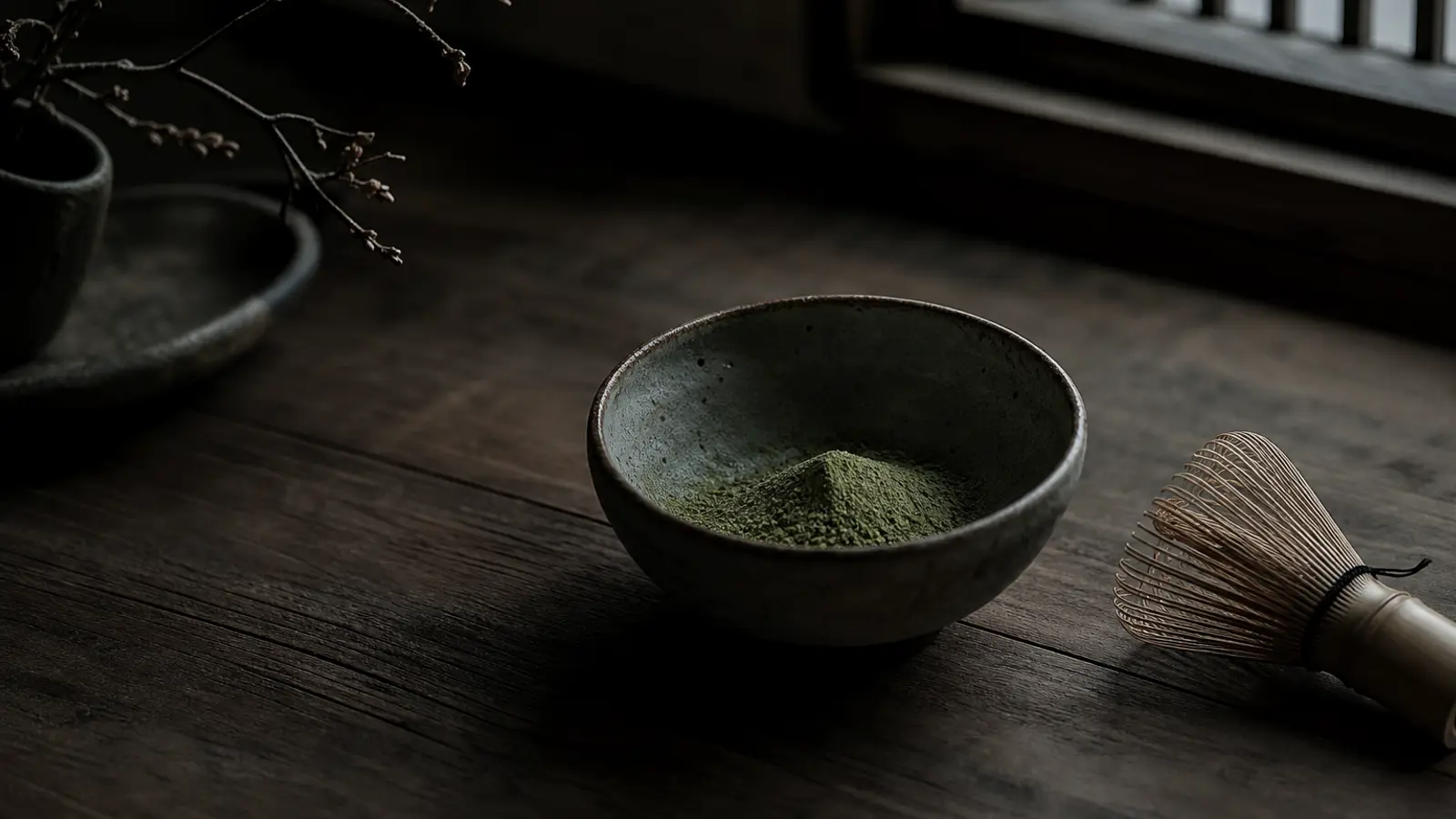
Korean matcha (말차 malcha or 가루차 garucha, powdered tea) is an emerging category in Korean tea production — green tea leaves stone-ground into fine powder following the same principle as Japanese matcha but using Korean cultivars grown in Korean terroir and processed with Korean technique. It is not a copy of the Japanese product. It is something different: partly a revival of Korea’s own historical relationship with powdered tea, partly an adaptation of Japanese methodology for a new market.
This is a category still forming its identity. That makes it interesting.
The Historical Roots of Korean Powdered Tea
Powdered tea in Korea is not new. During the Goryeo Dynasty (고려, 918–1392), powdered tea preparation was the dominant method. The practice was called 점다 (jeomda) — whisking powdered tea in a bowl — and it occupied the center of Korean tea culture for centuries. Buddhist monks and court officials practiced elaborate tea ceremonies built around this powdered format.
The shift away from powdered tea came during the Joseon Dynasty (조선, 1392–1897), when loose-leaf brewing gradually replaced whisking as the standard preparation. Tea culture itself contracted during much of the Joseon period, and when Korean tea began its modern revival in the twentieth century, the focus landed on loose-leaf green tea — the 녹차 (nokcha) that most people now associate with Korean tea.
Korean matcha production today carries both threads. It is a revival of jeomda heritage and a practical adaptation of Japanese matcha technique for contemporary Korean producers and consumers. The historical claim is legitimate. The modern execution is still young.
How Korean Matcha Differs from Japanese Matcha
The differences are not trivial. They start in the field and carry through to the cup.
Shade-Growing: The Critical Variable
Japanese matcha production depends on extended shade-growing — typically 20–30 days under 遮光 (ooishita) shading structures before harvest. This prolonged light deprivation dramatically alters the leaf’s biochemistry: L-theanine (テアニン) increases because the plant cannot convert it to catechins without sunlight, and chlorophyll concentrates as the plant reaches for diminishing light. The result is that intense umami-marine flavor and vivid green color that define high-grade Japanese matcha.
Korean matcha producers are experimenting with shade-growing, but the tradition is younger and the methodology is still developing. Some Korean matcha undergoes partial shading — shorter durations or lighter cover than the Japanese standard. Some Korean matcha is produced without shading at all: sun-grown powder with fundamentally different biochemistry.
The practical impact:
- Sun-grown Korean matcha has higher catechin levels (more antioxidant activity, more bitterness) and lower L-theanine (less umami, less of that calming sweetness)
- Shade-grown Japanese matcha has suppressed catechins and elevated L-theanine, producing the characteristic savory depth and reduced astringency
Neither profile is objectively better. They are different products.
Pan-Firing vs. Steaming
This is the other major divergence. Japanese matcha production uses steam fixation (蒸し mushi) to halt oxidation — a brief blast of steam that preserves a bright, vegetal, marine character in the leaf. Korean green tea production traditionally uses pan-firing (덖음 deokkeum), roasting the leaf in an iron cauldron to stop oxidation.
Pan-fired Korean tea ground into powder produces a fundamentally different flavor from steamed Japanese tea ground into powder. The roasted-nutty character (향 hyang) that defines Korean green tea carries through into the matcha format. Where Japanese ceremonial matcha tastes of seaweed, cream, and umami, Korean matcha from pan-fired leaf tends toward toasted grain, chestnut, and a drier sweetness.
Some Korean producers have adopted steam fixation specifically for their matcha lines, moving closer to the Japanese flavor profile. Others lean into the pan-fired identity as a point of differentiation. Both approaches are valid. The market hasn’t settled on a standard yet.
Korean Matcha Production Process
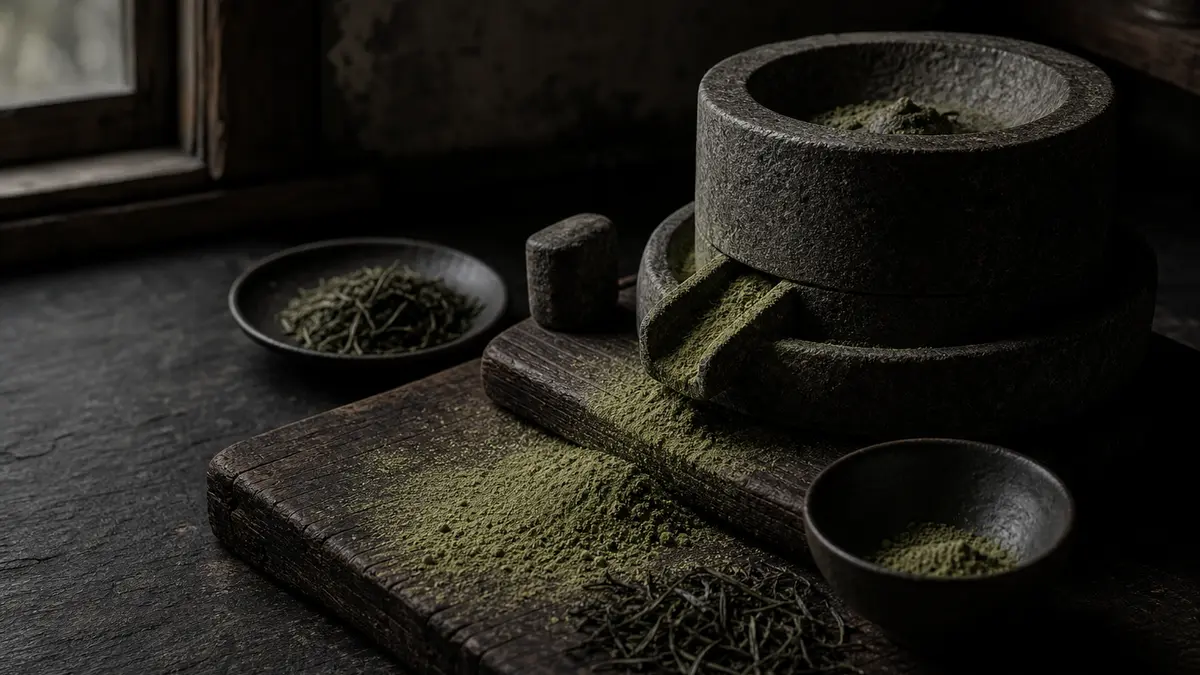
Quality matcha production — Korean or Japanese — requires specific leaf material. You cannot simply grind any green tea into powder and call it matcha. The process involves:
- Harvesting young leaves, typically first flush spring growth
- Fixation (steaming or pan-firing) to halt oxidation
- Removing stems and veins to produce clean leaf material — this is the equivalent of what the Japanese call 碾茶 (tencha), the base material for stone-grinding
- Drying the cleaned leaf until brittle
- Stone-grinding on traditional granite mills (맷돌 maetdol in Korean) at slow speed to avoid heat buildup that would damage flavor and color
The stone-grinding step matters enormously. Industrial blade grinding generates heat and produces coarser particles. Granite mill grinding at roughly 40g per hour produces the fine, sub-20-micron particle size that suspends properly in water and feels smooth on the palate. Quality Korean matcha production uses these slow stone mills, but the infrastructure is newer and smaller-scale than Japan’s established grinding operations.
The stem-and-vein removal step is where much Korean matcha falls short of the standard. Properly preparing tencha-equivalent leaf is labor-intensive. Some producers skip or abbreviate this step, grinding standard sencha-equivalent leaf — stems, veins, and all — into powder. The result is grittier, more astringent, and less vivid in color. This is the single biggest quality variable in the current Korean matcha market.
Korean Terroir in the Cup
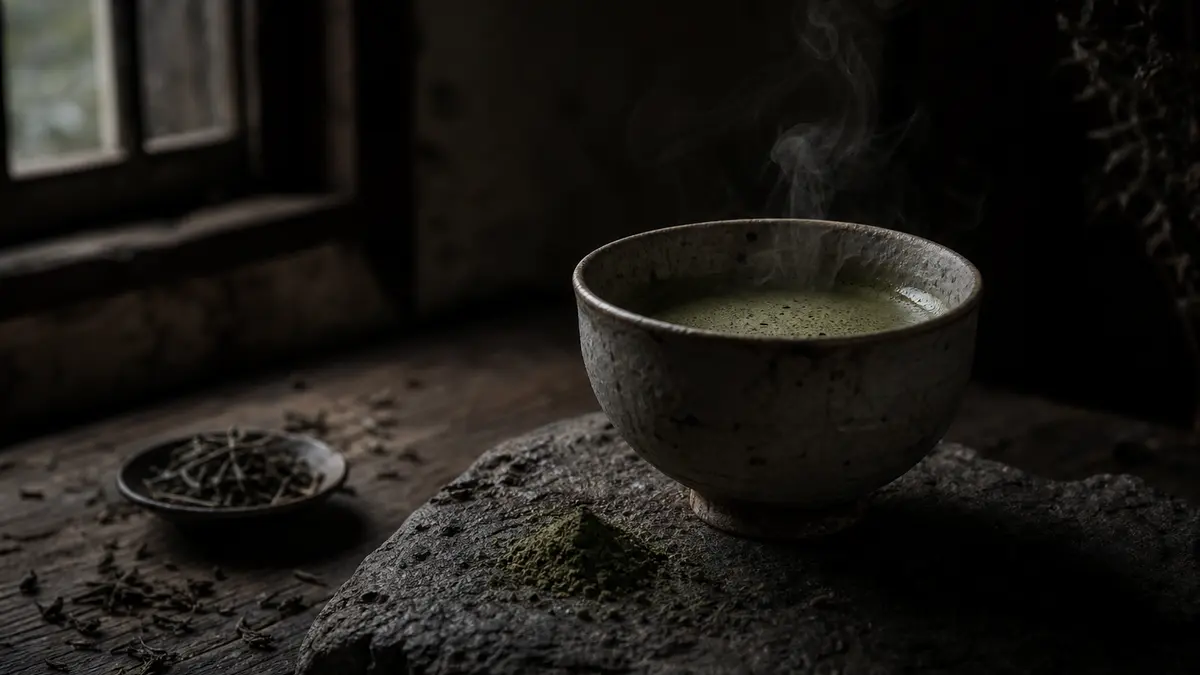
The regions producing Korean matcha — primarily 보성 (Boseong) in South Jeolla Province and 제주 (Jeju Island) — bring terroir characteristics that Japanese growing regions do not replicate.
Boseong’s misty hillside fields at lower elevations produce tea with a round, grain-forward sweetness. Jeju’s volcanic soil and maritime climate contribute mineral notes and a subtle salinity. These are real terroir signatures, not marketing language. The same cultivar grown in Boseong volcanic soil versus Uji (宇治) clay soil will taste different, the same way the same grape variety expresses differently across appellations.
Korean cultivars also differ from the Japanese yabukita (やぶきた) that dominates Japanese matcha production. Varieties like 참녹 (chamnok) and other Korean-developed cultivars bring their own amino acid and polyphenol profiles to the finished powder.
Market Position and Honest Assessment
Korean matcha currently sits in a niche between Japanese premium matcha and Chinese commodity matcha powder. Pricing runs roughly $15–$40 per 30g tin — generally lower than equivalent-grade Japanese matcha, which commands $25–$60+ for genuine ceremonial grade from established Uji producers.
I want to be direct about quality. Korean matcha is not yet at the level of the best Japanese matcha. The shade-growing tradition is newer. The stone-grinding infrastructure is less developed. The quality control standards that decades of Japanese industry refinement have established — the clear grading tiers, the consistent tencha preparation, the deep cultivar-specific knowledge — are still forming in Korea.
But the category is developing rapidly. Producers who are doing it well — proper shading, careful tencha preparation, slow stone-grinding — are making powder worth drinking on its own terms. The Korean terroir adds character that Japanese matcha from different soil and climate simply does not produce. The pan-fired variants offer a flavor experience that exists nowhere in the Japanese matcha canon.
This is a space to watch, not a space to dismiss.
Brewing Korean Matcha
Standard matcha preparation applies. For a bowl of 薄茶 (usucha-style thin tea):
- Dose: 2g powder (roughly 1.5 level chashaku scoops)
- Water: 70–80ml at 75–80°C
- Whisk: Briskly with a bamboo 茶筅 (chasen) in a W-pattern until frothy
For Korean matcha that skews toward the roasted-nutty profile, I find slightly hotter water (closer to 80°C) opens up the toasted grain notes without punishing bitterness. For shade-grown Korean matcha with more umami character, stay closer to 75°C.
The jeomda (점다) revival community in Korea sometimes uses a slightly higher water ratio and less vigorous whisking than the Japanese standard, producing a thinner, more tea-like bowl rather than the thick, foamy Japanese style. Both approaches work. Experiment.
Korean matcha also performs well in lattes and culinary applications, where its roasted character and generally lower price point relative to Japanese ceremonial grade make it a practical choice.
Where Korean Matcha Is Heading
The trajectory points toward specialization. As Korean producers develop longer shade-growing protocols and invest in dedicated tencha processing lines, the quality ceiling will rise. The producers who lean into Korean identity — pan-fired powder, Korean cultivars, Korean terroir — rather than trying to replicate Japanese matcha exactly will likely carve out the most defensible position.
Standards will need to form. Right now, there is no Korean equivalent of the Japanese matcha grading system, and the term “matcha” is applied loosely to products ranging from properly stone-ground tencha to blade-ground commodity leaf. Consumer education and industry self-regulation will determine whether Korean matcha becomes a respected category or a confused one.
The raw materials are there. The history is there. The terroir is distinctive. What remains is execution and time.