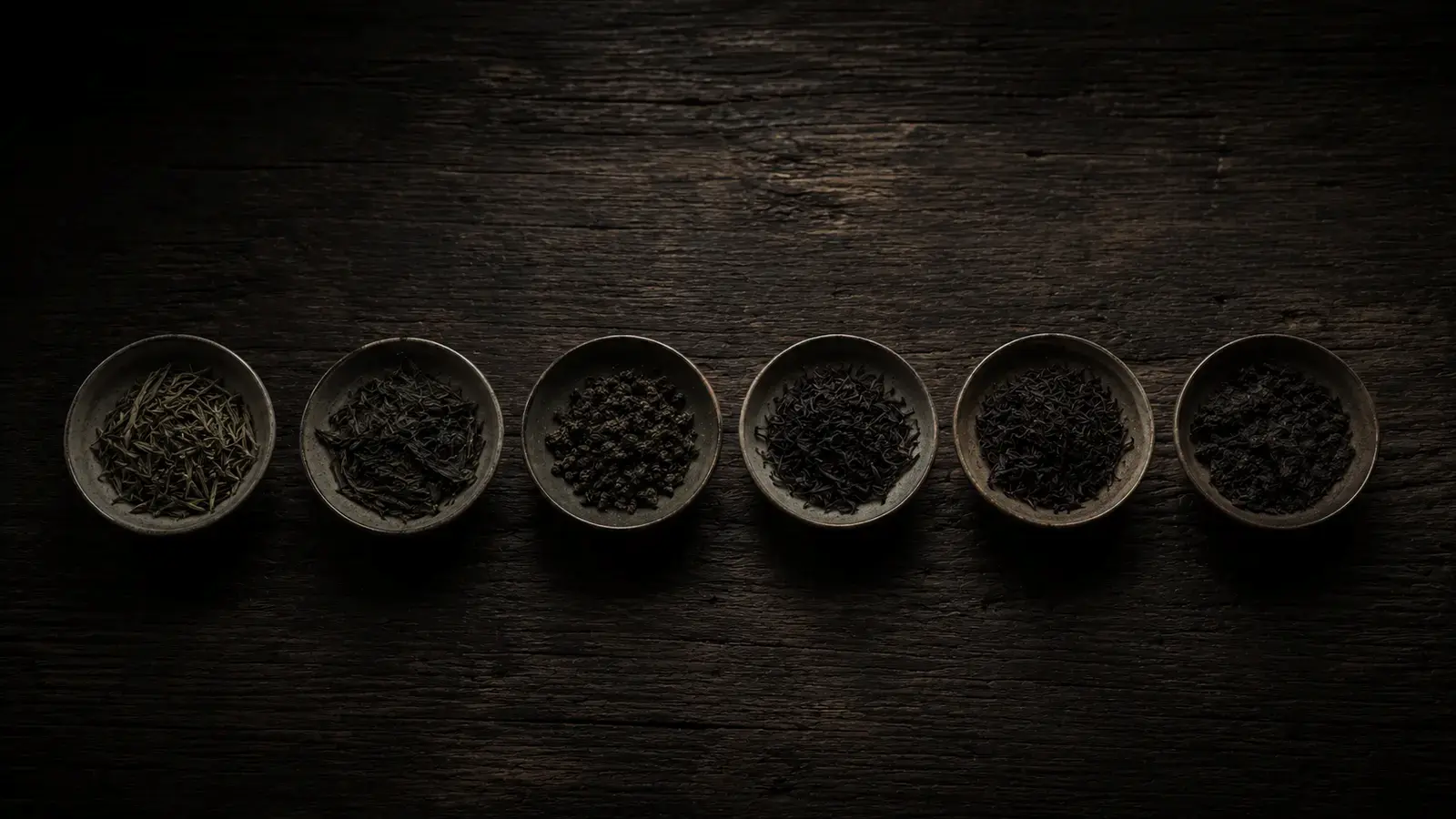
Every tea you have ever tasted — green, black, oolong, pu-erh, the delicate white tea in a Shanghai teahouse, the roasted rock oolong in a Fujian cliff-side garden — comes from the same plant. Camellia sinensis. One species. Two major varieties (sinensis and assamica). Six types of tea.
The difference between a pale, grassy Japanese sencha and a dark, earthy aged pu-erh is not the plant. It’s what happens to the leaf after it’s picked. Processing — specifically, how much the leaf is allowed to oxidize and whether microbial fermentation is introduced — determines which of the six categories the tea becomes.
This is the single most important concept in tea. Once you understand that processing creates the type, every tea you encounter has a place on the map.
The Processing Spectrum
The six types of tea sit on a spectrum defined by two variables: oxidation level and fermentation.
Oxidation is the enzymatic browning that begins the moment a tea leaf is picked and its cell walls are disrupted. It’s the same process that turns a cut apple brown. In tea, oxidation converts catechins (bitter, astringent, colorless) into theaflavins and thearubigins (mellower, darker, more complex). The tea maker controls oxidation by applying heat at a specific moment — the kill-green step (sha qing, 杀青) — which halts the enzymes. When that heat is applied determines the tea’s identity.
Fermentation is microbial activity — bacteria and fungi transforming the tea’s chemistry after production. Only one category (dark tea) undergoes true fermentation. The rest are oxidized to varying degrees but not fermented.
The spectrum from least processed to most:
White → Green → Yellow → Oolong → Black → Dark
White tea: minimal processing, near-zero oxidation. Green tea: oxidation halted immediately after picking. Yellow tea: like green but with a sealed yellowing step. Oolong: partial oxidation, the widest range. Black tea: full oxidation. Dark tea: post-fermentation by microbial activity.
Each type gets a section below. But keep the spectrum in mind — it’s the organizing principle that makes everything else make sense.
White Tea (白茶)
Processing: The least intervention of any tea type. Young buds and leaves are withered — spread on bamboo trays to lose moisture naturally over 24-72 hours — then dried with gentle heat. No rolling. No kill-green. No oxidation control beyond the natural slowing that occurs as the leaf dries. The leaf dictates the tea.
What it tastes like: Delicate, sweet, hay-like, with melon and stone fruit notes in the best examples. Silver Needle (bai hao yin zhen, 白毫银针) — buds only, the most prized style — is gentle, sweet, and almost ethereal. White Peony (bai mu dan, 白牡丹) — buds plus leaves — has more body and complexity.
Where it comes from: Primarily Fuding (福鼎) and Zhenghe (政和) in Fujian province, China. Fuding white tends lighter and more floral. Zhenghe white tends richer and more fruity.
The surprise: White tea ages. The Chinese saying — “one year tea, three years medicine, seven years treasure” (一年茶三年药七年宝) — reflects a tradition of aging white tea that predates the current pu-erh collecting trend. Aged white tea develops warmth, depth, and a dried fruit character that bears no resemblance to the delicate fresh version.
Brewing: 75-85°C water. Gentle steeps. Forgiving — white tea tolerates slight oversteeping better than green tea because its catechin content is naturally lower.
For the full guide: White Tea: The Least Processed Tea Explained.
Green Tea (绿茶)
Processing: After picking, the leaves undergo kill-green as quickly as possible — halting oxidation at near-zero. This preserves the leaf’s green color, grassy-vegetal character, and high amino acid content (particularly L-theanine, which produces sweetness and umami). How the kill-green is performed creates the fundamental split within the category:
Pan-firing (chao qing, 炒青) — the leaf is pressed against a hot wok or iron cauldron by hand. This is the Chinese method and, importantly, the Korean method. Pan-fired green tea has a toasted, nutty, sweet-grain character. Chinese Longjing (龙井, Dragon Well) is the most famous pan-fired green tea. Korean nokcha (녹차) is pan-fired in iron cauldrons (gamasot, 가마솥) using a traditional technique called deokkeum (덖음) that produces a distinctive roasted chestnut warmth.
Steaming (zheng qing, 蒸青) — the leaf is briefly steamed to halt oxidation. This is the Japanese method. Steamed green tea has a vegetal, marine, grassy character — completely different from pan-fired despite being the same category. Japanese sencha, gyokuro, and the tencha used for matcha are all steamed.
Same plant, same category, two radically different results based on how heat is applied. The wine parallel: it’s like Chardonnay — unoaked Chablis and buttery California Chardonnay are both the same grape, unrecognizable as relatives.
What it tastes like: Pan-fired: toasted chestnut, sweet grain, nutty (Longjing, Korean sejak). Steamed: grassy, marine, vegetal, umami (sencha, gyokuro). Both can be sweet and clean when brewed correctly.
Where it comes from: China (the largest producer — Zhejiang, Anhui, Jiangsu provinces), Japan (Shizuoka produces 40% of Japanese tea, Uji is the prestige origin), and Korea (Boseong, Hadong, and Jeju — three distinct terroirs producing green tea with character unavailable from Chinese or Japanese origins).
The critical variable: Water temperature. Green tea is the most temperature-sensitive category. At 100°C, catechins extract faster than amino acids — the result is bitter and astringent. At 70-80°C, amino acids dominate — the result is sweet, umami, and clean. This single variable is why most people think they don’t like green tea. They’ve been scalding it.
Brewing: 70-80°C. 4-5g per 100ml. Short steeps — 10-20 seconds gongfu style, 60-90 seconds Western style.
For Korean green tea specifically: Korean Green Tea: A Complete Guide to Nokcha.
Yellow Tea (黄茶)
Processing: The rarest of the six types. Yellow tea follows the same path as green tea — pick, kill-green, roll — but adds one unique step: men huang (闷黄, sealed yellowing). The still-warm leaves are wrapped in cloth or paper and left to sit in a warm, humid environment for hours or days. This micro-fermentation step softens the tea’s sharp green character while adding a mellow sweetness that green tea lacks.
What it tastes like: Gentler than green tea. Sweet, smooth, slightly honeyed. The sealed yellowing removes the vegetal brightness and the potential for bitterness, producing a cup that is easier to brew and harder to ruin. Think of yellow tea as green tea with its rough edges sanded off.
Where it comes from: Almost exclusively China, in small quantities. The famous yellow teas — Junshan Yinzhen (君山银针) from Hunan, Meng Ding Huang Ya (蒙顶黄芽) from Sichuan, Huo Shan Huang Ya (霍山黄芽) from Anhui — are produced in limited volumes. Many are difficult to find outside China.
The Korean connection: Korean hwangcha (황차) is sometimes called Korean yellow tea, but the processing differs. Korean hwangcha undergoes partial oxidation before kill-green (more like a very light oolong) rather than the post-kill-green sealed yellowing of Chinese yellow tea. The name overlap creates confusion — they’re related in spirit (both occupy the gentle, mellow space between green and oolong) but distinct in technique.
Brewing: 80-85°C. Forgiving. The men huang step has already reduced the catechin content that makes green tea bitter when overbrewed.
Oolong Tea (乌龙茶)
Processing: Partial oxidation — anywhere from 15% to 80%. This is the widest range in any tea category, which makes oolong the most diverse type. The tea maker picks the leaves, allows oxidation to proceed to a specific degree, then applies kill-green to stop it. The level of oxidation determines the character.
The key technique is shaking or bruising (yao qing, 摇青) — the leaves are tossed in bamboo baskets to bruise the edges while the center remains intact. Edge oxidation creates complexity. Center preservation retains freshness. The combination is what makes oolong oolong.
Many oolongs also undergo roasting (hong bei, 烘焙) after oxidation — sometimes multiple rounds of slow charcoal roasting over weeks — which adds another layer of complexity on top of the oxidation-driven character.
The spectrum within oolong:
Light oolong (15-30% oxidation): Floral, creamy, buttery. Tieguanyin (铁观音) from Anxi, Fujian. Taiwanese high-mountain oolongs from Ali Shan, Li Shan, and Da Yu Ling — ethereal, floral, grown above 1,500 meters where cold nights concentrate flavor compounds.
Medium oolong (30-50% oxidation): Traditional-style Tieguanyin. Some Taiwanese oolongs with roasting. More body than light oolong, with caramel and toasted grain notes beginning to emerge alongside the floral character.
Heavy oolong (50-80% oxidation + charcoal roasting): Wuyi yan cha (武夷岩茶, rock tea) — Da Hong Pao (大红袍), Rou Gui (肉桂), Shui Xian (水仙). Mineral, roasted, complex. The volcanic rock soil of the Wuyi Mountains imprints a character called yan yun (岩韵, rock rhyme) — a stony, wet-rock mineral sensation that no other tea region replicates. The roasting transforms without concealing.
Dancong (单丛): Phoenix Mountain oolongs from Guangdong — single-bush varieties where each tree produces a unique aromatic identity (orchid, almond, ginger flower, honey). Among the most aromatic teas on earth.
Wine parallel: Oolong is the Pinot Noir of tea — the maker’s category, where processing skill matters more than raw material, and the range of expression within a single type is wider than the gap between some different types entirely.
Brewing: 85-100°C depending on oxidation level. Lighter oolong at lower temperatures. Roasted and heavy oolong at 95-100°C. Gongfu method is essential for oolong — the multiple steeps reveal the evolution that is oolong’s defining experience.
For the full guide: What Is Oolong Tea? The Most Diverse Tea Category.
Black Tea (红茶)
Processing: Full oxidation. After picking, leaves are withered, rolled to break cell walls and initiate oxidation, then allowed to oxidize completely — typically 4-6 hours until the leaf turns dark copper-brown. Kill-green is applied at the end via oven drying to stop the process and stabilize the tea.
The naming confusion: In Chinese, black tea is called hong cha (红茶) — literally “red tea,” named for the red-copper color of the liquor. What Chinese and Korean speakers call hei cha (黑茶, “black tea”) is what the West calls “dark tea” — the fermented category that includes pu-erh. This naming mismatch is one of the most common sources of confusion for Western tea drinkers. When someone in China says “black tea,” they mean something different from what a Westerner means.
What it tastes like: Malty, brisk, sometimes sweet, sometimes astringent. The range spans from the muscatel complexity of a Darjeeling second flush to the thick, honeyed body of a Yunnan Dian Hong (滇红) to the smoky intensity of Lapsang Souchong (正山小种). Black tea has the strongest, most immediate flavor impact of any type — it doesn’t require multiple steeps to reveal itself.
Where it comes from: Everywhere tea grows. India (Assam, Darjeeling, Nilgiri), Sri Lanka (Ceylon), China (Yunnan, Fujian, Anhui), Kenya, Turkey, and many others. Black tea is the dominant tea type globally, accounting for roughly 78% of world tea production and nearly all tea consumed in the West, Turkey, India, and the Middle East.
Brewing: 90-100°C. Black tea extracts easily — Western brewing (3-5 minutes, one steep) works well. Gongfu brewing reveals more nuance from quality Chinese black teas, particularly Dian Hong and Keemun, which can sustain 6-10 steeps.
Dark Tea (黑茶)
Processing: The only tea type that undergoes true microbial fermentation after production. Dark tea — hei cha (黑茶) in Chinese — is a category, not a single tea. The defining step is post-fermentation: after kill-green and rolling, the tea is exposed to moisture and microbial activity that drives a biological transformation no other tea type experiences.
Pu-erh is the most famous dark tea, but it is not the only one. The category includes:
Pu-erh (普洱) from Yunnan — both sheng (raw, naturally aging) and shou (ripe, accelerated fermentation). The most collected, most studied, and most expensive dark tea. The one with terroir arguments that rival wine. The Complete Guide to Pu-erh Tea covers it in depth.
Liu Bao (六堡) from Guangxi — fermented in bamboo baskets, developing a distinctive warm cinnamon character called binlang xiang (槟榔香, areca nut aroma). Historically exported to Southeast Asian Chinese communities. Significantly undervalued compared to pu-erh of similar age and quality.
Fu Zhuan (茯砖) from Hunan — pressed dark tea colonized by a specific golden fungus (Eurotium cristatum, “golden flowers,” 金花) that produces a distinctive sweet, grain-like flavor. The presence and density of golden flowers is a quality marker.
Tibetan dark teas — various compressed dark teas produced in Sichuan, Yunnan, and Hunan for the Tibetan market, where tea is mixed with yak butter and salt. Utilitarian rather than connoisseur-grade, but historically significant.
Korean tteok-cha (떡차) — Korea’s traditional pressed tea, made by steaming and pounding leaves into molds. The compressed format allows slow fermentation over years, creating a tea that parallels pu-erh’s aging proposition through a different production pathway.
What dark tea tastes like: Earthy, smooth, deep. Shou pu-erh is chocolate and wet wood. Aged sheng is camphor and dried fruit. Liu Bao is cinnamon and hazelnut. The fermentation creates compounds — theabrownins, gallic acid — that exist in no other tea type. Dark tea is the category where time is an ingredient.
Wine parallel: Dark tea is the aged wine category of tea. Where black tea is the fresh Beaujolais — immediate, fruity, consumed young — dark tea is the Barolo in the cellar, slowly becoming something it wasn’t at birth. The collector market, the vintage obsession, the storage debates, the counterfeiting — all of it mirrors the fine wine world.
Brewing: 95-100°C. High leaf ratio (7-8g per 100ml). Multiple rinses for compressed material. Gongfu method essential — dark tea’s complexity unfolds across 10-20 steeps in a way that a single Western-style brew cannot capture.
For the dark tea category beyond pu-erh: What Is Hei Cha? Dark Tea Beyond Pu-erh.
The Comparison Table
| Type | Oxidation | Fermentation | Flavor Profile | Caffeine | Key Examples | Brewing Temp |
|---|---|---|---|---|---|---|
| White | ~5-10% | None | Delicate, sweet, hay, melon | Low-moderate | Silver Needle, White Peony | 75-85°C |
| Green | ~0-5% | None | Vegetal, nutty, umami, bright | Moderate | Longjing, sencha, Korean sejak | 70-80°C |
| Yellow | ~5-10% | Micro (men huang) | Mellow, sweet, honeyed | Low-moderate | Junshan Yinzhen, Meng Ding | 80-85°C |
| Oolong | ~15-80% | None | Floral to mineral to roasted | Moderate-high | Tieguanyin, Da Hong Pao, dancong | 85-100°C |
| Black | ~100% | None | Malty, brisk, sweet, strong | High | Assam, Dian Hong, Keemun | 90-100°C |
| Dark | Varies | Yes (microbial) | Earthy, smooth, deep, aged | Low-moderate | Pu-erh, Liu Bao, fu zhuan | 95-100°C |
One Plant, Six Destinations
The point worth repeating: every tea in this table grows on the same species. The difference is human decision — when to pick, when to stop oxidation, whether to roast, whether to ferment, how to dry, how to store. The leaf is the raw material. Processing is the craft.
Understanding this transforms how you taste. When you drink a roasted Da Hong Pao and detect mineral character underneath the charcoal, you’re tasting what the volcanic rock of the Wuyi Mountains deposited in the leaf before the tea maker transformed it. When you drink a 20-year aged sheng pu-erh and taste camphor and dried fruit, you’re tasting what two decades of microbial succession built from the sun-dried maocha a farmer pressed into a cake.
The plant provides. The processing reveals. Time, sometimes, completes.
Start wherever your curiosity leads. The six types are doors, not walls. Every one opens into more rooms than you expect.
Frequently Asked Questions
What are the six types of tea?
The six types — white, green, yellow, oolong, black, and dark — are classified by processing method, primarily oxidation level and whether microbial fermentation occurs. All six come from the same plant species, Camellia sinensis. The type is determined by what happens after the leaf is picked, not by where it grows or what variety it is.
Which type of tea is healthiest?
All six types contain beneficial compounds — polyphenols, amino acids, caffeine. Green tea has the most research behind its health claims, particularly around EGCG (epigallocatechin gallate) and its effects on blood sugar and cognitive function. Dark tea (pu-erh) has unique fermentation metabolites with emerging research on gut microbiome benefits. But the differences between types are smaller than the difference between drinking tea and not drinking tea. Drink the type you enjoy consistently — that’s the healthiest choice.
Why is Chinese “black tea” called “red tea”?
Chinese tea classification names teas by the color of the liquor, not the leaf. Fully oxidized tea produces a red-copper colored liquor — hence hong cha (红茶, red tea). Western classification named it by the leaf color — dried, fully oxidized leaves are black. Both are correct. The mismatch causes confusion because Chinese hei cha (黑茶, literally “black tea”) refers to dark, fermented teas like pu-erh — a completely different category from what Westerners call black tea.
What is the most caffeinated type of tea?
Generally, black tea and young sheng pu-erh have the highest caffeine per cup. Shade-grown Japanese teas (matcha, gyokuro) also have high caffeine due to the shading process increasing caffeine production. White tea and aged dark tea tend toward the lower end. But caffeine content varies more by specific tea, brewing method, and steep number than by broad category — a gongfu-brewed young sheng can deliver more caffeine per sitting than a mug of English Breakfast, despite both being “tea.”
Where does Korean tea fit in the six types?
Korean tea production is primarily green tea (nokcha, 녹차) — pan-fired in the traditional Korean deokkeum (덖음) method. Korea also produces hwangcha (황차), a partially oxidized tea that occupies the space between green and oolong. And Korean tteok-cha (떡차) — pressed, fermented tea — falls within the dark tea category. Korean tea is not a separate type. It’s a distinct regional expression within the existing six-type framework, the same way New Zealand Sauvignon Blanc is not a separate grape — it’s a distinctive terroir expression of an established variety.