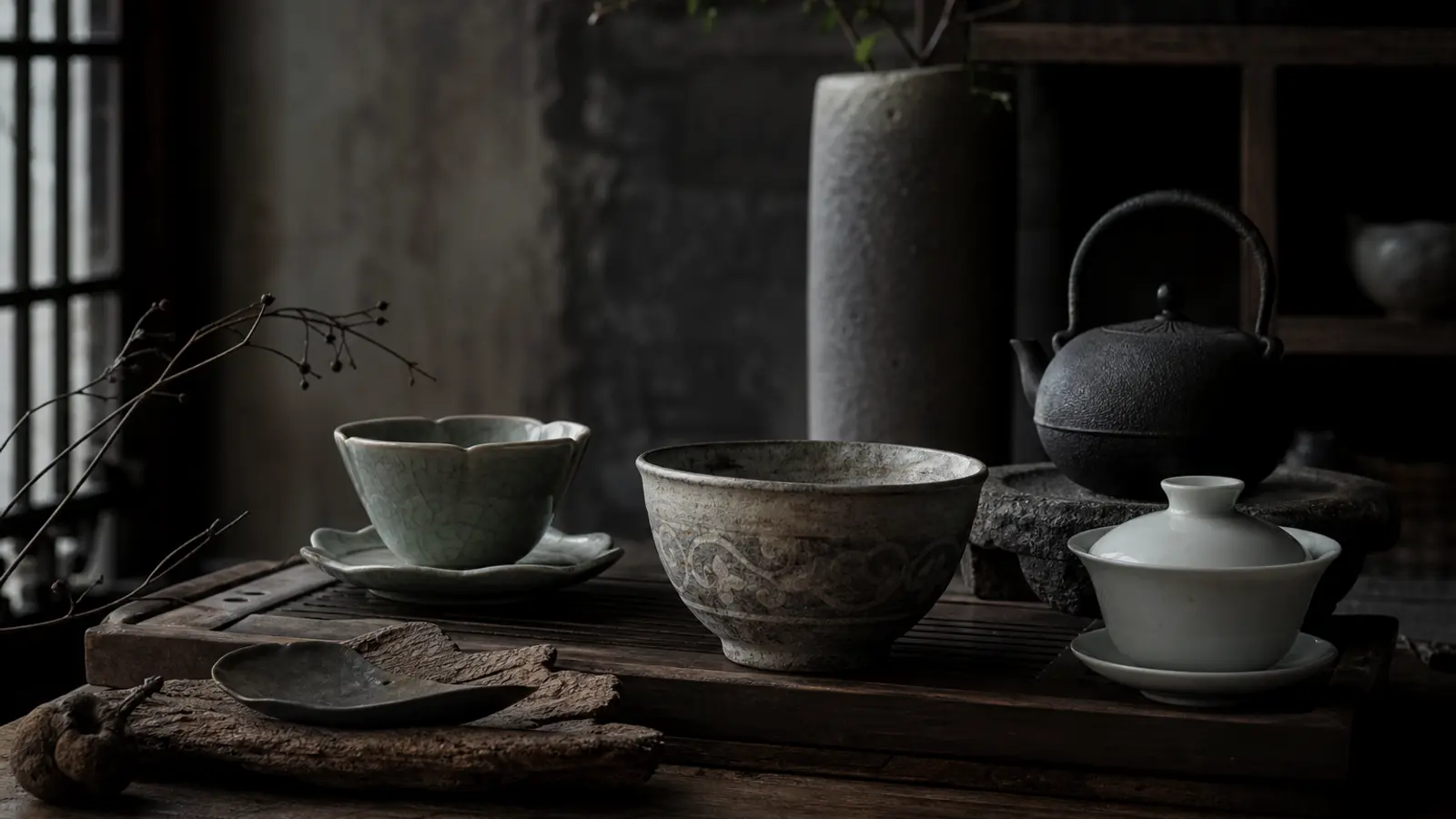
Korean teaware sits in an odd position in the broader tea world: widely admired, rarely explained. Most gongfu practitioners default to Chinese porcelain gaiwans and Yixing teapots because the literature points there. The Korean tradition — spanning three distinct ceramic lineages and its own vessel vocabulary — gets a paragraph in survey articles, if that.
This guide closes that gap. I cover the three core Korean ceramic traditions (청자 cheongja, 분청 buncheong, and 백자 baekja), the functional vessels you need to know, how Korean teaware performs in actual gongfu sessions, and when to reach for a Korean vessel instead of a Chinese one. I also address cost, where the traditions overlap philosophically with Japan and China, and where they diverge.
What Makes Korean Teaware Distinct
The short answer is 소박함 (sobakham) — a Korean aesthetic concept meaning understated, unpretentious simplicity. It is not the same as Japanese 侘び寂び (wabi-sabi), though the two are historically entangled in ways that matter. And it is deliberately unlike the refined technical ambition of Chinese 功夫 (gongfu) ceramics.
Where Chinese teaware — particularly thin-walled Jingdezhen porcelain or precision-fired Yixing clay — optimizes for control, Korean ceramics accept variation. A 분청 bowl with an uneven glaze run is not a defect; it is evidence of the kiln’s participation. Where Japanese wabi-sabi aestheticizes imperfection into a philosophy, Korean sobakham is less self-conscious — the imperfection is simply not worth correcting if the vessel works.
This matters practically. Korean vessels are typically heavier and thicker-walled than Chinese equivalents. They retain heat differently. Many are semi-porous in ways that Chinese porcelain is not, meaning they season with repeated use. The experience of holding and brewing from them is different in the hand. These are not worse qualities — they are different qualities that suit different sessions.
One piece of history worth knowing: the Japanese tea master Sen no Rikyu and the generation of tea masters who followed him were profoundly influenced by Korean ceramics brought to Japan in the 16th century, particularly rough Korean rice bowls repurposed as tea bowls. What became Japanese wabi-sabi aesthetics was, in significant part, catalyzed by Korean pottery. The tradition that “inspired” Japanese minimalism had existed in Korea, without philosophical elaboration, for centuries.
The Three Korean Ceramic Traditions
Cheongja (청자) — Celadon: The Ceremonial Vessel
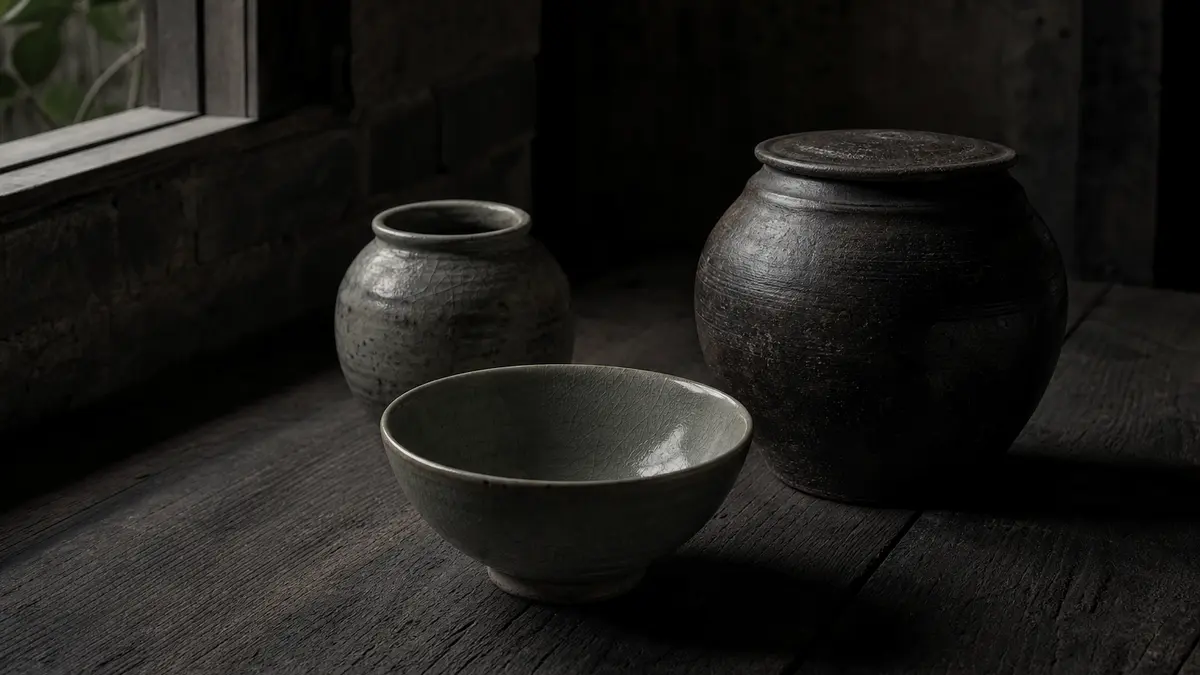
Celadon is the tradition most non-Koreans recognize first. The distinctive jade-green color comes from iron oxide in the glaze firing in a reduction atmosphere — oxygen-restricted kiln conditions that transform iron into the blue-green range rather than the red-brown of oxidation.
Korean celadon peaked during the Goryeo Dynasty (918–1392) and is considered among the finest ceramics ever produced anywhere. The Goryeo masters developed inlay techniques (상감청자, sanggam cheongja) that embedded white and black clay into carved designs, then covered with the celadon glaze — a technical achievement that Chinese ceramicists of the period studied with considerable interest.
Contemporary celadon for tea use maintains these traditions. The glaze is semi-porous — more so than Chinese porcelain, less so than unglazed Yixing or buncheong. Heat retention is moderate. The aesthetic is formal, ceremonial, and unambiguously Korean in character.
For tea brewing, cheongja suits occasions where the vessel is part of the statement. I find it particularly appropriate for Korean teas — 잭설차 (jakseolcha, sparrow tongue green tea) or aged teas where the jade vessel creates visual coherence with the session’s tone. It is less suited to rapid analytical tasting because the semi-porous body will absorb flavor compounds over time, making it inappropriate for switching between very different teas.
Buncheong (분청) — The Artisanal Vessel
Buncheong is the tradition that most directly parallels Yixing clay in function, if not in material. The name means “powdered blue-green” — a reference to the white slip coating applied over gray-brown stoneware clay, which is then manipulated through stamping, brushing, carving, or inlaying before a clear or semi-opaque glaze.
The results are radically variable. Two buncheong pieces from the same studio can look almost unrelated. Textures range from smooth to deeply tactile. Colors span warm gray to near-white to streaked brown where the slip application was uneven. This variability is the point.
Buncheong is semi-porous and seasons with use exactly as a well-used Yixing teapot does. The clay body absorbs oils from tea, and over months of regular brewing the interior surface develops a patina that is said — and I find plausible based on repeated sessions — to smooth and round the tea’s character. The effect is subtle, not dramatic. Do not expect buncheong to transform a mediocre tea. Do expect the vessel to become, over time, more specifically yours.
For gongfu brewing, buncheong gaewan and dagwan are the workhorses. They handle heat well, their thick walls mean you will not burn your fingers as easily as with thin Chinese porcelain, and the seasoning dynamic makes them particularly suitable for teas you brew regularly. I reach for buncheong for shou puerh (熟普洱), aged sheng, and heavily roasted oolongs where I want the vessel to integrate with the tea rather than present it neutrally.
Baekja (백자) — White Porcelain: The Precision Vessel
White porcelain is the tradition closest to Chinese gaiwan function. Baekja is high-fired, non-porous or nearly so, clean-surfaced, and neutral in flavor absorption. The Joseon Dynasty (1392–1897) produced some of the world’s finest white porcelain, and the tradition continues in studios across Korea today.
Baekja’s philosophical position within Korean aesthetics is interesting: it represents clarity, scholarly virtue, and Confucian restraint. The Joseon literati preferred white over the ornate colored ceramics popular elsewhere. This austerity translates into teaware that performs cleanly — it will not add to or subtract from the tea’s character, which makes it the right vessel when you want to taste the tea itself without interference.
For gongfu sessions focused on assessment — evaluating a new tea, comparing two harvests, working through a sample set — baekja is the Korean tradition I reach for. It occupies the same functional niche as Jingdezhen white porcelain, with the visual distinction of being unmistakably Korean in form and proportion.
The Vessel Vocabulary: Functional Pieces for Gongfu
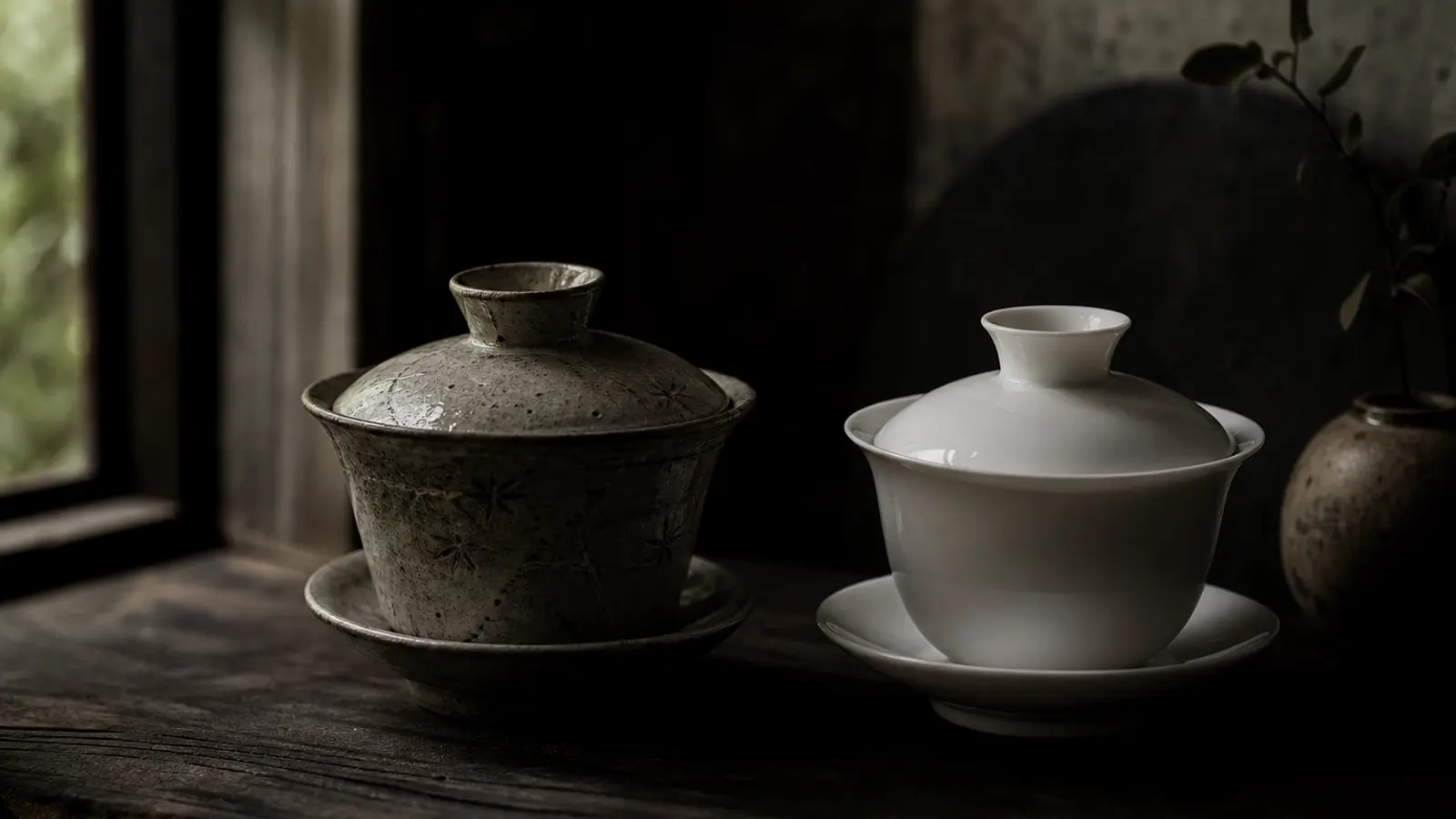
Gaewan (개완) — Korean Gaiwan
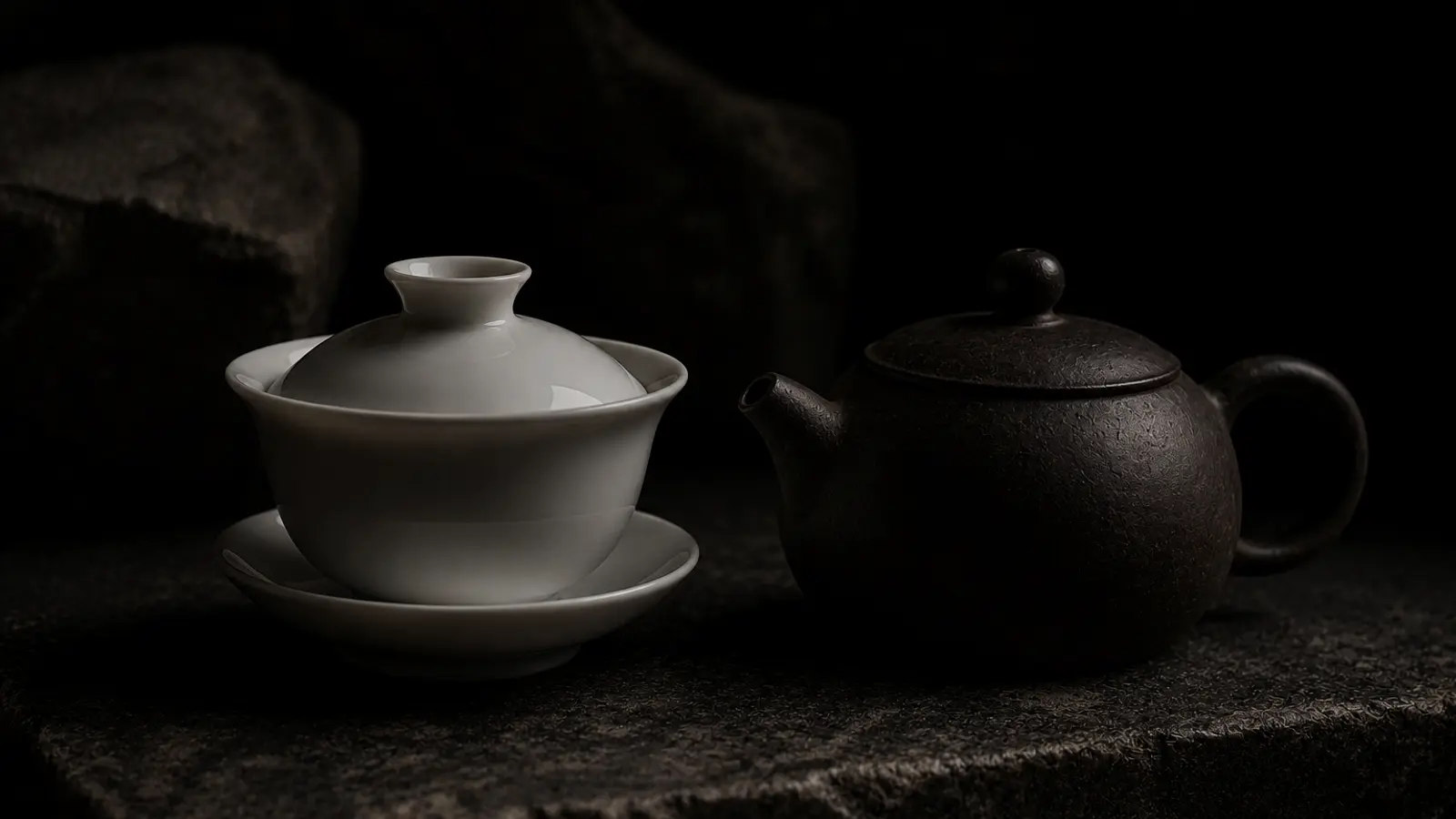
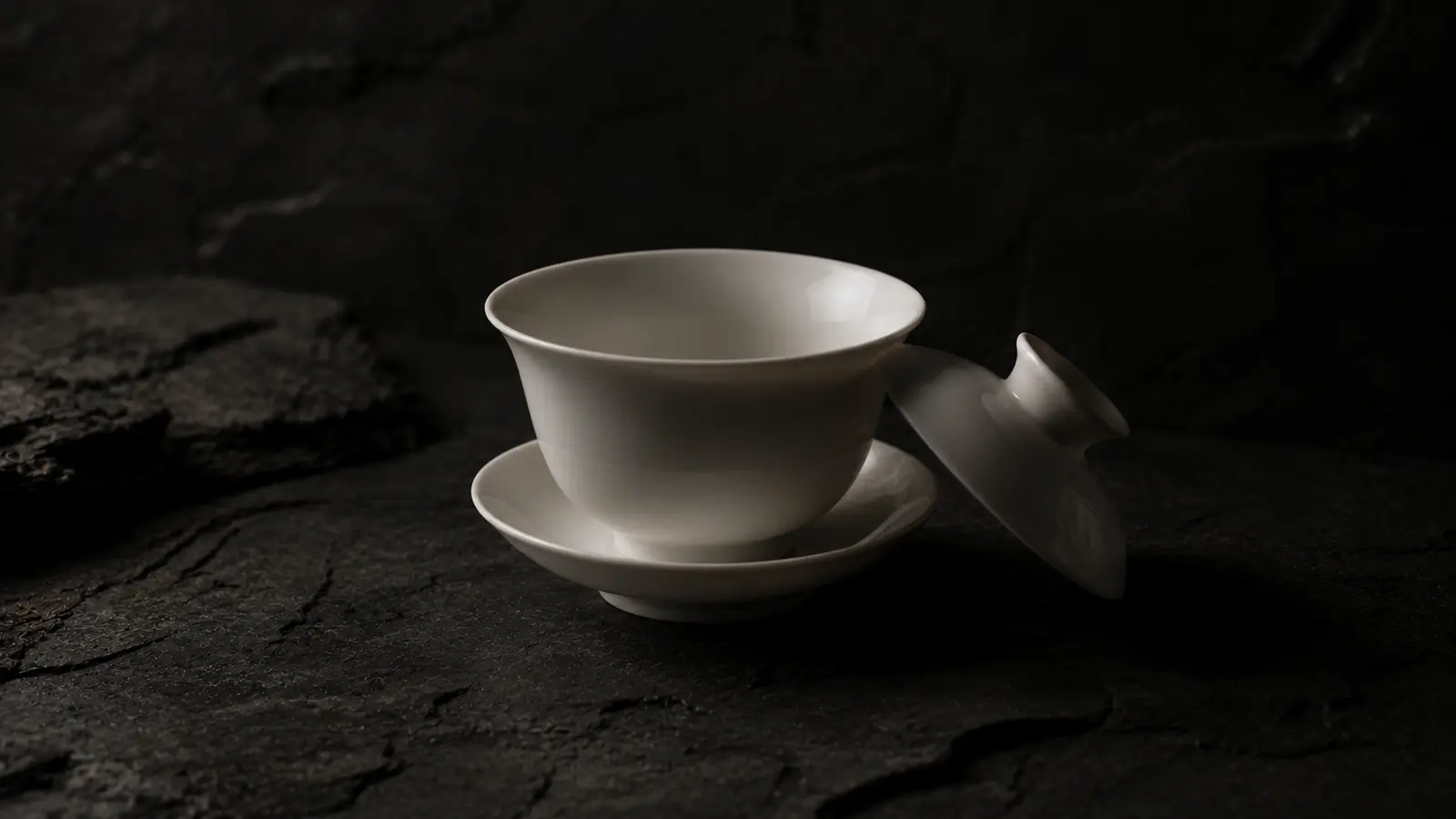
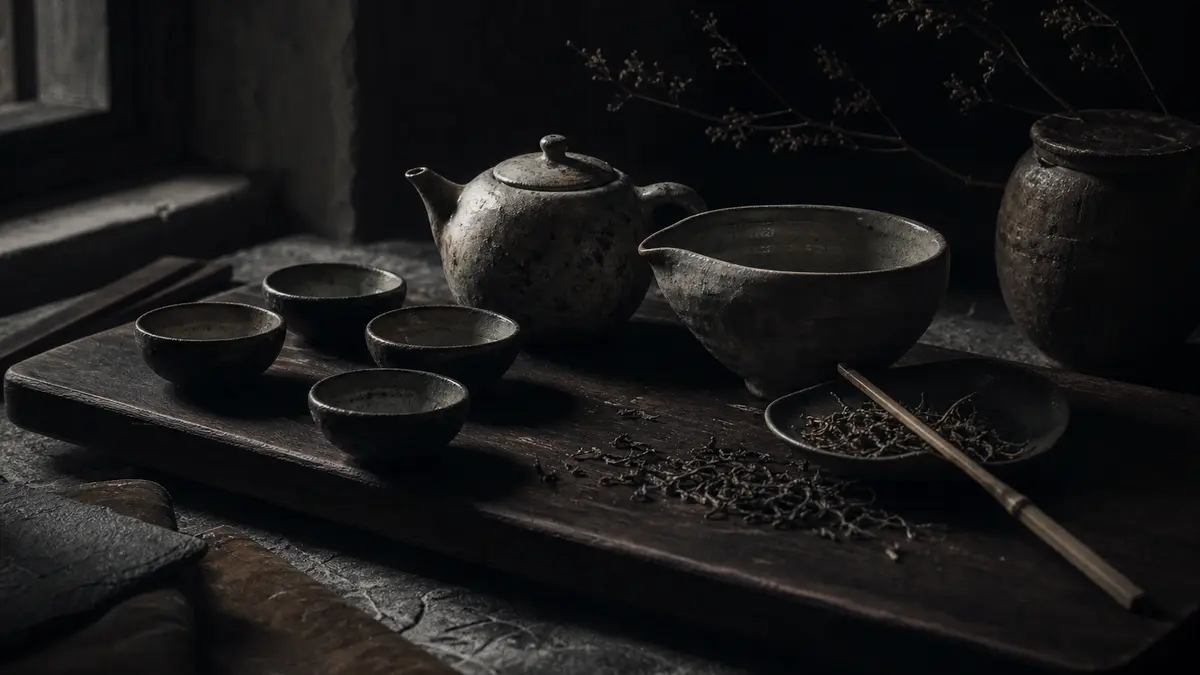
The gaewan is the Korean equivalent of a Chinese gaiwan (蓋碗), a lidded brewing vessel designed to be held in the hand during infusion. The functional logic is identical: add leaf, add water, steep, decant through the gap between lid and bowl edge.
The differences from a Chinese gaiwan are material and experiential rather than conceptual. Korean gaewan tend to run thicker-walled and heavier. The surfaces are often textured — particularly in buncheong — where a Chinese gaiwan is typically smooth. The foot ring is often more pronounced. The lid fit may be less precise, which affects the pour angle.
These differences mean the gaewan rewards a slightly different technique. The thicker wall means you can hold the vessel longer without discomfort, which extends the pour window. The semi-porous body in buncheong gaewan means temperature management behaves differently than with nonporous Chinese porcelain — the clay itself absorbs a small amount of heat from the water, then radiates it back, producing a slightly more stable temperature profile than Chinese porcelain through a long session.
For comparative or analytical tasting, I still default to a thin-walled Chinese porcelain gaiwan. But for contemplative sessions — one tea, time to pay attention — the Korean gaewan produces a qualitatively different experience that I value on its own terms.
Dawan (다완) — Tea Bowl
The dawan is a wide, open bowl held with both hands to drink from. It has no handle, no lid, no spout. You hold the bowl in your palms, feel its temperature, smell the tea’s aroma as it opens in the wide mouth, and drink.
This is a fundamentally different drinking experience from sipping from a small Chinese 品茗杯 (pinming bei, tasting cup). The wide opening releases more volatile aromatics before you drink; the two-handed hold creates physical engagement and slows the session down. A dawan session has a different tempo than a gongfu session with small cups.
Dawan are used in both Korean 다례 (darye, Korean tea ceremony) and in informal settings where the point is immersion rather than precision. For teas with complex aromatics — high-quality Korean greens, aged whites, oxidized oolongs — a dawan session will often reveal aromatic dimensions that small cups compress.
The 향 (hyang, aroma) in a well-made dawan is one of Korean teaware’s strongest arguments.
Dagwan (다관) — Side-Handle Teapot
The dagwan is a side-handle teapot, functionally equivalent to a Chinese 側把壺 (ceba hu). The side handle keeps your hand away from the hot body of the pot during pouring, which is practical for sessions involving many steeps.
Korean dagwan typically run 150–300ml capacity, appropriate for gongfu proportions. The spout filter is often part of the clay body rather than a separate mesh insert, which means the filtration is less fine than some Chinese teapots — plan to use leaves that clump at the bottom rather than fine-grade broken material.
A well-matched dagwan and sugu set from the same artisan is one of the more satisfying Korean teaware combinations. The visual coherence of matching pieces made by the same hands from the same clay batch creates a session aesthetic that assembled sets from different sources rarely achieve.
Sugu (숙우) — Fairness Pitcher
The sugu is the Korean fairness pitcher — equivalent to the Chinese 公道杯 (gongdao bei, literally “justice cup”). It receives the decanted tea from the gaewan or dagwan, equalizes the concentration, and serves as the pouring vessel into individual cups.
Korean sugu tend toward simple, rounded forms — often without a lid, with a single pour spout and a handle. In buncheong, the sugu’s textured exterior provides grip during the hot pour. In baekja, the clean white interior lets you read the tea’s color accurately.
Chatjan (찻잔) — Teacup
Chatjan are the individual drinking cups. Korean chatjan tend to be slightly larger than Chinese tasting cups — typically 60–100ml rather than 30–60ml — and the wider mouth angles outward more dramatically, again emphasizing aroma release.
The higher-walled, narrower Chinese pinming bei concentrates aromatics and produces a more focused sensory experience; the wider Korean chatjan releases them more freely. Neither is better — they are different instruments for different kinds of attention.
Janbatchim (잔받침) — Cup Saucer
The janbatchim is a small individual saucer for the chatjan. In Korean tea practice, placing the cup on a saucer is a gesture of care and hospitality rather than a purely practical measure. Korean janbatchim are often made from the same clay and glaze as the cups, and in a well-composed set they complete the visual logic of the whole.
Korean Teaware Price Ranges
Korean teaware spans a genuinely wide range, and understanding the tiers matters for setting expectations.
Entry artisan tier: ₩50,000–100,000 ($33–67 USD) Small workshops and production artisan pieces fall here. Quality is real — these are handmade ceramics, not factory goods — but the maker is not yet a recognized name. Good starting point for testing whether Korean vessels suit your practice.
Mid-tier 명장 (myeongjang) work: ₩200,000–700,000 ($133–467 USD) Myeongjang is a designation given by the Korean government to master artisans who have demonstrated exceptional skill and cultural contribution. Work at this tier represents serious craft — individual pieces with documented provenance, consistent technique, and often a recognizable visual signature. This is the range where Korean teaware becomes competitive with mid-tier Yixing teapots and high-tier Japanese studio pottery.
Collector and museum tier: ₩1,000,000+ ($667 USD and above) Work from the most recognized living ceramicists, historically significant pieces, and major studio productions. Some collector-tier Korean teaware reaches $3,000–10,000+ USD per set.
For context: a 고암 김흥복 (Go-am Kim Heung-bok) 홍청자 (hong cheongja, red-tinged celadon) set and a 녹원 유용철 (Nokwon Yoo Yong-cheol) 분청 (buncheong) dawan from established Korean ceramic studios sit solidly in the mid-tier myeongjang range — serious work by documented artisans, not decorative production pieces.
Comparison: Korean vs. Chinese vs. Japanese Teaware
| Dimension | Korean | Chinese | Japanese |
|---|---|---|---|
| Primary material | Stoneware clay (buncheong, cheongja) or high-fire porcelain (baekja) | Purple clay (Yixing) or high-fire porcelain (Jingdezhen) | Stoneware, porcelain, or unglazed clay |
| Core aesthetic | 소박함 sobakham — understated simplicity | 功夫 gongfu — refined skill, precision | 侘び寂び wabi-sabi — beauty in imperfection |
| Porosity | Semi-porous (cheongja, buncheong) to non-porous (baekja) | Non-porous (porcelain) to highly porous (Yixing) | Variable; often semi-porous |
| Wall thickness | Generally thicker | Thin (porcelain) to thick (Yixing) | Variable |
| Heat retention | Moderate to high | Low (thin porcelain) to high (Yixing) | Moderate |
| Seasonal seasoning | Yes (buncheong), minimal (baekja) | Yes (Yixing), no (porcelain) | Often yes |
| Best for | Contemplative sessions, shou/aged teas, Korean teas | Analytical tasting (porcelain), specific tea types (Yixing) | Matcha, Japanese greens, ceremony |
| Entry price point | $33–67 USD | $15–200+ USD | $30–200+ USD |
| Availability outside home country | Limited; improving online | Wide; established international market | Good; established export market |
| Historical influence | Influenced Japanese wabi-sabi aesthetics significantly | Foundation of gongfu brewing tradition | Developed from Chinese and Korean influences |
When to Reach for Korean vs. Chinese Teaware
This is a practical question worth answering directly.
Reach for a Korean gaewan when:
- You are brewing for contemplation rather than analysis. One tea, time to pay attention, no comparison agenda.
- You are working with shou puerh (熟普洱), aged sheng (生普洱), or heavily roasted oolongs. The semi-porous body of buncheong integrates well with these teas over time, and the heat retention supports their slower revealing character.
- You are brewing Korean teas — jakseolcha, 잎차 (iptcha, loose leaf), or wild-picked mountain teas. There is coherence in using the vessel tradition that shares cultural origin with the tea.
- The session has a ceremonial or social dimension where the vessel itself communicates something.
Reach for a Chinese gaiwan when:
- You are tasting analytically — comparing two harvests, evaluating a new tea against a reference, working through samples.
- You want maximum neutrality and repeatability. Thin-walled, non-porous Chinese porcelain is the precision instrument.
- Speed matters. Chinese gaiwans pour faster and cool between steeps more quickly, which gives you tighter control over infusion parameters.
- You are working with delicate green teas or white teas where small temperature variations have significant flavor impact.
The framing of “which is better” is the wrong question. These are different instruments with different strengths. A cellar in Burgundy uses different glasses for different purposes; a serious gongfu practitioner will eventually want vessels from both traditions.
Quality Indicators in Korean Teaware
Assessing Korean teaware requires knowing what you are looking at. A few markers:
Foot ring finish. The unglazed foot ring reveals the clay body directly. It should be smoothed — not rough enough to scratch a surface — but textured enough to show hand work. Machine-made pieces often have a uniform, slightly mechanical finish to the foot ring. Hand-thrown pieces show tool marks and slight irregularity.
Glaze application. In buncheong, look for slip application that has a responsive, gestural quality — brushmarks, wipe marks, stamp impressions that show the maker’s hand. Too uniform means production methods. In cheongja, evaluate the jade-green depth; shallow, even color often indicates a shorter reduction process.
Lid fit on gaewan. The lid should seat without rattling but lift without sticking. Slight irregularity is acceptable and expected. A lid that fits perfectly smooth and slides like glass was probably not thrown on a wheel.
Studio documentation. Mid-tier and above Korean ceramicists typically provide a cloth bag or box with the piece, sometimes with the maker’s stamp impressed into the clay base (낙관, nagwan). Established artisans can be verified through Korean craft organization records. You can also explore the work of Korean master potters making teaware today to familiarise yourself with recognized names before buying.
Where to Buy Korean Teaware
Sourcing Korean teaware outside Korea requires more effort than sourcing Chinese or Japanese equivalents — the international market infrastructure is thinner. The broad categories are Korean domestic studios with online export capability, specialist Western importers, and dedicated Korean cultural craft markets.
I am preparing a full sourcing article on this topic with specific sources, price comparisons, and navigation guidance for international buyers. The overview here is intentionally brief — the sourcing landscape changes, and a dedicated article is the right place to track it rather than embedding it in a materials guide.
What I will say now: several Korean ceramic platforms sell directly to international buyers — see our Korean teaware sourcing guide for current options. The language barrier is the main friction. Studio direct is the most reliable route for documented myeongjang work.
Caring for Korean Teaware
Seasoning buncheong vessels. New buncheong gaewan and dagwan benefit from a simple initial seasoning: rinse with hot water, brew a strong tea through the vessel (discard this brew), and allow to dry naturally. Repeat over the first few sessions. This begins the seasoning process and removes any residual kiln smell.
Cleaning. Avoid soap on semi-porous buncheong — it will absorb into the clay body and leach back into future brews. Rinse with hot water after each session, allow to air dry fully before storage. For cheongja and baekja, mild unscented soap is acceptable but not necessary.
Storage. Korean stoneware is robust, but the semi-porous bodies can crack if stored sealed while wet. Dry completely before putting away. Store with the lid slightly ajar or separately.
Thermal shock. Thick-walled Korean pieces are generally more tolerant of temperature transitions than thin-walled Chinese porcelain, but do not pour boiling water into a cold, dry vessel. Preheat with warm water first.
Building a Korean Teaware Set
A functional Korean gongfu set requires at minimum: a gaewan or dagwan, a sugu, and two to four chatjan. A janbatchim per cup is traditional and worth the addition if budget allows.
For a coherent first set, I recommend choosing a single tradition and a single maker. A mixed set — buncheong gaewan with baekja cups from a different studio — can work visually if you have a good eye, but a matched set from one hand has an integrity that assembled sets rarely achieve at the entry and mid-tier price points.
Entry investment for a functional matched buncheong set: roughly $100–150 USD for artisan-level work with documented studio origin. Mid-tier myeongjang-level set: $400–1,000 USD. Both are investments that will outlast any tea you brew in them.
Korean teaware is not a compromise or a curiosity. It is a fully realized ceramic tradition that has been producing vessels suited to meditative, skill-based tea brewing for over a thousand years. The three traditions — the ceremonial jade of cheongja, the earthy workmanship of buncheong, the scholarly clarity of baekja — offer genuine choices based on how and why you brew. The gaewan sits beside the Chinese gaiwan as an equal, not a substitute.
The vocabulary takes an hour to learn. The vessels themselves take years to understand.